HER SISTER LAUGHED AND GAVE HER A “WORTHLESS” FARM—THEN SHE DUG IN THE WELL AND UNCOVERED A SECRET SO BIG IT WOULD DESTROY THEIR WHOLE FAMILY
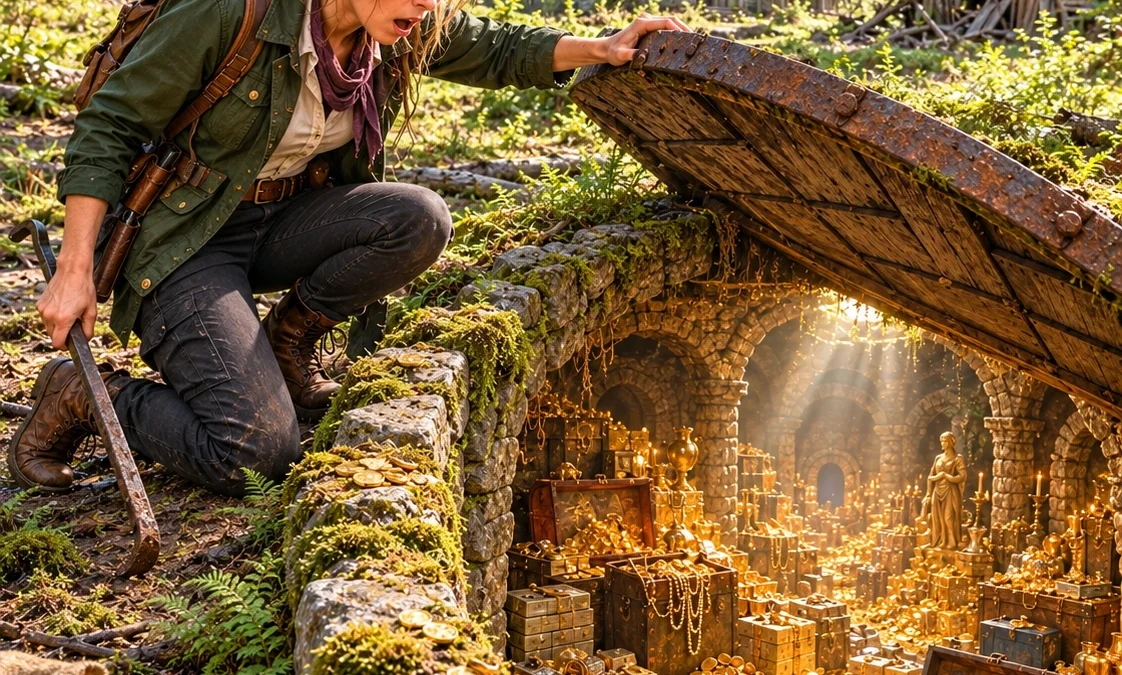
HER SISTER LAUGHED AND GAVE HER A “WORTHLESS” FARM—THEN SHE DUG IN THE WELL AND UNCOVERED A SECRET SO BIG IT WOULD DESTROY THEIR WHOLE FAMILY 🔥😱
Part 1
The rain had fallen for three straight days when 23-year-old Adeline Kavanaugh stood at the edge of the old stone well behind her grandfather’s abandoned Idaho farm.
She pulled her coat tighter—inside the pocket sat exactly nine dollars.
In her hand, a county notice: pay $38,322 in back taxes within 21 days, or they seize the land.
Her sister Karen had practically handed the farm to her as a joke.
“Toxic asset,” Karen had sneered, her fancy wool coat costing more than Adeline made in a year.
“Take it, little sister.
Try not to starve out there.
” Karen and her wealthy husband Julian had walked away with everything else—the family timber business, the main house, every valuable piece of property their father had owned.
Adeline got 50 acres of overgrown woods, a rotting farmhouse, a barn, and a well.
They thought they’d gotten rid of her.
But Adeline remembered something.
She remembered being ten years old, standing right here beside her grandfather Wilder.
His voice had dropped to a whisper, as if the trees themselves were listening.
“When the wolves come for the flock, child… you dig.
”
She hadn’t understood then.
She was starting to now.
The will reading had been a nightmare.
Their father, Silas, had signed it just six months before he died—when he could barely recall Adeline’s name, when he sometimes mistook her for his late wife.
Karen got the Bend store, the warehouses, the trademarks, the family home.
Adeline got Kavanaaugh Ridge Farm.
Nothing else.
“Letters aren’t wills, sweetheart,” Karen had smiled, the smile she practiced in mirrors, when Adeline mentioned a letter her father had written promising her a fair share.
Julian, the polished investment banker, leaned forward with a look that made her skin crawl.
“Let’s not make this uncomfortable.
Your father knew what he was doing.
”
Two doctors had signed off on his mental capacity—doctors, Adeline realized later, who had been seeing Julian socially.
Then came the blow no one had expected.
Their old family lawyer, Ambrose Darel, caught Adeline before she left the building, breathless and pale.
He pressed a small, yellowed envelope into her hand, sealed with red wax marked by a rough circle and three lines.
“Your grandfather left this with me in 1958,” he whispered.
“Said to give it to you if the family ever went wrong.
”
Adeline drove nine hours to Idaho that night.
She didn’t open the envelope.
Not yet.
When she finally reached the farm, the gate was rusted shut, the driveway swallowed by weeds, the house half-eaten by blackberry brambles.
It looked like a place no one had loved in decades.
Then she saw him.
Lying on the porch, muzzle gray, eyes milky at the edges, was Ranger.
Her grandfather’s golden retriever.
Wilder had died ten years ago.
Ranger was just a puppy then—he would be thirteen now, barely possible, but here he was.
He lifted his head, thumped his tail once, and looked at her as if he’d been waiting.
Adeline sank to the rotting boards and wept.
Not quiet tears—tears that came up from somewhere deep, tears she’d held in since her mother died, since her father forgot her, since Karen looked right through her at the funeral.
Ranger rested his head in her lap and let her cry.
That night, she slept on a canvas cot in the parlor, the unopened envelope tucked against her heart.
She dreamed of Wilder standing at the well, smiling.
“Took you long enough, child.
”
She woke to the smell of cornbread.
Confused, she walked toward the kitchen.
A woman stood at the old cast-iron stove—small, silver-haired, stirring batter.
“Coffee’s on,” she said without turning around.
“Cups are to the left of the sink.
”
“How did you get in?” Adeline stammered.
The woman turned, eyes the color of winter sky.
“Wilder gave me a key in 1957.
I’ve kept the mice down for eleven years.
I’m Cordelia.
My husband ran cattle with your grandfather.
Been waiting for someone from this family to come home.
”
She set a plate of warm bread and honey before Adeline.
“He told me if a Kavanaaugh girl ever showed up alone… she’d need a friend.
” Cordelia paused, then added softly, “He also said the well would provide.
”
The next few days passed in a blur of chopping wood, clearing brambles, and hauling water.
Then the county assessor arrived—kind-faced Emmett Row, with a clipboard and a heavy heart.
He confirmed the deadline: 17 days left.
No money, no farm.
That evening, the phone rang.
Adeline picked it up.
Karen’s voice came through, tight and strange at first, then hardening as Julian whispered in the background.
They’d “thought it over”—they would pay the tax debt and give her $10,000, if she signed the deed over immediately.
“Take it, Adeline,” Karen said, and for a heartbeat, there was a tremor in her tone, like she was trying to warn her.
“You don’t understand what he’s building.
” Then Julian cut in, cold and sharp: “If you don’t, we’ll buy it at auction for pennies.
Seventeen days.
”
Adeline hung up.
She sat on the kitchen floor, trembling.
Why would they want this worthless patch of land so badly?
Then she remembered the envelope.
She pulled it from her coat, broke the wax seal, and unfolded the single sheet of paper inside.
Her grandfather’s handwriting leaned forward, as if walking into wind.
“Addie, if you’re reading this, the wolves have come.
Trust no one but Ambrose—and him only halfway.
Go to the well behind the tall Douglas firs.
Take a shovel.
Dig until you hit iron.
What lies beneath was always yours.
I chose you the day you were born.
”
She looked at Ranger.
He was watching her, tail thumping slow.
At dawn, she set out—shovel, rope, lantern, and kerosene can in hand.
Ranger led the way along a path reclaimed by ferns and thorns.
When the trees parted, there it stood: the well, older than the house, older than the state itself, ringed by mossy stone, sheltered by a fir so vast it seemed to hold the sky.
She tied the rope to the tree, lowered the lantern, and descended forty feet into the dark.
At the bottom, she began to dig.
Hours passed.
Her hands blistered.
Her back ached.
She was about to rest when—
CLANG.
The sound rang up the stone shaft like electricity.
She dropped to her knees, scraping away mud with bare hands.
There, glinting in the lantern light, was a heavy cast-iron plate set flush into the floor, bolted fast.
In its center, a handle.
Through the hasp, a brass padlock thick as her fist.
She had found it.
✨
Part 2
She hauled herself up the rope as fast as she could, scrambling over the edge and collapsing breathless into the ferns.
Ranger licked her face, tail thumping wildly.
It was real—Wilder hadn’t been rambling.
She raced back to the barn, grabbed her father’s rusted hacksaw, a fresh blade, and the crowbar, then descended again.
Twenty minutes of sawing through thick brass, and the lock fell open.
She braced her boots and pulled with every ounce of strength she had left.
The seal broke with a hollow whoosh of stale air, and the heavy plate lifted away.
Beneath it, a square shaft lined with cedar planks, an iron ladder bolted to one side, dropping another eight feet into darkness.
Cool, dry air rose up, smelling of old wood and paper.
She lowered the lantern, then climbed down.
The small underground room was perfectly preserved.
And stacked against the far wall were four olive-drab military crates marked US Army 1945.
Beside them, five bundles wrapped tight in waxed canvas.
On top, a sleek black hard-plastic case.
Adeline’s hands shook as she cut the canvas wrapping from the nearest bundle.
She peeled back the paper from one brick inside.
Solid silver.
Hallmarked bars.
She crawled to the first crate and pried the lid open.
Rows of plastic tubes gleamed in the lantern light—each holding twenty gold coins, double eagles dated 1924.
She counted forty tubes before she stopped, too stunned to continue.
The second crate held glass jars filled with paper money—$500 bills, $1,000 bills, still bound in original bank straps.
Enough to pay the tax debt a hundred times over.
But the black case was what caught her breath.
It was modern—maybe five years old.
Someone had been here recently.
She lifted the lid.
Inside lay a leather-bound journal embossed with Property of Wilder J.
Kavanaugh, and beneath it, a stack of documents sealed in wax.
She opened the journal to the first page.
Her grandfather’s handwriting looked back at her.
“If you are reading this, then the wolves are at the door.
I built the timber business on land I registered under a trust tied to the master deed of Kavanaaugh Ridge Farm.
Whoever holds that farm owns everything—every store, every warehouse, every trademark.
Karen handed you the deed, Addie.
She thought she gave you a rotting farm.
She gave you an empire.
”
Adeline sat frozen.
Karen and Julian had no idea.
They were preparing to sell a company they didn’t actually own.
The farm wasn’t worthless—it was the key to it all.
The realization hit her like a wave.
She held the deed.
She held the power.
But Julian was moving fast.
The sale was scheduled in three days’ time.
She packed only what she needed—six gold coins, two bundles of cash, the journal, and the documents.
She covered the iron plate, smoothed the dirt back over it, and walked back to the house as the sun dipped below the mountains.
Cordelia was waiting in the kitchen, stew simmering on the stove.
“He told me you’d come,” the old woman said quietly.
“And that when you did, the work would begin.
”
Adeline drove through the night to Seattle, Ranger asleep at her side.
She sold six coins to a trusted dealer who knew Wilder—enough to pay the taxes and retain the best lawyer in Portland.
By afternoon, she walked into the offices of Harriet Blackwood—feared, unyielding, the lawyer who terrified bankers.
She laid the documents on the desk.
Harriet read them once, then twice.
Her face didn’t change—but her hands stilled completely.
“Your grandfather didn’t just hide assets,” she said slowly.
“He weaponized them.
Karen owns nothing but an empty shell company.
You hold the parent entity.
Everything belongs to you.
”
The sale was set for Wednesday morning at 11:00 AM.
The buyers—HomeBuild National—were bringing $22 million in escrow.
Julian and Karen would sign the papers, pop the champagne… and walk straight into the trap Wilder had laid twenty years earlier.
Harriet looked Adeline in the eye.
“They have no idea.
Not a clue.
”
Part 3
Adeline paid the $38,322 tax bill first thing Tuesday morning.
Emmett Row stared at the cashier’s check, then at her, then at Ranger sitting politely on the courthouse steps.
“My wife will still send cookies,” he said, shaking his head.
“You just make sure they know there’s no auction.
”
She smiled.
“They’ll know.
”
Wednesday arrived bright and sharp.
At 10:58 AM, the doors to the boardroom of Darel & Whitmore swung open.
Julian and Karen stood by the mahogany table, champagne already poured.
The HomeBuild National team sat waiting.
Ambrose Darel looked pale, like he hadn’t slept in a week.
Then Harriet Blackwood walked in.
And behind her came Adeline.
Karen’s face drained of color.
Julian’s smile faltered.
“This is a private proceeding—”
“Sit down, Mr.
Merritt,” Harriet said, and something in her tone made Julian sink back into his chair.
She placed the documents on the table before the HomeBuild executives.
“I represent Adeline Kavanaugh.
She holds the master deed to Kavanaaugh Ridge Farm, which is the sole controlling entity of the land trust that owns every property you are attempting to purchase here today.
Karen Merritt signed that deed over voluntarily in exchange for an estate non-contest clause.
She does not own the assets.
She never did.
”
Silence fell so deep you could hear the clock ticking on the wall.
Bradford Holstead, the HomeBuild CEO, scanned the papers quickly.
He looked up at Ambrose.
“Is this real?”
Ambrose lifted his head.
His voice was quiet but steady.
“I verified every document last night.
It is all authentic.
Wilder Kavanaugh structured it this way in 1948.
I never knew—not until Harriet called me.
”
Julian’s mouth opened and closed.
“That’s impossible—”
“Your wife sold you something she never possessed,” Harriet said calmly.
“The transfer is void.
The properties belong to Adeline.
”
Karen stood up, then sat back down, trembling.
Julian rounded on her in a hiss she could no longer suppress.
“You said you checked—”
“I didn’t know!” Karen whispered.
“I didn’t know!”
Holstead stood, gathering his papers.
“We’re done here.
Merritt—you’ll be hearing from our lawyers.
” He walked out with his team, leaving Julian and Karen alone in the silence.
Julian grabbed his coat.
“This isn’t over—”
“It is,” Adeline said.
“You’ll vacate the Bend offices by Friday.
All accounts are frozen.
You’re done.
”
He stormed out without a backward glance.
Karen sat at the far end of the table, her Chanel suit suddenly looking too tight, too expensive, like a costume.
She looked broken.
Adeline pulled out a chair and sat across from her.
“He’s going to divorce you,” Adeline said gently.
“And he’ll leave you with nothing.
You know that, don’t you?”
Karen nodded, tears spilling over.
“I heard it in his voice on the phone that day.
I tried to warn you.
”
“I know.
” Adeline paused, then offered the choice Wilder had prepared her to make.
“You have two ways forward.
You can go back to New York, and I will never contact you again.
I won’t sue you, I won’t pursue you—you just disappear.
Or you can come to the farm.
Not as a guest.
You’ll stay in the cabin behind the barn.
You’ll work.
You’ll help Cordelia, you’ll feed Ranger, you’ll learn the land.
Three months.
And at the end of summer, we’ll decide what comes next.
”
Karen stared, disbelieving.
“That’s… that’s punishment.
”
“It’s a chance,” Adeline said.
“The only one I’m giving.
Take it or leave it.
”
For a long time, Karen said nothing.
Then she wiped her eyes.
“When?”
“June first.
”
Adeline drove home as the sun set behind the mountains.
Ranger slept at her feet.
Cordelia was on the porch with a lantern, waiting.
That summer, Karen came.
She burned the cornbread, she pruned the apple trees wrong, she cried when she saw how much work there was to do.
But she stayed.
By August, she was laughing again.
She let her hair go natural, she wore denim, she learned to make Cordelia’s honey bread perfectly.
When Julian’s divorce papers arrived, she didn’t fight them.
She didn’t go back to New York.
Adeline kept her promises.
She sold the Bend, Roseburg, and Klamath Falls stores to the employees who’d worked there for decades—for one dollar.
She kept the original hardware store her grandfather built, reopening it under his name.
And she used the gold and silver to found the Wilder Kavanaugh Home—a place where caregivers could come and rest, for free, after months or years of tending to loved ones.
Ranger passed away peacefully in 1971, and Adeline buried him near the well.
Years later, a new golden retriever puppy named Wilder came to the porch.
In 1992, a journalist visited Adeline on the farm.
She was forty-seven now, silver at the temples, hands still calloused from work.
The journalist asked about the treasure—was it real?
Adeline smiled, looking out toward the trees that hid the well.
“The gold was real.
But that wasn’t the treasure.
The treasure was that he believed in me before anyone else did.
He spent his whole life making sure that when I needed it, I would know I wasn’t alone.
”
The wind moved through the firs.
Somewhere down the ridge, Karen was laughing with a group of women resting at the home.
Cordelia was baking bread in the kitchen.
Adeline whispered into the quiet evening, “Thank you, Grandpa.
I’m home.
”
And the well kept the secret, just as it always had.
This story is entirely fictional and created for entertainment purposes only.
It does not represent any organization or individual, nor does it encourage inappropriate behavior.
The content was generated with AI assistance.








