Her Sisters Mocked the “Farmer” She Brought to the Wedding… Then an Old Woman Revealed Who He Really Was
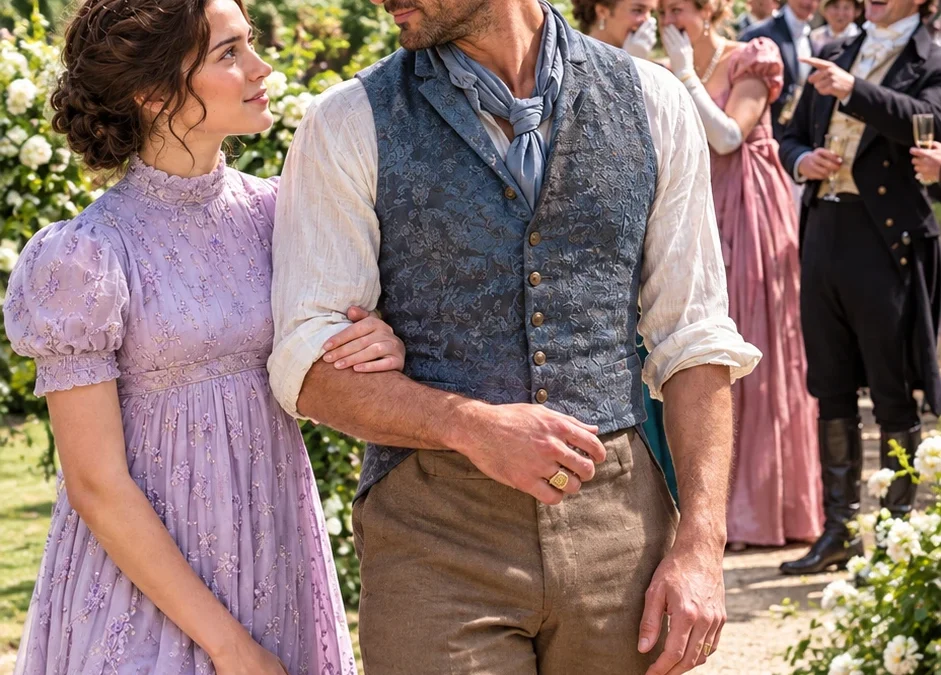
👑 Her Sisters Mocked the “Farmer” She Brought to the Wedding… Then an Old Woman Revealed Who He Really Was 😱
PART 1
There are two kinds of laughter at an English wedding.
The first is warm and harmless, and it is forgotten by supper. The second is quiet, hidden behind fans and glass rims, and it is never meant to be forgotten at all.
On the 23rd of September, 1817, in the long gallery of Dallow Court, Miss Agnes Truan heard the second kind. It came from her own sisters.
She sat at the foot of the bridal table beside a man in a brown coat. It was clean and brushed, but cut for a man who lifted things, and it sat on his broad shoulders like a saddle on a cart horse. Her sister Lettice had spotted it first. Lettice always noticed things first and said them first, in a voice pitched to reach the far end of the table.
“Agnes, darling, you didn’t tell us he’d come to the wedding straight from the lambing.”
Then Sophie laughed. Sophie, the bride, in white satin and orange blossom. Sophie, whom Agnes had nursed through measles, taught her letters, and dressed that very morning with her own two hands. It was a small, bright, guilty laugh, and that was the worst of it.
Forty guests turned to stare at the farmer. The farmer looked only at Agnes.
And Agnes, seven years the sensible one, the plain one, the one who kept the ledgers and never made a scene, felt something folded small inside her begin to unfold.
Here is what nobody in that gallery knew. At the head of the table, a gilded chair sat empty, kept all day for a great duke they had toasted with reverence and begged with longing. And he was sitting right in front of them, being laughed at. 😶
To understand how a sensible spinster of twenty-seven came to this, we must go back sixteen months, to a spring so cold the blossom froze on the bough.
On the 14th of May, 1816, frost lay white on the primroses at Cold Harbour House, and a cart was coming up the lane to take away the last thing Agnes’s father had ever loved.
She had not slept. She had sat up all night adding the same columns again and again, hoping they would come out differently. They never did.
Since her father died in 1809, Agnes had held the household together. Her mother had taken to her sofa. Lettice had married a pale clergyman who agreed with whoever spoke last. Little Sophie, the beauty, had just caught the eye of Augustus Pomfrey, heir to Viscount Dallow. It was a triumph, and it would cost £140 in lace, silk and slippers that the family simply did not have.
So the flock had to go. Her father’s Dorset horns, which he had known by name, were led by a stout, opinionated old ewe called Mab, with a brass bell engraved JT 1805.
The buyer was a large, quiet man in a weathered coat who gave his name as Fen. He farmed at Holland, eleven miles off. He handled every sheep gently, and even Mab, who had bitten the curate twice, stood for him like a lamb. Then he offered twenty-one pounds for the lot.
Agnes opened her father’s lambing book. “Mr. Fen, your offer is not merely low. It is an insult to a very respectable sheep.”
He took off his hat and laughed, a short, astonished bark, like a man who had stepped on a stair that wasn’t there and found he rather liked the fall. They bargained for an hour in the freezing yard and settled at £265. He was hard on a price and honest on a fact.
As the flock went down the lane, Mab stopped at the gate, turned her white face to the house, and rang her bell. Agnes gripped the gatepost.
“I’ll take good care of her, Miss Truan. You have my word.”
“Why should your word matter to me? I have known you an hour.”
“No reason at all,” he said. “But you’ll have it anyway.”
That night she wrote in the ledger, Sold the flock. £265. She wondered why it felt as though she had written down far more. 🐑
He kept coming back. All through the year without a summer, with snow in June and bread at double the price, he walked eleven miles with seed oats on his shoulder for her frost-blackened garden. One day he set a rent book on her kitchen table. It belonged to his landlord, he said, and he was “no hand at all with a column of figures.”
Agnes worked on it for three evenings. She found farms ruined by rents set in better times, and forty families who would not survive the winter. She wrote a scheme to remit rents by yield, supply seed corn, and turn no family off before Lady Day.
He folded it inside his coat. “He’ll do it.”
By November, the whole county was whispering about “the Duke’s remission.” The young Duke of Wendelsham, unseen for five years, was a saint or a lunatic. Agnes felt a secret glow like a coal under ash, and told no one.
Then, on a snowy night, he saved a stranger’s ewe from a frozen ditch and asked her something no one had ever asked.
“What do you want, Miss Truan? Not for your sisters. For yourself.”
“I should like to be chosen,” she whispered. “Not needed. I have been needed all my life. But just once before I die, I should like to be chosen.”
He looked at her as though she had cut him somewhere deep. ❄️
Then the invitation came, addressed to Miss Truan and guest. Lettice sneered, “Unless you mean to bring your shepherd, dearest.”
Agnes asked him quietly. “They will laugh. But I have heard it alone for a very long time. I should like to hear it with someone beside me.”
“I’ll come,” he said. “On one condition. Whatever you hear that day, let me explain before you judge me.”
She promised, thinking nothing of it.
Now Lettice’s cruelty reached its height. She turned to the whole table. “Papa’s precious sheep! And then she threw herself in with the bargain, two hundred pounds and a spinster. Very good value.”
Agnes Truan rose to her feet, and forty faces turned to watch the sensible sister finally make a scene.
👇 Part 2 is in the comments. Can’t find it? Leave any word below and I’ll send it to you privately.
PART 2
Agnes Truan rose to her feet, and forty faces turned to watch the sensible sister finally make a scene.
Her heart pounded like a flock bell in a high wind, yet her voice did not shake, and she was amazed by that.
“Two hundred and sixty-five pounds,” she said. “That was the price, Lettice, since you are so interested. And I shall tell you where it went. One hundred and forty is on Sophie’s back, in that satin and lace and those slippers I had dyed to match. Forty paid the arrears on your husband’s tithes, which you will remember, because you wrote and asked me for it. The rest kept Mama in coals through the coldest winter anyone here has lived.”
Nobody laughed now.
“You laughed at his coat. I have seen that coat at midnight in a frozen ditch, with a ewe across his knees because she could not breathe and he would not leave her. I have seen this gentleman walk eleven miles through snow in June to bring seed to a garden that was not his. In seven years, he is the only person who has ever asked me what I wanted.”
She looked at Sophie, whose face had gone white as her gown.
“I would rather be laughed at beside that coat than admired in any room in England.”
She held out her hand. “Mr. Fen, if you have had enough of this company, so have I.”
He rose slowly. His hand was warm, rough and perfectly steady, and the look on his face was not pity, not even admiration. It was something closer to awe. 🥹
They turned to leave, and found the way blocked by a small bath chair. In it sat the Dowager Lady Dallow, eighty-one, nearly blind, with a voice like a cracked bell.
“No, not yet. Nobody leaves this room until I have finished laughing.”
And she laughed, a thin, dry crackle like dead leaves, and it went on for some time. Lord Dallow half rose. “Mama, perhaps you are tired.”
“Sit down, Horace. I have been tired since 1790, and it has never stopped me yet.”
She held out one ringed hand. “Give me your hand, young man.”
He knelt beside her chair. She traced his calluses and the white scar on his thumb, and her voice turned gentle. “Your mother had hands like these. Hester Fen, a farmer’s daughter from Holland. The loveliest girl in Somerset, and she could dock a lamb’s tail and turn a cheese. I watched this county laugh at her for twenty years, at her hands, her accent, until she wore gloves to bed and stopped speaking at dinner. God forgive me, I laughed too.”
The gallery had gone so silent that Agnes could hear the candles hiss.
Then the old woman raised her voice to its full crack. “Horace, you great fool! You spent all morning at the window with a spyglass praying for the Duke of Wendelsham, and he has been sitting below the salt eating your pigeon pie!”
From the side door came a small, dignified cough. The old steward Proser bowed low and slow. “Your Grace, forgive me. I knew you the moment you came in.”
Lettice’s wine glass shattered on the floor. 🍷
The man in the brown coat stood. “Lord Dallow, my name is Barnaby Fen Coverdale, and I am the fifth Duke of Wendelsham. I did not wish to come to this house as Wendelsham. I came as Miss Truan’s guest. I find I prefer it.”
He turned to Agnes and held out his hand.
She did not take it. All the color had left her face. She was thinking of a rent book on her kitchen table, three evenings by a single candle, and a scheme tucked inside his coat. She was thinking of every word she had spoken in the snow, believing she spoke to a man of her own kind.
“The landlord’s ledger,” she whispered. “It was yours.”
Then Agnes curtsied to him, deeply and correctly, exactly as a lady of small fortune ought to curtsy to a duke. She walked the length of the gallery, past the painted ancestors and the pyramid of peaches and the empty gilded chair, and out the door.
Not one of the forty dared stop her. 💔
It is five miles from Dallow Court to Cold Harbour House, and a lady in thin silk slippers should never attempt them after rain. Agnes attempted them anyway. By the second mile, her hem was ruined. By the second stile, she heard footsteps behind her, and a voice she knew too well.
“You promised me something, Agnes. In your kitchen, in July. Whatever you heard today, you would let me explain before you judged me.”
She sat down on the stile in her ruined silk and folded her hands. “Then explain.”
👇 Want to know what the Duke confessed on that muddy road… and what happened when a familiar little bell began ringing in the dark?
LIKE ❤️ and COMMENT with the word “CHOSEN” to unlock Part 3. As soon as we reach enough comments, I’ll post it!
PART 3
So he did.
He told her about his mother, Hester Fen, a farmer’s daughter who married a duke at nineteen. Within three years his father was ashamed of her. The great houses smiled at her face and laughed behind their fans until she kept her hands gloved and her voice low, and very little of her was left.
“She used to take me to Holland in secret,” he said. “To her father’s farm. It was the only place I ever heard her laugh. She taught me to shear there. She taught me the names of the grasses. She died when I was fourteen, and I don’t believe one person in my father’s acquaintance ever asked her what she wanted.”
Agnes said nothing, but her hands in her lap had come unfolded.
“My father died five years ago and left me a title and a ruin. Eleven farms in arrears. Tenants squeezed for twenty years to pay for his horses and his card debts. I did not know how to mend it. So I went to my grandfather’s farm, took my mother’s name, and set out to learn the land the way my tenants know it, from the ground up.”
He turned his hat in his big hands. “And I will be honest, because you deserve it. I stayed for another reason. In London, every woman who looked at me saw strawberry leaves on a coronet. Every mother with a daughter, every father with a debt, every curate with an eye on a living. I could not find one person who looked at me and saw a man.”
“And then,” said Agnes slowly, “you came to buy my sheep.”
For the first time, something like a smile touched his mouth. “And you told me my offer was an insult to a very respectable ewe. You did not see a duke. You saw a man trying to cheat you by fifty-five pounds. Do you know how extraordinary that was?”
“The ledger,” she said. “You let me believe it was your landlord’s.”
“I needed you. That much was true. I had no one else who would tell me the truth instead of what I wished to hear. Your scheme saved forty families that winter. The county calls it the Duke’s remission. It should be called the Truan remission. Every word of it was yours.”
“Why did you not tell me in all those months?”
“I meant to, today. After the wedding, I had it planned. I would drive you home and tell you on this very road.” He looked down. “But God help me, I wanted to know whether anyone could choose me before they knew who I was. And then you did, in front of forty people, before I could say one word. That night in the snow, when you said you wished to be chosen, I went home and sat up until dawn. I stayed away five weeks, trying to find the courage. When I came back, I still hadn’t found it.”
“You let them laugh at you.”
“I have been laughed at before. It costs me nothing.” Heat rose in his voice. “But when your sister began on you, my hand was on the table to rise. I was going to stand and say who I was and let every one of them choke on it. You were simply faster. You generally are.”
She almost laughed. She very nearly did. But the hurt was too new, and she was too honest to pretend it wasn’t there.
“I need time,” she said. “I cannot think with you standing there.”
He nodded at once, as if he had expected it, and put on his hat. “Then I’ll go home. But Agnes, the ledger is still open. I have not drawn a line under it. I don’t intend to.”
He walked away up the muddy road, a big brown figure growing smaller against the gray hedge, until the bend took him out of sight.
And Agnes wept at last, as she had not wept since her father’s funeral. 😢
She did not hear the second set of footsteps until they were almost upon her. Light, quick, running, then a rustle of white satin and a scent of orange blossom, and a voice she had known since the day it first cried in her arms.
“Aggie! Oh, Aggie, please don’t go home without me!”
The Dallow carriage stood a little way up the road, its door flung open and Mrs. Truan’s anxious face at the window. And Sophie, in her wedding gown, with her orange blossom coming down and two inches of Somerset mud on her hem, had run the rest of the way. She dropped onto the stile and burst into tears.
“I laughed at you. On my wedding day, after you did my buttons. All forty of them.”
“Sophie, bother the gown.”
“You paid for it, didn’t you? With Papa’s sheep.” Sophie scrubbed her eyes with her glove. “I never asked where anything came from. And when Lettice said that about the lambing, I laughed because Lettice laughed. I have been laughing because Lettice laughs my whole life. And you never did. Not once. Not even when I deserved it, which was nearly always.”
Agnes put her arm around her. It was an old movement, and her body knew it before she did.
“What did Augustus say when you ran out of your own wedding breakfast?”
Sophie gave a damp, astonished laugh. “That’s the strange part. He said, ‘Go on, then. She’s worth ten of any of us.’ And he gave me his handkerchief. Aggie, I think he may be nicer than I knew.”
“Then go back to him,” said Agnes gently, “and find out.”
Sophie did, in the end. But first she rode beside her sister to the gate of Cold Harbour, holding her hand the whole way. And in the carriage, Mrs. Truan, who had not made a decision of her own since 1809, made one.
“I let them lean on you,” she said abruptly, staring out of the window. “All of us, because it was easier than learning to stand. And I let Lettice talk as she did because I was afraid of her, my own daughter, and that is a shameful thing for a mother to say. I have been a poor sort of mother to you, Agnes. I should like to try to be a better one, if it is not too late.”
It was not too late. Agnes found she could not speak. She simply took her mother’s other hand, and the three Truan women rode home in a silence that was, for the first time in a very long while, entirely peaceful. 🕯️
The sun went down behind Harrow Down in a long red smear. Agnes could not stay indoors. She put on her father’s old frieze cloak and went out into the dusk, to the empty fold where the flock had been.
The hurdles were still stacked against the wall. The trough was dry. It was the quietest place in the world, and she had avoided it for sixteen months because it was so quiet.
She thought of her own words in the snow. I should like to be chosen. And she thought of his on the road. I wanted to know whether anyone could choose me before they knew. It had never occurred to her until that moment that they had been wanting the very same thing.
Then, far off down the dark lane, she heard a bell.
She knew it at once. She would have known it in any lane in England. A small brass bell with a slightly cracked note, ringing in an unhurried, opinionated rhythm, coming up the hill toward Cold Harbour.
Agnes put her hand on the gatepost. A lantern appeared at the bend. And beneath it, trotting at the end of a rope with the air of a dowager arriving at her own house, came a stout, white-faced ewe. 🔔
Old Mab marched straight to the gate of the fold, looked at Agnes with the deepest disapproval, and rang her bell again.
Behind her, holding the lantern, in his brown coat, was the fifth Duke of Wendelsham.
“She has called at this fold every evening for sixteen months,” he said. “Every single dusk, she goes and stands at my gate and rings that bell. My shepherd says it’s unbecoming in a duke to keep a homesick ewe. I’m inclined to agree with him.”
Agnes opened the gate. Old Mab walked in as though she had never left and began, with great dignity, to eat the grass at the foot of the hurdles.
“I said I needed time,” said Agnes. Her voice was not quite steady.
“You did, and you shall have as much as you like. I haven’t come to hurry you. I’ve only come to bring back what was yours.” He hung the lantern on the gatepost, and in its light his face was very serious. “But since I am here, and since I am a coward in most things and do not trust myself to be brave twice, I should like to say one thing, and then I shall go.”
“Say it.”
“I need you. I won’t pretend I don’t. I have eleven farms, a house with ninety-four rooms, and not one honest ledger among them. But that is not why I am here.” He took a breath. “I choose you, Agnes Truan. I chose you on the 14th of May last year, in a frozen yard, when you told me my offer was an insult to a very respectable sheep. I have gone on choosing you every day since. I shall choose you every day for the rest of my life, whether you have me or not.”
The bell rang softly in the dark as Mab moved along the hurdles.
“And if I say yes,” said Agnes, after a long moment, “shall I have to be a duchess?”
“I’m afraid so. But only on Tuesdays. The rest of the week, you may be whatever you please.”
And Agnes Truan, the sensible one, the plain one, who had never made a scene in her life, laughed out loud in the dark fold.
It was the first kind of laughter, warm and whole. 🥹
She walked across the wet grass and took the big rough hand that had been offered to her twice that day, and this time she did not let go.
“Yes,” she said. “Yes. I choose you too.”
Old Mab did not look up from her grass. She had always known how it would end.
They were married in December, in the little church at Wendelsham Parva, with snow on the yews and every tenant from all eleven farms crowded into the pews and out into the churchyard. Sophie carried her sister’s train and cried through the whole service and was very happy. Augustus stood beside her and was, by every account, considerably nicer than anybody had known. Mrs. Truan sat in the front pew in a new bonnet she had chosen entirely by herself.
The Dowager was wheeled up the aisle and announced to the whole church that she had waited forty years to see a farmer’s daughter’s son marry a woman with sense, and that she now meant to live to a hundred out of pure spite.
Lettice, meanwhile, had found that nobody at Dallow Court wished to sit near her after the wedding breakfast. The Reverend Cuthbert had been heard to observe in the carriage home that he had always thought her manner a little too lively. It was the first time in his life he had disagreed with his wife, and he found he rather enjoyed it.
At Agnes’s own wedding, Lettice found herself, by somebody’s arrangement, in the very back pew beside the drafty door and the old cracked font. But before the service began, the bride walked down the aisle alone, took Lettice by the hand, and led her up to sit beside their mother.
Lettice turned scarlet. She had been ready for revenge. She had no idea what to do with kindness. It was, the Dowager remarked afterward, the cruelest thing she had ever seen done in a church, and she approved of it entirely. 😌
The living of Wendelsham Parva went to old Mr. Hobday, its faithful curate of thirty years. The Reverend Cuthbert became his assistant, to learn a little humility. In time, they say, he did.
On the night before she left Cold Harbour for good, Agnes sat at the kitchen table one last time with her father’s ledger. She turned through seven years of debts and economies until she reached the last clean page. Then she dipped her pen and wrote in her neat, unadorned hand:
Received: one ewe returned. One sister returned. One mother found. One heart freely given and freely taken. Balance: nothing owing.
She blotted it and closed the book. Outside, in the dark fold where she had once stood alone, an old brass bell rang softly, as if to say the account was settled. 🔔
There are two kinds of laughter at an English wedding. But there is only one kind of love worth having. It is not the kind that needs you. It is the kind that looks at you in a frozen yard, in a borrowed coat, with nothing to recommend you but yourself, and chooses you anyway.
Agnes Truan waited twenty-seven years for it. She would tell you it was worth every one.
💬 Have you ever been the one who held everything together while nobody noticed? And has anyone ever truly chosen you, just as you are? Tell me your story in the comments. I read every one. ❤️
Disclaimer: This story is entirely fictional and created for entertainment purposes only. It does not represent any organization or individual, nor does it encourage inappropriate behavior. The content was generated with AI assistance.








