HER STEPMOTHER SOLD HER TO THE MOST FEARED APACHE WARRIOR IN ARIZONA TO BE RID OF HER… BUT WHEN A CHILD’S BONE SNAPPED IN THE CANYON, THE “DISCARDED” GIRL DID SOMETHING THAT SILENCED THE ENTIRE CAMP
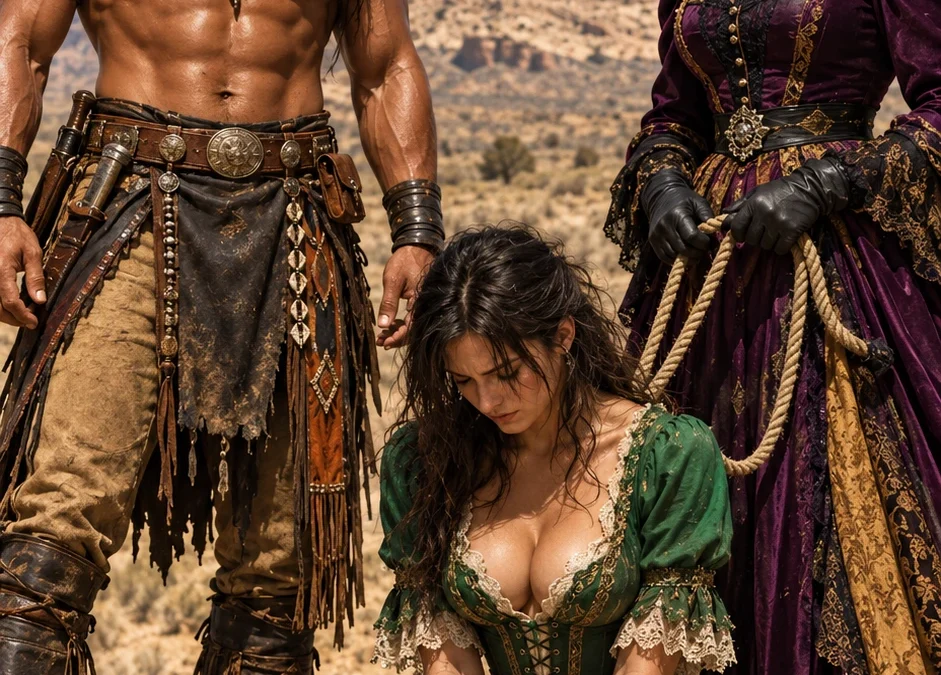
HER STEPMOTHER SOLD HER TO THE MOST FEARED APACHE WARRIOR IN ARIZONA TO BE RID OF HER… BUT WHEN A CHILD’S BONE SNAPPED IN THE CANYON, THE “DISCARDED” GIRL DID SOMETHING THAT SILENCED THE ENTIRE CAMP 😱
Part 1
Her stepmother gave her to the feared Apache as punishment.
This was not an act of mercy. This was not a mother’s desperate attempt to save a wayward daughter from scandal. This was calculated cruelty, dressed in the dusty veil of frontier justice. 💔
Abigail Whitaker, a woman whose smile never reached her pale gray eyes, had bartered away her stepdaughter’s life as coldly as one might sell a lame horse, hoping the transaction would end with blood soaking into the red Arizona clay and a young woman’s scream swallowed by the endless wind.
Before that betrayal, Eliana Thorne had known a different kind of suffering.
The sprawling Thorne Ranch, nestled at the foot of the Chiricahua Mountains, where the land cracked like old leather under the relentless sun, had once been a kingdom of childhood wonder. She remembered her father, Thomas Thorne, a man whose hands were rough as bark but whose eyes held the softness of morning light through mesquite branches. He taught her to read the desert, to see opportunity in the movement of cattle markets, to understand that survival in the territory was equal parts grit and calculation.
In his final days, when the fever took him, he pressed her small hand between his callused palms and whispered promises that she would inherit everything he had built from dust and determination.
Those promises died with him.
Abigail, a woman from St. Louis who had arrived on the afternoon stage with trunks full of silk and secrets, had married Thomas in his declining years. The marriage was brief, transactional, devoid of warmth. After Thomas was laid beneath a simple wooden cross, Abigail’s mask of widowed sorrow slipped away like morning frost.
She looked at Eliana not with a stepmother’s affection, but with the cold assessment of a woman calculating the value of an obstacle. The young woman, barely past twenty, stood between Abigail and complete control of thousands of acres of grazing land, water rights worth more than gold in that scorched territory, and army contracts that paid in reliable government silver.
The house became a cage of whispers and locked doors. Eliana was relegated to servant in her own home. Her father’s belongings burned in the courtyard fire pit. The loyal ranch hands who had worked beside him were replaced, one by one, with Abigail’s hired men: rougher types with calculating eyes and hands that lingered on their gun belts. 😨
But Eliana noticed something her stepmother had not counted on. Among her father’s papers, in a leather-bound journal, were notes about land deeds that did not match what Abigail now claimed. The handwriting was wrong. The dates were suspicious. Her father had always been meticulous, and these discrepancies gnawed at her like a persistent ache.
She said nothing. She waited.
That moment never came. Abigail struck first, with the efficiency of a rattlesnake.
On a blistering afternoon, three rough men arrived with a wagon. They spoke in hushed tones with Abigail on the porch while Eliana watched from her window, her heart hammering like a trapped bird. That evening, Abigail announced with theatrical sorrow that Eliana had become uncontrollable, that grief had twisted into dangerous rebellion, and that for the safety of the household she must be sent away for “correction.”
Before dawn, Eliana was bound with rough hemp that bit into her wrists and placed in the back of that wagon.
The men drove her deep into the foothills, to a place where the rocks rose like broken teeth against the sky. Frontier folk spoke its name in whispers: the Devil’s Fist. A jagged formation of red stone where the boundary between the settled world and Apache territory blurred into dangerous ambiguity. Deals were made here that honest men would never speak of in daylight.
As the wagon rattled to a stop, she saw them. Warriors emerging from the heat shimmer like vengeful spirits, their bodies painted with ochre and ash, their faces unreadable as carved stone. Her captors exchanged words she could not hear, passing something between them that glinted in the merciless sun. Then they were gone, retreating with the speed of guilty consciences.
The warrior who approached her moved with the fluid grace of a hunting cat. Shoulders broad as canyon walls. Skin burnished copper by the desert sun. Eyes that seemed to reflect centuries of survival. This was Chato, a name white settlers invoked with the terror they reserved for drought and disease.
But as he studied Eliana, bound and trembling in the wagon bed, his expression was not savage triumph. It was analytical. Measuring. Seeking something beneath the surface of her fear.
He cut her bonds with a knife that caught the light like captured lightning, the blade passing so close to her skin she felt its whisper. Yet he did not harm her. He tilted his head, observing the defiant set of her jaw, even as tears tracked through the dust on her cheeks. In her ruined silk dress meant for parlors and afternoon tea, she looked absurdly out of place against the brutal landscape.
But there was a spark in her eyes that refused to dim, even in the shadow of certain death.
He spoke a single word in his language and gestured toward the eastern ridge, where the rest of his band waited like patient wolves. Eliana understood without translation. She would walk, or she would be carried.
She chose to walk, her legs shaking and her spine straight, following this terrifying stranger into the unknown. Behind her, the wagon tracks were already being erased by the wind. 🕯️
What neither Eliana nor her stepmother knew was that among the items Abigail had burned in her purge of the household was an old leather journal belonging to Eliana’s mother… a journal filled with sketches of Apache faces. And one of them bore a remarkable resemblance to the man now leading her into the mountains… 😳
Part 2
One sketch bore a remarkable resemblance to the man now leading her into the mountains.
The rancheria appeared like a mirage carved into the mountainside: wickiups woven from willow and desert grass, smoke rising in lazy spirals, the scent of roasting meat and sharp herbs making her empty stomach clench. As Chato led her through the entrance, a profound silence fell. Women paused in their weaving. Children stopped their play. Warriors turned to study this pale ghost brought into their midst.
She saw curiosity in some faces, suspicion in others, and in a few, something disturbingly like pity. They knew what she did not yet understand: she had been discarded, thrown away like refuse by her own people, and her survival now depended on proving she possessed value beyond the color of her skin.
An elderly woman emerged from the largest wickiup, her face a road map of wrinkles, her eyes sharp as obsidian. Enju. She circled Eliana slowly, pinching the soft flesh of her arms, examining hands that had known only embroidery needles and piano keys. Her clipped words needed no translation. This soft creature will be useless. She will die before the next full moon.
Chato answered with the weight of command. The old woman’s eyes narrowed. At last she grunted and dragged Eliana toward the women’s area, where clay vessels and stretched hides waited.
The first task was hauling water from a spring half a mile down the mountainside, in an olla so heavy it seemed impossible even empty. The weight grew unbearable within minutes. She stumbled, nearly dropped it, and heard the barely concealed laughter of children who had made this journey countless times.
But something her father once said surfaced through the exhaustion: the ranch workers who carried heavy loads found a rhythm, made the weight part of their movement rather than fighting it. She adjusted her grip, found the balance point, and walked with shorter, more deliberate steps. The laughter faded. By the time she reached the camp, her hands were raw and her back like fire, but she had not dropped the olla. Enju took it, examined it, and did not send her back for more, which in itself felt like a small victory. 🥹
The following days blurred into relentless labor. She scraped hides until her fingers bled. She ground corn on stones that seemed determined to crush her hands. She learned to bank fires, to find water-holding roots, to move through the camp without disturbing hierarchies she was only beginning to understand. Through it all, Chato watched from a distance, never interfering, but always present like a shadow at the edge of her vision. His silent observation, not judgment but patient assessment, kept her moving when her body screamed for rest.
A week in, mountain traders arrived with pack mules, and Eliana watched the negotiation from the women’s area. The lead trader, a man with tobacco-stained teeth, was showing Enju a bolt of blue cloth, praising its quality while arguing down the price of her tanned hides. But Eliana’s father had taught her to spot textile fraud. The cloth passed off as pure wool was clearly blended, evident in the way it caught the light and the stiff drape of the weave.
Before she could think about the wisdom of it, she rose and walked toward the trading circle. The conversation stopped. She pointed at the cloth, then shook her head firmly, using the few Spanish words she had learned from ranch workers to say it was false, mixed, worth far less than claimed.
The trader’s face flushed red. But Enju’s weathered fingers were already testing the fabric, and her expression darkened. She thrust it back and demanded double the hides, or no deal at all. The trader, knowing word of his dishonesty would spread among the bands, had no choice but to accept.
Afterward, Enju offered Eliana a bowl of stew without the usual resentment. It was a small gesture, but in the economy of this harsh world, it spoke volumes. 🔥
Then came the crisis, with the brutal suddenness of a summer storm.
A boy of six named Little Hawk had been playing near the canyon edge when the ancient sandstone crumbled beneath him. He fell perhaps fifteen feet, struck an outcropping, and when the rancheria reached him, his screams had faded to whimpers somehow more terrifying than the cries. His leg was bent at an angle that made hardened warriors look away, bone pressing against skin from within. His mother, Singing Bird, was hysterical with grief.
The band’s healer, an ancient man whose hands shook with palsy, burned sage and mixed poultices. But even Eliana could see the doubt in his eyes. This was a compound break, beyond any remedy he knew. As the hours passed, the boy’s skin took on a gray pallor. The leg swelled and darkened. Eliana knew with horrible certainty that infection would follow.
A memory surfaced with the clarity of spring water. Her grandfather had been a battlefield surgeon in the Mexican War, and her father had inherited his medical journals: leatherbound books of anatomical sketches and instructions for treating field injuries. She had read them through long winter evenings. One section dealt specifically with compound fractures.
She had never performed such a procedure. She had never even witnessed one. But the child was dying before her eyes.
She pushed through the crowd, knelt beside the boy, and looked up at Enju, at Chato, at Singing Bird’s face of desperate hope. She made gestures that communicated both confidence and need. The old healer bristled, but Enju, remembering the traders, silenced him with a word. Chato’s eyes fixed on Eliana with an intensity like sunlight through a magnifying glass. Then he nodded once.
She demanded water boiled until it steamed, strips of leather, straight willow branches, and the strongest whiskey from the trade goods. Her hands shook, but she could not afford to let fear control them.
She scrubbed her hands in the scalding water, poured whiskey over the wound while others held the boy, and probed with clumsy fingers for the displaced bone, swallowing the bile that rose in her throat. The moment of realignment required more strength than she knew she had. She had to pull against contracted muscles while Little Hawk’s screams seemed to crack the sky.
Then she felt it. The subtle shift of bone sliding home. She splinted the leg with willow and softened leather, and sat back on her heels, shaking, her hands covered in blood and sweat. Little Hawk had mercifully fainted, his breathing shallow but steady. Singing Bird was sobbing, but they were tears with hope in them. 😭
And in the chaos, Eliana had noticed something her mind had not yet processed. Singing Bird’s leather pouch had fallen open, and inside lay a small silver locket of Mexican craftsmanship, engraved with a flowering cactus.
She had seen that exact locket before. In a portrait of her mother, in her father’s study.
One of only three ever made. And it was lying in the hands of an Apache mother in the mountains… 😳
Part 3
That night, after Little Hawk’s fever broke and he sipped broth from his mother’s trembling hands, the rancheria gathered around the central fire. Chato spoke at length, and though Eliana could not follow the words, she recognized herself at the center of his speech. When he finished, Enju placed around her neck a simple cord with a single turquoise stone. Not the jewelry of high status, but the mark of someone who had earned acceptance.
She said nothing of the locket. Not yet. She was learning that timing was everything.
In the weeks that followed, the women stopped watching her with suspicion. Children trailed after her, offering roasted grasshoppers and mesquite beans as tentative gifts. She was not yet one of them, but she was no longer entirely other.
Chato remained a constant, enigmatic presence. She would be gathering firewood and find him there, ostensibly checking snares, always positioning himself between her and the more dangerous approaches. One evening beside the creek, as they worked in parallel silence, he began to speak in slow, careful Spanish. He told her of his own arrival years ago, a boy running from a massacre at his birth village. Of Enju, who had tested him with the same relentless labor. Of the guilt of surviving when others had not, and the slow work of building new connections that could never replace what was lost, but could honor it by continuing to live with purpose.
Her hands stilled in the cold water. This was not casual conversation. It was a story shared as the foundation of trust. And she found herself telling him everything: her father’s death, the cage her stepmother had built, the moment in the wagon when she understood her own people had discarded her like a broken tool. She spoke of her mother, and the persistent sense that truths about her family’s past had been deliberately buried.
When she mentioned her mother’s connection to the Apache, his knife paused for a single heartbeat. 🕯️
Days later, Enju came to her with the silver locket in her weathered palm. In a mixture of Apache and Spanish she explained: it had been a gift from Eliana’s mother to Singing Bird’s grandmother, a midwife and healer. The two women had formed an unlikely friendship in an era when the ranch and the rancheria had existed in careful peace. When Eliana’s mother died in childbirth, both communities mourned, and the locket was kept as a sacred object, passed down through generations as a reminder that understanding between their worlds was possible.
The revelation struck her like a blow. Her mother had not merely known these people. She had been woven into their history. Her arrival here was not the random cruelty of Abigail’s betrayal, but a calling home to a people her mother had loved. That night, on a flat rock overlooking the valley, Chato’s hand covered hers briefly, a gesture of protection and promise, before he withdrew, mindful of the watching camp. The warmth lingered like a blessing. 🥹
But the peace was fragile as spider silk.
The wind came wrong one afternoon, from the southwest, making the dogs restless and the warriors reach for their weapons. Scouts returned at sunset with news that drained the color from battle-hardened faces: a dozen men were ascending the mountain trails with purpose, moving like bounty hunters, led by one of Abigail’s hired hands, a man named Dalton, who had been asking questions in Silver Creek and spreading silver among the town’s more flexible citizens. With him rode a man claiming to be a territorial marshal, carrying papers authorizing the “recovery of a stolen white woman held by hostile Indians.”
The legal fiction was perfect in its cynicism. If Abigail could not simply murder her stepdaughter, she would use the law’s veneer to achieve the same end, and any truth Eliana spoke would be dismissed as the ravings of a broken captive. 😠
That night, Eliana touched Chato’s arm and tried, in inadequate Spanish, to say she was not worth this. She could walk down the mountain and surrender herself to spare the children sleeping in the cave.
His answer was fierce. She was not a prisoner to be traded. She was not merchandise. She was a person who had saved a child’s life, who had worked until her hands bled to earn her place. The debt they owed her mother was real. But what kept her here now was not obligation. It was choice, hers and theirs.
They did not abandon their own to wolves.
At dawn, the men appeared on the lower trail. Chato posted his warriors at the narrow points, and sent Enju forward with a white cloth on a staff. At the parley, the false marshal brandished his papers and demanded the surrender of Miss Eliana Thorne.
And Eliana stepped forward and spoke in clear, measured English that carried across the ground. She gave her full legal name. She stated that she was not a captive. She had not been kidnapped. She had been sold by her stepmother to men who intended her death, and she had been saved by the Apache band, who now sheltered her of her own free will.
The words hung like gunsmoke. Panic flickered across Dalton’s face. Chato, reading the same dangerous shift, gestured, and three more warriors appeared on the rocks above, rifles aimed at the parley ground. The false marshal blinked first. His authority, he announced, did not extend to removing someone who claimed to stay of her own will.
Dalton retreated, eyes promising violence. 🔥
He waited three days.
Then, in the black hour before dawn, he sent men up the mountain with torches and kerosene-soaked rags. The first wickiup caught on the eastern edge, and the flames spread with horrifying speed. But the warriors were already moving, drilled for exactly this nightmare, and Chato’s rifle spoke in sharp, measured reports, turning the terrain into deadly ground. Two of Dalton’s men fell before they realized their advantage had evaporated.
Through the smoke, Eliana saw Dalton pass something to a young man: a metallic bundle that glinted in the firelight. Dynamite. They meant to collapse the cave where Singing Bird, Little Hawk, and a dozen children sheltered.
She ran. She knew a shortcut through the boulders that the stranger did not, and emerged ahead of him, a leather-cutting knife in one hand and a stone in the other. For a heartbeat they faced each other: a boy who had made terrible choices, and a woman defending Apache children. A rifle shot from the heights above dropped him, and the bundle fell from his fingers.
She dove and caught it, the fuse already lit and sparking.
She ran perpendicular to the camp, along the narrow trail to the sheer drop above the valley, counting heartbeats against the shortening fuse. At the edge, she hurled it into the darkness with a prayer. The explosion came before she hit the ground, the concussion slamming her forward, skidding her to a halt just short of the abyss. 😱
When her hearing returned, Chato was above her, his face streaked with soot and blood from a gash across his cheek, his hands running over her arms with rapid efficiency, his eyes burning with an emotion she could not name. She had saved them all. Without the dynamite, Dalton’s men were pinned down, and the battle turned.
By sunrise they had retreated, dragging their wounded. The Apache had lost one warrior, but they had held. And from a scout who had overheard Dalton, they learned the full scope of Abigail’s plan: Eliana’s death in an “Apache attack” would legitimize emergency powers to annex neighboring lands, lands with newly discovered copper deposits worth more than a decade of cattle sales.
Her murder was simply business.
Standing beside Chato on the outlook, his fingers intertwined with hers, Eliana understood she had crossed a final threshold. She was no longer a refugee sheltered out of honor to her mother’s memory. She was a warrior of this band. And she knew the war was only half won. To end it, she must leave the mountains and walk back into the viper’s nest, armed with truth and the terrifying presence of the warriors who now called her sister. 💪
The descent was a procession. Chato led his finest warriors in formation around her, not as captors displaying a prisoner, but as an honor guard escorting a queen to reclaim her throne. She wore buckskin leggings beneath a repaired silk dress, her hair braided, the turquoise at her throat.
She carried proof. Days earlier, a letter had reached the mountains through Mexican traders and Apache runners from her father’s loyal old servant, now dying in a Tucson boarding house. He had sewn her father’s true will into the hem of her traveling dress before Abigail’s men took her. It was yellowed and water-stained, but the signature was unmistakably Thomas Thorne’s, and the date preceded his marriage to Abigail by three years. It left everything to Eliana, with provisions for a wife only if she acted as faithful guardian to his child.
When she rode into Silver Creek in the golden afternoon, the town froze. Women stopped with buckets suspended. Men let their cards fall. The lost Thorne daughter, presumed dead or ruined, rode at the center of an Apache war party heading straight for the magistrate’s office. 😲
Magistrate Ward emerged onto his porch, pale beneath his careful beard. Eliana dismounted last, slowly, so every eye could see she moved under her own power. She climbed the steps alone, her father’s will in her hand, and in a voice that carried down the street she named her stepmother’s crimes: fraud, forgery, and attempted murder.
The door behind Ward opened, and Abigail emerged in severe mourning silk, her expression of shocked horror so perfectly calibrated that Eliana almost admired its artistry. But she saw the flash of rage before the mask settled, and the subtle gesture toward the shadows where Dalton waited. Her stepmother’s first instinct was not joy at a daughter’s survival, but annoyance at a problem that had failed to stay solved.
Abigail attacked instead of denying. The will was a forgery crafted by savages, she claimed. Poor Eliana’s mind was broken by captivity.
And then an unexpected voice cut in. The banker, Samuel Chen, son of Chinese immigrants who had come with the railroad, stepped forward, nervous but resolute. He had been Thomas Thorne’s personal banker. He held in his vault a duplicate of that very will, deposited for safekeeping, with instructions to release it only if Thomas’s daughter ever came to claim it. Chen had been waiting, hoping Abigail would honor her husband’s wishes. But seeing Eliana alive, he could no longer be silent.
He drew from his coat a second letter in Thomas’s own hand, dated three days before the will, explaining in lucid detail his concerns about his new wife’s intentions. 🔥
Abigail’s face went from pale to flushed. Magistrate Ward, feeling the wind shift, announced an immediate investigation into every property transfer since Thomas Thorne’s death. All of Abigail’s financial transactions were frozen. Miss Eliana Thorne was recognized as legitimate heir.
As the crowd murmured, Abigail’s eyes met Eliana’s across the porch. All pretense fell away, and what remained was pure hatred. But Eliana held her stare without flinching. She was no longer the frightened girl who had been bound and delivered to the Devil’s Fist.
Abigail fled Silver Creek two nights before the hearing, leaving debts and angry creditors. Some said San Francisco, others Mexico. No one troubled to pursue her. The inheritance was restored. 🤍
Eliana returned to the Thorne Ranch, and it felt like a museum of someone else’s life. The leather chair where her father read the evening papers. The kitchen where the hands gathered for coffee before dawn. A costume she had outgrown.
She leased the ranch on generous terms to a young family from Texas, with provisions for eventual purchase, and kept only enough of the inheritance liquid to build trade between the Apache bands and honest merchants, hoping mutual profit might forestall future violence. The territorial government, relieved to have a flashpoint resolved through commerce rather than cavalry, granted limited trading rights. It was imperfect, and always one incident from revocation. But it was a crack in the wall between peoples.
On a morning when autumn first touched the high country with gold, she rode back toward the mountains. Chato met her at the treeline, his horse moving beside hers without need for words. The band adopted her formally around the central fire, not as curiosity or charity, but as full member. In a brief civil ceremony the territory recognized, Eliana Thorne and Chato, whose paperwork read Charles Stone, were married. But the real marriage had happened over months of shared labor and silent understanding.
She learned that building bridges between worlds was not romantic adventure but grinding daily work. She failed as often as she succeeded. But there were victories: settlers who learned enough Apache to bargain directly. A band leader from another rancheria who came to study her trading system. Little Hawk, the boy whose leg she had set, who grew into a young man with a gift for languages and mathematics, and whom she taught everything her father had taught her about accounts, so that he would never be cheated by anyone. 🥹
The Apache called her Nadesti, lightning woman. Not for rage, but for the sudden illumination she brought to dark problems.
Years later, on an evening as the sunset painted the canyon walls in blood and honey, Eliana sat beside Chato, their daughter asleep in the wickiup behind them. Someone began a song in the peculiar harmonics of Apache music that had sounded so alien in her first desperate weeks and now sounded like home. Other voices joined. She added her own, imperfect and accented but sincere, and felt Chato’s chest vibrate against hers like a second heartbeat.
Her stepmother had intended cruelty, and had accidentally delivered grace. If she could have spoken to the girl who cowered in that wagon, she would have said: You are so much more than you know. The desert has sharp edges, and you will be cut. But those cuts will reveal what you are made of. Trust the journey.
Eliana Thorne felt, for perhaps the first time in her life, completely at peace with who she had become. ✨
Which moment of Eliana’s journey stayed with YOU: the trader, the broken leg, or the dynamite? Tell me in the comments, and share this with someone who needs to remember that being discarded is not the same as being worthless. 👇
This story is entirely fictional and created for entertainment purposes only. It does not represent any organization or individual, nor does it encourage inappropriate behavior. The content was generated with AI assistance.








