Her Stepsister Made Her Wear a Stained Yellow Dress to Her Wedding, Then Crushed Her Mother’s Brooch Into the Mud. What the Duke Did Next Started a War, and Someone Was Willing to Kill for It
Her Stepsister Made Her Wear a Stained Yellow Dress to Her Wedding, Then Crushed Her Mother’s Brooch Into the Mud. What the Duke Did Next Started a War, and Someone Was Willing to Kill for It
PART 1
“You will wear this,” Celia said, and she threw the yellow dress at Hester’s face.
Hester caught it before it fell. The cloth was old and thin, with a long brown stain down the front, as if tea had been spilled on it years ago and never washed out. One sleeve was torn at the shoulder.
“Celia,” Hester said quietly, “this dress has a stain. Everyone at the church will see it.”
“Yes,” said Celia. “They will.” 💛
Celia Thorne stood in her bedroom in her wedding gown, white silk sewn with tiny pearls, her golden hair pinned high. She was twenty-two and the most beautiful girl in Keswick. At eleven o’clock, she would marry Rufus, Duke of Brookgrave, and become a duchess.
She smiled at Hester in the long mirror. It was not a kind smile.
“Mother thought you should stay home. But I said no. My dear stepsister must come to my wedding. I want everyone to see where you came from and where I am going. You will carry my train, and you will walk behind me with your head down like a good little maid. Because that is what you are, Hester.”
Hester said nothing. If she argued, Celia would cry, her stepmother would come, and Hester would get no supper for three days. She had learned that lesson many times.
In her cold attic room, she put on the yellow dress. It was too short and showed her old boots. Then she looked at the one good thing she owned: a small silver brooch shaped like a bird, with a tiny blue stone for its eye. It had been her mother’s. Her father had given it to her at the funeral. “Keep it close, my bird.”
Her father had died four years ago, in a fall from his horse on the fell road. After that, everything had changed.
She pinned the brooch over her heart, where the stain was worst. It made her feel a little braver. 🐦
In the hall, her stepmother, Lavinia Paige, looked her over, thin lips curling. “Good. You look exactly like what you are.”
Behind her stood old Nan, the cook, who had worked in the house since before Hester was born. Her face was red with anger, but she could not speak; if she lost her place, she had nowhere to go. As Hester passed, Nan pressed a folded paper into her hand.
“Not now,” she whispered. “Later, when you are alone.”
At St. Kentigern’s church, crowds lined the wall. When Celia stepped down, they gasped at her beauty. When Hester followed, carrying the train, the clapping stopped.
“That,” said Celia in a sweet, carrying voice, “is my poor stepsister Hester. I brought her today out of charity. She has nothing of her own. She will come with me to Brookgrave Castle and be my maid. Isn’t that kind of me?”
Some people laughed. Some looked away. Hester kept her eyes on the white silk in her hands.
At the church porch, Celia stopped. “You have something on your dress.”
“It is only my brooch.”
“Oh, I know this. Your mother’s. The music teacher your father married for love, who had no money at all.” She said for love like a joke. “Please, Celia,” Hester whispered. “Not today.”
“It is crooked. It looks cheap.”
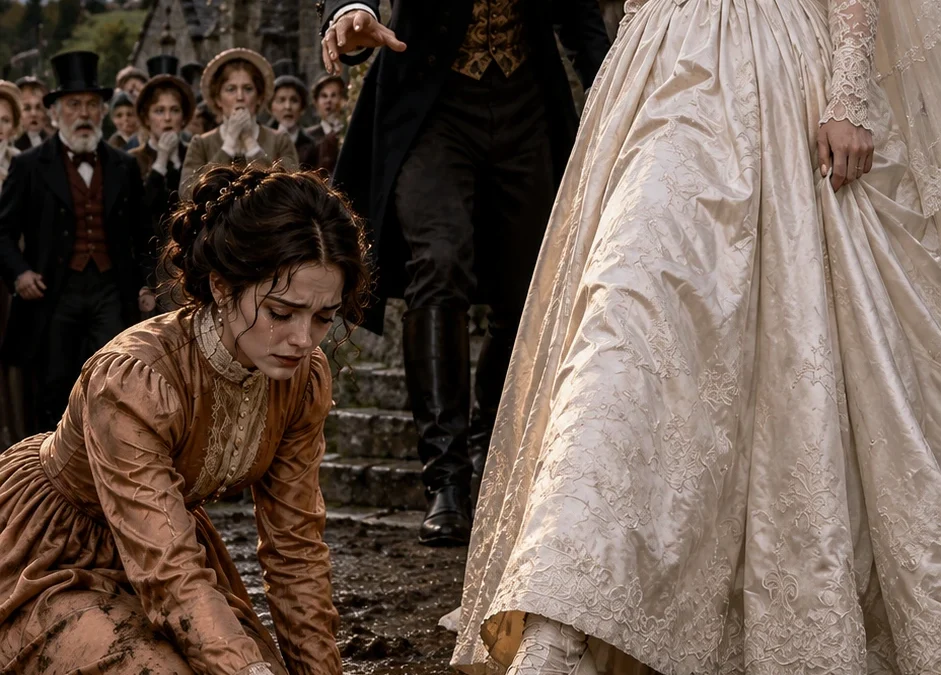
Before Hester could move, Celia tore the brooch from the dress. The pin ripped the cloth. She held the little bird up for everyone to see, then dropped it in the mud by the step, set her white silk shoe on top, and pressed down.
Hester heard the small crunch of silver.
“Oh dear,” said Celia. “How clumsy of me.” 💔
Nobody spoke. Celia would be a duchess in an hour, and nobody wished to be her enemy. “Come along, Hester. Don’t make me wait at my own wedding.”
She followed. At the door she looked back once and saw a tiny flash of silver in the dirt.
She did not see the tall man at the narrow vestry window, who had watched every second of it.
Inside, the church was full of lilies. At the altar stood the Duke, thirty-one, broad-shouldered, his hair the dark red-brown of beech leaves in autumn. People said he rarely smiled, but that he was fair, and that the poor of his lands loved him. He was not looking at Celia.
He was looking at Hester.
She walked behind Celia all the way up the long aisle, two hundred people staring at her stained dress and torn sleeve. The old vicar, Mr. Hale, opened his book. “Dearly beloved, we are gathered together…”
“Wait,” said the Duke.
It was not a loud word, but in the silence it rang like a bell.
“Miss Thorne. Before we go on, I would like you to do one small thing. Go back to the porch. There is a silver brooch in the mud by the step. Pick it up, give it back to your sister, and tell her you are sorry.”
The silence was so deep Hester could hear her own heart. 😶
“I don’t know what you mean,” said Celia.
“I think you do. I was in the vestry. The window looks onto the porch. I saw you take the brooch from her dress. I saw you put it under your foot. I heard what you said about her mother.”
Celia laughed her pretty ballroom laugh. “It was only a joke, Your Grace! A silly old brooch.”
“She minds. Anyone can see she minds.”
“Well, I am not going into the mud in my wedding gown. That is what maids are for.”
The Duke looked at her a long moment. Then he turned to the vicar.
“Mr. Hale, I am sorry for the trouble I have caused. But I will not be married this morning.” ⚡
PART 2
The church exploded. Ladies gasped. Men stood. Mrs. Paige rose from the front pew like a purple storm. “You gave your word!”
“I gave my word to a woman I thought was kind,” said the Duke. “I have just seen how she treats a person who cannot fight back. A man learns everything he needs to know from that.”
“Over a brooch? Over that girl?”
“Over that girl.”
Celia’s face went white, then red. “You will be sorry. You will be so sorry that everyone laughs at you.”
“I have been laughed at before.”
He walked straight across the church to the wall where Hester stood. Up close, his eyes were clear gray and not cold at all. “Miss Paige, I am sorry for what you have suffered. Please forgive me for making it worse by making a scene.”
“Your Grace, you should not have done this. Not for me.”
“It was not only for you. It was for me as well. I could not have lived with it.”
He bowed to her, a full, deep bow, the kind a duke gives a duchess. Two hundred people saw it. 🙇
Then he left, and the worst hours of Hester’s life began.
When the crowd had gone, she knelt in the mud and dug where the brooch had lain. She found the mark of Celia’s shoe. But the brooch was gone.
At home, her stepmother struck her across the face. “You stood there looking pitiful so he would feel sorry for you! Did you plan this with him?”
“I have never spoken to him in my life.”
“Get out,” said Mrs. Paige. “You came into this family with nothing, and you will leave with nothing.”
“This is my father’s house.”
“Your father left everything to me. Every stone, every spoon. It is in his will, and Mr. Crump read it to you himself.”
Hester took her gray dress, a few things, and her mother’s broken music box with the painted lid, and walked out into a cold rain. By dusk, she stood on the old stone bridge over the Greta, looking at the brown water. Then she remembered Nan’s note.
Your father’s will was not the true one. I saw the true one. Come and find me when it is safe. Burn this.
She heard hooves. A dark carriage drawn by four black horses stopped beside her, and a tall man stepped down into the rain, hair the color of beech leaves.
“Miss Paige. I have been looking for you all over Keswick. Your cook told me you had been put out. Please get into the carriage before you freeze. My aunt is inside. She has a very sharp tongue and a very warm fur rug.” 🌧️
From inside, a dry voice said, “I heard that, Rufus. Do hurry. I am letting all the cold in.”
Hester almost laughed. Then she almost cried. Then she took his hand.
At Brookgrave Castle, she was given the blue room, a hot bath, supper, and a dry nightgown. By morning, Lady Honoria, the Duke’s aunt, offered her a post as companion, thirty pounds a year, and the care of three greedy canaries named Faith, Hope, and Charity. For the first time in four years, nobody shouted at her. 🐤
In the garden, Rufus told her why he had stopped the wedding. His mother had been a glove-seller’s daughter. The fine ladies of the county had laughed at her, and once at a dinner a lady had put salt in her tea. “I was seven years old. I sat outside her door and could not do anything. I promised myself I would never sit at a table and let someone be stepped on. When I saw Miss Thorne put her foot on your mother’s brooch, I was seven again.”
Hester told him her story: her father’s graphite mine shares, the will read after the funeral, the attic, four years of scrubbing.
Then a clerk arrived with a long folded paper. Celia was suing the Duke for breach of promise, twenty thousand pounds, and the paper named Hester as a scheming young woman of low character who had secretly met him for months.
Worse followed. That night, from her window, Hester saw Celia in the Duke’s garden, meeting a tall man with a black mustache and a red scar over one eyebrow.
“The girl must be gone before the assizes,” he said. “Little nobodies have accidents all the time. A fall in the hills. A slip by the lake.”
He looked straight at the hedge where she crouched.
“Good night, little bird,” he said softly. 😨
Only her father had ever called her that.
PART 3
Hester ran to the Duke’s door and told him everything. He took her cold hands in his warm ones. “You are safe in this house. But he said they would deal with the cook.”
Nan, still at Fellside House, was in danger. They met her in secret at St. John’s church, Hester in a veil, the Duke in a farmer’s coat. Nan told them the truth: two months before his death, Hester’s father had signed a will leaving the house and mine shares to Hester, with £500 a year to his wife. Mr. Crump and his clerk, Amos Webb, had witnessed it. The will read after the funeral was a different one.
At the Seathwaite graphite mine, the manager, Mr. Burkett, showed them the shares sold to a Captain Ambrose Lyall for £100, though they were worth thirty times more. The Duke laid the signatures side by side. The “approved by J. Page” note was close to Hester’s father’s hand, but the loops were too careful. 🔍
Days later came the boat. Halfway across the lake, Hester felt cold water at her feet. The planks had been cut almost through and filled with wax. When the boat sank, Rufus pulled her to shore, kicking, while she told him in broken gasps about a robin named Admiral. On the pebbled beach, he held her face, and she wanted him to kiss her.
That night, Lady Honoria’s emerald necklace vanished and was found under Hester’s mattress. A new housemaid, Polly Grigg, swore she had seen Hester steal it. Even Lady Honoria, her eyes full of doubt, said, “How well do we really know this girl?”
That night, in the library, Rufus told Hester he loved her. “I think I began in the church when you told me I should not have done it, as if you were not worth it.” She told him she loved him too. He kissed her, and everything was gentle. Outside the door, someone heard.
At White Haven, they found Amos Webb hiding under the name Andrew Wood. He confessed everything: Crump had forged the second will, and had kept the true one in an iron box. “A lady who has stolen a fortune will one day want to stop paying her lawyer. On that day, I want something to remind her who is master.”
But when they returned, Sir Hugh Dacre, Celia’s godfather, stood on the castle steps with four constables. Polly Grigg’s sworn statement had arrived. “Miss Hester Paige, I am arresting you for theft.” 🚨
In the Cockermouth jail, Hester slept on straw. On the third day she heard the turnkey: the Duke had fallen on the Wind Ladder road when his saddle girth broke. “They say it was cut.” For the first time, a terrible thought came to her. Her father had been a fine rider. And he, too, had fallen.
On the fifth day, her stepmother came with a confession and a ticket to Quebec. Sign, and be free. Or rot at the bottom of the world.
Hester looked her in the eye. “Did Captain Lyall cut my father’s girth, the way he cut the Duke’s?”
For one moment, under the black veil, she saw fear.
Then Mrs. Paige smiled. “Mr. Crump’s office burned last night. Every paper is ashes.”
Hester tore the confession in four pieces. “My father left me his house, his robins, and his name. You took the house. You took the robins. You will not take the name.” ⚖️
On the eighth day, Lady Honoria came, weeping. “I doubted the one honest person in that whole sorry business.” The Duke had woken, seen Celia at his bedside, and said, “Get out of my house. Where is Hester?”
The next morning, he came himself, bandaged, one arm in a sling, on a horse he had been forbidden to ride. “I told you I would come. I am a day late. I was busy falling off a horse.”
Bail was paid. In Carlisle, Nan was waiting. Dismissed from the house, she had searched her mistress’s desk and found six letters from Lyall tied with pink ribbon. “My dear L, the old fool has changed his will. Leave it to me. I know his horse and I know the road. Burn this. A.” And the last, three weeks old: “The Duke is a problem and so is the bird. A lake is deep and a pass is steep.”
Her father had been murdered. 😢
At the Carlisle assizes, Polly Grigg stood in the witness box and, trembling, told the truth: “I put that necklace under Miss Paige’s bed myself. Miss Celia paid me to do it, and Captain Lyall told me what to say.” The judge discharged Hester without a stain on her name.
That afternoon, Celia cried beautifully before a jury, calling Hester a scheming thief. Mr. Pennington asked her only: “The yellow dress you gave your sister, was there a stain on it? Two hundred people remember. I can call fifty.”
Then Hester stood and lifted her mother’s music box.
The night before, she had pressed the bottom with a hairpin, and a thin painted board had slid open. Inside lay two papers. The first was a letter in her father’s round hand. “My little bird, if you are reading this, something has happened to me. I do not trust Crump as I once did. So I have made a copy and had it signed by two honest men, the Reverend Mr. Hale and Mr. Jonah Burkett.” The second was the will itself.
Mr. Burkett, called to the box, looked at his own signature, beard trembling. “I signed it in John Paige’s study. I had clean forgot it till this minute.”
“That is a forgery!” cried Crump. “The true will was burned in my office!”
The court went still.
“The true will,” Mr. Pennington said gently, “that you said was burned. Why would you call it the true will, if it was not the one you read?” 😮
Crump broke. The real will, his practice sheets, and Mrs. Paige’s letters were in the Cumberland Union Bank. He had only written what they told him. Lyall ran for the side door, and found the Duke waiting in it with his arm in a sling.
“You cut my girth. You cut my boat. You killed her father for a house and a mine.”
Lyall swung. Rufus stepped aside and put out his foot. Lyall crashed down three stone steps into a puddle before half the horses of Carlisle. The whole court rose and applauded, and the old judge, under his white wig, smiled.
Celia withdrew her suit. The bank box was opened before the judge, and the true will matched the music box copy word for word. Crump and Mrs. Paige were charged with forgery and fraud. Lyall, whose real name was plain Albert, was held to answer for murder. Sir Hugh resigned the bench and went to Bath.
At the end of April, Hester walked up the path to Fellside House with the key in her hand. Celia stood in the hall among her trunks, thinner and smaller without her silk.
“Come to gloat?”
“No. I came home.”
Hester asked if she had known about her father. “Not then. Mother told me later, as if it were a joke. And I didn’t care. That’s the worst of it.” Her voice shook. “Do you know what it’s like to be poor? Two rooms over a candle shop. One dress. Girls at church laughed at it.”
“Then you knew exactly how it felt,” said Hester slowly, “when you made me wear the yellow dress.”
Celia did not answer. For a moment, Hester thought she might be sorry. Then she picked up her bonnet and walked out. Hester never saw her again. Years later she heard Celia had married a plain, kind clergyman and taught village girls to sew, strict but fair. She hoped it was true. 🌿
Nan walked into the kitchen, opened the cupboards, and declared, “Four days I’ve been gone and the whole place is filthy.” In the parlor, Hester played her mother’s song on the old piano, and found Rufus listening in the doorway. That afternoon she crumbled bread on the garden wall and a robin came, and she cried by the pump while Rufus held her.
In June, at Friar’s Crag, with the whole of Derwentwater shining below them, he opened his hand.
On his palm lay a small silver brooch shaped like a bird, with a tiny blue stone for its eye. It was not crushed. It was not bent.
“After I left the church, I went round to the porch step. I knelt in the mud in my wedding coat and dug it out. Nan found me there on my knees. I took it to the best silversmith in the north. I wanted to wait until it could be given back where nobody would ever take it from you again.”
He pinned it over her heart. Then he knelt on the gray rock.
“I am asking you not as a duke, not as the man who stopped a wedding. Only as Rufus, who once sat outside a door and could not help, and has been trying to help ever since. Will you marry me?”
“Yes,” said Hester. “Yes, Rufus, with all my heart.” 💍
They were married on the last day of June in the same church, the same long aisle. This time there were no lilies, only wild roses and daisies picked by village children. The miners came with scrubbed faces and black-lined hands. Lady Honoria sat in black velvet beside Nan in her new lace cap. Hester walked up the aisle on Mr. Burkett’s arm, and nobody carried her train. A fat robin sat on the end of a pew.
“Dearly beloved,” began Mr. Hale, and then he looked over his spectacles with a twinkle. “Your Grace, I only ask in case. You do not wish to say wait this time?”
The whole church laughed. “No, Mr. Hale,” said Rufus. “Not this time. Not ever.” 🕊️
At the porch step, where a silver bird had once been pressed into the mud, the new Duchess of Brookgrave stopped and looked down. There was nothing there now but clean stone and a few white petals.
“Come, little bird,” said her husband softly. “Let’s go home.” 🤍
What would you have done in Hester’s place, with nothing but a broken music box and the truth? Tell me in the comments. 👇
Disclaimer: This story is entirely fictional and created for entertainment purposes only. It does not represent any organization or individual, nor does it encourage inappropriate behavior. The content was generated with AI assistance.








