HIS AXE SNAPPED IN HALF ON THE MORNING HE FOUND HER 😱 A TINY, STARVING WOMAN BREAKING ICE AT HIS CREEK… THEN SHE LIFTED A LOOSE BOARD IN HIS BARN AND REVEALED THE ONE THING THAT COULD SAVE HIS RANCH… BUT THE WHOLE VALLEY WAS ALREADY WATCHING 🔥
HIS AXE SNAPPED IN HALF ON THE MORNING HE FOUND HER 😱 A TINY, STARVING WOMAN BREAKING ICE AT HIS CREEK… THEN SHE LIFTED A LOOSE BOARD IN HIS BARN AND REVEALED THE ONE THING THAT COULD SAVE HIS RANCH… BUT THE WHOLE VALLEY WAS ALREADY WATCHING 🔥
Part 1
The axe handle split on the third swing. 🪓
Harlon Cole stood in the November cold, staring at his hands. Fourteen years he’d had that axe. Hickory handle, head pulled off a dead man’s belt at Adobe Creek. Nothing special about it except that it never broke. Now the head lay in the woodpile, and he just stood there a while.
That was the kind of morning it was.
He was forty-nine, gray at the temples, and his back complained the way a man’s back does after living the way he had lived. The north fence was two weeks behind. The banker in Tres Pedras, a smiling man named Holloway who made every sentence sound like a favor, had sent his third letter of the season. The ranch was called the Rafter J. Harlon had bought it eleven years ago from a widow and never bothered to change the name, because who was he going to tell? There was no J in his name.
The valley didn’t love him. It didn’t hate him either. He was just the man up on the north ridge. He didn’t come to dances. He didn’t ask for help. He didn’t offer it. He paid his debts in cash. A town tolerates a man like that because he needs nothing from anyone.
Harlon had stopped wanting much from people some time ago.
He lashed the axe head on with rope. It held six swings before skittering off a pine knot and nearly taking his boot. He leaned it against the wall. I’ll ride to town for a new handle, he told himself.
Instead, he rode out to check the cattle. Two Hereford cows had pushed through the weak section of the north fence. Two hours to get them back. By the time he reached the creek it was past midday, he hadn’t eaten, and the sky had gone the color of pewter. The air smelled the way it does before snow.
He almost rode past her.
She was crouched at the water’s edge, so still and so small that his eyes took her for a gray stone. It was the movement that caught him. She was breaking ice with a flat rock, careful and steady. When his horse stepped into the gravel, she lifted her face.
They looked at each other across thirty feet of frozen air.
Harlon had seen a lot of faces show a lot of things. Hers showed nothing at all. Not fear. Not relief. The blankest, most deliberate nothing he had ever seen on a human face. It told him that whatever she had come through to reach this creek had been worse than a large gray-haired white man on a horse.
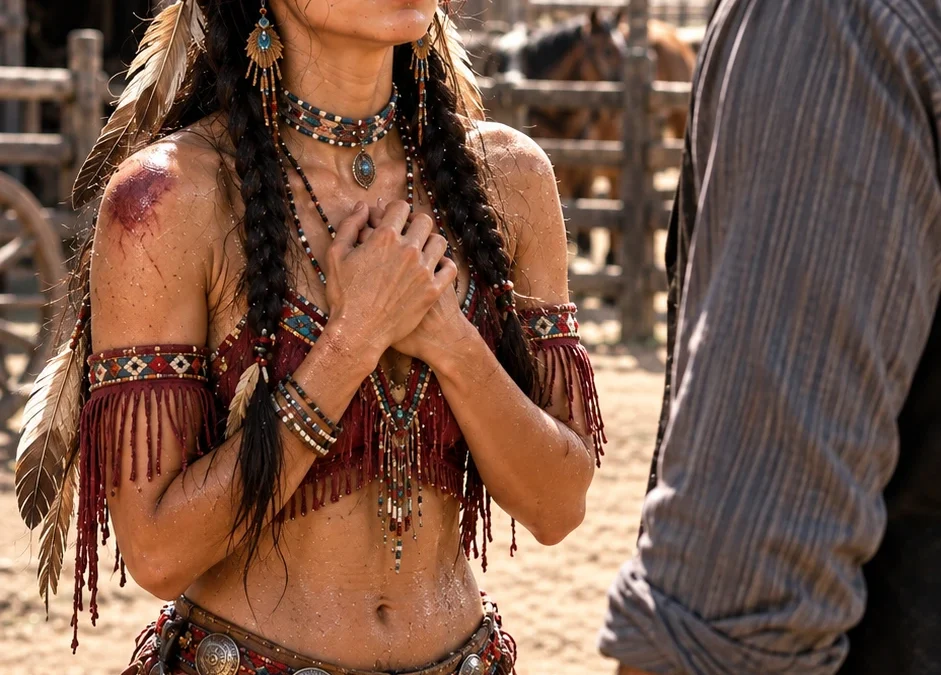
She was Apache. Barely over five feet. Thin in the way that means weeks without enough food. A blanket that was more hole than blanket hung from her shoulders, her feet were wrapped in hide scraps tied with rawhide, and an old bruise along her jaw had faded to yellow-green.
“Water’s free,” he said.
She didn’t answer. He watered his horse downstream and didn’t look at her again for a while. When he did, she was cupping water in her hands and drinking, and her hands were shaking.
“You got somewhere to camp?”
Nothing.
“I’ve got food up at the house. You’re welcome to come eat and get warm.”
She gave him that flat, considering look, taking her time.
“I don’t need your charity, cowboy.”
“All right,” Harlon said.
He rode home. He unsaddled the horse. He built up the fire, put beans on, and cut the last of the salt pork into the pot. He did all of it without thinking much about it. Or maybe he was thinking about it the whole time and not admitting it.
An hour later, a sound came from the porch. Not a knock. A boot scuffing the boards, testing whether they’d hold.
He opened the door. She stood there in the ruined blanket, saying nothing. Harlon stepped back and left the doorway open.
She came in. She sat. She ate slowly, carefully, the way a person eats who knows what it means to have nothing in her stomach and knows you can’t fill it all at once. Outside, the snow came in sideways off the ridge.
“You can take the bunk in the back,” he said. “It’s dry.”
“You don’t know me.”
“No.”
“I could be dangerous.”
“So could I.”
Something shifted in her face. A fraction of something.
“What do you want from me?”
Harlon said nothing. She didn’t believe that. He wouldn’t have either, in her place. She sat with it for a long time.
“One night,” she said at last. “All right.”
The snow didn’t stop for three days. And on the second morning, she set a cup of coffee in front of him as if she’d done it all her life, and said her name…
👉 Want Part 2? Find it in the comments, or drop any word below and I’ll send it to you privately! 👇
Part 2
“Sen Nalan.”
She said it the second morning, setting the tin cup down. It meant something in her language, she told him later. The woman who watches for the first light. ☀️
Over those three days, he learned her in fragments. She had been with her mother’s people north of Mescalero territory. Soldiers had moved the band to a government camp. She had stayed six months, and then she had left the camp. That was all she said about it. Harlon had seen enough government camps to know “left” covered a very wide territory, so he didn’t push. She’d been alone for a month. She’d had a horse until two weeks ago. She didn’t say what happened to it.
When the storm kept raging, he told her he had to check the cattle in the canyon. She put on an old canvas coat of his that hung to her knees, rolled the sleeves four times, and followed him out into the snow.
She was good with animals. Better than good. The cows settled around her in a way they didn’t always settle for him. She found the weak hinge on the stall door he’d been meaning to fix and mended it with wire from the repair bucket. No comment. She just did it.
She wasn’t helpless, Harlon realized. Whatever had been done to her, there was a core of competence in her that went bone deep.
On the third day, he rode to town and bought a new axe handle, salt pork, and a length of good wool blanket cloth. He set the cloth on the table without a word. She looked at it. Then at him.
“I’ll pay you back.”
“We’ll figure that out.”
She sewed herself a blanket that evening, cross-legged by the fire. And somewhere in there, Harlon realized the one-night agreement had expired three days ago, and neither of them had said a word.
But Tres Pedras was already talking.
Sheriff Art Gibbs found him at Reardon’s store. “Heard you had company out at the Rafter J. An Apache woman, I’m told. There’s been some talk.” Then Hector Morales, a rancher who’d been civil to him for eleven years, met him on the porch. “I’m not judging you, Harlon. But there are families in this valley. A man disturbs the way things work here, and…”
“I’ll tell her you said hello,” Harlon said.
“Don’t be stupid about this.”
When he rode home, she was at the north fence. She had finished two of the three bad sections on her own. Better tension than he would have pulled.
“The valley’s talking about you,” he said.
“The valley was talking about me before I ever came near it.” She looked at him with something between anger and grief, worn down by too much use. “I’ve known what white men think I am since I was eight years old. You probably think it too.”
“I think you fixed my fence better than I would have.”
She held his eyes a long moment. Then she turned back to the wire.
“The last section’s the worst.”
They finished it together before dark. 🌾
But in December, Holloway’s fourth letter arrived, with words the third hadn’t used. Foreclosure. Proceedings. Harlon was two payments short, and both men knew it. He had been carrying that weight alone all fall.
Sen found the letters while clearing the table. She read the whole thing. She looked at him with that flat, measuring look.
“How bad is it?”
He told her the number.
“It’s not your concern.”
“I’m living in your house, eating your food.”
“You’re working for it. You’ve worked for more than you’ve eaten.”
She sat quietly. Then she said something that stopped him cold.
“I told you my horse was gone. It was. Taken two weeks before you found me, by two men who knew I couldn’t stop them. But before they took it, I had hidden certain things from them.”
“What things?”
“Come with me.”
She led him to the barn, to the tack room. She moved the hay bale where he kept the winter blankets. Beneath it, she lifted a loose floorboard she had found weeks ago without telling him.
From the dark space below, she drew out a canvas roll tied with rawhide…
👍 LIKE or COMMENT “REVEAL” to see Part 3! It will be posted once we hit enough comments! 💬
Part 3
She untied the roll on the tack room bench.
Silver. Not a great deal, but some. A heavy Mexican brooch, the real thing. Two rings set with turquoise. And a small leather pouch that held six gold American double eagles.
“My mother’s. And her mother’s before her. We carried these a long way.”
Harlon stared at them.
“The land is worth more than the coins,” Sen said. “You keep the land. A man needs land. These can make up the gap at the bank.”
He stood there, a man who didn’t often fail to know what to do, and he didn’t know what to do. But he understood it was not pity and not charity. It was something closer to partnership, offered plainly, because plain was the only way she knew how to offer anything.
“I’ll pay every coin back.”
“I know you will.”
“These belong to your people.”
“I am my people,” Sen said. “What I do with them is what my people do with them.” A beat. “My mother would say the same.”
“Thank you.”
She nodded once and began retying the roll. 🙏
In January, Harlon rode into Tres Pedras on a gray Thursday with the coins in a pouch against his chest. He sat in the chair designed to make a man feel smaller than he was, and watched Holloway arrange his papers with the pleasure of a man who liked his power in quiet rooms.
Holloway was surprised. Not by the visit. By the coins. He turned them over in his hands.
“Where did these come from?”
“The Rafter J. They cover what I owe.”
“These are fairly unusual, Harlon.”
“Double eagles are double eagles.”
Holloway looked at him a long moment. Harlon knew what he was thinking. He let him think it, and watched him decide not to say it aloud. Art Gibbs’s office was two doors down, and Holloway didn’t make accusations he couldn’t stand on. He wrote the receipt. His confidence had thinned.
Back at the ranch, Sen was cooking venison with dried chilies she’d found in the back of a cupboard. The house smelled like someone who knew how to feed a man. He set the receipt on the table.
“Settled,” she said.
“Holloway’s going to tell people those coins came from you. That you stole them.”
“Will the sheriff come?”
“Maybe.”
“What will you tell him?”
“The truth. They’re yours, and you used them as you chose.”
She held his eyes. Then she said, “Eat.”
Art Gibbs came on a Saturday, which was decent of him. Hat in hand. He accepted coffee at the table, across from the woman who handed him his cup and looked back at him with that flat, steady regard.
She answered every question once, plainly. Whose coins they were. How they had been carried three hundred miles. What they had been kept for. What she’d chosen to do with them. Then she waited.
“I don’t suppose you have documentation,” Art said.
“I don’t.”
“Then I suppose it comes down to whether your word is worth anything.”
“What have you been told about me, Sheriff?”
“A fair amount.”
“Do any of those people know me?” He was quiet. “The man whose house you’re sitting in knows me. Ask him.”
Harlon said, “She told me exactly what she told you. The coins are hers. The decision was hers. I accepted them as a loan and I’ll pay them back.”
Gibbs looked at him. Eleven years had taught him that Harlon Cole didn’t lie to lawmen. Not because he was above it, but because he’d learned long ago it was a worse trade than the truth. He stood and put on his hat.
“I appreciate the coffee, ma’am.”
After he left, Sen watched the window until he was out of the yard. “That’ll be two days before it goes through town.”
“Yes.”
She thought for a moment. “Let it.” 🔥
February came in with a grievance. The cold had weight, like the sky was pushing down. Harlon worked from before light to after dark, and Sen worked beside him, not as a hand he directed, but as someone who saw what needed doing and did it, then looked for the next thing.
Somewhere in that month, something changed. Not on any day he could point to. More like how the light shifts in the afternoon, and you notice it’s been different for a while.
One day he came in half-frozen from pulling a calf out of the creek ice. He sat by the fire and couldn’t undo his coat buttons; his hands wouldn’t work. Sen came from the kitchen without hurry and unbuttoned it for him, matter-of-fact, the way you do for someone who needs it done. She hung the coat by the fire. She brought a blanket and wrapped it around him. She stood a moment with her hand on his shoulder.
It was the first time she had touched him. Four months in that house.
She went back to the kitchen. Harlon sat with the fire and his hands coming back, and thought, Well. He thought it again the next morning, and the one after.
He wasn’t a man who examined his feelings as a habit. But he knew what it was. The oldest thing. It was being known by someone, not for who he had been, but for who he was in this yard, at this fence, over this stove, in this cold.
In March, she told him after supper, looking at the fire, that she had planned to rest through the winter and move on in the spring.
“Where would you go?”
“I don’t know.”
“You could stay.”
“What would that look like?”
“I don’t know exactly. But I’ve got work that needs doing, and you’re better at half of it than I am. On honest terms. Whatever terms you can live with.”
She was quiet a long time. “I had a husband in the camp. He was not a kind man.”
“I know what I am. I’m not trying to be anything else.”
She looked at him then, fully, nothing held back.
“I know what you are, Harlon Cole. I’ve been watching four months. You’re a man who mends what’s broke and feeds what’s hungry and doesn’t ask for thanks. And you don’t lie. Not to the banker, not to the sheriff, not to me.”
“That’s about it.”
“It’s enough.” A pause. “It’s more than enough.” 💛
Spring was the best working season the Rafter J had seen in years. The wet weather brought the grass up. The calf from the creek fattened like it meant to spite the winter. Sen knew things he didn’t: about cattle, about plants, about reading ground. She showed him a place on the south ridge where a seep ran underground. When he dug eighteen inches, they found water. By summer, he’d run a pipe to a trough, and the south pasture carried more cattle than it ever had.
In April, no one in town said a word about Sen Nalan. Mrs. Callaway stopped him on the boardwalk. “I heard you got good help with that fence line.” “I did.” She looked at him with those sharp, kindly eyes. “Good.”
He never knew exactly when the valley decided to leave them alone. Partly Art Gibbs, a fair man who gave people a fair account. Partly that they kept working and paying what they owed. And partly Sen herself. She didn’t shrink and she didn’t make trouble. She looked every man in the eye and didn’t apologize.
Then came a day in May. They had moved the cattle to the high pasture, and they came back late and tired in the way good work leaves you. Sen stopped at the barn door with both horses’ leads in her hands, looking at the ridge. The sky was going from red to gold to that deep violet you only get at that altitude.
Harlon came and stood beside her.
“My grandmother used to say the light at the end of the day is what the day kept back. All the good it had.”
“Sounds like it runs in the family.”
She laughed. A short, surprised sound, like something escaping her. She put a hand to her face. Then she looked at him with her face more open than it usually was.
“You’re a funny man, Harlon Cole. You don’t know it.”
“I don’t try to be.”
“I know. That’s what makes it funny.”
They stood until the violet went gray and the stars came in one by one. Then she spoke without looking at him.
“Harlon. I told you the first night I was not what a man needs. I was wrong about that.”
He turned. She was looking at the stars, open and tender, like someone who had set down something she’d carried a long time.
“You weren’t wrong. You were working with what you knew.”
“I know more now.”
“So do I.”
She looked at him fully. Then she reached up and laid her small, warm hand against his face.
“You’re a good man.”
Not what she thought he was. What he was.
He put his hand over hers. There wasn’t a word he’d have used. She stepped close and rested her forehead against his chest, just below the collarbone. He put his arm around her and felt her breathe. Behind them the horses settled. Up the ridge, a nighthawk called once and went quiet. 🌌
It has been six years since that November.
Sen isn’t small. She is in body, but you stop thinking about her size about twenty minutes into knowing her. She fills whatever room or yard or pasture she’s in. Hector Morales tipped his hat to her last spring at the store, and she nodded back as if they’d been neighbors all her life. Mrs. Callaway had her to tea, which in that valley is the official declaration that a person is a person. At Art Gibbs’s retirement supper, he shook Harlon’s hand, looked at Sen, and said, “I’m glad I came out to that ranch and heard the truth instead of staying in town and hearing the other thing.”
“Thank you, Sheriff,” she said, in the voice she uses when something is settled.
Holloway is gone. The bank was bought out by a firm from Santa Fe, and a young man came, looked at the land and the books, and said the note was in good standing.
Sen paid herself back the coins over three years, quietly setting aside money from the calves, keeping her own account. One evening she showed Harlon the final figures on a sheet of paper, column by column, neat.
“My mother’s things should not be owed to anyone.”
She folded the paper and put it in the fire. They watched it burn.
She decided to give him the coins. She decided to stay. She decided every morning after that. Harlon never takes it as given. That’s the thing about being chosen by a woman who has no obligation to choose you. You carry it as a gift, not a right.
This morning he split wood with a new axe, a good hickory handle with years left in it. Then he stamped the snow off his boots and came inside. She was at the table with the account books, her dark eyes moving down the columns.
“The north fence,” she said.
“After the snow. Two days.”
She nodded and went back to the books. He poured coffee and sat across from her. Snow came off the ridge in long white sheets, catching the light. The house smelled of coffee and cedar.
This is what he had wanted when he bought this place. He couldn’t have told you then what it was. Land. Quiet. Something to build with his hands. He didn’t know about this: how a woman’s presence changes the weight of a day. Not by softening it, but by being in it with you, without pretending the cold parts aren’t cold.
He hadn’t known he’d been waiting for her.
She looked up. There was something she wanted to tell him; he could see it. And she looked at him with the eyes that had decided, all those years ago, to look at him without the wall.
Here it is, he thought. Snow against the window. The fire at my back. The woman across the table who knows every hard thing about this life, and chose it, and chose me in it.
The man who had once stood in the cold staring at a broken axe had, at last, been chosen. 💛🌄
This story is entirely fictional and created for entertainment purposes only. It does not represent any organization or individual, nor does it encourage inappropriate behavior. The content was generated with AI assistance.








