HIS DOG VANISHED FOR TWO NIGHTS. ON THE THIRD, IT CAME BACK WITH A BRUISED APACHE WOMAN CLUTCHING ITS FUR… AND WHEN SHE WHISPERED “I NEED SHELTER,” ELIAS WARD REALIZED THE DOG HAD BEEN LEADING HER TO HIM THE WHOLE TIME
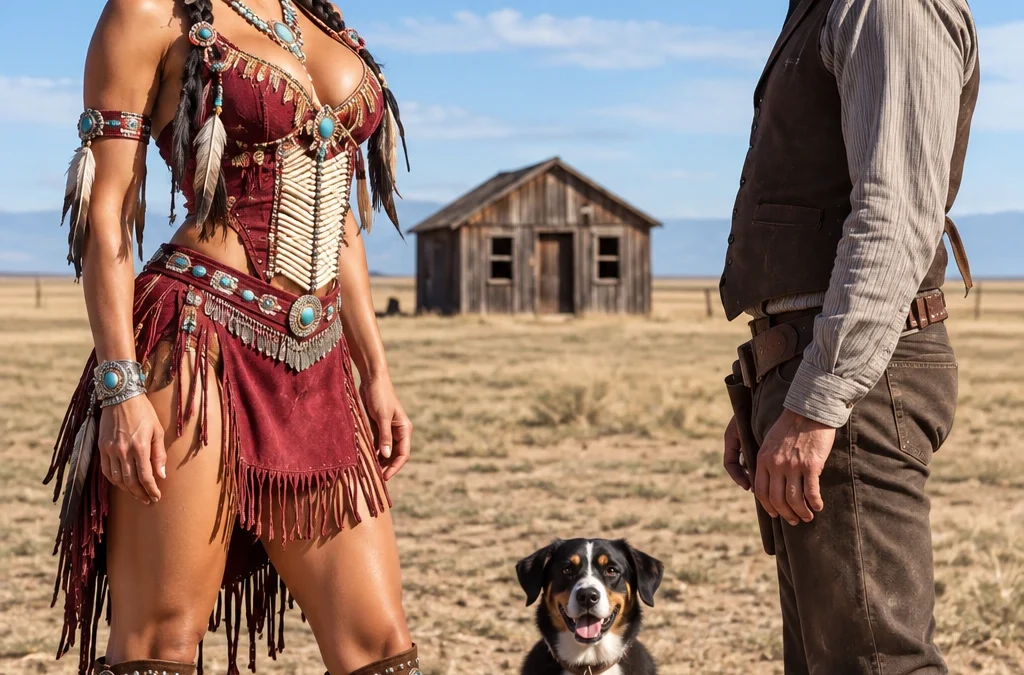
HIS DOG VANISHED FOR TWO NIGHTS. ON THE THIRD, IT CAME BACK WITH A BRUISED APACHE WOMAN CLUTCHING ITS FUR… AND WHEN SHE WHISPERED “I NEED SHELTER,” ELIAS WARD REALIZED THE DOG HAD BEEN LEADING HER TO HIM THE WHOLE TIME 😱🐕
Part 1
The last light faded behind the ridge in a slow, uneven crawl. 🌄
Elias Ward stepped onto his porch with a tension he couldn’t name. For two nights, his dog had slipped into the dark without a sound, and for two nights, he had stood right here, gripping the railing, listening.
He didn’t call after it. Calling never worked.
And a man who had spent years alone learned not to expect quick answers from anything that lived out here.
Still, a tight knot of worry settled in his stomach. Worry wasn’t familiar to him. He didn’t like feeling it now.
The ground near the fence was dry. The pine shadows lay long and motionless. He listened for footsteps, for distant howls, for anything that might explain the dog’s behavior.
The land stayed quiet.
Too quiet.
Was something out there? Was the dog tracking a scent he couldn’t see? Was he missing a danger he should have recognized sooner?
He told himself to go inside.
He stayed.
Then, near the edge of the pasture, a shape moved. Slow. Deliberate.
And not alone. 😨
Elias tensed, his hand drifting to the revolver at his hip. It wasn’t aggression. It was habit.
The dog stepped into the lantern glow, tail low but wagging, and his shoulders loosened a fraction.
Then he saw her.
A woman stood behind the animal, one hand buried deep in its fur like a lifeline. She was thin and unsteady, so exhausted that her legs shook even while standing still. Her deerskin dress was torn at the neckline, and she kept pressing a frayed blanket against her chest to hold it closed. When she shifted her weight, the blanket slipped, revealing bruised skin along her collarbone before she snatched it back up.
Elias felt his breath catch. Not from desire.
From the sudden realization that she was hurt, frightened, and out of places to run.
He stepped forward slowly, careful not to move too fast.
She watched him with sharp, tense eyes, the kind taught to expect danger before help. She was young, maybe mid-twenties, and the strain on her face said she hadn’t slept properly in days.
Her chin stayed lifted, even though she looked moments from collapse.
Who chased her? Was danger coming toward his home right now? Could he protect her if it did?
She swallowed hard. When she finally spoke, her voice cracked at the edges, but stayed steady enough to show she hadn’t given up on herself.
“I need shelter.”
The dog pressed against her leg and glanced at Elias, as if urging him to decide quickly.
Elias nodded once. Not dramatic. Not hesitant. Firm.
If she was hunted, if she needed a doctor, if letting her in put them both at risk, none of it stopped him. The way she stood, holding her torn dress together with a shaking hand, made the decision feel like the only reasonable one.
He stepped aside and opened the door. Warm lamplight spilled across the porch. 🕯️
She hesitated only a second, studying him, judging whether she was stepping into more danger. Then she walked past with slow, measured steps, her body angled slightly away in case she needed to run.
Inside, she stopped near the stove and gripped the table with trembling fingers. Elias saw dirt and dried blood on her arms, faint bruises across her ribs, and a fatigue that threatened to drop her where she stood.
Something twisted in his chest. An old instinct to help. He’d thought it had dried up years ago.
“Sit,” he said quietly.
She obeyed, her knees buckling more than she meant them to. He poured water into a tin cup, and she drank with both hands, eyes never leaving his face.
He didn’t move closer. He didn’t speak unless he had to. He understood too well what fear looked like when it was trying to stay dignified.
The dog curled at her feet, a barrier and a comfort at once.
Elias took an old sewing kit from a drawer and sat at the table. He didn’t touch her dress. He didn’t ask her to show anything. He simply lifted the edge of her blanket and began stitching its torn corner, so she wouldn’t have to clutch it against her all night.
She watched his hands. Her eyes softened.
No one had done anything for her in a long time. He could see that truth settle over her.
Her head drooped from exhaustion. Elias touched her shoulder lightly to steady her. She startled but didn’t pull away. When she looked up, their faces were close, and something quiet passed between them. Not desire yet.
Recognition. Two people who had run out of places to go.
“Rest,” he said, nodding toward the cot. “You’re safer tonight.”
She watched him another silent moment before lowering herself onto the mattress.
Elias took the chair, set his revolver within reach, and kept the lantern low. His eyes stayed open long after hers closed.
By morning, he learned her name was Nia.
And by the third day, he learned something else.
Nia stood at the window, scanning the tree line with narrowed eyes. Not fearful. Watchful. She wasn’t checking for danger the way a frightened woman does.
She was checking the way a hunted one does.
“No sign of anyone,” Elias said behind her.
She nodded, but her fingers tightened on the curtain. Then, so quietly he almost missed it, she said:
“They will come. They always find where the dog goes.”
Elias froze.
Because that meant someone had been following his dog for two nights. 😰
Part 2
“They always find where the dog goes.”
Elias stared at her. Then at the dog, sleeping peacefully by the stove, as if it had done nothing but a good deed.
“Who is they?” he asked.
Nia’s shoulders lowered a fraction. She didn’t answer right away. She pulled the blanket tighter and looked at the floor.
“Men who do not ask,” she said at last. “Men who take.”
That was all. Elias didn’t press. He had learned that some answers come only when the person is ready.
So he did what he knew how to do. He worked.
He checked the fence line at dawn and dusk. He studied the dirt for fresh prints. He kept the revolver close and the lantern low. And all the while, he watched Nia from the corner of his eye, not the way a man watches a woman, but the way a man watches something precious he’s afraid to lose.
She wouldn’t sit idle. She swept the floor in slow strokes. She sorted kindling. When he repaired a loose hinge, she stood behind him, studying his steady hands.
“Many men rush,” she said quietly. “Break more things.”
“I don’t rush things I care about.”
The words slipped out before he could catch them. Elias looked down at his work at once, as though the hinge had said them. Nia’s expression softened, almost vulnerable, but she said nothing.
That evening, the dress finally gave her trouble again. She tried stitching the neckline herself, wincing in frustration. At last she set the needle down.
“I can’t fix it.”
“Show me.”
She hesitated. Then she opened the blanket just enough, no more than necessary. Elias kept his eyes on the cloth and never on her.
“It’s pulled too wide. The fabric’s worn thin. I can reinforce it, but it won’t look new.”
“That’s fine. I just don’t want it to fall open.”
He worked in silence with leather scraps and thread, careful and slow. She noticed everything he didn’t do as much as everything he did.
When he finished, their eyes met. Trust, forming one stitch at a time. 🧵
Outside, the weather turned. A cold front rolled down the ridge, wrapping the pines in mist. Elias stepped out at first light and found no tracks, no broken branches.
But the silence held weight.
Nia followed him to the fence. When a cold wind cut across the field, she stepped closer without thinking. Her shoulder brushed his arm, and she froze, unsure she had crossed a line.
Elias didn’t move away. He only shifted his stance to give her more room for warmth.
“You check the fence every day?” she asked.
“Most days. Keeps cattle in. Keeps strangers out.”
She swallowed hard at the second part.
Later, in the barn, he noticed her shivering under her thin blanket. He unbuttoned his coat and laid it over her shoulders with slow, deliberate care.
“You need it more,” she said.
“I’ve got layers.”
That night, a jar fell from the shelf by the stove and shattered against the floor. Nia flinched so hard she nearly fell. Her eyes went wide, her breath short, and for a terrible second she wasn’t in the cabin at all.
“Nia,” Elias said gently. “It’s just a jar.”
“I know. My body doesn’t know.”
“Give it time.”
She nodded, ashamed. But he didn’t make it bigger than it was.
When they sat to eat, she pulled his coat tighter around her and looked at him with a new steadiness.
“Today, I didn’t feel alone.”
“You’re not.”
It wasn’t dramatic. It was just true. 🤍
And that was exactly when the dog, lying quietly at the door, lifted its head and began to growl.
Low. Steady. Aimed at the dark.
Elias was on his feet before he knew it, revolver in hand.
Through the window, at the far edge of the pasture, lantern light was bobbing among the trees.
Three of them. Maybe four.
And a voice called out, calm and cold across the darkness:
“We know she’s in there, rancher. Send her out, and nobody gets hurt.” 🔫
Part 3
Nia went rigid. All the color drained from her face.
“They found me,” she whispered.
Elias didn’t take his eyes off the window. “Stay behind me.”
“No.” Her voice cracked, then hardened. “If they take you, it is because of me.”
“They won’t take anyone.”
He blew out the lantern. The cabin dropped into darkness, lit only by the red glow of the stove. The dog stood rigid at the door, a growl rolling in its chest.
The voice came again. “Don’t make this harder, rancher. That woman belongs to the Calder outfit. She ran off with property that isn’t hers.”
“Property?” Elias called back. His voice was low and even.
“She stole from us. Come out, hand her over, and we ride away.”
Nia gripped his sleeve in the dark. “I stole nothing,” she breathed. “I took my own people’s horses back. Eight of them. They took my brother, my mother’s horses, my whole camp.” Her voice shook. “They killed my husband, Elias.”
He turned and looked at her. In the red light, her eyes were bright and fierce.
The widow, he realized. Not just a runaway. A widow, hunted for the crime of refusing to lose everything.
“Then they’re wrong,” Elias said. “And you’re not going anywhere.”
He opened the door a hand’s width and stepped onto the porch, revolver down but ready.
Four men sat their horses at the edge of the yard. The lead rider, broad-shouldered with a drooping mustache, held a lantern high.
“Evening,” Elias said. “You’re on my land.”
“We want the woman.”
“She’s under my roof. Which makes her my concern.”
The mustached man smiled without warmth. “Mister, you don’t know what you’ve stepped into.”
“I know a woman came to my door bruised and half starved. I know my dog led her here. And I know I’m not handing her to four men who ride at night.”
A silence stretched.
Then the man leaned forward. “There’s a hundred dollars on her return. Walk away from this, and I’ll cut you in.”
Elias thought of the bruises along her collarbone. The way she’d flinched at a falling jar. The way she had whispered thank you in the dark, as though kindness were something she had to hide.
“My answer’s no.”
The men shifted. Rifles slid from saddle holsters.
And then, from the darkness behind them, came a sound that made every horse prance and every man go still.
A rifle being cocked.
“I’d put those down,” said a new voice. Rough. Old. Unhurried.
A lantern swung out of the trees. Behind it rode a gray-haired man in a battered hat, and behind him, six riders, Apache men on spotted ponies, rifles resting across their saddles.
Nia made a sound that was half sob, half gasp. 💔
“Uncle.”
The old man’s eyes found her in the doorway. His stern face cracked, just for a moment. Then it hardened again as he turned to the Calder men.
“My niece’s husband was murdered by your people,” he said quietly. “Her horses stolen. Her brother taken. We have been following your tracks for three weeks.” He nodded toward the dog. “It seems that one has been following ours.”
Elias glanced down at the dog, and understanding rolled through him.
The dog hadn’t been wandering. It had been leading. Night after night, back and forth, between the cabin and the Apache riders camped miles away, carrying a message no one could read, until Nia, hurt and hiding, had followed it home.
The mustached man’s hand drifted toward his holster.
A dozen rifles clicked.
“I wouldn’t,” said the old man.
For a long moment, nobody breathed.
Then the Calder men did the only sensible thing.
They lowered their weapons.
By dawn, the yard was quiet again.
The Calder men had been marched off, disarmed and humiliated, to face a territorial judge who had been waiting a long time for proof of their raids. Among the saddlebags they carried, the old man found a ledger with Nia’s husband’s name in it, and her brother’s, and a dozen others.
Her brother, they learned, was still alive. Held at a Calder camp two days north. The old man’s riders left within the hour to bring him home.
Nia stood on the porch in the gold morning light, wrapped in Elias’s coat, her hair loose down her back. The dog sat beside her, tail sweeping the boards.
Her uncle approached slowly and stopped in front of Elias.
“You took in a stranger,” he said, “and asked nothing of her.”
“She needed shelter.”
“Many men have shelter.” The old man studied him with sharp, weathered eyes. “Few have honor.” He extended a hand. “I am in your debt.”
Elias took it. “No debt. The dog did most of the work.”
The old man’s mouth twitched. “Then I owe the dog.”
When the riders had gone, Elias and Nia stood alone on the porch. The silence between them was easy now, full instead of empty.
“You could go with them,” he said quietly. “Your people. Your family. They’d take you home.”
Nia was silent for a long moment.
“I have been running a long time,” she said at last. “And when I came to your land, I was not running to you. I only wanted a place to stop.”
She turned to face him.
“But I stayed because you never asked me to leave. Because you did not look at me the way the others did. Because when the jar fell, you did not shout.” Her voice trembled. “Because with you, I can breathe.”
“Nia…”
“I am not asking for shelter anymore.” She lifted her chin. “I am choosing.”
Elias looked at the woman who had stumbled out of the dark with one hand buried in his dog’s fur. Bruised, exhausted, and still unbroken.
He had spent years alone, telling himself it was easier. That a man who expected nothing could lose nothing.
But he had been wrong. 🤍
“Then stay,” he said. “Not as someone I took in. As someone I want.”
She stepped closer and pressed her palm against his chest, light and certain. This time, she didn’t hesitate.
“I want this,” she whispered. “I want you.”
He lowered his head, and she rose to meet him. The kiss was soft and slow, shaped by gratitude, and loss, and something brand new.
When they parted, her eyes were shining.
“Tomorrow,” she said, “I want to be like today.”
“We’ll make it that way.”
Spring came early that year.
By April, the frost had melted off the porch rails, and the first green shoots pushed up along the fence line. Nia’s brother came home, thin and wary, then slowly stronger. Her uncle and his riders visited often, trading horses, sharing stories, and teasing Elias about the dog.
Elias built a second room onto the cabin, with a window facing east, where the morning light came in longest.
Nia planted herbs along the porch. She taught him which ones healed and which ones cooked well. He taught her to read the sky and to hold a hammer without flinching.
And every evening, they sat together on the porch while the dog slept at their feet and the sun slid behind the ridge.
One night, Nia leaned her head against his shoulder.
“Elias.”
“Mm?”
“Do you ever wonder how the dog knew?”
He looked down at the old, scruffy animal snoring between them, one ear twitching in a dream.
“I think,” he said slowly, “he knew a lonely man and a lonely woman when he saw them.”
Nia laughed, soft and real. It was the first time he’d heard it, and it changed everything about her face.
He realized he would spend the rest of his life trying to earn that sound.
She slipped her hand into his.
“Then he is the cleverest creature on this land.”
“And the luckiest.”
“And us?”
Elias looked out over the quiet pastures, the long gold light, the porch that no longer held an empty chair.
“We’re the luckiest of all.”
The wind moved gently through the pines. The dog sighed in its sleep.
And in a small cabin at the edge of the world, two people who had run out of places to go finally found the one place worth staying. 🌄
This story is entirely fictional and created for entertainment purposes only. It does not represent any organization or individual, nor does it encourage inappropriate behavior. The content was generated with AI assistance.








