His Mother Called Her a “Fortune Hunter” Before 60 Guests… Then the Lawyer Unrolled Two Maps, and Whispered, “One of These Proves a Crime”
😱 His Mother Called Her a “Fortune Hunter” Before 60 Guests… Then the Lawyer Unrolled Two Maps, and Whispered, “One of These Proves a Crime”
Part 1
“A fortune hunter.”
The Dowager Duchess raised her wine glass so that all sixty guests could hear.
Audrey Kincaid stood beside the Duke, her plain gown suddenly heavier than armor. 😨
The Great Hall of Brackenford blazed beneath hundreds of candles. Light spilled across silver platters, crystal decanters, and the jeweled throats of more than sixty aristocrats and wealthy landowners.
Lucinda Fairmont, Dowager Duchess of Brackenford, had planned every detail herself. The flowers had come from three counties away. The musicians had been hired from London. And the announcement she meant to make before dessert had been rehearsed in her mind for weeks.
Her son, Holden Fairmont, the Duke of Brackenford, would soon be engaged to Lady Cora Beckett, a young woman whose fortune was whispered to be large enough to steady any family’s ledgers.
Lucinda had chosen the moment, the toast, and even the look of gracious surprise she would wear when the guests applauded.
What she had not planned was the sight of her son walking through the tall doors with another woman on his arm. 💙
Audrey wore a gown of deep blue silk, cut cleanly and adorned with nothing at all. No pearls circled her neck. No diamonds caught the candlelight. She carried herself with a quiet steadiness, as though the staircase before her were only weather she had walked through many times before.
Conversations faltered. A fork clinked against porcelain somewhere along the long table.
Lucinda’s smile stayed fixed, but her eyes turned cold as river ice. In her world, a woman without a title who entered on a duke’s arm was not a guest.
She was an insult.
Lucinda lifted one gloved hand, and the orchestra fell silent in the middle of a waltz.
“Tell me, Miss Kincaid,” she said, her voice carrying to the farthest corner of the hall, “how much of my son’s fortune have you already imagined spending?”
A few guests laughed nervously behind their fans.
Audrey did not answer. She simply met the duchess’s gaze and waited, which seemed to irritate Lucinda more than any reply could have.
Holden stepped forward, jaw tight. “Mother. Apologize. At once.”
Lucinda tilted her head, as if her son were a boy who had tracked mud across her carpets.
“Women like Miss Kincaid appear whenever an unmarried duke begins to look for a wife,” she told the room. “They arrive modestly dressed, speaking softly, pretending they want nothing. They are fortune hunters, and every family in this hall knows exactly how they operate.”
The words landed like a slap.
Then she did something worse. She took a cream envelope from a waiting footman and laid it on the white tablecloth before Audrey.
“Inside is £300. More than enough for a sensible young woman to leave Brackenford tonight without further embarrassment to anyone.”
Audrey looked at the envelope for a long moment.
Then, with two fingers, she slid it back across the table until it rested against the duchess’s wine glass.
“And what would you offer,” she asked calmly, “a woman who has no interest in your son’s money?”
Lucinda laughed, bright and brittle. Could Miss Kincaid afford to buy even a single field belonging to the Fairmont family, let alone the estate itself?
The guests leaned closer, sensing blood. Holden opened his mouth to end the spectacle entirely.
But before he could speak, the doors at the far end of the hall opened again. 🚪
Harlan Webb, the solicitor who had managed the estate records of half the county for nearly thirty years, walked in carrying two leather map cases sealed with red wax.
He bowed briefly to the Duke. Before any marriage settlement could be discussed, he explained, the ownership of certain lands must be verified before witnesses.
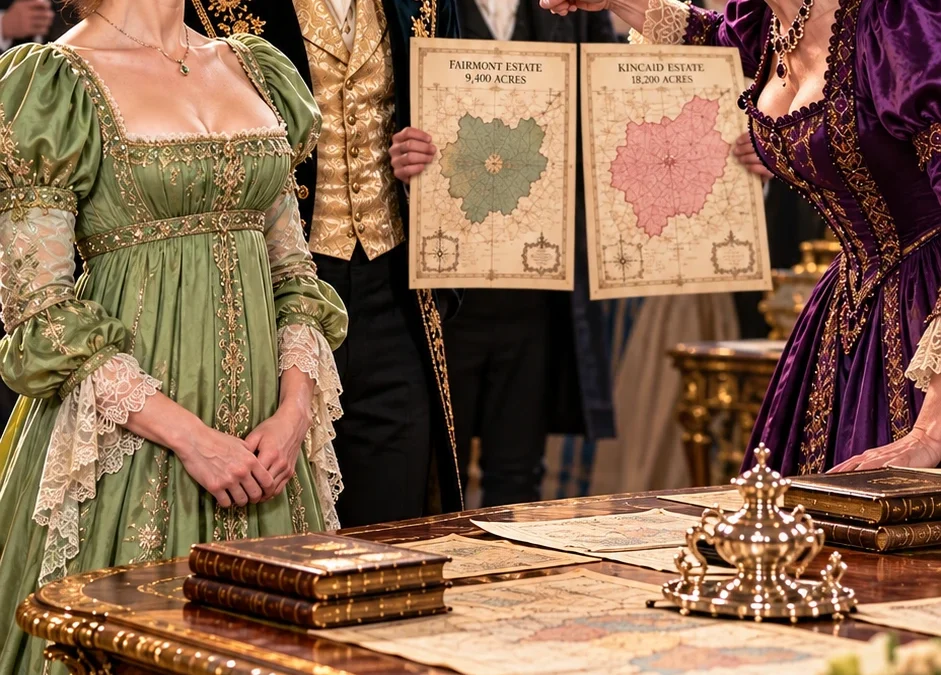
He broke the first seal and unrolled a map bearing the name Holden Fairmont.
Then he broke the second.
Across the top, in careful black ink, were the words Audrey Kincaid.
Lucinda glanced down. Her eyes found a faded silver emblem stamped in the corner of Audrey’s map, an old crest shaped like a bridge over running water.
Before Harlan had announced a single acre, the color drained from the Dowager Duchess’s face.
No one in the hall understood what she feared.
To understand it, you must go back twelve days.
Morning light fell across the study at Brackenford Manor, where Holden sat surrounded by lease agreements, repair estimates, and road surveys. He was not the kind of duke who spent his days hunting foxes and his nights collecting compliments. At thirty-five, he still rode out to inspect fences and argued with his steward about drainage ditches.
Lucinda believed appearances kept a great house standing. Holden believed honest accounts did. Neither had ever convinced the other.
When his father died six years earlier, Holden had opened the estate books expecting order. He found a tangle of unpaid tradesmen, mortgaged woodland, and promises made at dinner tables that no ledger could honor. He had spent every year since repairing the damage, quietly selling his racehorses and closing half the guest wings.
His mother called it shameful economy. Holden called it survival.
And it was a broken bridge that had first brought Audrey into his life.
The old stone crossing in the northern valley was crumbling. When Holden rode out to meet the neighboring landowner’s representative, he found a woman standing in the pouring rain, hem soaked with mud, arguing with two masons about the footings.
She knew exactly which section needed reinforcement, and why the earlier repair plans had cost three times what they should have. Holden stood beneath a dripping oak, captivated by a woman who spoke of load-bearing stone the way other women spoke of lace. 🌧️
Over the following months, their meetings grew longer and less concerned with masonry. They walked the valley road, debated crop rotations, and laughed at the absurd demands of tenants on both sides.
Audrey never claimed to be poor. She simply never explained the full scale of what she managed. And Holden, who had spent his life being measured by his holdings, found it a relief not to ask.
One afternoon in the walled garden, among the last clinging roses, he told her he loved her and meant to propose, whatever his mother might say.
“I do not need a duchess who can make my family richer,” he said. “I need a wife whose hand I would still reach for if all of this disappeared.”
Audrey’s eyes shone. But she did not say yes.
Something in his family’s affairs had begun to trouble her. She was not a woman who stepped onto a bridge without testing its stones.
That same evening, on the other side of the house, Lucinda received a visitor she had told no one about.
Victor Sloan, a financier with silver at his temples and patience in his voice, reminded her that a loan of £41,000 would soon come due.
“Everything will be settled once Holden marries Lady Cora,” Lucinda assured him.
Victor raised an eyebrow. If the debt went unpaid, he warned, he would be forced to examine the validity of the securities she had pledged.
Lucinda turned toward the framed map of the northern valley above the fireplace.
“That land has belonged to this family for generations. No one will question it.”
Victor set down his glass.
“Your Grace,” he said softly, “it is precisely the ownership of that land that concerns me most.” 😶
👇 Want to know what Lucinda did next, and what Audrey found in those papers? Find Part 2 in the comments, or leave any word and I’ll send it to you privately! 👇
Part 2
When Victor had gone, Lucinda summoned her most trusted servant and ordered him to discover everything about Audrey Kincaid.
Before the banquet, she decided, that woman would be removed from her son’s life entirely.
Two days later, a letter arrived at Audrey’s door in Lucinda’s elegant hand. It invited her to tea at Brackenford. The tone was gracious, almost warm.
Audrey read it twice and folded it into her pocket. She had learned long ago that the politest invitations were often the most dangerous.
That lesson had come from her aunt. Mabel Kincaid had taken in an orphaned Audrey and raised her among tenant cottages, account books, and muddy boundary stones rather than drawing rooms. Mabel wore the same gray gowns for twenty years and owned more land than most earls in the county. Jewels, she used to say, were simply a way of announcing your price to people who intended to haggle.
Her last advice had been simple: Never let anyone know what you own until you know what they want.
When Audrey arrived at Brackenford, there was no tea. A footman led her to the study, where a thick document lay squared upon the desk.
Lucinda did not rise. Every woman entering the Fairmont family, she explained, must meet certain conditions. Audrey would disclose her complete holdings. She would accept a fixed allowance after marriage. And any property she brought would be supervised by trustees chosen by Lucinda herself.
She spoke as though reciting the price of candles.
Audrey sat and read every page. Halfway through, she slowed.
The agreement kept referring to rights over land around Brackenford: the valley road, the water channels, and several parcels that had never belonged to the duke’s estate at all.
“Who drafted these clauses?”
“The family solicitor approved them.”
Audrey closed the document and laid her hands on it. “You seem far more interested in what a wife can surrender than in whom your son wishes to marry.”
Lucinda’s composure cracked. Audrey had no title, no suitable family, no right to set foot in the Fairmont line. She slid across an envelope containing £300. Audrey refused it. A second envelope raised the offer to £1,000.
Audrey refused again.
“Society will crush a woman of no standing who dares oppose me,” Lucinda warned.
Audrey rose and returned the agreement to the desk.
“Then I suggest you begin by learning which land actually belongs to your family.”
For the first time in many years, Lucinda Fairmont had nothing to say. 😮
The next morning, Audrey met in secret with Harlan Webb and Conrad Hale, a surveyor whose weathered hands had measured nearly every boundary in the county. They spread old maps across a long oak table and weighed down the corners with inkwells.
A strip of 460 acres, including the valley road and the banks of the water channel, appeared under two different owners.
Harlan studied a set of copied loan contracts, then looked up gravely.
“If these documents are genuine, someone has borrowed against land they never owned.”
At the bottom of one appendix, Audrey recognized a signature.
Lucinda Fairmont. ✍️
She asked Harlan to obtain the originals, and decided to say nothing to Holden until every fact was certain.
Now the story returns to the Great Hall, where more than sixty guests stood frozen around the table, and the candles burned lower with every passing second.
Lucinda had already called Audrey a fortune hunter. She had already offered her money to vanish. She had already declared before the finest families in the county that a woman like Audrey could never be fit to marry a duke.
Harlan smoothed the first map flat.
“The lands legally owned by Holden Fairmont at Brackenford measure 9,400 acres.”
Lucinda’s smile returned, wide and triumphant. She turned to Audrey and asked whether she had ever laid eyes on an estate of such magnitude.
Harlan did not answer her. He unrolled the second map.
Meadows and forests spread across the parchment in a different color. Working farms. A stone quarry. A network of carriage roads. And at the top, beneath the old silver crest, the name Audrey Kincaid.
“Miss Kincaid inherited 13,000 acres from her late aunt, Mabel Kincaid,” Harlan said. “She has since added 5,200 through lawful purchase. The total is 18,200 acres, carrying no active mortgage, every deed verified.”
The hall went utterly silent.
The woman they had mocked owned 8,800 acres more than the Duke. Very nearly twice his estate. 😱
Lucinda stared at Audrey as if a stranger had stepped into her place. “It is impossible,” she stammered. “No woman dressed so plainly could hold so much land.”
Audrey answered without raising her voice.
“Land does not vanish because its owner refuses to wear diamonds.”
Guests who had laughed moments earlier began trading uneasy glances. Then Lady Cora Beckett stepped out from among them and asked Lucinda, quite clearly, why she had called an independent landowner a fortune hunter without bothering to learn a single thing about her.
Holden was stunned, but not with delight. What struck him was the sight of Audrey standing alone among people who had just humiliated her. And the bitter realization that he had underestimated his mother’s cruelty.
He crossed the floor and took his place at her side.
Lucinda fought for her footing. “The papers may be forged! Have the solicitor examine everything again!”
Harlan agreed readily. But instead of rolling the maps away, he placed a third document on the table.
A loan contract bearing Lucinda’s signature.
In its appendix, the 460 acres belonging to Audrey were listed as property the Dowager Duchess had the right to pledge as security.
Harlan lifted his gaze and looked directly at her.
“Your Grace, the size of Miss Kincaid’s estate is not the most troubling discovery here tonight. The troubling discovery is that you pledged part of it as though it were yours.”
The wine glass slipped from Lucinda’s fingers and shattered across the marble, scattering red wine like spilled blood at the hem of her gown.
Not one guest moved to help her.
But Lucinda Fairmont was not finished. Before the shards were swept away, she lifted her chin, and what she did next would turn the whole county against Audrey… 😨
👇 LIKE or COMMENT “REVEAL” to see Part 3! It will be posted as soon as we have enough comments. 👇
Part 3
Lucinda changed tactics.
She announced that Audrey had pursued Holden only to take revenge on the Fairmonts over a boundary quarrel that had festered for years. She demanded that Harlan stop speaking and that the matter be settled privately, away from curious ears.
Audrey agreed that the evidence should be examined through proper legal channels. But she refused, before every witness, to accept further slander in the meantime.
In the days that followed, Lucinda wrote to every noble family with whom she had shared a dinner table in thirty years. Her letter suggested that Audrey was exploiting Holden’s affections to force the Fairmonts to recognize disputed land rights.
The rumor spread through drawing rooms and hunting lodges. Invitations to Audrey were withdrawn without explanation. Neighbors she had known for years began asking pointed, insulting questions when they met her on the road.
Lucinda had used this weapon before. It had never failed her.
Audrey refused to defend herself one gossip at a time. Instead, she instructed Harlan to send formal letters to every party using her land. The letters confirmed that she had no intention of blocking lawful passage along the valley road, and required that every lease and mortgage correctly name the true owner.
Within a fortnight, the rumor lost its teeth. Farmers and carters held written assurances in their hands, and the families repeating Lucinda’s story found themselves looking foolish. 😏
Meanwhile, Holden uncovered something far more serious.
Victor Sloan called on him and laid a demand for payment on the table: £41,000, due within weeks. On paper, the loan was secured by land rights described as part of the Brackenford estate. If those securities proved invalid, Victor explained, he could hold Lucinda personally liable, and he would investigate whether any estate funds had been misused.
Holden went straight to his mother.
Under his questioning, Lucinda admitted she had borrowed the money to renovate the manor, host lavish entertainments, and preserve the image of a family far wealthier than it truly was. But she denied any deliberate fraud.
Then she leaned close and offered a solution.
If Holden married Audrey, a marriage settlement could allow the family to renegotiate the rights to the northern valley.
Holden stared at her and understood, with a chill, that his mother now saw the woman he loved as a method of repaying debt.
He refused outright.
“Then you may lose everything your father spent his life protecting,” Lucinda said, swift and merciless.
That evening, Holden found Audrey and asked why she had never told him about her inheritance.
“I never pretended to be poor,” she said. “But I did not want every conversation between us to become a financial negotiation.” She confessed she had suspected problems with the land records before the banquet.
Holden was wounded that she had not trusted him enough to share it.
“I would never ask you to turn against your mother,” she answered softly. “But you must decide for yourself whether the truth matters more than your family’s reputation.”
Before the night was over, a courier delivered Victor’s ultimatum. If no settlement was reached within the term in the contract, he would begin proceedings against Lucinda.
Beneath the quarrel about love lay something far darker. A land fraud that could bring down an entire house. 💔
Audrey rode north with Harlan and Conrad to the small stone archive where the Kincaid estate had kept its deeds for generations. Dust drifted through slanting light as they opened chest after chest. Late in the afternoon, Conrad lifted a bundle tied with faded ribbon.
Inside lay an old agreement between Mabel Kincaid and the Fairmont family.
It granted Brackenford only limited use of the road through the valley and certain waterworks. Ownership remained with the Kincaids. And it expressly forbade the Fairmonts from transferring those rights or pledging them as security for any private loan.
Yet the appendix Lucinda had signed recorded those very rights as property that could be mortgaged.
Conrad worked through the evening by lamplight, measuring and remeasuring, and finally sat back with a grim face.
“The map attached to the loan shifted the boundary northward, so the whole 460 acres appears to fall within Brackenford. This was no surveying error. The false line erased the true owner’s name entirely.”
Then he pointed to something Audrey had overlooked.
Pressed into the wax on the original agreement was a silver crest: a bridge over running water. The private seal of the Kincaid estate.
Lucinda had seen that seal before, years ago, on the very document that limited her family’s rights. That was why her face had drained of color at the banquet before a single acre was announced.
She had not been frightened by the size of Audrey’s land. She had been frightened because she recognized the seal of the woman whose property she had already pledged. 😳
Harlan found something worse among the copied correspondence. A note in Victor’s hand referred to arranging a marriage to strengthen control over neighboring estates.
At first, Lucinda had wanted Holden to marry Cora, so Cora’s investments could quietly settle the loan. But once she discovered that Audrey owned the very land her fraud depended on, she changed course at once. The agreement she had forced upon Audrey in the study had never been an ordinary family document. It was designed to place Audrey’s property under trustees Lucinda controlled.
Audrey returned to Brackenford and laid the two maps side by side before Lucinda.
“Why did the boundary move?”
“That is a matter for surveyors.”
“Who approved the appendix?”
Lucinda did not answer.
Audrey placed a letter on the desk, written years earlier by Mabel Kincaid and bearing Lucinda’s own signed acknowledgement of the limits on the valley rights. Lucinda could no longer pretend ignorance. Cornered, she accused Audrey of investigating the Fairmonts from the very beginning.
“You tried to turn my marriage into a deed of surrender,” Audrey said, her voice steady. “That is why I began asking questions.”
Holden had been standing silently in the doorway throughout. As he listened, the final illusion about his mother fell away.
Lucinda drew herself up to her full height. She would rather see all of Brackenford dragged through scandal, she declared, than let Audrey Kincaid expose her.
Audrey gathered the maps and looked at the older woman with something close to pity.
“You still have one choice left. Tell the truth yourself, before someone else is forced to tell it for you.”
News of the dispute spread through the county like smoke through dry grass. Farmers and merchants who depended on the valley road feared they would lose the right to pass if the loan dragged into court. Suppliers halted deliveries to Brackenford.
Audrey saw the danger at once. If she focused only on punishing Lucinda, innocent families would suffer for crimes they had never committed.
So she acted first. She extended every existing permit for passage along the road for as long as the lawyers needed, on one condition: none of those permits could ever be used as security for a loan.
Carts rolled again within the week. The decision quietly destroyed Lucinda’s favorite argument, that Audrey meant to strangle Brackenford by seizing its roads and water. 🚜
Holden ordered a complete examination of every sum his mother had handled through the manor’s restoration fund. What he found sickened him. Rents collected from the estate had been diverted to pay for banquets and to cover interest on Lucinda’s private loan, all without the required approval.
He revoked every financial authority she still held and ordered the steward to hand all ledgers to an independent lawyer.
Lucinda erupted. She reminded him of the sacrifices she had made to hold the family together after his father’s death.
Holden did not deny those years.
“You taught me that our name stood for honor,” he said quietly. “I cannot defend that name by helping you hide dishonor.”
For the first time in his life, he refused her completely.
Then help came from an unexpected quarter. Lady Cora Beckett called on Audrey and confessed that Lucinda had promised her a marriage to Holden without the consent of either of them. Cora had also been urged to invest in the restoration fund. While studying those papers, she had received a draft from Victor Sloan, with a note in its margin: the signature of the Kincaid owner would be required before the valley rights could serve as valid security.
Victor had known about the legal flaw before he released a single pound.
Cora handed a copy to Harlan and promised to testify. Audrey thanked her, aware the young woman was risking her own standing.
“I was invited to this house as a solution to its debts,” Cora said. “I refuse to become part of its dishonesty.”
With that evidence, Harlan confirmed there were grounds to ask the court to halt any wrongful enforcement of the mortgage. But one weakness remained. Unless Holden formally declared that he had never authorized his mother to use the disputed rights, the lender could keep invoking Lucinda’s authority and drag the case on for years.
Holden would have to sign a statement that might expose his own family.
Audrey did not ask him to sign it for her sake. She laid the paper on his study table, placed a pen beside it, and walked out into the corridor, leaving the decision entirely in his hands.
The clock on the mantel ticked through a long silence.
Then Holden picked up the pen and signed. ✍️
When word reached Lucinda that Audrey’s petition was being prepared for the court, she understood her past could not stay buried much longer. Yet surrender had never been in her nature. She wrote to Audrey, requesting one final private meeting and declaring herself ready to bless the marriage publicly.
Audrey came, but she brought Harlan and insisted he remain to witness any agreement touching property.
In the yellow drawing room, over tea and every outward sign of courtesy, Lucinda made her offer. She would host a magnificent engagement celebration, present Audrey as the future Duchess of Brackenford, and require every noble who had insulted her to apologize in person.
In return, Audrey would sign an agreement placing the 460 acres under a board of trustees in which Lucinda held the deciding voice.
Audrey saw through it instantly. She set down her teacup.
“You humiliated me when you thought I owned nothing. Now you wish to welcome me because I own what you need.”
“Every noble marriage is an exchange,” Lucinda replied, without shame.
Audrey placed the agreement face down on the table and refused.
Lucinda reached for her last weapon. Not law, but doubt.
“Holden loves you now only because he did not know your true wealth. A titled man will never tolerate living in the shadow of a wife who owns more land than he does. That love will curdle into wounded pride.”
The words were carefully chosen, and they followed Audrey all the way home. 🌙
She did not sleep. Long after midnight, she walked down to the old stone bridge and stood above the dark water. She had watched proud men wither beside capable wives. She had watched her aunt’s suitors retreat one by one the moment they understood Mabel would never hand over the keys to her estate.
Perhaps Holden would be different. Perhaps he would not.
The cruelty of Lucinda’s final weapon was that it required no proof at all, only a single seed of doubt planted in the one place Audrey had never thought to guard.
That night she went to Holden and spoke honestly. She did not want a marriage that began with lawsuits and hatred. If he felt he must protect his mother by compromising with deceit, she would leave Brackenford and release him from every promise.
Holden did not beg her to abandon the case.
Instead, he placed two documents in her hands. The first was the declaration he had already signed. The second was a draft marriage settlement prepared by an independent lawyer, placing all of Audrey’s estates in a separate trust after the wedding, beyond the reach of both Holden and Lucinda.
He claimed no rights to the northern valley as a dowry.
“I want to marry you, Audrey,” he said. “Not your acres, not your rents, and not the solution to my mother’s debts.”
Audrey read the settlement twice, and something inside her that had been braced for years finally loosened. 💛
Before she could answer, Harlan arrived breathless at the door. In the final comparison of records, he had found a map exchange between Victor and Lucinda, annotated with instructions to remove the Kincaid name from the security appendix.
What had looked like a civil dispute could now become an investigation into deliberate fraud.
Several weeks later, once every essential document was verified, a formal meeting convened in the Great Hall of Brackenford. It was the same room where Audrey had once been mocked. Lawyers for each side sat along the table, with representatives of the interested parties and those who held a stake in the estate fund.
Audrey had no wish to turn the inquiry into a public humiliation. But Holden insisted that the people his mother had pressured with the family’s name deserved to know exactly who owned what.
Harlan presented the evidence one piece at a time.
First came the lawful deeds confirming that Audrey owned 18,200 acres, including the 460 in dispute. Second, the agreement on the road and water, granting Brackenford only limited rights and forbidding Lucinda to pledge them. Third, the loan appendix with its altered boundary, set beside the original map preserved in the estate records. Fourth, the letters between Victor and Lucinda showing both had been warned about the ownership problem before the loan was completed.
Holden’s signed declaration and Cora’s testimony demolished any claim that all parties had consented.
Lucinda insisted she had acted only for her family. Holden faced her across the table.
“You borrowed money in the name of preserving our honor. Then you tried to use an innocent woman’s property to conceal what you had done.”
Harlan delivered the decisive blow. The £41,000 loan could not be enforced against Audrey’s land on the strength of falsified documents. Lucinda herself remained liable for every valid personal commitment she had signed. Victor would face scrutiny of his role in the fraudulent file, and the lawyers had already taken steps to preserve evidence and block any unlawful transfer.
In the settlement that followed, Lucinda was forced to sell her private country retreat and a large part of her art collection to meet obligations that were hers alone. She lost control of the Brackenford Restoration Fund, lost any authority to sign contracts on the estate’s behalf, and was required to leave the main house. The allegations of falsified documents were referred to the authorities for separate review. ⚖️
Victor Sloan, at the far end of the table, had arrived expecting to collect a debt. He left understanding that he might become a defendant. When his own margin note was read aloud, he tried to argue that Lucinda had assured him the matter was settled.
“A financier who knowingly accepts a defective security,” Harlan observed mildly, “can hardly claim to have been deceived.”
Victor fell silent, gathered his papers with unsteady hands, and did not look at the Dowager Duchess again.
Lucinda turned to Audrey with naked hatred. Had she planned all along to take everything?
Audrey met her eyes.
“I did not take your land, Your Grace. I prevented you from taking mine.”
The Dowager Duchess had no answer. But Harlan was not finished. He drew one final deed from his case, prepared at Audrey’s instruction. It sought no money and had nothing to do with the marriage. It concerned the permanent use of the valley road, the very ground Lucinda had tried to mortgage.
“What do you intend to do,” Lucinda whispered, “with the most valuable strip of land joining the two estates?”
“Something you will never be able to undo,” said Audrey.
The deed was signed on the old stone bridge, the same bridge where Audrey and Holden had first argued over crumbling footings in the rain. Neighboring landowners, tenant farmers, and representatives of the merchants who used the road gathered along its parapets to witness.
Audrey announced her decision regarding the 460 acres. She would not sell them to Holden. She would not turn them into a dowry. Instead, through an agreement drawn up with the owners of the surrounding estates, she established lasting rights of passage bound to the properties that relied on them, and secured the use of the water under clear and fair conditions.
Those rights were designed so that no single person could ever cancel them on a whim, or pledge them as private property. Audrey kept ownership of the land, but the road would never again become a weapon for any manager to threaten the livelihoods of those who used it lawfully.
Lucinda’s defeat was complete. She had wanted that land to rescue her finances, and now a legal structure stood in place that made her scheme impossible to repeat.
Along the parapets, an old carter named Walter Briggs removed his hat and held it against his chest. For forty years he had hauled grain across that valley, never certain whether the next steward would raise the toll or bar the road altogether. Beside him, a miller’s widow wiped her eyes without embarrassment.
They had come expecting to watch the gentry settle a quarrel among themselves. Instead, they were leaving with a promise written into law that their livelihoods would no longer depend on the temper of whoever happened to rule the great house. 🥹
Holden watched it all from the end of the bridge. He understood that Audrey could have used the valley to force Brackenford into any terms she wished. She had chosen instead to protect the people who depended on that road and that water.
When the signing was finished and the witnesses began drifting home, he led her down to the riverbank, to the spot where they had once stood together beneath a dripping oak.
He brought no contract and no extravagant gift. He held out a simple gold ring.
“My mother spent her life measuring people by what they owned,” he said. “I nearly lost you before I understood that love must be measured by what we refuse to take.”
Audrey looked at him for a long moment, a smile tugging at her lips.
“Are you truly ready to become the husband of a woman who owns more land than you?”
Holden smiled back. “I have never feared the size of your estate. I only feared the day you might decide I was not worthy of standing beside you.”
“Yes,” said Audrey. 💍✨
They married that spring in a ceremony that was dignified but never showy. The settlement protecting Audrey’s estates was completed before the vows. Holden went on governing Brackenford under transparent financial controls, and Audrey continued to make every important decision about the Kincaid lands exactly as their agreement guaranteed.
Lucinda left the great house she had treated as a monument to her own power. She moved into a far smaller home and lived on whatever income remained once her personal debts were settled. She was barred from interfering in Audrey’s property or in the Brackenford fund. She had not been invited to the signing on the bridge.
For a woman who had believed no one would ever dare refuse her, the loss of control wounded her more deeply than any sum she had been forced to pay.
Some months later, a courier delivered to her an official copy of the Valley Passage Agreement. She turned to the final page and found two signatures witnessing it: Audrey Kincaid Fairmont and Holden Fairmont, Duke of Brackenford.
She had once humiliated Audrey for supposedly wanting the Fairmont name in order to seize its wealth. Now Audrey bore that name, yet the Kincaid estate remained protected under her own ownership, and the rights Lucinda had schemed to exploit had become guarantees for the very people she had always despised.
The Dowager Duchess had called Audrey Kincaid a fortune hunter.
In the end, Audrey took neither the Duke’s land nor his fortune. She won something his mother had never understood: a marriage built on respect, and a legacy no one could purchase. 🕊️
THE END
If Audrey’s courage and quiet strength kept you on the edge of your seat, please LIKE and SHARE this story with fellow romance and historical drama lovers! ❤️
This story is entirely fictional and created for entertainment purposes only. It does not represent any organization or individual, nor does it encourage inappropriate behavior. The content was generated with AI assistance.








