HIS WIFE WAS “SOLD AT PAR” TO PAY HER UNCLE’S DEBT, AND ON THEIR WEDDING NIGHT THE FEARED DUKE STOPPED AT THE DOOR AND ASKED ONE QUESTION NO ONE HAD EVER ASKED HER
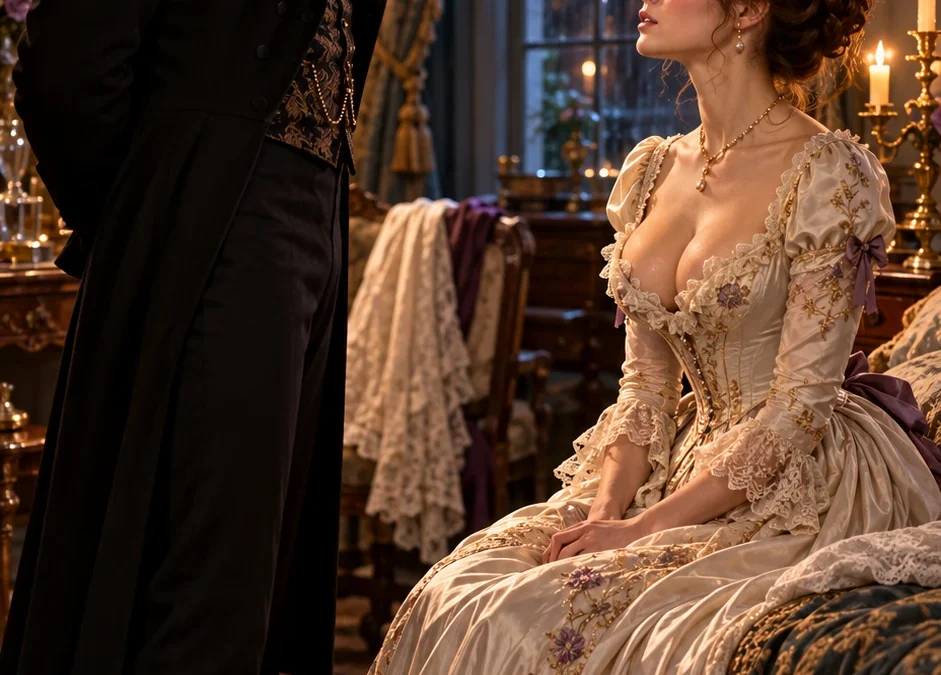
HIS WIFE WAS “SOLD AT PAR” TO PAY HER UNCLE’S DEBT, AND ON THEIR WEDDING NIGHT THE FEARED DUKE STOPPED AT THE DOOR AND ASKED ONE QUESTION NO ONE HAD EVER ASKED HER 😱
Part 1
The railway share collapse of 1847 ruined better men than Cuthbert Strang.
But it was Cuthbert Strang’s ruin that Amelia felt in her very bones. Her inheritance, left in her uncle’s care since her parents died, had gone into the same doomed shares as his own fortune.
And it was her hand, not his, that he offered in settlement of the debt. 💔
The creditor was the Duke of Radstone, known across Clifton and the Hot Wells as the Railway Duke. He had earned the name partly for the lines of iron and navvy labor he had driven across half of Somerset, in defiance of every gentleman who told him a duke ought not to dirty his hands with trade. He had earned it partly for his temper. He never raised his voice. He lowered it, until contractors and directors alike found urgent business elsewhere.
Cuthbert owed him a sum large enough to end in debtor’s prison. So he settled it with a letter, forged in Amelia’s own hand, in which she consented warmly and at length to becoming the Duke’s wife.
She had never seen it.
The night before it was sent, she sat in her uncle’s study and watched him pace before a cold hearth. They could no longer afford coal enough to keep it lit through an evening.
“Is there no other way?” she asked plainly.
“There is no other way, my dear.”
He did not quite meet her eyes. It was the same evasion she would come to recognize as the tell of a man about to speak a lie he had half convinced himself was a kindness.
She trusted him. She had never yet had reason not to.
Then he told her a different story. Weeping, he said the Duke had seen her once at an assembly and demanded her in payment of the debt, willing or not, in the manner of powerful men who were used to having whatever caught their eye. 😨
So Amelia went to her wedding in Clifton in March of 1848 believing herself a hostage to a man’s appetite.
The whole Hotwell set gathered to watch with barely suppressed relish. Behind their fans they whispered that Colonel Strang’s niece had been sold at par, like railway stock nobody else would touch.
She did not know that the man beside her at the altar believed an entirely different lie.
The Duke believed she had freely accepted him. The letter in his solicitor’s files was proof enough. Whatever coldness she showed on her wedding day, he took for the shyness of a bride overwhelmed by a match above her expectations.
Two strangers, each deceived by the same man, were married before all of fashionable Clifton. The church was so crowded that the verger turned latecomers from the door.
The wedding breakfast was an ordeal of polite cruelty disguised as celebration. Every toast was a small dagger. Every congratulation was a reminder of exactly what the county believed had been bought and sold. One elderly matron, not troubling to lower her voice, remarked that she had never seen a bride look so much like a woman attending her own funeral.
Amelia overheard. She could not entirely disagree. 🥀
She held her composure through all of it, with a discipline that cost her more than anyone in that room troubled to notice.
It was only that night, alone at last in the Duke’s townhouse, with the bedchamber door closed behind them both, that it very nearly failed her.
She sat rigid on the edge of the bed in her wedding gloves, unable to remove them, unable to move at all. She stared at a point past the Duke’s shoulder and waited for whatever came next with the frozen dread of a woman who believes herself owed nothing but endurance.
The Duke of Radstone crossed the room toward her, and stopped.
He had built four hundred miles of railway line. He had faced down directors and Parliamentary committees without once losing his composure. Yet something in the rigid stillness of the girl before him struck him with a force none of those battles ever had.
She did not look like a woman who had consented to anything.
She looked like a woman braced for a blow. 💔
He stopped at the edge of the bed. Then, deliberately, he walked back to the door, putting the whole width of the room between them. Some instinct older than any contract told him that, whatever the paper said, the truth in front of him was something else entirely.
“May I continue?” he asked, his voice low and even. “Or may I not?”
Amelia looked up at him properly for the first time since the ceremony, startled out of her dread by a question nobody had ever asked her in her whole short life. Nobody had asked her opinion on the shares that ruined her uncle. Nobody had asked her opinion on the marriage meant to settle his debt.
And here was the man she believed had bought her outright, standing at the door rather than the bed, waiting for her answer as though it truly mattered… 😳
Part 2
Waiting for her answer as though it truly mattered.
“Not yet,” Amelia said, and her own voice shook with the surprise of saying it.
He bowed once, without a flicker of the anger she had braced for.
“Then I will not. A man who builds his life on contracts learns that the only ones worth honoring are those both parties truly agreed to. I do not believe, whatever paper my solicitor holds, that you agreed to this one.” He paused at the threshold. “I confess I had not expected to be relieved by your refusal. I had rather dreaded this evening myself.”
He took a chamber down the corridor and did not return.
Amelia lay awake a long while. A duke dreading his own wedding night as thoroughly as she had. She could not make it fit the portrait her uncle had painted. 🕯️
Within the week he brought her to the railway yards at Temple Meads. The hiss and clank of iron, the shouting of navvies, the sheer improbable size of the engines struck her speechless. Then she stood beside him on the footplate as it thundered toward Bath, wind and cinders whipping past, and found herself laughing aloud before she remembered she was meant to be afraid of him.
“You are not what my uncle described!” she shouted over the roar.
“Nor, I think, are you,” he called back, with something almost like a smile.
He showed her the stone cottages he had built for navvy families, with proper drainage and a school besides. Then he asked what she made of the line’s accounts, which he had left on her desk like a test.
She had read them in one night. She had found a sum unaccounted for in the Bath extension, spread among contracts that looked legitimate on paper but corresponded to no work performed.
“I gave you those accounts to see whether you would trouble to look at them at all,” the Duke said slowly. “I did not expect you to find, in one night, a fraud my own solicitors have circled for a month.”
That was how a marriage neither of them chose began to become something they might have chosen after all. 🥹
Evening by evening in the library, they worked and talked. He learned she had gone to her wedding believing him a man who demanded her as payment. She learned he had demanded nothing, and that the temper Clifton gossiped about was reserved for men who cheated his navvies of a fair wage.
“I begin to think,” she said one night, “that I have believed a great many wrong things about you on less evidence than I should have required.”
“I would rather correct that error slowly,” he said, “over a great many more evenings like this one.”
But it could not stay simple.
Lord Vessie, a director of the very railway that had ruined Cuthbert Strang, arrived with a document that threatened to unmake everything: a betrothal contract in Cuthbert’s hand, with Amelia’s forged signature, promising her to Vessie months before the Duke’s claim.
He laid it on the library table with the smile of a man holding every card. 😨
“You were promised nothing by anyone with the right to promise it,” the Duke said.
But when he turned to Amelia, her silence was not the outraged denial he expected. It was the sick recognition of a woman realizing how thoroughly her signature had been used without her knowledge.
And for the first time since their wedding night, the Duke felt a cold seed of doubt take root.
Vessie sued in the consistory court. Cuthbert, promised his debts forgiven, swore the contract genuine. The railway board called in all the Duke’s loans within a week.
Then, one night, Amelia finished copying by hand every figure of the fraud she had traced to its true source. She rose to find the Duke, the last page still wet with ink.
And smelled smoke.
She turned back to find flame already climbing the curtain beside the table where the original ledgers lay… 🔥
Part 3
Amelia beat at the fire with her own shawl until the Duke, roused by her screams, came running with two footmen and a bucket chain from the kitchen pump. Between them they saved the room and the house.
They could not save the papers.
The original accounts, the only evidence not yet moved from that table, curled to ash before anyone could reach them. 💔
Amelia stood in the smoke-filled hall in her scorched nightclothes and understood, with terrible clarity, that the fire was no accident. The curtain had caught nowhere near any hearth or candle she had left burning. Whoever set it would not hesitate to burn a good deal more than paper to keep the fraud from a courtroom.
She still had her hand-copied accounts. But Vessie’s board was strangling the line. The navvies’ wages were already in arrears, because the funds to pay them were frozen pending the court’s decision. She thought of the cottages. The schoolroom full of laborers’ children. Her uncle’s perjury that had brought them to this.
Turning it over through a sleepless night, she saw only one road that might spare the Duke the worst.
At first light she wrote him a letter, her hand only a little unsteady while her heart broke with every word. She told him the betrothal to Vessie had been real after all. She had deceived him from the beginning. She was going to Vessie to end the matter honestly, rather than see them both dragged through a court that would believe the worst.
She left it on his pillow before dawn. Then she went to Vessie’s house in Bath with nothing but the copied accounts hidden in a false bottom of her trunk, meaning to hold the man in talk and delay by any means she could invent, long enough for the Duke to salvage his line and his name. 😭
The Duke read the letter in his study with a stillness that frightened his own steward.
And for one entire day, he believed it.
It was among the worst days of his life, worse than the collapse that had first threatened his railway. He sat in the library where the fire had so nearly taken everything, staring at the burned patch on the carpet, asking himself how thoroughly he had misjudged a woman he had let himself, against every hard lesson he had ever learned, begin to trust completely.
It was his engine driver, a blunt man named Sowerby with no patience for gentry secrets, who broke the spell.
He stood awkwardly in the doorway with his cap in his hands.
“Begging your pardon, your grace. It isn’t my place to say what a lady feels for a man. It’s my place to say what I saw. Her grace sat up copying figures by a single candle near every night this past fortnight, till her own maid told my wife she feared for the duchess’s eyes. That isn’t a woman running off to a sweetheart, your grace. That’s a woman building a case for someone.”
The Duke sat up the rest of the night with those plain words turning in his mind.
By morning, he no longer believed a word of the letter. 🔥
In Bath, Vessie had found the copied accounts in the false bottom of her trunk and understood at once why she had come. He locked her in an upper room. Then he sent her uncle, the same uncle who had now forged her name to two documents, to tell the Duke that his wife had gone willingly to her true husband and meant to stay.
The Duke did not believe it.
He gathered the navvies who had built his line, men who owed him their cottages and their children’s schooling, and who would to a man have walked into a burning tunnel on his word. He rode with them to Bath before the sun was fully up.
Vessie’s front door did not last a minute against men who spent their lives moving earth and stone. It splintered off its hinges under a dozen determined shoulders while startled servants scattered from the hall.
Locked in her upper room, Amelia heard the crash. Then, unmistakably, the Duke’s own voice, calling her name through the house.
She wept for the first time since the fire. Not from fear, but from a relief so total it nearly buckled her knees. 🥹
She came down into the gray morning light with the copied accounts still clutched to her chest. She had refused, even locked away with no hope of rescue, to burn the one piece of proof she had left, however Vessie had threatened her.
The Duke crossed the wrecked doorway to reach her before he troubled himself with a word to Vessie, who stood pale and furious among the ruins of his own front hall. He took her face in both hands and checked her for injury before he said anything at all.
“Did you truly mean to hold him in talk, alone, with nothing but a copied ledger to protect you?”
“I meant to spare you,” she whispered. “I did not stop to think how poor a plan it was until I was locked in that room.”
“Then we are agreed,” he said, his voice rough from a sleepless night, “that neither of us is to make decisions alone on the other’s behalf, ever again.”
His shaky, relieved laugh told her he meant it as the closest thing to a vow he had left in him that morning. 🤍
When the consistory court sat to hear the matter, the gallery was packed with every idle member of the Hotwell set who could find a reason to attend.
It was not the Duke’s solicitor who broke Vessie’s case.
It was a quiet Bristol bank clerk named Hollis, called almost as an afterthought to speak to the paper the disputed betrothal contract was written on. He held it up to the tall courtroom windows and turned it this way and that, with the unhurried patience of a man who handled paper for his living. He found nothing dramatic about doing so before an audience.
“This paper bears a watermark first manufactured by my bank’s suppliers no earlier than 1848,” he said, with the flat certainty of thirty years’ experience. “The contract is dated 1847. It was written well after the fact and dated backward to suit its purpose.”
Vessie’s face went the color of old ash. 😶
Beside him in the dock, Cuthbert Strang put his head in his hands and did not lift it again for the rest of the hearing. A broken old man whose last gamble on his niece’s misfortune had cost him his liberty along with his name.
Then Amelia’s careful handwriting was read into the record, tracing every false contract to Lord Vessie and Cuthbert Strang together. It was the very scheme that had helped bring down half of Bristol’s railway shares and ruin a hundred families who had trusted their savings to men they believed were gentlemen.
Vessie was committed for fraud and forgery before the sessions ended. Cuthbert, whose testimony rested on a document now proven false, was committed for perjury beside him. His last hope of settling his debts through betrayal collapsed as completely as the shares that had ruined him.
Within the month, the railway board that had called in the Duke’s loans on Vessie’s word found itself owing the Duke a considerable sum in damages. The line was declared entirely his own, free of every encumbrance Vessie’s fraud had placed upon it. The navvies’ wages were paid within the week.
Amelia stood in the stone cottages she had once toured from the footplate and watched the relief on the faces of women who had feared for a fortnight that their children would go hungry through the winter. She understood, more fully than any verdict could have taught her, exactly what she had helped save. 🙏
Some weeks later, in the assembly rooms at Clifton, before the very set that had once priced Colonel Strang’s niece at par like unwanted railway stock, the Duke of Radstone stood beside his wife.
He addressed the room in the low, even voice that had once sent contractors and directors in search of urgent business elsewhere.
“I asked my wife a question on our wedding night,” he said, “and she told me honestly that the answer was not yet. I have waited a year for it since. Through a false contract, a fire, a fraud, and a great deal else besides. And I find I have not once regretted the waiting.”
He turned to Amelia, and the whole assembly room, scandal-hungry as it had ever been, went very still.
“May I continue?” he asked her again, exactly as he had on that first frightened night. This time there was no bought bride’s dread in the question at all. Only a year’s patient hope, laid bare before everyone who had once whispered that she was sold at par.
Amelia looked at the man who had waited a year without once demanding what a lesser husband might have taken as his due. The man who had trusted her with his railway’s accounts, and his own name, and in the end his whole fragile heart.
“Yes,” she said.
The word carried through the room with a clarity that silenced even the most avid gossip. 💍
And the Duke of Radstone, who had built four hundred miles of iron line without once losing his composure before a hostile board, found that a single word from his wife undid him more completely than any of it ever had.
He crossed the small distance between them, in front of every fashionable eye that had once watched them married in cold silence, and took both her hands in his.
And Clifton, which had gossiped so freely about a bride bought at par, found itself instead witness to a duke, publicly and unashamedly grateful to have been given, at last, the one answer money could never have bought. 🤍
Tell me in the comments: would you have believed Amelia’s letter for even one day, or trusted her from the start? And share this story with someone who believes real love begins with asking, and waiting for the answer. 👇
This story is entirely fictional and created for entertainment purposes only. It does not represent any organization or individual, nor does it encourage inappropriate behavior. The content was generated with AI assistance.








