I Came Home From Baghdad to Find My $154,000 Parked in My Parents’ Driveway. My Mother Said, “Stop Being Dramatic.”
I Came Home From Baghdad to Find My $154,000 Parked in My Parents’ Driveway. My Mother Said, “Stop Being Dramatic.”
Part 1
My mother looked me dead in the face and said, “Stop being dramatic.”
I was standing in her brand-new kitchen, dripping rainwater onto her white oak floors, after fourteen months in Baghdad. I had just told her that my bank account was empty. She said it the way you’d talk to a toddler who dropped ice cream.
I didn’t argue. I didn’t yell. I’ll explain why in a minute.
It started in my car, outside the airport, in the rain. I opened my military banking app, the one with two-factor authentication and biometric login and enough security to protect launch codes. I pressed my thumb to the scanner and watched the screen load.
Available balance: $3.18.
I stared at it for ten full seconds. I didn’t gasp or cry. It was just math, because I knew exactly what should have been there: $154,217.83.
Every dollar was hazard pay, overseas housing and reenlistment installments. It was months of twelve-hour trauma shifts patching up soldiers after mortar attacks. It was Christmases in a medical tent, eating rubber eggs on a video call with relatives who forgot the time difference every single year.
That account was my exit plan. It wasn’t a mansion or a fake Instagram life. It was a small cabin somewhere quiet, a used truck that started in winter, and maybe nursing school someday.
I opened the transaction history.
Wire transfers. $30,000. $22,000. $18,000. All of them in the last six weeks, while I was finishing deployment processing.
Then I checked the account permissions, and my blood went slow and cold.
Authorized power-of-attorney access: Richard Lynwood.
My father.
I leaned back against the seat and laughed once. It wasn’t funny. My father had spent my combat pay with the confidence of a man returning a borrowed lawn mower.
I called my mother. Voicemail. I called my younger sister, Chloe, who answered on the fourth ring, half asleep.
“Quick question,” I said. “Did Mom or Dad buy a new car recently?”
Silence. Not shocked silence. Guilty silence.
“Why?” she whispered.
“What color is it?”
A long pause. “Sapphire blue.”
Of course it was. My mother never met an expensive color she didn’t like.
I drove the last four miles to Maplewood Estates with both hands steady on the wheel. The neighborhood looked exactly the same, with identical brick homes, tiny decorative trees and mailboxes polished like they were waiting for inspection.
And there it was, parked across my parents’ driveway like a trophy.
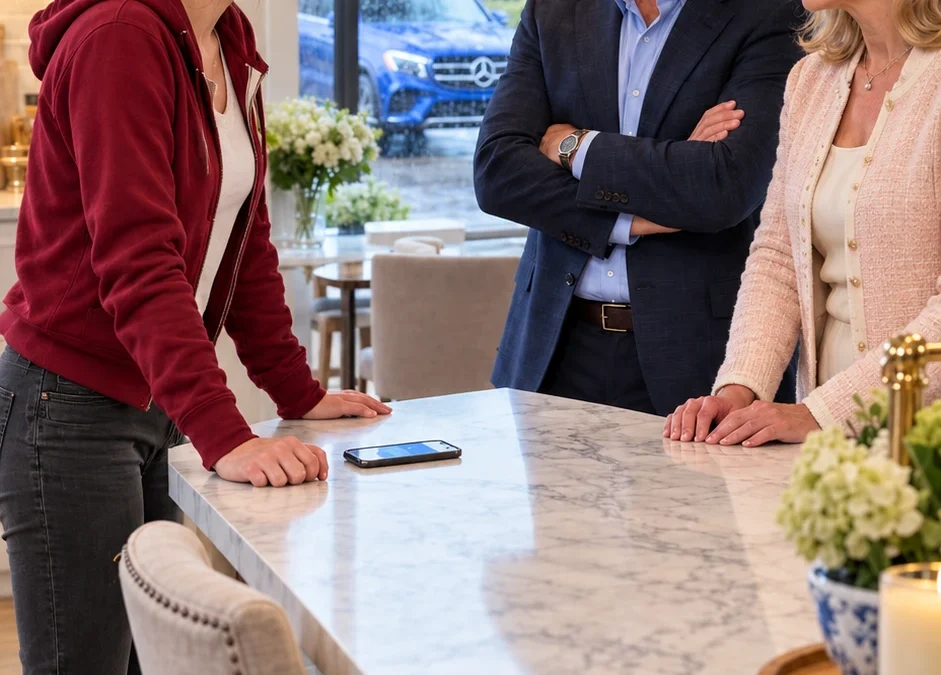
A brand-new Mercedes SUV in sapphire blue, with dealer tags still attached. Rain beaded across the hood. The window sticker read $94,780. Through the tinted glass I could see beige leather so clean it looked medically sterile and a monogrammed baby seat already installed in the back.
Through the bay window, I watched my father at the kitchen island with a mug that said Retired but Still Right. My mother laughed at something he said, wearing a cream cardigan that probably cost more than my first rifle.
They looked warm, comfortable and completely at peace.
Twenty feet away from them sat the physical shape of my missing money.
I got out of the car and walked toward the house in the rain.
What happened next still gives me chills. Part 2 is in the comments, or leave any word below and I’ll send it to you privately.
Part 2
What happened next still gives me chills. Part 2 is in the comments, or leave any word below and I’ll send it to you privately.
I used the side door, out of habit. In our house, the front door was for guests. My mother treated her home like a furniture showroom.
The kitchen smelled like cinnamon coffee cake and fresh paint. Marble countertops. Custom pendant lights. A built-in wine fridge. When I was a kid, my mother clipped coupons like a Wall Street trader, and now this room looked like a surgeon’s Pinterest board.
Funny how financial stress vanishes when you steal from your own kid.
My mother looked up, and her smile disappeared. It wasn’t guilt. It was calculation. That was always her first emotion.
“Maya,” she said carefully. “You’re home early.”
“Flight landed ahead of schedule.”
“Hey, kiddo,” my father said, barely glancing over. I was thirty-two years old and had spent a year treating blast injuries, and I was still kiddo unless he needed something to brag about at the golf course.
Nobody hugged me. Nobody said welcome home.
I set my phone on the counter. “My account’s empty.”
“Well, technically not empty,” my father said. “There’s a few dollars left.”
My mother stepped in. “Before you overreact, Maya, there are things you don’t understand.”
“You took $154,000.”
“We borrowed it,” she corrected immediately.
Borrowed. In my family’s dictionary, borrowed meant stolen, disrespectful meant disagreeing, and love meant obedience with a smile.
“You were deployed,” my father said. “The money was just sitting there.”
“That’s generally how savings accounts work.”
“Chloe’s pregnant,” my mother said, lowering her voice like I was a difficult child. “She needed a reliable vehicle.”
“A $95,000 reliable vehicle?”
“It’s safe.”
“So is a Honda.”
Then my father said the sentence he truly believed would calm me down. “You’ve always been tougher than Chloe.”
That was their whole philosophy. Because I survived hard things, I deserved hard things. Because Chloe cried easier, she deserved protection. I’d spent my life being punished for functioning well under pressure.
“You forged military banking authorization,” I said.
“No one forged anything,” he snapped, but there was a tiny pause before it. I’m trained to notice tiny pauses.
And then my mother said it, cold and quiet. “A good daughter wouldn’t make this into a big ugly situation.”
That’s when I understood. The Mercedes wasn’t the real betrayal. The real betrayal was that they honestly believed they deserved my life more than I did.
Stop being dramatic.
I didn’t scream. I picked up my phone and I walked out.
That night I checked into a $68 room at the Sunset Motor Lodge with a sagging mattress and a rattling air conditioner. After Baghdad, it still ranked above average. I didn’t cry. In emergencies you stabilize first and process later, and stabilizing meant documentation.
I opened the authorization history. One request was submitted thirty-nine days earlier. The IP address traced straight to my parents’ home internet in Maplewood Estates. My father still used the same password for half his accounts.
Then I found the uploaded power-of-attorney form and zoomed in on the signature.
It was a bad forgery. The M curved too sharply. My last name slanted upward in a way I’d never written it. The file metadata showed it was created on a computer registered under Richard Lynwood.
My phone buzzed. “Maya, please stop overreacting.” Then: “Families work through things privately.”
Translation: Don’t embarrass us. Not one sorry.
I kept working. The dealership payments had been split into structured chunks to avoid attention, which meant someone deliberately broke them up. That wasn’t stupid anymore. That was criminal. I found a receipt with the Mercedes VIN and my father’s electronic signature authorizing delivery. Another invoice showed they’d used my money to renovate the kitchen too.
By 1:13 a.m., I had a folder called Lynwood Financial Fraud: seventy-three pages, clean, chronological and undeniable.
Chloe called. Her voice was small. “Maya, Mom’s freaking out.”
“Good.”
“They thought you’d calm down by now.”
I almost smiled. They had no idea who they raised.
I wasn’t building an argument. I was building a case.
The next morning I walked into the federal building in the same hoodie, a thick manila folder under my arm. Consequences, it turns out, are surprisingly portable.
Special Agent Marcus Vance, mid-forties, gray at the temples, tired in a highly trained way, sat across from me and said, “Walk me through it.”
I slid the folder across the table.
He opened it, and I watched the skepticism drain out of his face page by page. When he reached the dealership transfers, he stopped.
“You came here before the police,” he said.
“This isn’t a domestic argument. It’s federal wire fraud.”
He looked at me for a long moment. Then he said one word.
“Okay.”
It carried more weight than anything my parents had said in two days.
Two weeks later, I was parked two blocks from my parents’ house on a perfect Sunday afternoon, windows down, engine off, with my phone buzzing in the cup holder.
It was Marcus.
“We’re about fifteen minutes out,” he said.
I looked up the street, and my stomach went still.
On my parents’ front lawn, my mother had set up a full brunch party.
If you want to know what happened when the black SUVs arrived, LIKE this post and comment “CUFFS.” When enough people comment, I’ll post Part 3.
Part 3
The brunch was in full swing.
White folding tables. Glass pitchers of orange juice. My mother floated between guests in a pale green dress and oversized sunglasses, even though she was standing under an umbrella. My father worked the grill like he was hosting a campaign fundraiser. Chloe sat on the patio, rubbing her stomach while two neighbors fussed over her like she was carrying royalty.
Parked in the center of the driveway, polished and waxed and angled toward the street, was the sapphire Mercedes.
“Smart investing, that’s all it is,” my father announced to a circle of men.
A neighbor asked what the car cost.
“Sticker was just under ninety-five.”
“Well, Chloe deserves something safe for the baby,” my mother added.
Deserves. Funny word. Nobody ever used it for me. I deserved responsibility. I deserved resilience. I deserved understanding.
Not one of them looked worried. They thought my silence meant surrender. For thirty-two years, I’d absorbed every blow quietly, and somewhere along the way they’d confused my self-control with weakness.
“Anything change?” Marcus asked over the phone.
“No. They’re hosting brunch.”
A pause. “Seriously?”
“Yes.”
I heard another agent laugh faintly in the background. “That’s bold.”
“No,” I said, watching my mother refill champagne glasses. “That’s entitlement.”
“Stay in your vehicle until we secure the scene,” he said. “And Maya? You did everything correctly.”
It shouldn’t have mattered as much as it did. But when you grow up in a family that twists truth into disloyalty, those words land like a medal.
Twelve minutes later, the first SUV turned onto the street. Matte black. Unmarked. Slow enough to look intentional. Then the second. Then the third.
Suburban neighborhoods run on pattern recognition. Delivery vans, dog walkers, lawn crews. And three identical federal SUVs moving in formation.
The conversation on the lawn thinned out before they even reached the driveway. Heads turned one by one. My father noticed last. He always assumed attention belonged to him.
The SUVs boxed in the driveway, trapping the Mercedes between them. The jazz playlist on my mother’s patio speaker kept playing for a few awkward seconds before someone hurried over and shut it off.
Four agents stepped out, calm and unhurried. People who already control a situation never rush. Marcus stepped out of the last vehicle with a thick folder in his hand.
My mother walked forward with her hands slightly raised and her fake social smile ready. “Hi there. Can I help you, gentlemen?”
Marcus unfolded a warrant. When he spoke, the entire lawn could hear him.
“Richard and Valerie Lynwood.”
My father stepped forward, still holding the barbecue tongs. “That’s us.”
“Federal Bureau of Investigation. You are both being detained pending charges of wire fraud, conspiracy, identity falsification and unlawful transfer of federally protected military compensation.”
A woman by the mimosa table gasped out loud.
“This is some kind of misunderstanding,” my mother said, laughing too high and too fast.
“No, ma’am. It isn’t.”
“That vehicle belongs to my daughter!” my father snapped, pointing at the Mercedes.
“According to financial records,” Marcus said evenly, “that vehicle was purchased with stolen military funds transferred through fraudulent authorization.”
My father tried a new angle. “My daughter is just emotionally upset right now.”
“Your daughter,” Marcus said, “provided seventy-three pages of evidence.”
That landed like a gunshot. Evidence doesn’t get intimidated by louder voices.
“This is harassment!” my mother shouted. “I want to speak to somebody in charge.”
Marcus glanced around theatrically. “I am somebody in charge.”
I nearly lost it in my car.
Then my father moved into bargaining. “Look. We can resolve this privately. There’s no reason to make a spectacle.”
“You made the spectacle,” Marcus said, “when you spent stolen deployment funds on a luxury SUV.”
An agent moved behind him. “Turn around, sir.”
“You’re handcuffing me?” My father looked genuinely stunned, like consequences were a policy for other households.
“Yes, sir.”
The cuffs clicked shut beside the same Mercedes he’d spent two weeks bragging about. And suddenly he looked smaller. Not physically. Structurally. As if someone had removed the invisible stage he’d stood on his whole life.
My mother saw the handcuffs and unraveled. “Oh my God. Oh my God.” She grabbed the patio table hard enough to rattle the glasses, and champagne spilled across the tablecloth.
It wasn’t an act this time. At that moment Valerie Lynwood understood something worse than prison. People were watching. Country club women. Neighbors. Everyone she’d competed with for twenty years was watching federal agents take her husband away beside a stolen Mercedes.
Her knees gave out, and she folded onto the wet grass in her expensive green dress.
The whole polished world my parents had built for decades collapsed in under six minutes. There was no violence, no revenge speech and no screaming match. There was only the truth, finally arriving with federal clearance.
I didn’t feel victorious. I just felt tired that it took this much for someone to finally tell my parents no.
A tow truck arrived twenty-three minutes later. The driver walked around the Mercedes checking the VIN, chewing gum like it was the most ordinary Sunday of his life.
“Parking brake’s still on,” he called out.
Even at the end, Richard Lynwood managed to inconvenience somebody. I almost laughed.
I stayed in my car. There’s a difference between witnessing consequences and feeding on them.
Marcus knocked on my window with a paper cup. “Black coffee, no sugar.”
“Thanks.”
“Recovery on the funds will take time,” he said. “But most of the assets are traceable. You okay?”
I looked at my father on the curb, shoulders slumped, staring blankly at the ground. At my mother wrapped in a neighbor’s borrowed cardigan, still glancing around between sobs to see who was watching. At Chloe crying on the porch beside her husband, who looked like a man who’d married into brunch and gotten federal indictments.
“I think I’m just done carrying them,” I said.
Marcus nodded. “That sounds healthier than most family therapy I’ve seen.”
I placed the coffee in the cup holder and started the engine. The last thing I saw before I turned the corner was my father lifting his head as the tow truck pulled away. For the first time in his life, something valuable was leaving him instead of me.
Three days later, I rented a small cabin near Lake Hope. Creaky porch. A coffee maker that sounded like construction equipment. One chair facing the water.
I woke at 5:42 a.m. out of habit and just sat there while fog rolled over the lake. No guilt trips and no pretending everything was fine so other people could stay comfortable. Silence can feel terrifying when your whole life has been about managing other people’s emotions.
By the water I finally understood something. I’d kept giving my parents access to my life because of hope, not loyalty. I hoped they’d someday become the family I kept trying to earn. And that hurt worse than the money, because money can come back. Time doesn’t.
Forgiveness and access are not the same thing. You can wish someone healing and still never hand them your bank information again.
Months later, I paid cash for a used Toyota Tacoma from a retired electrician named Ron. $12,400, manual transmission, two dents in the bumper. It felt more honest than most relationships I grew up around. I moved into a quiet apartment outside Lexington. I started cooking again. One night I made spaghetti from scratch, and halfway through I realized nobody was going to interrupt with guilt or a manufactured crisis. I almost cried over garlic bread.
Chloe called around the three-month mark. Her voice sounded softer, less polished, and for the first time I heard real fear beneath it. She apologized, not perfectly, but honestly. I told her I loved her, and I told her things could never go back to how they were. Both were true. Love doesn’t automatically rebuild trust.
A few weeks ago, I drove back to Lake Hope, parked near the water and sat in the truck bed with bad gas station coffee as the sun dropped behind the trees. For the first time in my life, my future felt bigger than my past.
Not perfect, not magical, just mine.
If anyone reading this is the one everyone calls the strong one, hear me. Strength is supposed to support your life, not replace it. You’re allowed to rest. You’re allowed to say no. And you’re allowed to stop carrying people who treat your stability like a resource they can mine forever.
I used to think leaving made me selfish. Now I think protecting your peace is just basic hygiene.
Now I’d love to hear from you. If your own family crossed a line you couldn’t forgive, would you walk away quietly, or make sure they faced the consequences? Tell me in the comments. I read every one. 💬
Disclaimer: This story is entirely fictional and created for entertainment purposes only. It does not represent any organization or individual, nor does it encourage inappropriate behavior. The content was generated with AI assistance.








