I Came In at Dawn to Check on the “Vegetable” Patient, and He Whispered: “If They Find Out I’m Awake, You and Your Baby Are in Danger.”
I Came In at Dawn to Check on the “Vegetable” Patient, and He Whispered: “If They Find Out I’m Awake, You and Your Baby Are in Danger.”
Part 1
His family was already dividing his fortune when the man everyone had given up on opened his eyes and whispered to me.
“If they find out I’m conscious,” Alejandro Valdés said, “you and your son are in danger.”
I froze beside his bed.
My name is Clara Robles. I’m thirty-one. Three weeks earlier I had arrived at that enormous house in La Moraleja, outside Madrid, as a live-in caregiver. I had a ten-month-old baby named Nico and nowhere stable to go. The family had agreed to let him stay with me in a room in the service wing, and I had said yes before they could change their minds.
Alejandro was fifty-two. He had built a business empire out of hotels, logistics, and private residences. Two months earlier, a severe medical crisis had left him almost motionless, unable to speak, apparently unaware of anything around him.
His nephew Iván acted as if the house already belonged to him.
He asked about accounts. He rescheduled meetings. He talked about properties, shares, and the will in front of Alejandro, the way you’d talk in front of a piece of furniture.
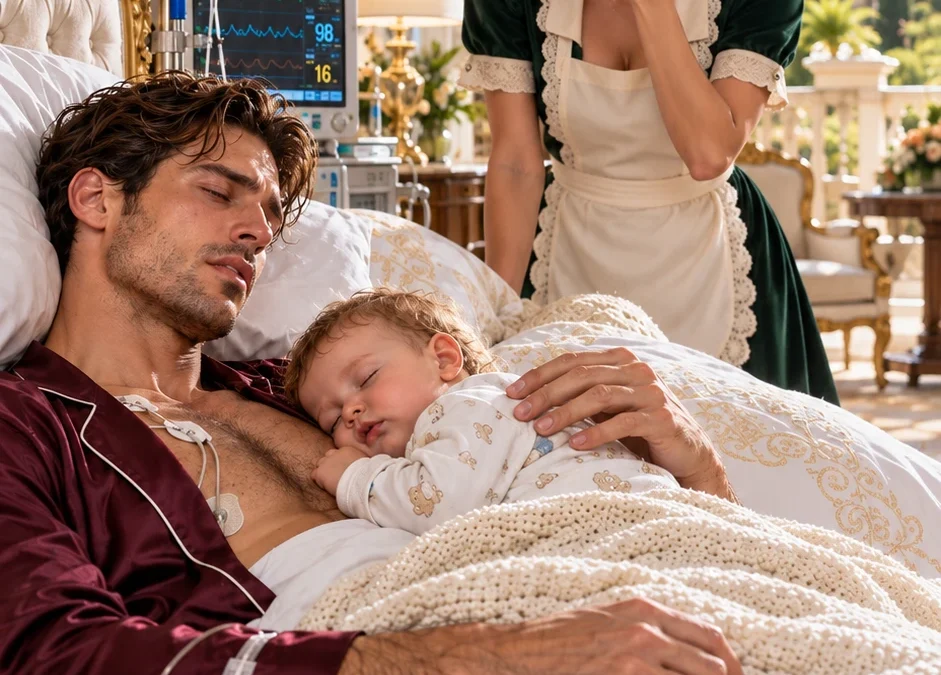
That night, Nico would not stop crying. I had been pacing the hallway for hours. Finally I went into Alejandro’s room to check his IV, and, exhausted and out of ideas, I set my son on the patient’s chest for a few seconds.
Nico went quiet at once.
Then Alejandro’s fingers moved.
I told myself it was a reflex. Then it happened again.
“Can you hear me?” I whispered.
He blinked once.
Over the next few hours, we invented a code. One blink meant yes. Two meant no.
By dawn, he managed to move his lips.
“I’m not… how they think.”
A chill ran down my spine. “What’s happening to you?”
Before he could answer, I heard footsteps.
Iván walked in with Dr. César Velasco, the family’s private physician.
“Any change?” Iván asked.
“None,” I lied.
Velasco took a small ampoule from his bag, prepared a syringe, and added it to Alejandro’s treatment.
Within minutes, Alejandro stopped responding. Not even his fingers.
“He’s getting weaker every day,” the doctor said. “It wouldn’t be strange if his body simply stopped resisting soon.”
Iván didn’t look sad.
“Are we talking days?”
I lifted my head.
Velasco answered with a calm that made my skin crawl. “Probably.”
That night, as the effect began to fade, Alejandro opened his eyes again.
“Desk,” he breathed. “Third drawer. False bottom.”
Behind a stack of papers, I found a small phone.
“Who do I call?”
He swallowed. “No one yet. First I need to know who is still with me.”
Then he looked at Nico.
“And you need to find out why Iván asked yesterday about your son’s father.”
The floor seemed to vanish beneath me.
I had never told Iván about Sergio, the man who left when Nico was four months old.
Before I could ask how Alejandro knew, he said something that stopped my heart.
“There’s more. Your son looks far too much like someone I’ve spent thirty years trying to forget.”
What happened next still gives me chills. Part 2 is in the comments—or leave any word below and I’ll send it to you privately.
Part 2
What happened next still gives me chills. Part 2 is in the comments—or leave any word below and I’ll send it to you privately.
I started keeping records. Times. Photos of every ampoule. Every visit from Dr. Velasco.
I noticed something. Each time the doctor left, Alejandro slowly regained movement. Each time he returned, it vanished.
Then one afternoon I found my room turned upside down. Beside the trash can lay the wrappers of two cotton swabs, the kind used for mouth samples.
“They touched Nico,” I said, shaking.
Alejandro went pale.
Two days later, Iván received an envelope. I heard him shouting from the study.
“Run it again! It’s impossible!”
That night he came back with Velasco. They argued for nearly an hour behind a closed door.
When they left, Alejandro asked me to open his safe and bring him an old photograph. A young girl holding a newborn.
“I had a son at nineteen,” he confessed. “His mother disappeared from Madrid. I was told the baby ended up in state care. I never found him.”
“What was his name?”
“Sergio.”
I stopped breathing.
Nico’s father was also named Sergio. He was thirty. He had grown up in group homes and foster families.
Alejandro looked at my baby.
“If Iván compared his DNA to mine, he already knows what we’re only guessing.”
“That Sergio might be your son,” I whispered.
“And Nico my grandson.”
Then the hidden phone buzzed.
A message from Alejandro’s lawyer:
“Tomorrow, 10:30. We enter with authorization. Change nothing.”
For the first time, Alejandro smiled.
“Now we let Iván believe he has already won.”
If you want to know what happened when the front door opened and Iván walked in, LIKE this post and comment “LIMONERO.” When enough people comment, I’ll post Part 3. 🍋
Part 3
At 10:26 the next morning, I was changing Nico’s diaper when I heard several cars stop outside the gate.
Iván had left early. He believed his uncle was still bedridden, unable to lift a hand.
I opened the front door.
The first through it was Tomás Aguirre, Alejandro’s personal lawyer for eighteen years. Behind him came an estate attorney, two investigators, and authorized staff to document his medical condition and any possible financial crimes.
Tomás barely said hello. “Where is Alejandro?”
I pointed to the staircase. “Doing something he shouldn’t.”
Everyone looked up.
Alejandro appeared leaning on a cane. Every step cost him enormous effort. For two nights he had practiced in secret, first gripping the furniture, then walking beside me.
Tomás went white. “My God.”
Alejandro smiled. “Don’t start dividing my paintings yet.”
He came down slowly. When he reached the last step, his shirt was soaked with sweat. But he was standing.
For more than an hour, they went through everything. My photos. My notes. The ampoules. I had logged each moment Dr. Velasco gave Alejandro a different substance and how long it took him to lose movement.
The investigators had already found suspicious payments from a company linked to Iván to one owned by a relative of the doctor. It didn’t prove what had happened by itself. But it justified investigating.
“I don’t want this turned into a spectacle,” Alejandro said. “If someone broke the law, I want proof. Nothing more.”
Tomás nodded. He had one more document.
The genetic analysis Iván had ordered without my knowledge. A lab had compared a sample from Nico with biological material taken from Alejandro’s personal belongings in the house.
The match indicated a direct family relationship, consistent with grandfather and grandson.
My stomach clenched. “Then Sergio…”
“We still need a direct test,” Tomás warned. “But the probability is very high.”
Alejandro didn’t celebrate. He looked at Nico sleeping in my arms.
For thirty years he’d imagined his son might be living in another city, with another family, perhaps not even remembering where he came from. Now his grandson had been sleeping under his own roof for weeks.
And he hadn’t known.
At 12:14, the front door opened.
Iván walked in talking on the phone. “I want Velasco here before…”
He stopped.
He saw Tomás. Then the investigators. Then me.
Finally he looked into the living room.
Alejandro sat in his usual armchair, dressed, completely lucid.
The phone nearly slipped from Iván’s hand.
“Uncle.”
“Hello, Iván.”
“What are you doing up?”
Alejandro tilted his head. “That question would be far more interesting if I hadn’t spent weeks listening to you ask when I’d finally stop being a problem.”
Iván turned white. “I don’t know what you’re talking about.”
“Of course you do.”
Tomás laid documents across the table. Iván glanced at the exit.
Alejandro didn’t raise his voice. “You don’t have to explain anything to me now. You’ll have your chance through the proper channels.”
“She’s manipulating you!” Iván burst out, pointing at me. “She shows up with a child and suddenly he belongs to our family? Doesn’t that seem like too much of a coincidence?”
I stepped forward. Alejandro raised a hand.
“Let him.”
He fixed his gaze on his nephew. “The coincidence wasn’t that Clara came into this house. It was that Nico cried one night and she set him on my chest. If that hadn’t happened, I might still be unable to warn anyone while you argued over my inheritance beside my bed.”
Iván’s jaw tightened. “Velasco said you were unconscious.”
“Velasco was wrong.”
“How long were you listening?”
“Almost from the beginning.”
Iván’s expression changed.
“I heard you ask whether I needed a hospital. I heard you say there would be fewer eyes here. I heard you plan to start managing certain shares in my name.”
“I was trying to protect the companies.”
“Then you’ll be able to prove it.”
Iván jabbed a finger at me. “And her? You’re going to trust a stranger because her son shares your DNA?”
Alejandro took a moment. “I trust that when she found out I could move, she didn’t ask for money. She didn’t call the press. She didn’t call my nephew. She found a way to keep me safe.”
Iván laughed, high and nervous. “Sure. She doesn’t want money.”
“Don’t speak for me,” I said.
He looked at me with contempt. “You knew who Sergio was.”
“I knew he grew up without a family. Nothing more.”
That seemed to surprise even him.
Tomás stepped in. “Paternity will be verified legally, with consent. The test you commissioned also raises questions about how you obtained the samples.”
“I’m calling my lawyer,” Iván said.
“Do,” Alejandro replied.
He walked toward the door. Before he left, Alejandro called after him.
“Iván.”
He turned.
“I took you in when your father left. I paid for your education. I gave you a position you weren’t ready for and forgave mistakes I’d have fired anyone else for. I thought that was taking care of you.”
Iván said nothing.
“But always giving you what you wanted may only have taught you that everything else could be bought too.”
For one second, the hardness left Iván’s face. Then it returned.
“You don’t know what you’re saying.”
And he walked out.
The investigation didn’t end that day. It couldn’t.
Over the following weeks, investigators reviewed medical records, accounts, medication purchases, and communications between Iván and Velasco. An independent analysis found serious inconsistencies between the treatment on paper and several substances purchased by the doctor’s private practice.
Then something worse surfaced. Velasco had saved messages, perhaps out of fear that Iván would blame him for everything. One read:
“As long as he can’t sign or ask for a second opinion, we have room.”
Another spoke of “avoiding any changes until the estate paperwork is ready.”
Authorities determined which facts could be proven and which couldn’t. Alejandro refused to use his fortune as leverage.
“If they’re responsible, let the evidence decide.”
I discovered a side of him nobody in that family seemed to know. He didn’t want revenge. He wanted his body back. For months he worked with physical therapists, relearning how to stand unaided, climb stairs, and hold a cup without his fingers shaking.
Meanwhile, another search moved quietly forward. The one for Sergio.
Old records confirmed that thirty years earlier, a baby named Sergio Ortega had entered a child protection center in Madrid. His mother’s name matched the girl Alejandro had loved at nineteen.
There was also a letter. Alejandro had sent it decades ago to the woman’s last known address. It never arrived. His own father had intercepted it and kept it among family papers.
Alejandro read it in his study. In it, he’d written that he wanted to find the boy and claim him as his own, even if his family objected.
“My father knew where he was,” he murmured.
Tomás stayed silent.
“Why didn’t he tell me?”
The lawyer didn’t offer an invented comfort. “We can’t ask him now.”
It was one of the few times I saw Alejandro cry. Not over money. Over decades of believing he’d failed to find a son he might have found, if the people around him hadn’t decided which truth he was allowed to know.
They finally located Sergio in Zaragoza, working as an industrial maintenance technician, living alone in a small apartment near Delicias.
I got the news sitting across from Alejandro.
“I don’t want you calling him yet,” I said.
He frowned. “He’s my son.”
“He’s also Nico’s father.”
“I know.”
“And he left.”
Alejandro breathed slowly. I’d never told him the whole story.
I met Sergio when we both worked at a restaurant in Madrid. He was guarded, distrustful, always changing jobs. When Nico was born, he tried to stay. But every responsibility seemed to wake a fear he couldn’t explain.
One night he packed a backpack. We didn’t fight. He stood by the door and said:
“I’ve never known how someone stays. I was always the one waiting for someone to come get him.”
Then he left. I never saw him again.
“I won’t ask him to come back to you,” Alejandro said.
“Then what do you want from him?”
“To tell him I exist.”
“And if he doesn’t want to know you?”
He looked at his hands, still trembling slightly. “Then I’ll have to accept it.”
He traveled to Zaragoza four days later. Alone. No lawyers, no driver, no investigators.
He found Sergio leaving work. The young man made the same gesture Alejandro does when he’s nervous, pressing his thumb against his index finger without realizing it.
“Sergio?”
Sergio turned. “Do we know each other?”
“I think we should.”
Sergio listened for less than three minutes. Then he shook his head.
“No. I’ve spent my whole life without a father. I don’t need one now because he has a big house.”
He went inside and closed the door.
Alejandro had feared exactly that moment for decades. A closed door.
But this time he didn’t leave right away. He sat in a café across the street and wrote a note.
“I’m not here to ask for anything. You don’t have to forgive me. I didn’t know where you were, but I stopped looking too soon. That part was my decision. If you ever want to ask me something, I’ll answer.”
He added a phone number, dropped it in the mailbox, and went home to Madrid.
“What happened?” I asked.
“He shut the door.”
I looked down. “I’m sorry.”
Alejandro took off his coat. “Then he opened it again.”
I lifted my head. “What?”
“As I was crossing the street, he came out and asked what his mother’s name was.”
They talked for twenty minutes. That was all. Sergio didn’t hug him. He didn’t ask about the inheritance. He asked about dates. Documents. Why Alejandro had stopped searching. Alejandro answered every question, even when the answers hurt.
Before leaving, he mentioned Nico.
Sergio went pale. “Is he okay?”
“Yes.”
“Is Clara still with him?”
“Yes.”
“Did she talk about me?”
Alejandro looked at him. “Enough for me to know you hurt her.”
Sergio lowered his head. “That one was my fault.”
Three weeks passed before the first message came. Sergio wrote to me directly.
“I know I have no right to ask for anything. I only want to know if Nico is okay.”
It took me hours to answer. “He’s okay.” Nothing more.
Then small messages began arriving. Did he walk yet? What was his favorite food? Did he still wake up at night?
I didn’t mistake interest for repair. But I didn’t close every door either.
The final genetic test came months later. It confirmed Sergio was Alejandro’s biological son, and that Alejandro was Nico’s grandfather.
Tomás asked if he wanted to change the will immediately.
“Yes.”
I tensed. Alejandro saw it.
“Not to turn Nico into a number.”
He created a protected fund for the boy’s education, with a condition that neither Sergio, nor I, nor any relative could use the money as their own. He also restructured several companies so no single person could control the estate if he ever fell ill again.
Iván stopped being the center of that inheritance long before any judge ruled. Not because Nico took his place, but because Alejandro had finally understood that the problem began when an entire family confused affection with access to money.
Months later, Iván and Velasco faced legal consequences for the facts that could be proven. Alejandro didn’t go to hear the ruling. He was planting a lemon tree.
“Don’t you want to know what they said?” I asked.
“Tomás will tell me.”
“I thought today would matter to you.”
He drove the shovel into the earth. “What mattered was waking up.”
He looked at Nico, toddling clumsily across the grass.
“This is what came after.”
Sergio came back to Madrid in the spring. Not as my partner. I made it clear from the start that a second chance at fatherhood didn’t mean automatically reclaiming a relationship he had abandoned.
He accepted that. He began visiting Nico two hours every Saturday. The first time, he sat across from the boy for several minutes without knowing what to do.
Nico handed him a toy car. Sergio took it.
“Thank you.”
My son immediately reached out to take it back.
Alejandro laughed from the terrace. Sergio glared at him. “It’s not funny.”
“A little.”
It was the first time they looked like father and son. Not because they embraced. Because they could joke without running.
Over time, the visits grew longer. I found another job and rented a small apartment nearby. Alejandro wanted to pay for a better one. I refused.
“You already paid what you owed me for the work.”
“I could help you.”
“You can help Nico by being his grandfather.”
He smiled. “You sound more like my lawyer every day.”
“Then I should charge more.”
A year later, we celebrated Nico’s birthday in the garden at La Moraleja. No press. No businessmen. No guests asking about shares or property. Just Tomás, a few people who worked in the house, and Sergio, who arrived early to set up the tables.
Nico ran straight to the newly planted lemon tree. Alejandro caught him before he tripped. He no longer used a cane. He still walked slower when he was tired, but that day nobody mentioned his old bed.
After lunch, my son fell asleep against his chest.
I stood watching them. It was exactly the same position as that night. The same boy. The same chest.
But nothing around them was the same.
“Don’t move,” I whispered.
Alejandro smiled without opening his eyes. “I did that for too long.”
Sergio appeared with two glasses of water. He watched his father holding Nico. “Is he asleep?”
“Yes.”
“Then we’re trapped.”
“It seems hereditary,” Alejandro said.
Sergio burst out laughing. So did I.
Then Alejandro looked at the little lemon tree.
“When I was ill, I listened to Iván talk about what he’d receive when I was gone. Houses, shares, land. Everything had a price.”
I sat down across from him. “And now?”
He stroked Nico’s hair with great care. “Now I know that leaving a fortune and leaving a family are not the same thing.”
Sergio lowered his eyes. There were still wounds between them. Questions that might never be answered. I didn’t know if I’d ever fully trust Sergio again. But nobody pretended anymore that repairing meant erasing.
Alejandro pointed at the tree. “A house can be bought finished. A tree can’t. You plant it without knowing who will sit in its shade twenty years from now.”
Nico sighed in his sleep.
“That’s what I want to leave him.”
I smiled. “A lemon tree?”
“The chance to stay.”
Sergio looked at his father. Alejandro held his gaze.
For thirty years, one had believed his son had vanished. The other had believed nobody was ever looking. No document could give that time back.
But that afternoon, neither of them left.
I looked around the house where, months earlier, I had walked in silence for fear someone would discover that Alejandro was awake. I remembered the hidden phone, the ampoules, the talk of inheritances, and the DNA test that had turned my baby into a threat for people obsessed with money.
Now Nico slept peacefully. Sergio was here. Alejandro breathed without machines and without fear.
And the fortune everyone had been fighting over was still sitting in the banks, the companies, and the documents.
But it was no longer the most valuable thing in that family.
What mattered most was under a tree too young to give shade: a grandfather who had learned to stand again, a son who had stopped running, a mother who had learned not to accept empty promises, and a little boy who, without knowing it, had joined three generations just by falling asleep on the chest of the man everyone had given up on.
Alejandro closed his eyes.
“Now I can breathe.”
I looked at Sergio, then at Nico, and finally at the little lemon tree swaying in the wind.
“Now you can learn to stay.”
And this time, nobody opened the door to leave. 🍋
Disclaimer: This story is entirely fictional and created for entertainment purposes only. It does not represent any organization or individual, nor does it encourage inappropriate behavior. The content was generated with AI assistance.








