“I CAN’T LIVE WITHOUT A MAN,” WHISPERED THE WHIPPED APACHE WOMAN — THE LONELY RANCHER WHO SAVED HER HAD NO IDEA SHE WAS THE BAIT IN A TRAP THAT WOULD POISON 600 PEOPLE AT DAWN
🔥 “I CAN’T LIVE WITHOUT A MAN,” WHISPERED THE WHIPPED APACHE WOMAN — THE LONELY RANCHER WHO SAVED HER HAD NO IDEA SHE WAS THE BAIT IN A TRAP THAT WOULD POISON 600 PEOPLE AT DAWN 😱
PART 1
The buzzards told him first. 🦅
Three of them, circling low over the ridge road, lazy and patient. Merritt Howerin saw them from a mile away and kept riding. Buzzards meant a dead cow or a dead coyote, and he had no room left in his life for anything dead. He had buried enough.
He was forty-five and felt every year. His old horse Deacon had a bad knee and a worse temper. Neither of them had spoken since sunrise.
Then the wind shifted, and he smelled blood.
Not your road. Not your business. Not anymore.
The buzzards were dropping. “Ah, for pity’s sake,” he muttered, and turned the horse off the road.
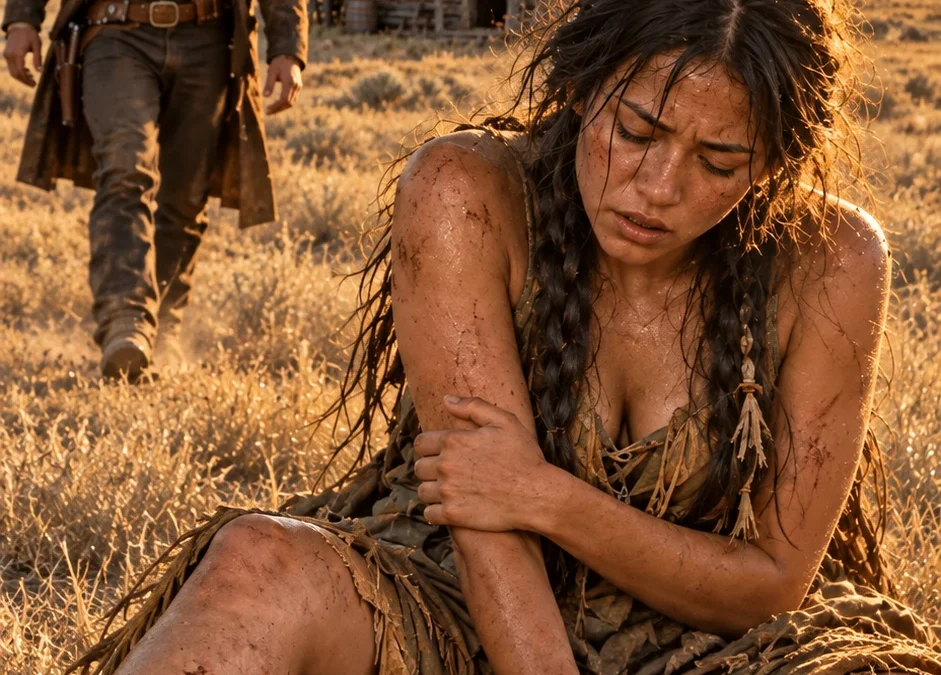
She lay face down in a dry wash, one arm stretched ahead of her as if she had been crawling toward something. An Apache woman, thirty or so. Her back was a ruin of purple welts, some split open, some dried black. Her wrists were bound behind her with a strip of rawhide.
When he rolled her over, she made a sound like a dry branch cracking. She was alive, barely. She was tall, broad-shouldered, forearms roped with muscle. Even dying, her hands were fists.
Too neat, he thought. A woman left on the one day he rode this road, half a mile from his own boundary. The Apache had warned him last winter: keep to your side. A trap, maybe.
But he thought of three graves and a promise made with a shovel in his hand. Never again. Not one more soul.
“Oh, hell,” he said, and cut the rawhide.
He carried her home across Deacon’s saddle, walking the whole way, swearing at everyone. His crooked gate hung on a leather hinge. On the left post, bleached by four summers, hung a little bundle of dried sage tied with red thread. He never looked at it. He never took it down either.
Behind the cabin, under a dead cottonwood, stood three wooden markers. Two were small.
He gave her the last bowl of water in his barrel, cleaned her back, wrapped it in strips torn from his late wife’s sheet, and spent the night mending a bridle at the corral fence, back to the cabin, face to the dark.
Past midnight the door creaked. Bare feet. The poker leaving its hook.
“That poker’s still warm at one end,” he said without turning. “If you mean to hit me, take the cold end.”
A long silence. Then a rasping voice. “Why?”
“I don’t know,” Merritt said. It was the truest thing he’d said in four years.
The poker thudded into the dirt. She sat down on his bucket, and he stood there with nothing to sit on.
“I’d offer you water,” he said, “but I’ve given it all away.”
She laughed, a dry, startled sound. “You are a terrible host.”
Her name was Red Heron. Cast out by her people, called barren and dry stick. She had said nothing, because no one asks a childless widow for her side.
She stayed. She fixed his corral gate without a word. She told him his stew was “rough, deliberate, like a man punishing somebody.” On the fifth night she asked about the graves, and he told her. His wife Lorena. Two boys, Tobias and Wells, eleven and eight. The fever. She did not say she was sorry. She only let the silence sit beside him, and it was the kindest thing anyone had done in four years.
Then she tipped his empty cup onto the porch boards three times. “A drop for each of the gone.”
On the sixth morning, sixty riders’ worth of thunder… no, three. Broken Lance, the war leader, on a gray horse. “Three days,” he said. “Hand her over, or we are your enemy.”
The next day came a gleaming black buggy and a silver-haired man in a gray coat. Ambrose Puit, owner of the Double P. “Water is the only real currency in this country, Mr. Howerin. There is only one of you left.”
When the buggy left, Red Heron’s face had gone ashen. “I have seen him. At the salt wash, beside Broken Lance. Two weeks before they whipped me. There was a crate of new rifles.”
Merritt’s fingers found the rawhide hanging on its nail. He turned it to the light.
A brand. Two letters, burned into the hide. DP.
Not tribal. A rancher’s.
“They wanted me to find you,” he whispered. “The whip, the road, the rope. It was never about you being left to die. It was a trap for both of us.”
💬 Part 2 is waiting in the comments! Can’t find it? Leave any word below and I’ll send it to you privately.
PART 2
A trap for both of us.
The words hung in the dry air as Merritt looked past the barn, toward the ridge where his creek had once run. When the boys were small. When Lorena hung her wash on the rocks.
“When did your people say the creek died?”
“In spring. The council called it drought.”
“Did anyone go up and look?”
A long pause. “No.”
He rode out at noon. Three hours up a canyon he hadn’t entered in years, he heard iron on stone and men’s voices. He crawled up the last slope on his belly and stopped breathing.
A dam. Forty feet of timber and stacked rock, twelve feet high, mortared with clay. Behind it, a green pool glittering in the sun. His creek, turned sideways into a channel cut through the rock, running east, toward the Double P. Thirty men swarmed the wall.
Then the first bullet hit the stone by his face.
He rode home half-dead and told her everything. Red Heron listened with the shotgun in her arms. “Then we will need a bigger hammer.”
He had two years’ worth of stump powder in his barn, four feet from a lantern.
“You are the most dangerous man I have ever met,” she told him. “And I have met Broken Lance. He is dangerous on purpose. You are dangerous by accident.”
At midnight they crept in on their bellies. She dropped both guards with grunts in the dark and told him where the mud ran thin. “I watched the workers while you were talking. Someone in this partnership has to pay attention.”
The night split open. The wall groaned, tore, and gave way. Silver water roared down the dead creek bed, and Red Heron stood up in the starlight, mouth open, eyes shining.
“It is running.”
Then she threw her arms around his neck. “You are supposed to hug back.”
“Am I?”
By dawn they were rolling in six inches of creek water like children, until they stopped face to face, half a foot apart.
But Puit’s reply came by noon. Merritt’s last three cows lay shot at the far fence. A printed poster hung on his gate post: WANTED, Merritt Howerin, $500, by order of the stockman’s association.
On the ninth day, sixty riders came over the ridge in silence. Old Cedar, white-haired and carrying no weapon, spoke for the council.
“You are cast out forever. Your name will not be spoken at our fires. But no hand of ours will be raised against you.” His eyes turned to Merritt. “Her blood is tied to yours now.”
As the riders left, Broken Lance said something low in the old tongue. Red Heron went white.
“The bundle on your gate,” she whispered. “It is not a blessing. Ask whose it is.”
Merritt looked at the post. The sage. The red thread.
“I saw it the first morning,” she said. “I knew the knot. It is my mother’s. She is a healer. Four summers ago she rode here alone, because she heard the water at your spring had been poisoned, and your family was going to die. She knocked at your gate with a lantern.”
The world fell away. A dark yard. A sweating man in a dead man’s shirt. Lorena coughing upstairs. A small shape in the road, shouting in a language he’d never learned.
He had lifted the rifle.
“Yes,” Red Heron said softly. “You shot at my mother.”
💬 Want to know what happens next? LIKE or COMMENT “REVEAL” to unlock Part 3! It will be posted as soon as we have enough comments. 🔥
PART 3
Merritt could not speak. He stood in his yard with his hands hanging empty, and the cottonwood watched him over three small graves.
“I did not tell you,” Red Heron said, “because you were kind to me, and I needed you to be kind to me. I was afraid you would send me away.”
“I should.”
“You did not know.” She laid her hand flat against his chest, over the pounding. “You will carry it every day. And I will carry it beside you. Old Cedar was right. We are tied together.”
He wept then, silently, standing in his yard, a woman’s hand on his heart. She did not let go, not once.
That evening a boy on a swaybacked pony threw down a folded note and was gone. Hal. Come to the office after dark. Back door. Alone. I can fix the bounty. W.T.
“Wendell Tarant,” Merritt said. “The sheriff. My oldest friend. He dug all three graves with me.”
“A man who sends a note by a boy in the dark,” Red Heron said, “does not sound like a man who wants to help.”
Before he left, she untied a strip of red cloth from her braid and wrapped it three times around his wrist. “For luck.” “Is that a custom?” “No. I just want you to have something.”
In the jail, Tarant poured coffee with a shaking hand. When Merritt asked for the coroner’s file, the sheriff’s eyes flicked to a locked bottom drawer, and a distant thunder of hooves rumbled away from town, toward the Howerin place.
“They hold the note on my wife’s brother’s farm,” Tarant whispered. “They said they’d only take the woman.”
Merritt hit him once, clean, and ran.
He saw the glow from three miles out. The cabin was a pillar of fire. The barn was a black skeleton. Only the three markers stood untouched. In the ash, he found her knife, clean and unused, and a long ragged furrow where something heavy had been dragged.
“Mr. Howerin.” Puit sat his black horse at the edge of the light, four rifles clicking behind Merritt. “She is alive. She will remain my guest until you sign the deed on Friday.”
Merritt lowered the Winchester. It was the hardest thing he had ever done with his arms.
By Tuesday he was on the ridge above the Double P, counting guards. A valley of green, a pond with ducks, roses, a windmill, all of it fed by his stolen creek. After midnight he strangled one guard, felled another with a shovel, and was found out by an orange cat that sat on his boot and purred. He carried it into the house under one arm.
The safe’s combination was taped under a painted brass clock. Inside lay a ledger six years deep: Howerin. Fever spring. Dead calves hauled upstream. Four summers ago, in darker ink: Family tenant, not intended.
Not intended. His whole life reduced to a margin note.
Beneath it: WT wrote fever on the county paper. A frightened man is cheaper than a paid one. Then: Forty rifles delivered to BL at the salt wash. Woman RH saw the crate. We’ll have her cast out. “Barren” is the word. Nobody questions barren. And the last page: Thursday, dark of the moon, sixty pounds of strychnine into the Kestrel Fork. RH found on the bank with the barrels. Blame the Apache. Cavalry from Fort Bowie arrives Friday dawn.
Six hundred people. A massacre, written in neat handwriting by a man who owned roses.
Tarant waited at the end of the orchard with a lantern. He confessed: the doctor had come, two days after the burials. His report said poison. Tarant had put it in a drawer and sat in front of it for four years. Never cashed Puit’s check.
“Give it to me.” “Not here. Bring anyone who’ll stand behind you.”
Boots pounded. Tarant’s gun went off. Merritt dropped, shot low in the side. The sheriff dug the ledger from his shirt, smashed the lantern on it, and burned six years of a rich man’s crimes. “He’s finished,” he told the guards. “Leave him for the wash.”
Then, very low, to the ground: “The woman hangs at dawn.”
They dumped him four miles down the ridge road, face down in the red dust, arms stretched ahead like he had been crawling. “Well,” Merritt croaked. “That is a familiar view.”
He crawled north toward a thin line of smoke, the camp he’d been warned never to approach. Somewhere he lost his hat and boots. He talked to Lorena about the cat. When his arm finally stopped, a shadow fell across him.
“You are on our side of the line, white man.”
“I am aware.”
Old Cedar’s men lifted him. A small figure on a brown mule slid from the saddle, lifted her shawl, and Merritt saw Red Heron’s eyes in an old, lined face.
“You are late,” said Quiet Water, “but you are here.”
He woke Wednesday evening to cedar smoke and out-of-tune humming. “She was not hanged,” the old healer said. “It was a leash to pull you where they wanted. Angry. Fast. Foolish.”
“Did it work?” “I crawled six miles. Yes.”
Then she told him why she was healing the man who’d fired on her. “I saw your face that night by the lantern. It was the face of a man drowning, who thought I was the water.” And she smiled slyly. “I tied the bundle to your gate four summers ago, Merritt Howerin, hoping one day a stubborn man would look at it. But you never took it down.”
He laughed until it hurt.
Old Cedar sat down heavily. Broken Lance, he admitted, was his sister’s son. He had taught the boy to string a bow. He had watched him change for two years but had no proof. “Three words against one. It is not proof. It is more than nothing.”
On Thursday, Quiet Water packed both holes with yarrow and pine pitch and stitched them with sinew. At dusk Merritt rode out with fifteen painted riders. Behind them trotted Deacon, who’d wandered into the camp at midnight and refused to leave.
At the Kestrel Fork, six wagons lined the bank, barrels stencilled with a single black word. Puit stood by a great iron-banded headgate wheel. Broken Lance sat the gray beside him. And tied to a wagon wheel by the water, braid hacked off, face painted in stripes belonging to no people, knelt Red Heron.
“The wheel opens the sluice,” Merritt whispered. “It sends the water down a dry draw to the salt wash. Nothing drinks there.”
“Can one man turn it?”
“Not a wounded one.”
“Then you will need to be very determined.”
He crept down alone. A voice spoke above him. “You are late.”
She stood on the wagon bed, ropes in a heap at her feet, a splinter in her fist. “The knots were terrible. I am a person. Not a parcel.” She grabbed his collar and kissed him once, hard. “For luck.”
“Is that a custom?” “No. Now hurry.”
The wheel would not move. His stitches tore. She put her shoulder into the next spoke, and it groaned one inch. A shout. Rifles. Bullets chewed the planks.
“Kill them both,” said Puit, as calmly as ordering tea.
Something huge struck Merritt from the dark and drove him flat. Coffee and lamp oil. Tarant.
The sheriff lay across him, shot through, gray-faced. “I am late. Damn fool thing, getting in the way.” He pressed an oilskin packet into Merritt’s hands. “The doctor’s real report. The sealed check. I carried it four years. Coward.”
“You are,” Merritt said gently. “And I forgave you when you ran across that grass.”
Tarant’s face went soft. “Tell Martha—” “Tell her yourself.” “No. But that is a kind thing to say.”
Merritt laid his oldest friend down, closed the tin star in his fist, and turned back to the wheel, hauling with everything he had. It gave a foot. Then it spun free, and the sluice opened.
Thunder rose through his boots. The poisoned pool rushed for the wall. Barrels spun. Wagons tilted. The walkway cracked, and Red Heron and Broken Lance, locked in struggle, went over the edge.
She caught the gate frame with one hand. The other gripped the war leader’s wrist. He swung above ten feet of white water.
“Let go,” he said. “You’ll fall.”
“Then I fall.” Her voice shook. “Because you were a boy once. And my husband taught you to ride.”
His face cracked like a wall. For half a heartbeat he looked like the child in the old stories. His eyes went to the ridge, where fifteen riders came down with his uncle in front. “Tell him,” he said quietly, “I was not always.”
He opened his hand. The current took him down the dry draw toward the salt.
Merritt hauled her up. They lay on the planks in mud and blood. “Is that your fault?” she gasped. “You picked the wheel. You picked the plank. You are bleeding on me.”
“I am sorry.” “Do not apologize. Just stay alive.”
Puit fled up the canyon trail, but Old Cedar’s riders blocked it. “You are the one who counts our water,” the old man said. Puit reached for a smile that no longer fit.
“Not intended,” Merritt said. “Three words in your own ink, next to my wife’s name.”
Then the bugles. Friday dawn, exactly as written. Thirty cavalrymen crested the ridge, and a sunburned lieutenant stared at a canyon full of overturned wagons and a war party.
Merritt held up the oilskin packet. “Lieutenant, my name is Merritt Howerin. I’d like to make a report.”
Only four drums had been opened. The army surgeon dipped his flasks in the Kestrel Fork at noon, at dusk, and the next morning. Clean every time. Six hundred people never knew how close it came, until Old Cedar told them himself.
Puit went east in irons. The territorial judge read the ledger back from Merritt’s memory, line by line, and found the numbers matched the county’s own books. The Double P went into receivership. The headgate stood open. The creek ran free.
Merritt rode to Willow Fork alone and told Ike Dunning’s brother everything, the fuse, the wall, the sleeping man on the far bank. He did not dress it up. The brother stood a long moment. “Ike took Puit’s wages. I told him not to. Whatever you’re carrying to that judge, I’m going with you.” It was his statement, more than any paper, that cleared Red Heron’s name for good.
Rain came four days later, gray and patient. It fell on the burned cottonwood, the three markers, three mounds for cows, and one more pile of stones with a tin star set in the top. Broken Lance had been found on the salt flat, face up, hands open. Old Cedar had knelt beside him until the light changed.
Merritt stood in the rain, hatless and bootless. Red Heron joined him, her braid growing back and a new scar on her chin.
“Well,” she said, “it was a very bad cabin.”
“It had character.”
The council would speak her name again, she told him. Some were sorry. Some were still afraid. “People are like rock. They turn a little every year.”
“Will you go back?”
She looked at him. “Do you want me to?”
“No.”
“Why not?”
He opened his mouth, shut it, and looked at the crooked post, the faded bundle. For the first time in four years, he reached out and touched the red thread.
“Because this place,” he said, “was never big enough for one person. I just didn’t know it.”
Her hand crept out from under the blanket and tangled its fingers through his. “That is the worst proposal I have ever heard.”
“It wasn’t a proposal.”
“It was a proposal.”
“Yes,” he said.
“Good. Now go get a hammer.”
They built the gate first, not the house. Two cedar posts and a crosspiece, arguing the whole time about whether it was straight. It was not. It was the best gate either of them had ever seen.
That afternoon Quiet Water rode over the ridge on the brown mule, tied a fresh bundle to the new post, sage and gray herb and red thread, tight and neat, and stepped back. “There. Now you can see it.”
“I came to help,” Merritt said.
“You are not a complete fool.”
“That’s high praise.”
“It is the highest I have.”
At dusk Old Cedar arrived with twelve riders and a wooden bucket and looked toward the thin silver thread of the spring behind the barn. Merritt understood. He filled a tin cup, a thimble at a time, and carried it over. Twelve riders passed it down the line. Nobody wasted a drop.
“Good water,” the old man said. “It comes with a condition. It belongs to everybody.”
Old Cedar laughed for the first time, a creaking sound like a door that hadn’t been opened in years.
That night Red Heron filled the cup one last time and tipped a drop onto the ground, once, twice, three times. Merritt drank, and tipped the last drop himself. For a fat sheriff who died learning to be brave. For a husband who talked too much. For a war leader who had once been a boy. And for a stranger named Ike Dunning who had only been asleep.
A drop for each of the gone.
They sat on the bare foundation of the porch, shoulders touching, a cat asleep on a stump, a horse dozing under a tree. The creek ran on beside them, loud, clear, stubborn.
For four years, Merritt had held a door shut. It had taken a woman with a bloody back and a strip of rawhide to teach him that you cannot choose what is done to you, but you can choose what you do with the rest of your life.
He chose the gate, and the open gap between the posts, and the little bundle turning in the dark. 🌙
💬 Would YOU have taken the stranger in? Tell me in the comments! ⬇️
This story is entirely fictional and created for entertainment purposes only. It does not represent any organization or individual, nor does it encourage inappropriate behavior. The content was generated with AI assistance.








