“I CAN’T PAY YOU,” SHE WHISPERED… THE MOST RUTHLESS MAN IN LONDON SET DOWN HIS PEN AND SAID FOUR WORDS THAT CHANGED HER LIFE FOREVER
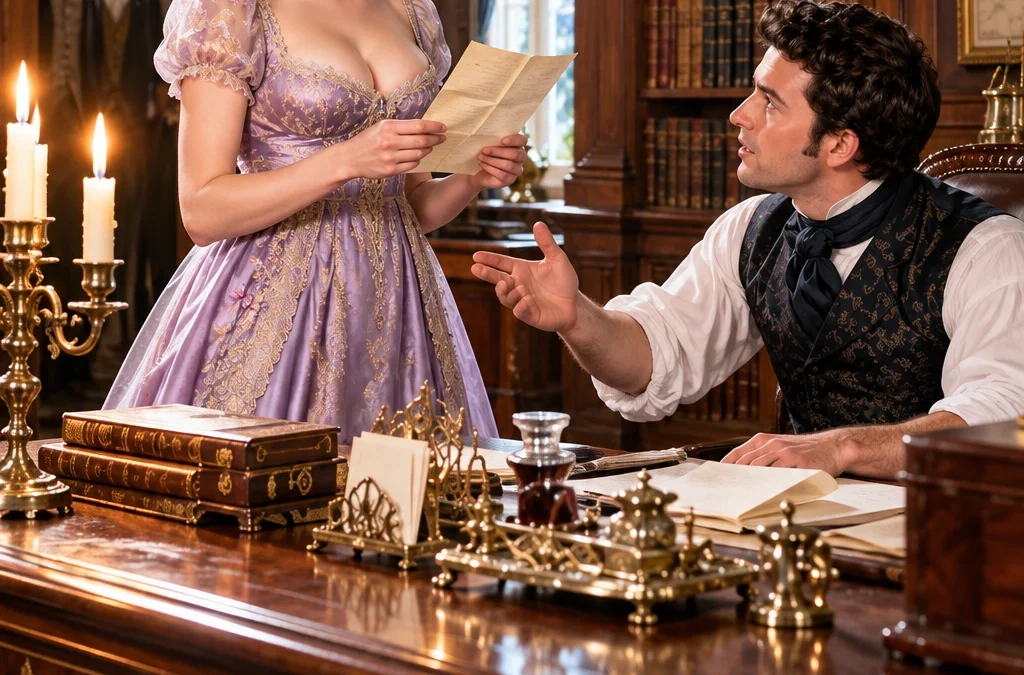
“I CAN’T PAY YOU,” SHE WHISPERED… THE MOST RUTHLESS MAN IN LONDON SET DOWN HIS PEN AND SAID FOUR WORDS THAT CHANGED HER LIFE FOREVER 😱
Part 1
She stood in the freezing study of the most ruthless man in London, clutching a worthless ledger.
The debt was five thousand pounds.
Her father was dead. The money was gone. The workhouse loomed.
“I can’t pay you,” she whispered, her voice cracking under the humiliating weight of her ruin.
He didn’t blink. He didn’t yell. He simply set down his pen, leaned back in his leather chair, and said the words that would alter her existence entirely.
“Then marry me instead.” 💔
The mud of the Thames docks clung to the hem of Beatrice Haywood’s only surviving wool dress. A heavy slate gray, dyed twice to hide the fading, it dragged at her ankles like wet iron.
November in London was not a season. It was an affliction. The wind sliced off the river, smelling of raw sewage, salt and burning coal. Beatrice pulled her thin shawl tighter and ignored the cold and the stares of the dock workers.
Gentlemen’s daughters did not walk through the East End. They did not dodge cargo carts or step over gutters reeking of fish blood.
But Beatrice was no longer a gentleman’s daughter. She was a debtor.
Her father, Arthur Haywood, had died three weeks ago, leaving behind empty sherry bottles, half-finished landscape paintings, and a mountain of promissory notes. The bailiffs had already stripped their narrow townhouse in Bloomsbury. They took the silver. They took the velvet curtains. Yesterday they took the little pianoforte she had played since she was seven.
All that remained was the heavily mortgaged house, and her younger sister Clara, sixteen, wrapped in three blankets at home, coughing into a linen handkerchief.
Beatrice stopped before a looming three-story brick building. The sign above the oak door read, in stark, unadorned lettering: GIDEON CROFT, SHIPPING AND FREIGHT.
No coat of arms. No gilded flourish.
Gideon Croft was the Duke of Kendall, but no one on the docks called him that. To the aristocracy he was a vulgar rumor, a man who had inherited a bankrupt dukedom ten years ago and abandoned high society to rebuild his fortune in the mud of trade. He owned half the ships in the harbor.
And as of four days ago, he owned the whole of Arthur Haywood’s debt.
She pushed open the door. The heat struck her like a blow, smelling of tobacco, polished wood and roasting coffee. A dozen clerks looked up from their sloped desks. The scratching of pens stopped.
“Miss, you are lost,” a senior clerk said, eyeing her with pity and annoyance. “This is a counting house.”
“I am not lost.” Her voice shook a fraction, and she hated herself for it. “I am here to see His Grace. The Duke of Kendall.”
“Mr. Croft does not see unappointed visitors.”
She pulled a crumpled notice of debt from her reticule. “Tell him Beatrice Haywood is here. About the five thousand pounds.”
The clerk’s eyes dropped to the seal. He swallowed. “Wait here.”
She refused to approach the coal stove, though her fingers were numb. If she warmed up, she might start shivering, and she could not afford to look weak. She counted the floorboards. She calculated for the hundredth time how long five shillings would feed her and Clara if she watered down the soup.
Three minutes later, a heavy door opened at the back of the room.
A massive man filled the frame. Gideon Croft did not look like a duke. No cravat. His collar open at a thick column of neck. His shirtsleeves rolled to the elbows, exposing forearms corded with muscle. His face was all sharp angles and hard shadows, a heavy brow, a nose broken and healed slightly crooked, and eyes the color of winter ice.
He did not speak. He simply looked at her, and she felt pinned to the floor.
He stepped back and held the door.
The office was austere. Maritime maps. A roaring fire. A mahogany desk buried in shipping manifests. No art. No comfort.
“Sit,” he said, in a low, gravelly baritone.
“I will stand, Your Grace.”
“No one here calls me that. And if you have come to weep over Arthur Haywood’s debts, you have wasted a walk in the rain, Miss Haywood. I do not grant extensions.”
“I did not come to weep. I came to reason with you.”
“Math does not reason.” He recited the numbers coldly, without malice, which somehow made it worse. “Your father bought shares in a textile venture that sank off India. The bank called the notes. I bought the notes. The sum is five thousand pounds. The Bloomsbury house will cover perhaps eight hundred. The remaining four thousand two hundred is due Friday.”
“I know the numbers. I have stared at them until my eyes bled.” She forced her pride down her throat like shattered glass. “My sister is sixteen and ill. If you take the house on Friday, we will be in the street. I am asking for six months. I will find work.”
“As a governess? A seamstress? You would need a hundred lifetimes to earn four thousand pounds with a needle.”
“Then I will work a hundred lifetimes!” She slammed her gloved hands onto his desk, mirroring his stance. “You own half the Thames. My father’s debt is a drop in your ocean. Why do you even care?”
“Because it is mine,” he said simply.
She searched his icy eyes for a flicker of sympathy. There was nothing but the brutal reality of men and money.
The fire hissed. The adrenaline that had carried her across London evaporated, leaving a bone-deep exhaustion. Her arms gave out. She fell into the leather chair.
She did not cry. She was too empty.
“I can’t pay you,” she whispered. “I have nothing left.”
Gideon stood perfectly still. He had expected hysterics. He was used to the sobbing and the fainting spells of the aristocracy when their debts were called. He had not expected this brittle woman with mud on her hem and fire in her spine, who had walked through the worst slums of London in a freezing rainstorm and looked him dead in the eye.
He looked at her hands. The gloves were patched. The wool of her coat was thin. The sharp angles of her cheekbones were not only breeding. They were skipped meals.
He walked to a side table, poured brandy from a crystal decanter, and set it in front of her.
“Drink it.”
“I am not thirsty.”
“You are freezing, and you look like you are about to shatter on my floor.”
She sipped. She coughed as it burned. But a small flush of color returned to her cheeks.
Gideon sat. He turned his pen between ink-stained fingers. He had bought Arthur Haywood’s debt because Haywood had belonged to a syndicate that tried to price him out of the Mediterranean routes. It had been business. Haywood’s daughter had been collateral damage.
But looking at the wreckage, this proud, desperate woman, his practical mind began to turn.
“I require a wife,” Gideon said.
The words landed like a dropped anvil.
Beatrice froze, the glass halfway to her mouth.
“My grandfather was a traditionalist. He hated that I went into trade. His will stipulates that the bulk of the unentailed Kendall fortune, roughly two hundred thousand pounds, will be held by the bank until I marry a woman of proper aristocratic blood and unimpeachable standing. If I am not married by my thirty-fifth birthday, the money goes to my cousin, a man who spends his days losing it on slow horses at Newmarket.”
“What does this have to do with me?”
“My birthday is in three weeks. I despise the ton. I have no time for balls, or debutantes, or a mother-in-law obsessed with my title. I need a woman with a spotless reputation, a good bloodline, and enough practical sense to stay out of my way.” His ice-blue eyes locked on hers. “Your mother was an earl’s daughter. Your reputation is flawless. You are not prone to hysterics. And you are currently in need of a miracle.”
The room tilted.
“You are asking to buy me.”
“I am proposing a transaction. It is entirely your choice. If you say no, I take the house on Friday. If you say yes, the debt is erased. The mortgage is paid. Your sister is moved to my estate in Mayfair, with the best physicians in London. And she will have a dowry when she comes of age.”
Beatrice could not breathe. It was salvation. It was absolute security for Clara.
“And what is expected of me?”
“You will be the Duchess of Kendall. You will manage my household. You will sit at the end of my table when I entertain shipping magnates. You will wear the Kendall diamonds. You will not ask questions about my business. And you will not expect a love match.” His jaw tightened. “I do not require a child. You will have your own chambers. I will not force myself upon you.”
He saw the exact moment the horror faded and the cynical survival instinct kicked in. She was measuring her soul against her sister’s life.
“Why me?” she asked softly. “You could buy any impoverished noblewoman in London.”
“Because you walked into this office and yelled at me.” The faintest ghost of a smirk touched his mouth. “You have spine. I despise weak things.”
She looked at her muddy boots. At the notice of debt on his desk. At the workhouse, and Clara’s cough.
There was no choice. For people like her, there never was. There was only survival.
She lifted her chin and met the icy gaze of the Iron Duke.
“When do we marry?”
“Tomorrow morning. I will procure a special license today.”
“I do not have a wedding dress.”
“Then wear what you have on.” He dipped his pen. “We are signing a contract, Beatrice. We are not dancing at a festival. Be ready at eight.”
She walked out into the freezing rain. A woman utterly destroyed, and completely saved.
The church of St. Jude was damp and hollow. Beatrice stood at the altar in her dark blue Sunday dress, the best thing she owned, frayed at the cuffs and smelling faintly of camphor. Beside her stood Gideon in a severe black coat, looking more like a man at a funeral than a wedding.
When he took her left hand, it was the first time they had touched. His fingers were warm, rough, calloused from years on ships before he inherited the title. He slid a heavy, unadorned gold band onto her finger. It felt impossibly heavy.
“I pronounce you man and wife.”
There was no kiss. Gideon dropped her hand, handed the vicar a heavy pouch of coins, and said, “Come.”
In the carriage, the silence stretched, thick and awkward.
“Your sister was moved this morning,” Gideon said suddenly. “My men packed her belongings. She traveled in a closed, heated carriage. Dr. Aris is with her now. He is the best pulmonary man in London. She will reside in the south wing. The rooms catch the most sunlight.”
Sudden tears stung the back of her eyes. She had expected cruelty, or at least indifference. She had not expected him to move so swiftly to fulfill his end.
“Thank you.”
“It was the terms of our agreement,” he said, looking out his own window. He did not look for gratitude.
The Kendall estate was a fortress of pale Portland stone. Three stories of windows stared down at her like indifferent eyes. In the black-and-white marble foyer, a line of servants stood at attention.
“Mrs. Hughes,” Gideon said, handing off his coat. “This is your new mistress. Show her Grace to her rooms. Have a hot bath drawn. Burn the clothes she is wearing.”
Beatrice flushed hot, her pride stinging at the casual order given before a dozen servants.
“I will be at the docks until evening,” he said, speaking to the empty air. “You will dine in your rooms tonight. I will come to you at ten.”
He walked down the long corridor and vanished into his study.
I will come to you at ten.
Beatrice stood frozen. He had said he would not force himself on her. But men lied. Men always lied when it came to ownership.
And he owned her completely now.
Part 2
I will come to you at ten.
The hours blurred into surreal luxury and profound isolation. Beatrice was led to a suite larger than her whole house in Bloomsbury, its walls hung in pale blue silk, a great fire roaring in the marble hearth. Maids descended on her, silent and efficient. Her old, damp clothes were stripped away. She was lowered into a copper tub of scalding water scented with bergamot and cedar.
The heat seeped into her bones. But it could not melt the knot in her chest.
By evening she sat in a gown of dark green velvet, a tray of roasted pheasant untouched beside her. The carriage clock ticked. 9:45. 9:50.
At precisely ten, a heavy knock sounded.
She stood. Her heart hammered. “Come in,” she called, her voice miraculously steady.
Gideon stood in the doorway. He had bathed. His dark hair was damp, curling at the ends, and he wore a simple white shirt open at the collar. Without the severe black coat, he looked massive and overwhelmingly male. He shut the door with a solid click.
They were entirely alone. He stopped three feet from her.
Beatrice held her ground. She forced her hands to stay clasped so he would not see them tremble.
Gideon saw the fear. And he saw the exhausted, desperate bravery masking it.
He reached into his pocket and pulled out an iron keyring and a thick leather ledger. He tossed them onto the table beside her tray.
“The keys to the household. And the accounts for the London estate. You will find them somewhat neglected. I do not care how much you spend on food, coal or wages, but I expect the numbers to balance.”
She stared. “You are giving me the accounts.”
“You are my wife. It is your house.” He glanced at the tray. “You have not eaten.”
“I was not hungry.”
“You were starving yesterday in my office. You are starving now. Sit down.”
“I will eat when I choose to, Your Grace.”
“Sit down, Beatrice.”
It was not a yell. It was a heavy, immovable fact, the voice he used to command a deck in a gale.
She sat.
He carved a slice of pheasant, added potatoes, poured a fresh glass of water, and set the plate in her lap. “Eat.”
Then he walked to the fireplace and leaned his forearm against the mantel, staring into the flames. He gave her the dignity of his turned back.
Her fork rattled against the porcelain. She took a bite. The meat was cold, but rich and savory, and the moment it hit her stomach, a hollow, agonizing ache she had been ignoring roared to life. Within three minutes, the plate was clean.
“Better?”
“Yes,” she whispered.
“Good.” He pushed away from the mantel. “My chambers are through that door. It locks from your side. You may slide the bolt if it gives you peace of mind. I leave for the docks before dawn.”
He was leaving. He was actually going to leave.
“You said you did not expect an heir,” she blurted. But men changed their minds about property.
He paused, ice-blue eyes catching hers across the room. “I do not break my contracts, Beatrice. I bought your debt. I did not buy the right to force myself upon a woman who looks at me as though I am an executioner. Slide the bolt.”
He stepped through the door. It clicked shut.
She crossed the carpet and laid her palm against the oak. She listened. Silence. Her fingers brushed the brass bolt. She thought of his cold, practical eyes, and the plate of food in her lap, and the absolute lack of cruelty in his movements.
She dropped her hand.
She did not slide the bolt.
For the first time in six months, Beatrice Haywood slept through the night without waking in terror. 🕯️
The Kendall estate ran with the silent efficiency of a naval warship. On her third morning, Beatrice knocked on a heavy door in the south wing.
Clara lay propped on a mountain of pillows, surrounded by pale yellow sunlight. A brass kettle hummed on the grate, filling the room with eucalyptus vapor. Her skin was translucent, her eyes bruised with shadow, but she was not shivering.
“Bee,” Clara rasped. “Dr. Aris says my lungs are congested but not ruined. He says if I rest and eat, I will recover by spring.” Her eyes filled. “He said I will recover.”
Beatrice pressed her forehead to her sister’s. “You will.”
“You married the Iron Duke,” Clara whispered. “The girls at school said he killed a man in a tavern in Lisbon. Is he cruel to you? Did you do this just for me?”
“No,” Beatrice lied smoothly. “I did it for us both. He is not cruel. He is strictly business.”
When she stepped out into the hallway, she felt a heavy shift in her chest. Whatever rough, transactional monster society thought him, Gideon Croft had kept his word. The crushing weight of the debt was gone.
Now she had a debt to him.
She went straight to the kitchens, where the housekeeper sat over a slate of grocery orders. Beatrice laid the ledger on the table.
“We are paying three shillings a pound for beef. The market rate is a shilling and a half. We order forty hundredweight of coal a week for floors half of which are closed and unheated.”
Mrs. Hughes flushed. “His Grace never questioned my numbers.”
“His Grace runs a shipping empire. He does not have time to argue over the price of a roast. I do.” Beatrice closed the ledger with a snap. “Cancel the butcher. Weigh the coal carts when they arrive. If they are light, send them back.”
The two women held each other’s gaze. The housekeeper was testing her, looking for the pampered aristocrat she assumed Beatrice to be. But Beatrice met her with the deadeyed calm of someone who had recently negotiated with starvation.
Mrs. Hughes lowered her head. “As you wish, Your Grace.”
That evening, Gideon walked into the dining room and stopped dead. Beatrice sat at the far end of the great table with a book open beside her plate.
“You are eating downstairs.”
“I am the Duchess of Kendall. It is improper for me to take meals in my chambers like a sick child.”
A slow, rough smirk pulled at his mouth. “I hear you threatened the butcher.”
“I merely corrected an inefficiency in your supply chain.”
“Inefficiency,” he repeated, with low, gravelly amusement. “I think, Beatrice, we are going to get along just fine.”
A week later, he announced a dinner for twelve men: shipping merchants, and two members of Parliament. Parliament was threatening to raise tariffs on independent merchant vessels, and the East India men wanted to squeeze him out of the Levant.
“I need you to show them I am not just a dock worker who inherited a title,” Gideon said bluntly. “An earl’s daughter at the head of my table, wearing my name, changes the arithmetic. Where are the Kendall sapphires? Show them exactly who you are.”
She noticed it was the first time he had said you and not the duchess. And that she had said we.
On Thursday night, the dining room blazed. Silver polished to liquid mirror. A thousand candles over hothouse orchids. Beatrice sat at the foot of the table in midnight-blue silk, the Kendall sapphires resting against her collarbone like quail eggs. She looked every inch an aristocrat.
It was Lord Harrington, thin, balding, drinking too much wine, who provided the poison.
“A fascinating home, Your Grace,” he said loudly. “Though I am surprised to see you entertaining. We rarely see the Duke in polite society. One assumes he is too busy hauling crates.”
Gideon’s eyes narrowed to cold slits. He opened his mouth.
Beatrice set down her wine glass. The crystal clinked sharply.
“His Grace is indeed occupied, Lord Harrington.” Her voice was perfectly modulated, dripping with the lazy condescension only the highest-born women could master. “Building an empire requires a great deal more effort than simply inheriting one and squandering it at the card tables. Wouldn’t you agree?”
The silence was absolute. A servant froze with a silver tray. Harrington flushed a deep, ugly red. Everyone knew he had nearly bankrupted his estate before marrying an heiress to save himself.
“And yet the Crown seems quite content to tax that rough pursuit to fund the navy that protects your country estates. How fortunate you are that my husband does the heavy lifting, so that you may drink his wine and offer opinions on matters you clearly lack the stomach for.”
She did not raise her voice. She gutted him with a butter knife and a smile.
Harrington did not speak for the rest of the evening.
At the far end of the table, Gideon said nothing. He simply watched his wife. The cold ice in his eyes had vanished, replaced by a dark, burning intensity that sent a jolt of heat down her spine.
Hours later, the carriages were gone. In the dying firelight, she struggled with the clasp of the necklace.
“Leave it.”
Gideon stood close. He had discarded his jacket and cravat. The air between them crackled.
“You defended me.”
“He was insulting my house,” she said, her breath shallow.
His calloused fingers brushed the sapphires. His knuckles grazed her collarbone. Beatrice shivered. His thumb moved slowly over her pulse point, which beat wildly against his touch.
“You are a terrifying woman, Beatrice.”
“You wanted someone with spine.”
“I got more than I bargained for,” he said softly.
He did not kiss her. He let his hand fall, stepped back, and walked out, leaving her standing in the firelight with her heart pounding.
The contract had changed, and they both knew it.
Then, in February, a terrified clerk arrived at the estate door, dripping melted snow onto the marble.
“Your Grace. Three of our ships were caught in a squall off Gibraltar. Tea and silk. A total loss. The bank heard before we did. They have called in the loans on the new dockyards. Seventy thousand pounds, due by close of business tomorrow. If we do not pay, they seize the entire company. And Lord Harrington sits on the board.”
Beatrice felt the blood drain from her face.
“Fetch my carriage,” she said. “And my heaviest cloak. My husband is bleeding to death in the snow. I am going to bring him a bandage.”
Part 3
The journey east was brutal. The carriage slid on icy cobblestones, the wind howling against the glass. When they reached the looming brick building of Gideon Croft, Shipping and Freight, it was nearly dark.
Beatrice stepped out into the freezing slush. She was not the starving girl in the frayed dress anymore. She wore a heavy gray wool cloak lined with fox fur, her spine straight, her face a mask of aristocratic fury.
The counting house was in chaos. Clerks ran with ledgers. Men shouted over the wind. And in the center, by the coal stove, stood Gideon, coatless, waistcoat unbuttoned, sleeves shoved up, barking orders in a low, gravelly voice.
He looked up as the door closed. He saw her.
The room fell dead silent. The clerks remembered the muddy girl who had walked in three months ago. Now she looked like a queen stepping onto a battlefield.
Gideon crossed the room in five massive strides, seized her elbow, and pulled her into his private office, slamming the door.
“What are you doing here? It is freezing. The streets are dangerous.”
“You are losing the company,” she said flatly.
The iron finally bent. He turned away and dragged a hand through his hair. “Harrington called the notes. I am overleveraged. I have until tomorrow to produce seventy thousand pounds or they take the fleet, the docks, the warehouses, everything I built in ten years. My cash is tied up in the Baltic timber run. I cannot liquidate in twenty-four hours. Harrington knows it.”
“Then we pay it.”
He laughed, harsh and bitter. “With what?”
“You have two hundred thousand pounds in an unentailed trust at the Bank of England.”
Gideon stopped. He turned slowly.
“That money requires my grandfather’s stipulations,” he said, the words sticking in his throat. “It requires my wife’s signature. And the bank requires proof of a true marriage before they release the principal. A consummated marriage.”
The silence was deafening, broken only by the hiss of the fire.
Beatrice stared at him. They had been married three months. He had not touched the fortune he had married her to secure, because he refused to force her to fulfill the last clause of the will.
He had protected her boundaries, even when it meant risking his own empire.
“You fool,” she whispered, her voice trembling. “You arrogant, stubborn fool.”
“I made a contract with you,” Gideon snarled, stepping toward her, his eyes blazing. “I told you I would not touch you. I do not break my word, even if it costs me everything.”
“Why?”
“Because you looked at me in this very room and expected me to be a monster!” The word shook the window glass. He stopped inches from her, breathing hard, looking down with raw, agonizing vulnerability. “And I would rather lose the docks, the ships and the title than prove you right.”
Something inside her chest fractured and broke wide open. It wasn’t pity. It wasn’t duty. It was a fierce, consuming, terrifying love.
She seized the lapels of his unbuttoned waistcoat and pulled him down.
She kissed him.
It was not gentle. It was desperate. It tasted of cold wind and fear and three months of unspoken tension. Gideon froze for a fraction of a second. Then, with a low groan like a dying man finding water, his arms came around her and hauled her against his chest, lifting her off her feet.
His hands tangled in her hair, holding her face as if she were the only solid thing in a collapsing world. He backed her against the mahogany desk, and the shipping manifests scattered to the floor.
“Tell me to stop,” he whispered violently, resting his forehead against hers. “Tell me to stop right now, Beatrice, or I will not be able to.”
“Do not stop.” She grabbed his face. “I am not paying a debt. I am not fulfilling a contract. You are my husband, and I am entirely yours.”
The last remnants of the Iron Duke shattered.
He did not take her there, amid cold ledgers and a ticking clock. He threw his heavy coat over her shoulders, marched her out the back, and practically lifted her into the carriage. He roared at the driver to reach Mayfair or he would rip his heart out. When they burst through the doors of the estate, Mrs. Hughes took one look at Gideon’s face and cleared the hallway. The staff vanished like ghosts.
He carried her up the marble staircase as though she weighed nothing, kicked open the door to his chambers, and set her down before the roaring fire.
He did not rush now. He took her face in his hands, his thumbs tracing her cheekbones.
“I am going to ruin you,” he warned, in a dark rasp. “I am not a gentleman, Beatrice. I have never been a gentleman.”
“I do not want a gentleman,” she said, reaching up to unfasten his shirt. “I want you.”
She had braced herself for pain, for the clinical, necessary reality of a marriage bed. But there was nothing clinical about Gideon Croft. He watched her face constantly, reading her breath, adjusting, and when the brief pain came, it was swallowed instantly by a rushing, blinding heat.
He did not simply claim her. He let her claim him. He surrendered the heavy, isolated burden he had carried for a decade, burying his face in her neck, shuddering as the last walls between them collapsed.
For the first time in their lives, neither of them had to fight to survive.
They only had to hold on. 🔥
Beatrice woke to the smell of rain and the warm weight of an arm across her waist. Pale blue morning light filled the room. Gideon was awake, propped on one hand, simply watching her, the harsh lines of his face softened.
“You have seventy thousand pounds due at noon,” she reminded him, her mind already sharpening.
“I know. My signature clears the trust.” He pulled her against his chest and kissed the top of her head. “I did not pick you for your father’s debt, Beatrice.”
She stilled. “What do you mean?”
He let out a long breath. “A year ago I saw you outside a bakery in Covent Garden. It was raining. Your father was drunk, arguing with a cab driver. You paid the driver, dragged your father into the cab, and then stood in the rain to make sure your sister had an umbrella. You looked as though you wanted to murder the world. But you did not let them see you crack.”
Her heart hammered. “You knew who I was.”
“I made it my business to know. When the bank offered to sell your father’s debt, I bought it at once. I knew he was going to drag you into the gutter.” His arms tightened, as if afraid she would pull away. “It was not a business transaction. It was the only way I could think of to save you without you throwing the money back in my face. You were too proud. You would have starved before you took charity. So I made you my wife.”
Tears pricked her eyes. She turned in his arms and looked up at the ruthless, terrifying Iron Duke who had built an empire just so he could buy her freedom.
“You absolute idiot,” she choked out, a wet laugh escaping her. “You could have just asked me to dance.”
“I do not know how to dance,” Gideon murmured into her hair. “But I know how to keep what is mine.” 💛
At eleven that morning, the Kendall carriage pulled up to the Bank of England. Gideon and Beatrice walked through the marble lobby arm in arm. They did not look like a businessman and a debtor’s daughter. They looked like a king and queen walking to a coronation.
Lord Harrington waited in the boardroom, flanked by three nervous directors, smug, certain Gideon would hand over the deeds to the fleet.
Instead, Beatrice stepped forward and dropped a leather-bound document on the mahogany table. The marriage certificate, with the notarized release forms for the Kendall trust.
“Transfer seventy thousand pounds to the Mediterranean holding accounts,” she said, her voice echoing in the silent room. She looked at Harrington, her eyes flashing with cold aristocratic ice. “And withdraw the remainder. We will be moving our accounts to a bank that does not employ vultures.”
Harrington turned the color of spoiled milk. “Your Grace, you cannot—”
“I am the Duchess of Kendall,” Beatrice said softly, leaning forward. “I can do whatever I please. And if you ever attempt to corner my husband again, I will personally buy your ancestral estate and turn it into a warehouse for salted fish.”
Gideon stood behind her. He did not say a word. The slow, terrifying smirk on his face said everything. 😏
They walked out ten minutes later, leaving a ruined Harrington in their wake. The sun had broken through the gray clouds, casting golden light over the city.
Gideon stopped by the carriage door. He looked down at his wife, brilliant, ruthless, everything he had ever wanted and more than he deserved.
“A warehouse for salted fish?”
Beatrice smiled and adjusted his cravat. “I thought it was practical. You always said you liked my practical sense.”
Gideon laughed. A deep, genuine sound that startled the carriage driver. He pulled her against him right there on the busy street, ignoring the stares of passing society, and kissed her until the cold vanished entirely, replaced by the blazing heat of a future they had fought for and won.
“Come home, Beatrice,” he said, his forehead against hers.
“I am already there,” she whispered.
And as the carriage rolled back toward Mayfair, the ledgers finally balanced and the debt finally paid, she knew it was true. The girl who had once whispered, “I can’t pay you,” had paid in full, with a heart she had never meant to give, and had received in return everything she never dared to ask for. ❤️
THE END
This story is entirely fictional and created for entertainment purposes only. It does not represent any organization or individual, nor does it encourage inappropriate behavior. The content was generated with AI assistance.








