I Fled My Own Wedding With a Secret Letter Stolen From My Preacher Father… Then the Lakota Warrior Who Saved Me Said: “The Man Who Killed My Wife Was a Preacher”
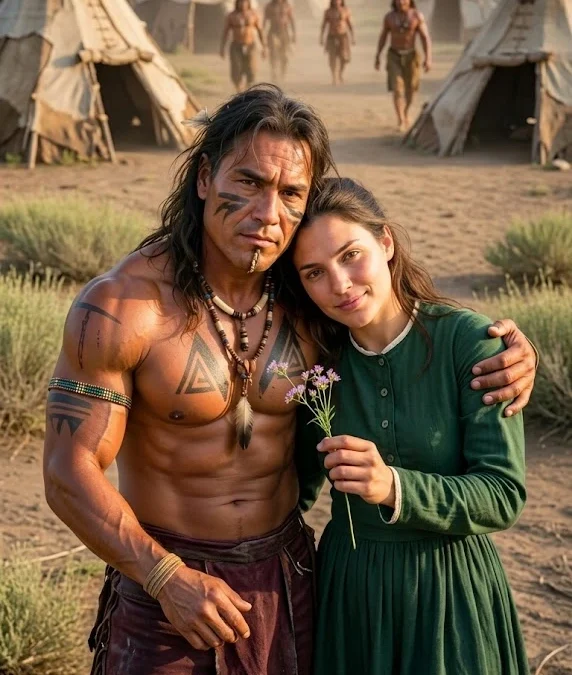
💔 I Fled My Own Wedding With a Secret Letter Stolen From My Preacher Father… Then the Lakota Warrior Who Saved Me Said: “The Man Who Killed My Wife Was a Preacher”
PART 1
My father is on his way here. I know it the way you know a storm is coming before the clouds arrive.
Reverend Thomas Hallett has never let go of anything he considers his. Not a piece of land. Not a debt. And not a daughter who ran away before sunrise on the morning of her own wedding.
In the pocket of my dress is a single page, folded three times, gone soft at the creases from how many times I’ve opened it.
That letter could destroy him.
It could also destroy the man sitting across this fire from me. The man who hasn’t looked at me once in the last hour, yet whose presence I feel in every breath.
To understand why I’m still holding it, you need to know who I was before. 🌾
I grew up in Harrow’s Bend, Nebraska Territory, a quiet town along the Elkhorn River that looked honest from a distance. My father preached every Sunday in the white clapboard church at the end of Main Street, and his congregation believed he was a good man.
That’s the part that made everything harder. He wasn’t a villain. He had a warm smile and a voice that could fill a room. I truly believe he loved me.
But a person can love you and still make you smaller every single year. Still teach you that your voice comes second, your needs come second, your whole self comes second, and call it protection.
By twenty-two, I had become so good at being invisible that I couldn’t have told you what I wanted from life. I’d stopped believing I wanted anything at all.
Then came Deputy Callum Strode.
Polite. Handsome. He pulled out chairs and waited for everyone else to be served first. The women in town told me how lucky I was.
They didn’t see what I saw. One evening, when I said I was too tired to play the piano, Callum gently closed his hand around my wrist. Not hard. Nothing anyone could call violence. Just firm. Deliberate.
“Why don’t you play something anyway, Nora? I do enjoy listening to you.”
Then he let go and smiled. And the most frightening part? He truly thought that was love.
The night before my wedding, I couldn’t sleep. Past midnight, I saw a thin line of lamplight under my father’s study door. I don’t know why I went in. Something in me that hadn’t been fully trained away pulled me toward that light.
In the bottom drawer, beneath his Bible, was a letter on United States Army letterhead. November 1873. Signed by Captain R. Morrison, 5th Cavalry.
It thanked my father for “the information he had provided,” noted it had been “used effectively” in a campaign in the Elkhorn River country, and reminded him to keep their correspondence confidential.
I remembered the whispers I’d heard growing up. Something terrible that happened to an Indian settlement along the Elkhorn, five years ago. People spoke of it like a flood or a storm. No names. No faces.
And I realized I had been taught not to ask.
I took the letter. I hid it against my skin. I slipped out the kitchen door barefoot, and I didn’t look back.
I walked north under a sky so full of stars it looked like silver rain. When the town lights disappeared behind me, I stopped and looked down at a tiny pale prairie flower growing through the dry grass. ✨
I had never once in my life stopped to look at a flower simply because I wanted to.
I stood there until dawn. And when the light came, I wasn’t alone.
A Lakota man sat on a painted horse at the top of a low rise. Not behind me. Ahead of me, to the north. Still and watchful as a hawk.
He rode closer and stopped ten feet away. He didn’t crowd me. He just waited. Long black hair, a pale scar above his left eye, hands resting easy on the saddle.
He didn’t ask where I was going. He didn’t ask whose daughter I was.
He asked, “What is your name?”
“Nora,” I whispered. “Nora Hallett.”
He repeated it carefully, like he was weighing it. Then: “Are you hurt?”
Something in my chest shifted, like a door when you finally stop leaning on it.
My foot was bleeding. He knelt and asked, “May I?” before touching it. He cleaned and wrapped it with soft doeskin. I noticed an old scar on his wrist, the kind left by ropes tied too tight for too long. I didn’t ask.
His name was Daniel Sleeping Bear.
“I can bring you somewhere safe,” he said. “You do not have to stay. You can leave whenever you choose.”
Nobody had ever offered me a choice before. 🥺
He brought me to his people’s camp, where his uncle, Chief Tall River, welcomed me. A woman named Sage Woman gave me a soft deerskin dress and taught me to scrape hides, never gently, never unkindly. A young man named Young Hawk watched me from across the camp like he was adding something up.
That first night, lying in the lodge, I waited for the familiar dread to tighten my chest. It never came. And I cried, because I finally understood how tired I’d been my whole life.
Three weeks passed. Every afternoon, Daniel taught me to read the land. On the nineteenth evening, we sat by a creek while he carved a small wooden bird, the same shape as the one he always wore around his neck.
“My wife used to sing while she worked,” he said quietly, eyes on the water. “Every day for four years. Now the days are too quiet.”
I chose my words carefully. “The person who took her from you… do you know who it was?”
He was silent a long time.
“A preacher,” he said. “A white preacher who told the soldiers where to find us. I do not have his name.”
He looked out at the darkening prairie.
“But names can be found.”
And in my pocket, pressed against my heart, was the proof.
The man who destroyed his life… was my father. 😱
👇 Part 2 is in the comments! Can’t find it? Leave any word below and I’ll send it to you privately. ❤️
PART 2
And in my pocket, pressed against my heart, was the proof. I didn’t sleep that night. I lay in the dark turning the letter over and over, adding it up: my father’s letter, Captain Morrison’s “campaign,” the autumn of 1873, a young wife singing softly every morning until the cavalry knew exactly where to come. I could burn it. Bury it. Be the grateful runaway who repaid kindness with silence. I had repaid everything with silence my whole life. Then I heard footsteps outside, slow and steady. Daniel, walking the edge of the camp in the dark, keeping watch over people who were sleeping. And I understood: this wasn’t my silence to keep.
At dawn I found Sage Woman repairing a basket and showed her the letter. She couldn’t read English, but she touched the cavalry seal and her face changed, the way a face changes when an old wound is opened again. “I know this mark,” she said. “A white man came here the autumn before the soldiers. A man of God. He stayed three days. Ate our food. Slept under our roofs. Prayed over our children.” When the soldiers came before dawn, she saw him standing at the edge of the camp, those papers in his coat, telling the soldiers, This is the one. Then she said something that broke me. “He had a daughter. He said everything he did was for her.” 💔
I turned around and Young Hawk was standing behind me. “I know who your father is,” he said. His cousin worked at the livery in Harrow’s Bend and had heard the whispers for years. He hadn’t told Daniel because he feared Daniel would seek revenge, and that would give the army a reason to come back. “My mother was here in 1873,” he said quietly. “She has not slept through the night since.”
So I went to Daniel at the horses and held out the letter. “I found this in my father’s desk the night I left. It’s not mine to keep. It’s yours.” He read it twice. His stillness became something heavier, something deciding whether to move. “Your father,” he finally said. “He is coming here.” It wasn’t a question. “Yes.” He folded the letter three times, closed it in his fist, and walked out alone onto the prairie.
That afternoon, the dogs started barking. Not the friendly bark. The other one. I stepped outside. At the southern edge of the camp, Chief Tall River and his men stood facing five riders. My father rode in front. Beside him, on a gray horse, sat Callum Strode. 😨 My father’s eyes found me. He opened his mouth, the way he had opened it first in every room for twenty-two years. But this time, I stepped forward and spoke before he could. “I know what you did.” The whole camp went silent. Callum’s eyes swept across the warriors, counting. And slowly, his hand moved toward the pistol on his hip…
👍 Want Part 3? LIKE this post and comment “TRUTH” below! Once we hit enough comments, I’ll post the ending right here. 🔥
PART 3
…and stopped.
Callum caught himself before his fingers reached the gun. He’d done the math. Too many warriors. Too much open ground.
I didn’t look away from my father. Behind me, I heard footsteps. Daniel had come back. He stopped about ten feet behind me, and I didn’t turn around. I couldn’t afford to see his face. Not yet.
I expected my father to draw himself up into the Reverend, all certainty and scripture. Instead, I saw something I’d never seen on his face in my entire life.
Fear. Not of the warriors. Of me.
“Five years ago,” I said, “you wrote to Captain Morrison of the Fifth Cavalry. You told him where this camp was. How many people lived here. How they could be found before dawn, when they wouldn’t have time to run.”
His lips parted. No sound came out.
“You called it a campaign. He called it effective. Seventeen people died here. Women and children among them.”
The word children sat in my mouth like a stone.
“A man named Daniel Sleeping Bear lost his wife,” I said. “She was twenty years old. She used to sing while she worked. And now the days are too quiet.”
Behind me, I heard Daniel draw in a breath and hold it.
“Nora,” my father said. Just my name, the way he’d said it when I was small and a correction was coming.
“Don’t.”
He stopped.
I pulled out the letter and held it up so he could see his own name, Morrison’s signature, the cavalry seal.
“There’s a woman in this camp who saw you that morning,” I said. “She heard your voice. You stayed here three days before you wrote that letter. Three days you ate their food and slept under their roofs and prayed over their children.”
My father closed his eyes. When he opened them, something inside him had finally given way.
“I didn’t know they would kill people,” he said hoarsely. “Morrison told me it would be relocation. That they’d be moved west, peacefully. I believed it because I wanted to believe it. Because I wanted the land along the Elkhorn. And not believing it would have required me to be a different man than I knew how to be.”
I want to be honest: his confession didn’t fix anything. Seventeen people didn’t come back. Daniel’s wife didn’t come back. Sage Woman’s son didn’t come back.
But it was real. It was the first real thing my father had said to me in years.
Around us, the camp had gathered. Chief Tall River stood at my left. Sage Woman stood outside her lodge, watching my father with a look that was neither hatred nor forgiveness. It was witness. 👁️
Then Callum dismounted and walked toward me, calm and confident, as if this ground belonged to him. He stopped three feet away.
“Nora,” he said gently. “Come home. Whatever your father did, that’s his to answer for. You don’t need to carry it.”
For two years I couldn’t name what was wrong with Callum Strode. Now I could. He wasn’t asking. He was telling me, dressed up as a question. And he truly believed that was love.
“Callum,” I said. “I’m not going back.”
“Nora—”
“I’m not going back. I’m staying because this is where I choose to be. These people have treated me like a person who can make her own decisions, something I never learned in twenty-two years in my father’s house. For the first time in my life, I feel the ground under my feet as something I’m standing on, not something I’m trying not to fall through.”
He stared at me like I was speaking a language he didn’t know.
“I only ever wanted what was best for you.”
“I know,” I said, and I meant it. “I hope one day you understand the difference between love that makes space… and love that fills it.”
He turned, mounted his horse, and said to my father, “Thomas, this is beyond what I came here for.” Then he rode south without looking back. The three men who came with him followed.
It felt like watching a door close on a room I would never enter again.
I faced my father. He looked smaller on his horse now, as if something holding him upright had gone out of him.
“There’s something you need to do,” I said. “The Omaha Herald has been investigating what happened in the territory in 1873. Go to them. Give them a signed statement. Everything you told Captain Morrison, and when.”
“It will ruin me.”
“Yes. I imagine it will.” I swallowed. “It won’t bring anyone back. It won’t be enough. Nothing will. But it creates a record. It makes it harder for this to happen again. And it gives the people who died something they don’t have now: proof that what happened to them wasn’t an accident. It was arranged.”
He looked down at his big hands, the same hands I’d watched write sermons by lamplight my whole childhood.
“Your mother used to say a confession made when there’s nothing left to lose isn’t courage,” he said quietly. “It’s just arithmetic.”
“She was right.”
“So this would be courage.”
“It would be a start.”
He dismounted and stood in front of me. Not a reverend. Just a tired man in his late fifties carrying a five-year-old decision that had never gotten lighter.
“Will you come with me to Omaha?”
“No.”
He nodded. He already knew. Then he looked past me toward Sage Woman’s lodge. “I would like to speak to the woman who lost her son.”
“That’s not mine to arrange. That’s between you and her.”
I watched him walk across the camp. And for the first time, the letter in my hand felt lighter.
Daniel stepped up beside me. “You knew what it would mean when you gave me the letter,” he said.
“Yes.”
“You could have burned it. You had every reason to protect yourself.”
“It wasn’t mine to keep. It belonged to the people it was taken from.”
He studied me with that same careful look from the first morning in the grass. “Even knowing what your father did here, you would stay among the people he harmed?”
“I would stay among the people who showed me harm doesn’t have to be the whole story. I’ve watched Sage Woman carry her grief every morning and still live. I want to learn how she does it.”
“She would say there is no method,” Daniel said. “You simply decide each morning that the grief is yours and the life is also yours, and you do not have to choose between them.”
“I was terrified out there,” I admitted.
“I know. I was standing behind you. I could see your hands.”
I looked down. They were steady now.
“I’m learning the difference,” I said, “between fear that tells me something true… and fear that’s just the old cage rattling in my chest because it doesn’t know the door is open yet.”
“That,” Daniel said softly, “is a very good distinction.” 🌅
My father stayed in Sage Woman’s lodge for about an hour. When he came out, he looked like a man who had set down something terribly heavy and would now have to learn how to walk without it.
He gave his statement in Omaha. Two months later, on a Tuesday in November, the story ran on the front page of the Omaha Herald: names, dates, the letter itself, compared against the army’s own records, with Sage Woman’s account translated by Daniel. Captain Morrison was recalled to Washington. Three months later, he received a formal censure and reassignment.
It wasn’t enough. It never could be. But the dead had names now, printed where Washington could read them.
“Truth on paper lives longer than truth in memory,” Chief Tall River said when Daniel translated it for him. “This time, the pen pointed in a useful direction.”
My father left for his sister’s home in Ohio. Before he rode away, he looked at me across the camp.
“Be well, Nora.”
“Goodbye, Father.”
It wasn’t forgiveness. It wasn’t its absence either. It was something more honest: I saw him. Both versions of him. The man who loved me, and the man who wrote that letter.
Sage Woman stood beside me as he disappeared. “I told him the name of my son,” she said. “A man should know the name of the person he is accountable for. Numbers do not make things real. Names do.”
“What did he say?”
“He said it back to me. Slowly. Like a man trying to memorize something he means to carry.”
That evening, I found Daniel with a nervous young colt, simply standing still and letting the animal decide when to come closer.
“Young Hawk leaves next week,” I told him. “He’s sorry he didn’t come to you first.”
“There is nothing to be sorry for,” Daniel said. The colt took a step. “My uncle says your father’s failure was not in the deciding, but in limiting what he was willing to understand. That is the most common failure, and the hardest to fix.”
The colt pressed its nose against his shoulder.
“My uncle also says you have been here long enough to have a name in our language,” he went on. He told me the Lakota name Chief Tall River had chosen. It means a woman who moves with purpose. A woman who acts.
My throat closed. I couldn’t speak.
“I told him I thought it was accurate,” Daniel said. Then he dropped the colt’s lead and turned to face me fully.
“I have been careful with you since the day I found you in the grass,” he said. “You needed that, and it was right. I am still that person. Nothing I say now changes what I promised you.” He paused. “But I would like to stop being only careful.”
Somewhere behind us, a child laughed, high and clear into the November sky.
“Daniel,” I said. “The night you found me, I wasn’t running toward anything. I was only running away. I’m not running anymore. I’m staying because I choose to. Because Sage Woman is teaching me how to carry grief and hope in the same body. And because of you. Not because you saved me. Because you walk ten feet behind me in new places until I’ve had time to read the space. Because you explain instead of command. Because you told me about your wife’s singing without asking me to carry it for you.”
I took a breath.
“I know what you lost is real and permanent. I’m not asking you to replace it. I’m asking if there’s room beside it for something new.”
He was quiet. Then: “The morning I found you, I had woken from a dream about the camp after the soldiers. I could not stay inside. I rode south. Much farther south than I ever ride.” He looked at me steadily. “I do not say this to make it more than it is. But I was farther south than I had any reason to be. And you were there. Walking north.”
“That doesn’t make it inevitable,” I said. “We still have to choose it.”
“Yes,” he said. “I am choosing it.”
“Chief Tall River will want to be consulted.”
“He already knows.” The faintest dry humor touched his voice. “My uncle sees things before they happen. It is deeply inconvenient. He will want it done properly, the way of our people, with the whole camp as witness. That will take some weeks.” He reached out and took my hand, slowly, in full view, unmistakably a choice. “In the meantime, I would like to walk with you in the evenings. If you are willing.”
I looked at our hands. The old rope scar on his wrist. The new calluses on mine.
“I’m willing.” ❤️
We walked out into the last gold light of the prairie, side by side. Not behind him. Not ahead. Beside him. He pointed out a hawk floating high on the wind, held up by something invisible. We walked until the first stars appeared, then turned back toward the fires.
The next morning, I sat beside Sage Woman as the sun rose.
“My son’s name was Fly Straight,” she said. “I tell you because you acted for his memory before you even knew his name. That is the rarer kind of action, and the more trustworthy.”
“Fly Straight,” I repeated softly.
“He was seventeen. He was going to be a good man. He was already asking the right questions.” She glanced at me. “I think you know something about asking the right questions.”
I thought of a small pale flower in the dark, and the question it had opened in me.
“I’m learning.”
“Yes. I can see that.” She waved her hand. “Now go do something useful. The hides do not scrape themselves.”
I laughed, freely and fully, without editing a single piece of myself.
On my way across camp, Young Hawk looked up from his packing. “I heard the name my uncle chose. It is a good name. I will come back in the spring.”
“I’ll be here,” I said.
I picked up my scraping tool and set my hands to the work. For twenty-two years, I worked through mornings in a house that wasn’t mine, for purposes that weren’t mine. Here, every morning built on the one before. A life made of chosen things.
That’s what I’ve learned it means to choose a life instead of just occupying one. It isn’t one decision made once. It’s a decision you make again every morning, knowing exactly what it costs and exactly what it gives.
I chose this morning. I’ll choose the next one, and the one after that.
The prairie wind moved through the grass, the camp lived and breathed around me, and I stayed. 🌾
THE END.
Disclaimer: This story is entirely fictional and created for entertainment purposes only. It does not represent any organization or individual, nor does it encourage inappropriate behavior. The content was generated with AI assistance.








