I Found a Stranger’s Coat in My Duke Husband’s Locked Study. I Summoned the Whole House, Smiled, and Asked One Question: “Whose?”
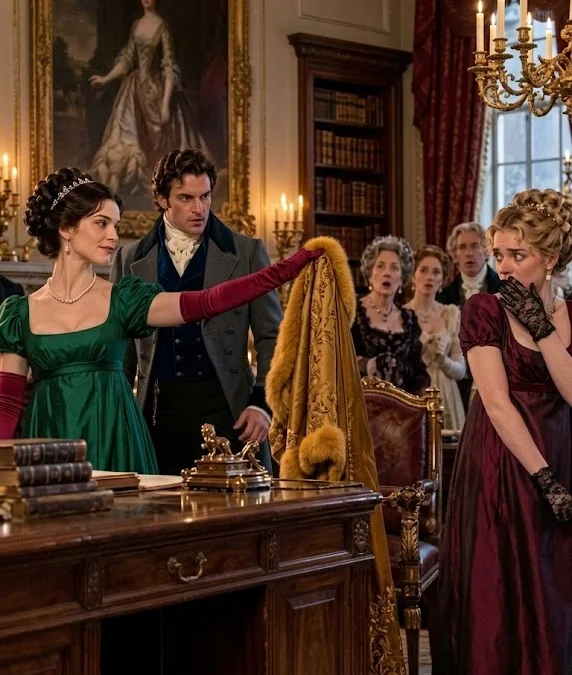
🧥 I Found a Stranger’s Coat in My Duke Husband’s Locked Study. I Summoned the Whole House, Smiled, and Asked One Question: “Whose?” 😳
Part 1
The ivory pelisse lay across the Duke of Hearthmere’s campaign chest as if a woman had removed it only moments before. 🧥
Clara stopped in the doorway of her husband’s library. Rain tapped the long windows behind her, and water from the hem of her brown cloak darkened the carpet. She had returned to Ravenmere Hall a day early after floodwaters closed the northern road. No one but the lodge keeper had seen her carriage arrive.
The room smelled of leather, smoke, and the cedar blocks Nathaniel kept among his maps.
The pelisse did not belong there. Its pale wool was too fine for a servant and too fashionable for the country. Narrow green braid followed the high waist and cuffs. A small spray of wood anemones had been embroidered inside the collar, where only the wearer would see it.
Clara touched one flower. The silk was worn smooth.
She had been married to Nathaniel Vale, Duke of Hearthmere, for fifteen months. She knew every gown in the Dowager Duchess’s wardrobe, every bright shawl owned by Nathaniel’s sister Rosamond, and every sensible coat worn by their cousin Beatrice. And she knew that no lady staying at Ravenmere would leave an expensive pelisse in a gentleman’s library.
On the escritoire stood an open dispatch box. Nathaniel had taken most of its papers to London three days ago, to a committee on relief for soldiers and their families. The campaign chest beside it had traveled with him through Spain and Belgium. Clara had never opened it. She had never been invited to.
She lifted the pelisse. A scent rose from the folds: not perfume, but dried lavender and the faint smoke of a long-dead fire. Something stiff pressed beneath the lining near the breast. When her fingers found it, she felt the square edge of paper.
Footsteps sounded in the corridor. She lowered the garment just before Mrs. Penrose, the housekeeper, entered with an armful of account books. The older woman saw the pelisse and stopped dead.
“Your Grace. I did not know you had returned.”
“Clearly. Whose is this?”
Mrs. Penrose’s eyes moved from the coat to the campaign chest. “I could not say.”
It was a poor lie from a woman who could name the owner of every handkerchief left below stairs. 😶
Clara carried the pelisse to the morning room. On a sheet of paper she wrote, in a firm hand: This garment was found in His Grace’s library. Would its owner kindly claim it before dinner? She placed the note beside the coat on the center table and rang for tea.
Her mother-in-law arrived first. Augusta, Dowager Duchess of Hearthmere, read the note and went very still.
“It is mine.”
Clara looked at the narrow shoulders of the pelisse. Augusta had not possessed shoulders that size in thirty years. “How fortunate. When did you leave it in Nathaniel’s library?”
“Yesterday. I was looking for a book.”
“You wore black yesterday.”
“Then I intended to wear it. Must a duchess account for every coat she owns?”
“Only those found on her son’s private campaign chest.”
Before Augusta could answer, Lady Rosamond swept in, cheeks bright from the wind. “Clara, about the pelisse. It is mine. I left it there while searching for sealing wax.”
Silence filled the room. Augusta closed her eyes.
“Oh, how generous of you both,” said Clara. “Perhaps you might share it.”
Their cousin Beatrice appeared at the open door, took in the three faces, saw the garment, and said too quickly, “There it is. My maid has searched everywhere.”
Augusta made a sound of despair. Clara almost laughed. Instead she looked from one woman to the next. “Three owners. Shall we wait for a fourth?”
Mrs. Penrose stood in the passage holding the tea tray, her face drained of color. “The pelisse belonged to a former guest. It was delivered by mistake.”
Four claims. Four lies. 🎭
Clara had spent the first year of her marriage learning how silence worked in a great house. Servants silenced doors with felt. Families silenced scandals with invitations withheld. Men silenced women with money and called the result peace. She had not expected every woman at Ravenmere to lie to her before luncheon.
“Who was the guest?”
No one answered.
Clara rested one hand on the ivory wool. “I see.”
She did not weep, accuse, or send a groom racing to London. She carried the pelisse upstairs to her sitting room, locked the door, and drew out the small square of paper hidden beneath its lining.
It was a miniature portrait of a young woman Clara had never seen. On the back, in Nathaniel’s unmistakable hand, were six words:
“For Alice, when I have courage.” 💔
👉 Want Part 2? Find it in the comments, or leave any word below and I’ll send it to you privately. 🧥
Part 2
Clara did not sleep.
At dawn she sat beside the cold hearth with the miniature on her knee. The painted woman had chestnut hair, gray eyes, and a direct gaze. She was not conventionally beautiful. There was intelligence in the firm mouth and impatience in the raised brow. Clara could imagine her interrupting pompous men. She could also imagine Nathaniel loving her.
That hurt more than the thought of a careless affair. Nathaniel was not careless. He measured his words, paid his debts, and remembered which tenant’s son had lost a hand at Waterloo. Their marriage had been kind. It had not been intimate in the ways that mattered most. Whenever she asked about his years in the army, he closed a door behind his eyes.
At breakfast the three ladies ate very little. Clara spread marmalade on toast and let the silence ripen.
“I found a miniature in the lining.”
Rosamond dropped her spoon. Augusta’s hand tightened around her cup. “You had no right to search another lady’s garment.”
“Which lady? You have supplied three owners and a former guest.”
Augusta rose. “My son has suffered enough.”
“From what?”
The dowager’s anger collapsed into fear. For one moment Clara saw not a duchess but a mother guarding an injured child. Then the old discipline returned. “It is not my story to tell.”
“No. But it has entered my marriage. That makes part of it mine to understand.”
Examining the pelisse in daylight, she found a small label in faded blue thread: M. Arno, Bath. Beneath it lay the ghost of two unpicked initials. A.M.
By nine o’clock she had ordered her traveling carriage. Rosamond intercepted her in the hall. “You cannot mean to leave alone.”
“I will not be managed.”
“We wished to spare you.”
“From the truth, or from the inconvenience of my response?” 🚪
The journey to London took most of the day. Clara used the hours to separate facts from fear. The pelisse had been made for Alice M. Nathaniel had placed his miniature inside it. His family knew Alice’s name and believed Clara must not. Everything else was conjecture, and conjecture became dangerous when dressed as certainty.
Madame Arno’s workroom occupied the first floor above a silk merchant near Hanover Square. The dressmaker, nearly sixty, small and straight-backed under a lace cap, recognized the pelisse at once. When Clara said where she had found it, the woman locked the workroom door.
“I cannot give you a customer’s private correspondence. But the lady for whom this was made has been dead for two years. You are not pursuing a living rival.”
Relief came first, swift and shameful. Then sorrow followed. “Alice Morton.”
“Yes.”
The old ledger entry was dated March 1815. Ivory wool pelisse. Green silk lining. Paid by Colonel N. Vale. “He commissioned it as a betrothal gift. He asked me to remove his note after he lost his courage. I refused. Then the fighting began again. Miss Morton went to Brussels with a surgeon’s household. The pelisse was never delivered.”
She wrote an address on a scrap of paper. A lodging house near the Strand.
A young woman in a dark blue gown opened the door. Her chestnut hair and gray eyes matched the miniature so closely that Clara knew her at once.
“Miss Morton.”
The woman’s gaze fell to the parcel in Clara’s hands. “You found it. Then I owe you an apology. I left it at Ravenmere when no one was meant to be home.”
“Why?”
Lydia Morton stepped aside. “Because cowardice is not confined to dukes.”
Inside the narrow room, among trunks and papers tied with string, Lydia told her everything. Her sister Alice had met Nathaniel in Lisbon, where their father served as an army surgeon. Alice had kept his records, dressed wounds, and argued with every officer who treated soldiers’ wives as baggage. Nathaniel had wanted to marry her. The old Duke had threatened to ruin them both. Nathaniel asked Alice to wait.
“She told him a woman was not a parcel to be stored until a man found the courage to claim it.”
After Waterloo, Alice worked in a house for the wounded in Brussels and caught a fever. By the time Nathaniel found her, she was dying.
Clara closed her eyes. She had imagined infidelity. Instead she found a deathbed, and two years of silence. The truth was kinder to her pride and far harder on her heart. ⚰️
Lydia untied a packet and took out a folded list: names, regiments, injuries, dependents, in Alice’s handwriting. Laundresses, wives, widows, and children who received no relief because their papers were lost. “Nathaniel’s committee now uses part of this list. Her name was removed from the copy.”
Not merely sorrow, then. Erasure. 😨
When Clara stepped out of the lodging house, the Hearthmere carriage waited across the street. Nathaniel stood beside it, bareheaded, the wind disordering his hair, his face holding the rigid calm she now recognized as fear.
“Rosamond sent word you had gone to Madame Arno.”
“Your family communicates efficiently when it chooses.”
His gaze dropped to the pelisse. Then he said the words she had waited fifteen months to hear, and she had no idea whether they would save their marriage or end it…
👉 What did the Duke confess, and what did Clara do with the truth? LIKE this post and COMMENT the word “ALICE” 🧥 and Part 3 drops as soon as we hit our goal!
Part 3
“I loved Alice Morton,” Nathaniel said. “I intended to marry her. And I failed her before I could.”
Clara entered the carriage because she wanted answers, not spectacle. He sat opposite her rather than beside.
“Why did you fail?”
“Because I believed I needed my father’s blessing. Because I asked her to wait while I tried to preserve my allowance, my commission, and my comfort.”
“You asked her to bear the cost of your caution.”
“Yes.” A pale scar crossed his right knuckles. Clara had kissed it once, and he had told her it came from Spain. She wondered how many true things in their marriage had been offered without their meaning. “In her last hour she asked me not to turn guilt into a monument.”
“So you turned it into silence.”
He flinched. “Yes.”
“Why did you marry me?”
He answered too slowly. “Do not give me the kind answer,” she said. “Give me the true one.”
“At first, because you were intelligent and composed and unimpressed by my title. Because you did not ask me to speak about the war. I believed respect would be safer than love.” The words cut. “And now I know safety is not what I feel when you enter a room. You disturb every comfortable lie I have. I love you, Clara. I have for longer than I allowed myself to name.”
She wanted to believe him. Wanting was not enough.
“You allowed your mother, your sister, your cousin, and your housekeeper to lie to me. They acted according to the rule you created.” She took Alice’s list from her reticule. “Did you remove her name from the relief records?”
“My father ordered it.”
“That was not my question.”
“I signed the revised copy.”
“Then you erased her twice.” 💔
He looked down. Clara had rarely seen a duke without defense. It did not satisfy her as she had expected.
“Tomorrow your committee hears the petitions from the Waterloo families. Seven women were excluded because their marriages cannot be proved by the forms you require. Alice recorded five of them herself. I will have those cases reconsidered.”
“Yes.” He met her eyes. “And her name restored, if Lydia permits. Do not make your confession another use of her. Ask her what she wants.”
At Hearthmere House, he asked if she would come inside. She had her own income under the marriage settlement, rooms at her widowed aunt’s, and work that did not depend on his affection. But emotional freedom required more than financial safety. It required space to decide without being pursued.
“I will stay with Aunt Margaret tonight. Do not call. Do not send your mother.”
His jaw tightened, but he bowed his head. “Very well.”
For the first time in their marriage, Nathaniel let her walk away without trying to make the path easier, shorter, or different from the one she had chosen. 🚶♀️
The committee met in a paneled room near Whitehall. Twelve men sat around a long table. Sir Barnaby Holt read the first disputed petition with visible impatience. “Mrs. Ellen Price presents no certificate of marriage. Rejected.”
“The parish register was destroyed during the retreat from Burgos,” said Clara.
Holt frowned. “Your Grace, committee wives do not usually address deliberations.”
“The petition summaries are Her Grace’s work,” Nathaniel said. “You will hear her.”
It was a use of ducal power, clean and immediate. It opened the room. It did not decide the case.
Clara laid three documents on the table: a quartermaster’s ration record, two sworn statements, and Alice Morton’s own notes. “If this committee insists that one missing certificate can unmake a marriage, then it values paper more than human evidence. Rules should prevent fraud. They should not manufacture abandonment.”
“Who is Alice Morton?” a member asked.
The room changed. Nathaniel could have called her a clerk, a surgeon’s daughter, an unreliable source. Authority offered him the escape. Instead he looked toward Lydia in the visitors’ row. She gave one small nod. He rose.
“Alice Morton was the daughter of an army surgeon. She kept records of women and children missed by official returns. She died of fever in Brussels. I intended to marry her. My father opposed the match, and I lacked the courage to defy him before it was too late. After her death, I permitted her name to be removed from a copy of these records. That act was dishonorable.”
No one moved. Clara watched the cost arrive on his face. Gossip would begin before the committee adjourned. He did not look at her for rescue. 🕯️
The debate lasted two hours. Nathaniel spoke when his rank could secure a hearing, and stayed silent when Clara’s evidence needed to stand alone. The committee approved a six-month review of disputed claims and restored Alice’s name to the record. It was not a revolution. It was a door opened for nineteen families.
Outside, when reporters gathered, Nathaniel said only, “Any account of today should credit the Duchess’s review and Miss Morton’s records. My private history is not evidence of my wife’s forgiveness, and you will not use it to invent one.”
Clara stayed with Aunt Margaret for ten days. He obeyed her request. No flowers, no uninvited calls. Once he wrote about an estate matter, offering two options and no plea. She chose a third and returned the paper.
On the eleventh morning, Rosamond called. “I have not come to persuade you home. I came to apologize. When I saw the pelisse, I panicked. We learned not to say Alice’s name after Brussels. I thought silence protected you both. It protected the family from discomfort.”
“Yes.”
“I lied to you because it was easier than trusting you with a painful truth. I am sorry.”
It was not a perfect apology. It was a real one. “Thank you. I cannot promise never to be angry about it.”
“I would distrust you if you did.”
Rosamond held out a small key. “It opens the campaign chest. He has removed nothing. He says you may examine it, burn it, or refuse it.”
“Tell him I will meet him at Ravenmere on Thursday, in the library.”
On Thursday the pelisse lay on the table, no longer hidden. The chest stood open. Inside were maps, orders, a worn Bible, and two letters tied with black ribbon. Nathaniel waited by the window.
“I opened it because I no longer wished the lock to speak for me.”
“What do you want from me?”
“I want you to come home. I want to tell you when Brussels returns in my sleep instead of pretending I never dream. I want a marriage in which neither of us must be easy to be loved.” 🗝️
She looked at the ivory coat. “I feared Alice because I thought she might be alive. Then I feared her more because she was dead. A dead woman cannot disappoint you.”
“Alice did disappoint me, frequently. She was impatient, proud, reckless with her health. I loved her as a living woman, not a saint. But I used her death to avoid the risks of loving you openly. That was unfair to us both.”
“Did you compare us?”
“At first. Then you became too entirely yourself for comparison.”
He told her he had instructed his solicitor that her work for the Relief Review would be contracted and paid by the committee, not treated as a duchess’s unpaid assistance. “The proposal does not depend upon your return.”
“You instructed him to offer terms, not to settle them.”
“Yes. I am learning. Slowly. Painfully.”
They did not burn the pelisse. Clara refused to turn destruction into proof of love. Madame Arno removed the hidden pocket and repaired the lining without disguising the old stitches. From the broad hem she cut nineteen small squares, each sewn inside a plain winter cloak made for one of the women Alice had recorded. No recipient was told she wore a relic. The cloth served the living without asking them to carry someone else’s grief. 🧵
The remaining coat went to Lydia, who chose to take it across the Atlantic after all, not as a shrine, but as a well-made garment against a Halifax winter.
“Alice would laugh at the thought of becoming practical.”
“Then let her laugh,” said Clara.
Lydia faced Nathaniel in the workroom. “I blamed you for years. You had reason. I also blamed Alice for dying and myself for surviving. Reason had little to do with any of it.”
“I am sorry.”
“I know. Do something useful with it.”
That evening, Clara and Nathaniel walked home through lamplit streets. “Are you coming home?” he asked.
“I am considering it. Whether you understand that confession is not the end of repair.”
“I do.”
“I will return to Ravenmere. Not because the committee accepted my proposal, not because you opened the chest, and not because you have finally said you love me. I will return because you let my no remain no, and because when the door opened again, you did not stand in it.”
His breath left him. She placed her hand in his. He did not pull her toward him. He simply closed his fingers around hers and walked beside her. 🕯️
Winter settled over Ravenmere. Clara returned not to the old marriage but to a changed household. Augusta apologized without presenting her motives as virtues. Mrs. Penrose admitted she had let Lydia into the library and lied because the late Duke had trained the household to treat Alice’s name as dangerous. Trust returned in small acts. Nathaniel began knocking before entering Clara’s sitting room. When he woke from dreams of Brussels, he spoke Alice’s name, and Clara listened when she could and said not tonight when she could not. He accepted both answers.
One midnight she found him outside her bedchamber with a steward’s report. “You were wrong about the northern road.”
“I have brought proof that I was only partly wrong.”
“That is a poor seduction.”
“I had not realized I was attempting one.” His gaze dropped to her mouth, then returned to her eyes. “May I come in?”
The question mattered, because he would leave if she refused. Clara opened the door wider, took the report from his hand, set it unopened on the table, and kissed him first. The old marriage had contained tenderness. This contained recognition. ❤️
By spring, seventeen of the nineteen cases had been resolved. Twelve families received payments. Three were referred to parish relief rather than dismissed. Two proved false. Clara recorded every reason. Alice’s list was placed in the archive under her full name. No monument was built.
On the second anniversary of Waterloo, they traveled to a small churchyard in Kent. Lydia had given Clara a letter before sailing: Do not go because you think the dead require your permission. Go only if the living need honesty. Clara carried wood anemones from Ravenmere’s garden. Alice’s stone stood beneath a yew. She saw those whom others failed to count.
Nathaniel remained several paces away. “Will you come closer?” Clara asked.
“I wish to say farewell without pretending farewell means forgetting.”
“Then do so.”
He spoke quietly, too softly for her to hear. She did not try. Some privacy could exist without secrecy. Clara set down the flowers. “Thank you,” she said to the woman she had never known. Not for preparing Nathaniel for her. Alice had not lived or died for another woman’s marriage. She thanked her for the name she had written, and for forcing truth into a house that had mistaken silence for care. 🌼
Years on, the North Dower House held ledgers, witnesses, noisy children, two clerks, and a kettle that never left the fire. On their third anniversary Nathaniel brought the old campaign chest into the drawing room. It was empty now.
“What shall we keep in it?”
Clara fetched the first completed volume of the Relief Review and laid it inside. Nathaniel added the plans for the Dower House office. After a moment, she placed their private correspondence beside them, not hidden, but tied and kept because it belonged to the life they were making. He closed the lid without locking it.
Later, her head on his shoulder, he asked, “Are you happy?”
“Yes. Not because nothing hurts. Because nothing important must be hidden in order for us to remain.”
In the North House, the last clerk closed a ledger in which nineteen families had finally been counted. In the drawing room, an old campaign chest stood unlocked. And in a marriage rebuilt by truth, there was room for memory without surrendering the future. 🌅
💬 Tell me in the comments: was Clara right to walk away and make Nathaniel wait, or should she have forgiven him sooner? And have you ever uncovered a secret that changed how you saw someone you loved?
If this story moved you, share it with someone who needs to know that silence is never the same as protection. Follow for more. ❤️
Disclaimer: This story is entirely fictional and created for entertainment purposes only. It does not represent any organization or individual, nor does it encourage inappropriate behavior. The content was generated with AI assistance.








