I Found Two Homeless Boys Sleeping Next to the Trash, and They Had My Son’s Face. My Family Had Spent Six Years Telling Me My Other Two Babies Died.
I Found Two Homeless Boys Sleeping Next to the Trash, and They Had My Son’s Face. My Family Had Spent Six Years Telling Me My Other Two Babies Died.
Part 1
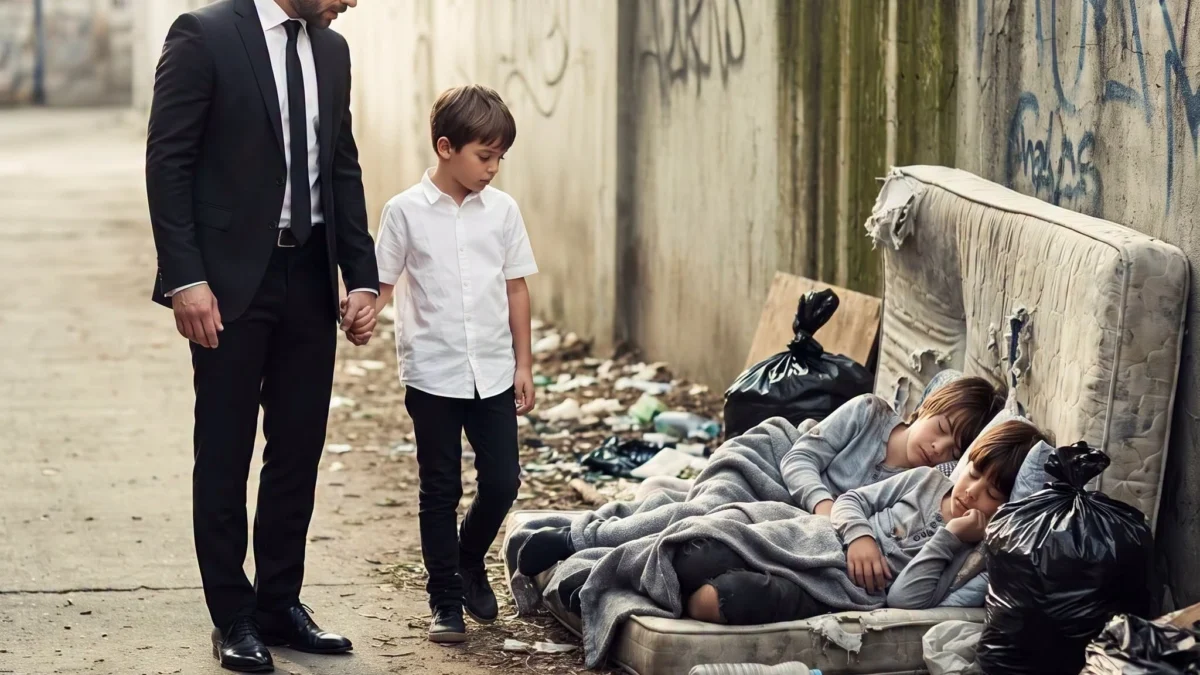
“Papá, those kids have my face.”
My six-year-old son, Nico, said it in the smallest voice, and I stopped so fast my shoes skidded on the wet pavement.
I’m Álvaro Serrano. I run a real estate company. I’m a man who controls every detail of his life: schedules, contracts, the exact route I drive to my son’s school. But that Friday there was a traffic jam on the Castellana, so I took a detour through Tetuán, down a narrow alley a few minutes from the school.
I regretted it for about three seconds. Then I saw what Nico was pointing at.
Two small boys were asleep on an abandoned mattress, wrapped around each other, between black garbage bags and soaked cardboard. My dark suit and freshly polished shoes looked like they belonged to another planet.
Nico let go of my hand and walked toward them.
“Nico, come back here.”
I felt the ground move under my feet. Not a metaphor. My knees actually loosened.
The boys were exactly Nico’s age. The same dimple in the chin. The same arched eyebrows. And green eyes, almost identical to those of my wife, Clara, who died giving birth six years ago.
One of them woke up. He sat up, frightened, and threw an arm across the other boy to protect him.
“Please don’t make us leave. We’ll go when it stops raining.”
That voice took the air out of my lungs. It wasn’t only the face. It was the way he frowned. The way he touched his ear when he was nervous.
Exactly like Nico.
“What are your names?” Nico asked.
“Lucas. And he’s Mateo.”
I put a hand against the wall.
Lucas and Mateo were the names Clara and I had chosen for the other two babies of that pregnancy.
Six years ago, Clara was expecting triplets. After an emergency delivery, I woke up in a private room with Nico in my arms and a sentence from my mother burned into me forever.
“The other two didn’t make it.”
Clara never came home either.
I never saw their bodies. I never received their hospital bracelets. My family handled everything while I could barely stand.
“Who looks after you?” I asked. My voice cracked.
Lucas glanced at Mateo before answering.
“Our aunt Marta. She said our mother’s name was Clara, and that our father had another son. Three nights ago she left us here. She said someone would come for us.”
Marta.
Clara’s younger sister. The woman who vanished from Madrid two days after the funeral.
Nico unzipped his backpack, pulled out his sandwich, and tore it into three pieces without anyone asking. Lucas did the exact same thing with his half: split it again, and handed the first bite to Mateo.
I felt a pang that had nothing to do with pity.
I called my pediatrician. I called my lawyer. Then social services. I didn’t want to move the boys without a record of how I’d found them. While we waited, I bought water, fruit, and clean clothes at a shop down the street.
Then Mateo pulled something out of a torn plastic bag.
A crumpled envelope.
“Our aunt said to give this only to our father, if he ever came.”
On the front, in blue ballpoint, was one name.
ÁLVARO SERRANO.
My own name. In a handwriting I didn’t recognize.
What happened next still gives me chills. Part 2 is in the comments—or leave any word below and I’ll send it to you privately.
Part 2
What happened next still gives me chills. Part 2 is in the comments—or leave any word below and I’ll send it to you privately.
I didn’t open the envelope until the social worker approved a temporary transfer of Lucas and Mateo to my house in Pozuelo, under supervision. The boys showered, ate slowly, and stood in the doorway of a room full of toys as if they had walked into another world.
Nico never left their side. Not for one minute.
At midnight, I tore the envelope open.
“Marta can no longer protect them. Look for the bracelets from Hospital Santa Isabel. Ask your mother about the inheritance pact for the grandchildren. Don’t believe any certificate that carries Esteban’s signature.”
Esteban Serrano. My uncle. The chief financial officer of our family group.
The next morning, Dr. Elena Vega examined the boys. Underweight, mild anemia, nothing that care couldn’t fix. She took DNA samples from all three children and from me.
“Urgent results take about forty-eight hours.”
Before I could even exhale, two police officers arrived with a child protection specialist. Someone had reported that I was holding two missing children.
Lucas clung to my jacket. “We don’t want to go.”
The specialist asked to speak with the boys separately. Mateo described where they’d slept. Lucas explained how Marta would vanish for days, and how for years she’d repeated a strange sentence to them:
“When you turn six, your real family will have to decide what to do with you.”
When Nico heard they might be taken to a center, he planted himself in front of the door.
“They already separated them once.”
The team’s psychologist asked that the brothers stay together until the DNA came back. The authorities agreed to a seventy-two-hour emergency guardianship. Before she left, she made it clear that any attempt to hide information could mean immediate separation.
I accepted every condition. Visits, interviews, medical reports, full access to my home.
That afternoon my lawyer, Inés Robles, arrived with a folder from the Civil Registry. She had found something that shouldn’t have been possible.
Lucas and Mateo were registered as Marta’s children, born the same day and in the same hospital as Nico. But the document had been filed eleven days after the birth, validated by a doctor who had been retired for four years.
“This looks like a manufactured registration,” Inés said. “And there’s something worse.”
She pulled out a copy of an old shareholder pact signed by my grandfather. Each biological grandchild would receive 8% of the business group at age eighteen. If only one grandchild was recognized, the administration of that stake stayed in the hands of Esteban until the child came of age.
I understood it all at once. This wasn’t just a family lie. It was money, control, and two little boys turned into an accounting problem.
My phone rang.
My mother. Adela.
“Bring all three children tomorrow. I already know you found Lucas and Mateo.”
I tightened my grip on the phone.
“How do you know their names?”
A long silence.
“Because I’m the one who let them be taken.”
If you want to know what my mother told me, LIKE this post and comment “PULSERAS.” When enough people comment, I’ll post Part 3.
Part 3
At ten the next morning, I drove through the gates of the family estate in La Moraleja feeling something I had never felt in the worst negotiations of my life: fear of hearing a truth I couldn’t undo.
My mother was waiting in the living room. When Nico, Lucas, and Mateo walked in, the color left her face. The three of them wore simple, clean clothes, and side by side it was impossible to ignore the resemblance. Lucas took a step back. Mateo reached for Nico’s hand.
“Grandma, they’re my brothers,” Nico said.
She covered her mouth and began to cry.
I asked Pilar, our old housekeeper, to take the boys out to the garden. Then I closed the door.
“Now you’re going to tell me everything.”
It took her several seconds.
Six years earlier, during Clara’s pregnancy, my father had been gravely ill and obsessed with leaving the company “in order.” The old family pact divided a significant part of the group among all biological grandchildren. If three were born, Esteban would lose the control he expected to hold over those shares until they came of age.
“Your father said three heirs would turn the company into a war,” my mother admitted. “Esteban insisted we had to protect the family’s assets.”
“Protect them from my children?”
She lowered her eyes.
The delivery had gone wrong. Clara was rushed away. All three babies were born premature. Nico was the most stable. Lucas and Mateo needed incubators for days. I was destroyed by Clara’s death and sedated for an anxiety crisis. I could barely process anything.
That’s when Esteban proposed the lie.
Marta, Clara’s sister, had debts and a strained relationship with the family. They offered her an apartment in Valencia, a monthly payment, and a lump sum to appear legally as the mother of Lucas and Mateo. A hospital doctor, a friend of Esteban’s, altered reports and helped with an irregular registration. And they told me the two babies had not survived.
“I agreed,” my mother said. “Not because I wanted to lose them. They convinced me you couldn’t bear raising three newborns after losing Clara.”
I slammed my palm on the table.
“You didn’t decide for me. You decided against me.”
She cried and didn’t defend herself.
For the first two years, Marta was paid on time. Then she started asking for more. She’d discovered the true value of the shares that would belong to the boys, and she threatened to tell the truth. Esteban responded by cutting the payments and moving her around through intermediaries.
Lucas and Mateo’s lives became unstable. Small flats in Valencia, then Cuenca, and finally Madrid.
“Did you know they were suffering?”
“I knew there were problems. Esteban said Marta was exaggerating.”
“You chose to believe him.”
She nodded.
Then I asked about the envelope.
Her face changed.
“Marta didn’t write it.”
A chill ran down my spine.
My mother opened a drawer and took out a metal box. Inside were three newborn hospital bracelets, each with the same date, Clara’s name, and consecutive hospital codes. Also a memory stick and a letter.
“Pilar found this two weeks ago behind a panel in your father’s old study. She called me. I didn’t have the courage to tell you.”
The letter was from my father, written a few months before he died.
“If Lucas and Mateo ever return, it means the decision we made ended up destroying what we meant to protect. Esteban turned my fear into a business, and I allowed it. All three boys are Álvaro’s sons. The original proof is in this box. Let no one separate them again for money.”
I had to sit down.
The memory stick held copies of transfers to Marta, messages from Esteban, and photographs of the three babies in neonatal care. In one of them, Clara was still conscious, touching the incubators with one finger. On the back, someone had written:
“Nico, Lucas, and Mateo.”
For the first time in six years, I was looking at Clara beside all three of our sons.
I didn’t cry right away. I sat perfectly still, as if all the pain had arrived too fast to find its way out.
The doorbell broke the silence.
Inés walked in with the preliminary lab result. She looked at my mother, then at me.
“The match is conclusive. All three boys are brothers, and Álvaro is their biological father.”
My mother closed her eyes.
But Inés wasn’t finished.
“We also found Marta.”
I looked up.
Marta was in a social care center in Alcalá de Henares. She hadn’t left Madrid or disappeared completely. Two days before leaving the boys, she’d gone to an association asking for help. She was sick, penniless, and convinced Esteban was watching her. She had left instructions: if anything happened to her, a volunteer was to bring the envelope to the place where she planned to leave the children.
“Why that alley?”
“Because it’s three streets from Nico’s school,” Inés said. “Marta knew your Friday route. She wanted you to find them.”
That changed the picture I had of her. It didn’t erase years of neglect, or the times she’d left Lucas and Mateo alone. But it explained the last gesture.
Marta hadn’t waited for a stranger.
In some terrible, desperate way, she had put them in their father’s path.
I went to see her that same afternoon, alone.
She looked much older than her thirty-four years. When she saw me, she didn’t apologize right away.
“Are they with you?”
“Yes.”
She started to cry. “Then at least one thing went right.”
I kept my distance. “Why did you accept?”
She stared at her hands.
After the birth, she’d lost her sister and she was in debt. Esteban told her I didn’t want to take on three babies, that the other two would end up separated in foster care, and that she could keep them together. He offered money and documents already prepared.
“At first I thought I was saving them,” she said. “Later I understood they had bought me.”
Over the years she became dependent on Serrano money. When she began demanding answers, Esteban threatened to report her for document fraud and child abduction. She spiraled into an increasingly chaotic life. Some days she cared for the boys tenderly. Other days she couldn’t care for herself.
“I wasn’t the mother they deserved.”
“No,” I said. “But you weren’t the only one responsible.”
She handed me her old phone. She’d kept audio recordings of Esteban.
In one, his voice came through clearly:
“As long as the boys are your children on paper, the shares stay where they belong. If Álvaro finds out they’re alive, we lose everything.”
Inés took the recording to the police and requested protective measures. Esteban was removed from the administration of the group while the document forgery, transfers, and corporate fraud were investigated. The story came out without turning the boys into a spectacle: the court protected their identities and ordered the registrations reviewed.
But the hardest conflict didn’t happen in an office.
It happened that night, when I gathered the three boys in the living room.
I couldn’t explain companies, crimes, or inheritances. I could only tell them the truth a six-year-old could carry.
“Lucas, Mateo, your mother’s name was Clara. She was also Nico’s mother. You were born together. Some adults made very wrong decisions and separated you.”
Mateo lowered his head. “Was it because we were bad?”
I knelt in front of him. “No. There was never anything wrong with you.”
Then Lucas asked the question I’d been dreading.
“Why didn’t you look for us?”
The silence hurt more than any accusation.
“I didn’t look because they told me you were gone. I believed a lie. If I had known you were alive, I would have crossed all of Spain to find you.”
He studied me for several long seconds.
“Then you came late.”
I swallowed. “Yes.”
“But you came.”
He threw himself into my arms.
Mateo joined. Nico slipped into the hug from the other side, and for a few seconds I couldn’t speak.
The following weeks weren’t perfect.
Lucas hid bread under his pillow, afraid of going hungry again. Mateo woke some nights to check whether the door was still open. Nico had moments of jealousy, because for six years he’d had his father all to himself.
I didn’t pretend everything was fine. I found child psychological support, reorganized my work, and turned three separate bedrooms into spaces the boys could use whenever they wanted, though for months they preferred to sleep close together.
The provisional guardianship turned into legal recognition of filiation, then full custody. The Civil Registry corrected the records. The shareholder pact had to be corrected too: the shares meant for the grandchildren were blocked by the court until they came of age, out of reach of Esteban or any other adult in the family.
My mother asked to see them.
At first I refused.
It was Lucas who, weeks later, asked about “the grandma who cried a lot.”
The first visit was short and supervised. She didn’t bring expensive gifts. She only came with the box of bracelets and an enlarged photograph of Clara with the three incubators.
“I don’t expect you to forgive me,” she told them. “I only want you to know that what I did was wrong.”
Nico took the photo. Mateo studied Clara’s face. Lucas pointed at the three bracelets.
“So we were always three.”
My mother nodded. “Always.”
There was no instant forgiveness. I wouldn’t have allowed it, and I wouldn’t have believed it. There was something harder: limits, time, and consequences.
Marta began a recovery program and agreed to testify before the court. She did not regain custody, but, when the professionals judged it appropriate, she could see Lucas and Mateo in accompanied meetings.
The boys didn’t call her Mamá. They didn’t hate her either. To them she was a complicated part of a life they were still learning to understand.
Six months later, I took all three back to that alley in Tetuán.
The mattress was gone. The city had cleaned the area, and an association had set up a small support point for homeless families. I had funded the project anonymously, without putting the Serrano name on any plaque.
Lucas stood looking at the spot.
“I thought nobody was going to come here.”
Mateo pointed at Nico. “But he came.”
Nico smiled. “I only said you looked like me.”
I looked at my three sons together. For years I’d believed that night had taken a wife and two children from me. Now I knew it had also taken the truth.
I couldn’t get back Lucas’s first steps, or Mateo’s first words, or six birthdays celebrated far from me. I couldn’t erase the hunger, the borrowed flats, the mattress beside the garbage.
But I could decide what happened from that day on.
As we were leaving, Lucas turned to me.
“Papá, tomorrow are we going to be the four of us again?”
I took one of his hands. Nico took the other, and Mateo grabbed onto his brother.
“Tomorrow too.”
“And the day after?”
I looked at my three boys.
“That too.”
Mateo smiled for the first time without looking back over his shoulder, as if he finally understood he no longer needed to memorize an escape route.
And the four of us walked out of the alley, slowly, hand in hand, while the old envelope with my name on it stayed in a box in my office, next to the three hospital bracelets.
Not as a memory of the lie that separated us, but as proof that sometimes a family can take six years to find each other and still arrive in time to begin again.
Disclaimer: This story is entirely fictional and created for entertainment purposes only. It does not represent any organization or individual, nor does it encourage inappropriate behavior. The content was generated with AI assistance.








