I Heard My Parents Bragging About Stealing My $600,000 Trust. Then My Dying Grandmother Made One Phone Call.
I Heard My Parents Bragging About Stealing My $600,000 Trust. Then My Dying Grandmother Made One Phone Call.
Part 1
I never knew my own family had stolen my future. I found out because I needed a moment of quiet in a hallway, forty-two floors above Manhattan.
My sister Charlene had just bought a $3 million condo, or rather, my parents had bought it for her. That night they threw her a housewarming party with crab cakes, champagne, and a view of the park that probably cost more than my entire house.
“We moved some things around,” my father Franklin said, adjusting his silk tie like a man who had never worked a day without my grandfather’s name behind him. “You don’t need to worry about the details, Lorraine. Just be happy for your sister.”
I looked at Charlene. She was glowing. She was also waving over the caterer for more crab cakes.
This was the woman who flunked out of Vassar and needed “stability,” which meant a gap year in Florence. Her dog-treat boutique went under, and she needed “stability” again, which meant a brand-new Mercedes. When her second husband left her for his personal trainer, she apparently needed a $3 million condo to feel stable.
Funny how stability only ever cost me.
A headache started throbbing behind my left eye. I’m a vice president of operations at a logistics firm. I work sixty-hour weeks. I live in a sensible colonial in Connecticut that I pay for myself. I haven’t asked my parents for a penny since I was eighteen.
And still, watching them fawn over Charlene, I felt like a neglected little girl again.
“I need the powder room,” I muttered, and slipped away.
I found a quiet alcove near the library and leaned my forehead against the cool plaster wall. I closed my eyes and just breathed.
That’s when I heard the voices.
They drifted from a bedroom door that wasn’t quite shut. I knew that booming baritone before I even understood the words.
“She’s going to notice eventually, Bernice. The statement comes annually.”
“She never checks the mail, Franklin.” My mother’s voice dripped with disdain. “She’s too busy with her career. Besides, the trust matured when she turned forty-five.”
A pause.
“Oh, wait. She turned forty-five three years ago. If she hasn’t asked for it by now, she clearly doesn’t need it.”
I stopped breathing.
“It’s not about need,” my father hissed. “It’s about the legalities. That was the Grandfather William Trust. It was designated specifically for Lorraine. If Thorne finds out we liquidated it to buy this place—”
“Archibald Thorne is a dinosaur,” my mother scoffed. “He’s practically in the grave with Mother. By the time anyone looks closely, we’ll have refinanced the summer house. Or… well, we’ll figure it out. Charlene needed the cash now. This condo was a steal. We couldn’t let it slip by just because Lorraine is hoarding money she doesn’t use.”
My blood turned to ice.
The Grandfather William Trust.
My grandfather built a shipping empire from one fishing boat. He was stern and brilliant, and he called me “the sensible one.” When I was born, he set aside a nest egg meant to be mine and mine alone. I never touched it. I let it grow for my retirement. I trusted the bank, and I trusted my parents, who were the trustees until I formally took control. It was a paperwork step I kept putting off because I was always working.
They had drained it.
I didn’t storm in. I didn’t scream. Women like me don’t handle betrayal that way.
I walked back through the party, picked up my purse, and left without saying goodbye to anyone. As the elevator dropped forty-two floors, the shock peeled away and something cold and sharp took its place.
They thought I was the quiet, hardworking daughter who would never make a scene.
The drive home to Connecticut was a blur of red taillights. My fingers cramped around the steering wheel, and I barely noticed. All I could see was my whole life, every ignored birthday and every “you’re so strong, Lorraine, you can handle it.”
At sixteen I asked for a used Honda Civic, and they told me money was tight. I took the bus. Two months later, Charlene got a pony.
“You’re so strong,” my mother said, smoothing my hair. “Charlene is sensitive.”
So I became the strong one. I worked three jobs to get through Columbia while they fully funded Charlene’s degree, the one she dropped out of to marry a DJ.
I got home at 2:00 a.m. and didn’t sleep. I sat at my kitchen table, printing statements and highlighting dates. Then I logged into the trust portal for the first time in ages.
The balance was $42.18.
The withdrawal had happened three months ago. The description read: “Transfer to FNB joint account, authorized trustee action.”
They hadn’t even tried to hide it.
I watched the sun rise over my quiet street, and I knew the good daughter was gone.
By morning, I had put on my sharpest charcoal suit and was driving to Greenwich.
It was time for an exit interview.
What happened next still gives me chills. Part 2 is in the comments—or leave any word below and I’ll send it to you privately.
Part 2
What happened next still gives me chills. Part 2 is in the comments—or leave any word below and I’ll send it to you privately.
I let myself into my parents’ Georgian manor with my own key at 9:00 a.m. The hydrangeas were perfect. The driveway was freshly raked. The whole place was a monument to appearances.
“In the library, Miss Lorraine,” the housekeeper said before I could ask.
Of course. The library, where every important family decision had always been made without me.
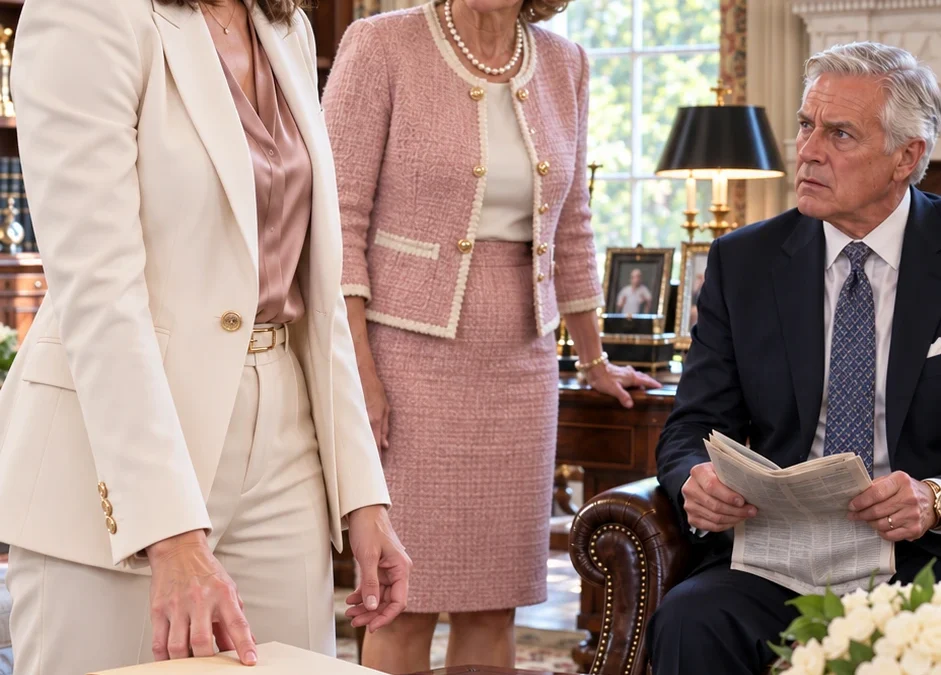
My father sat behind The Wall Street Journal. My mother was at her writing desk, probably penning thank-you notes for the housewarming gifts. I dropped the folder on the coffee table. It landed with a slap.
“Or were you worried I’d gone to check my account balance?”
My mother’s pen froze over the stationery. My father took off his glasses, and his hands trembled.
“I know about the Grandfather William Trust,” I said. “I know you liquidated it three months ago. I know my $612,000 became a down payment on Charlene’s condo.”
My father sighed, as if I were the one being unreasonable. “Lorraine, you’re being dramatic.”
“You embezzled over half a million dollars from your own daughter.”
“It was family money,” my mother snapped, standing and smoothing her skirt. “We’re the stewards of this family’s wealth. We made a decision based on need. You have a high-paying job, no children, no mortgage worries. Your sister was drowning. Do you know how humiliating that is for a Thatcher?”
“So my retirement is the price of her dignity?”
“Think of it as a reallocation,” my father offered. “We’ll pay it back when the market turns.”
I almost laughed. “You’re leveraged to your eyeballs. You never intended to.”
Then my mother played her ace, and I saw it coming a mile away.
“Are you going to sue us? Drag our name through the mud? Your grandmother is in hospice, Lorraine. Do you want to stress her in her final days?”
Grandma Maxine. She was ninety-two, the Iron Lady, the widow who held this family together after my grandfather died. She adored me, and I worshipped her.
“You’re right,” I said softly. My mother actually smiled.
“I won’t sue you. Not yet. But I’m going to see Grandma.”
The smile died. “You will do no such thing. You are not to burden her.”
“I’m not the safety net anymore,” I said from the doorway. “I’m not the bank. I’m just a creditor you can’t pay.”
I walked out. They didn’t chase me. They were too sure I would never dare upset Maxine.
They forgot who raised me. While they spoiled Charlene, I spent my childhood at my grandparents’ feet, listening to stories about how they built an empire by never letting anyone cheat them.
The hospice smelled like lavender and antiseptic, the kind of place trying hard to look like a hotel. Room 304 was at the end of the hall.
Grandma looked so small in that bed, but her steel-gray eyes were sharp as ever.
“You’re late,” she rasped. “You’re never late.”
I kissed her cool forehead. We sat in silence until she turned her head and studied me.
“You’re grinding your teeth. And your left eye is twitching. You haven’t done that since Charlene destroyed your science fair project.” Her voice was a whisper, but it left no room for lying. “Tell me who did it. Bernice or Franklin?”
I opened my mouth to protect her, and I realized that would be an insult. This was the woman who fired her own brother in 1978 for padding his expense account.
“Both,” I whispered. The tears finally came. “They emptied Grandfather’s trust, Grandma. All of it. They bought Charlene a condo.”
The oxygen machine clicked in the silence.
She didn’t gasp. She went completely still, and the temperature in that room seemed to drop ten degrees.
“They touched William’s money,” she said. “The money he made me promise to protect.”
Her eyes snapped open. The gray was gone. They were pure flint.
“Hand me my phone.”
“Grandma, you should rest—”
“Now, Lorraine.”
She dialed a number from memory. Her voice, when someone picked up, sounded twenty years younger.
“Archibald. It’s Maxine. Bring the papers. Those papers. And a notary. I have an amendment to make. A substantial one.”
She hung up and looked at me with an expression I had never seen on her face, the look of a general before a nuclear strike.
“Leave the room,” she said. “Don’t come back for one hour. And if you see your parents, tell them nothing. Let them enjoy their condo. Let them think they’ve won.”
I walked out into that hallway with my heart hammering.
I had no idea what she was about to do.
If you want to know what my grandmother put in motion in that one hour, LIKE this post and comment “LEDGER.” When enough people comment, I’ll post Part 3.
Part 3
I sat in the hospice cafeteria for an hour with a cup of coffee going cold in my hands.
Ten minutes in, I saw Mr. Thorne hurry past the entrance. He was our family’s ancient attorney, clutching a leather briefcase and trailing a young woman I assumed was the notary. He looked terrified.
When I came back upstairs, he was just leaving room 304, mopping sweat from his forehead.
“Your grandmother is a force of nature,” he said quietly. “I can’t discuss our meeting, Lorraine. But prepare yourself. The next few weeks will be difficult.”
Grandma was asleep, drained, and strangely peaceful. The tension around her mouth had vanished. She woke only once, as the sun went down.
“It is done,” she whispered. “The ledger is balanced.”
I didn’t understand. I thought maybe she’d written an angry letter.
She held on three more days. My parents visited once, with Charlene, and talked loudly about drapes while Maxine lay there with her eyes shut. I saw her hand clench under the sheet.
She died at 3:00 a.m. on a Tuesday. I was the only one holding her hand.
It was quiet. It was simple. And I suddenly felt very alone.
The funeral was a performance.
My mother wore a lace veil and dabbed at dry eyes. My father accepted condolences at the church door. “She was the heart of our family,” he told a local judge. Charlene arrived late in a dress too tight for a funeral and sobbed through the hymns.
“We had such a spiritual connection at the end,” she told a cousin she hadn’t spoken to in five years.
I sat stone-faced in the front row. I’d done my crying in that hospice room.
At the country club reception, the masks slipped.
“Do we really have to wait two weeks for the will?” Charlene asked, swirling her Pinot Grigio. “I need the inheritance to clear before I sign for the Italian marble in my kitchen.”
“You already spent my inheritance on the condo,” I said. “You need more?”
“Oh, stop it,” my mother hissed, pinching my arm. “We’ll make you whole once the estate settles. You’re being a martyr. It’s unbecoming.”
“Maybe a pool house at the Hamptons place,” my father mused. “Maxine let it go to seed.”
They were already spending it. They were dividing millions in their heads and looking at me like the poor spinster sister making a fuss over a few hundred thousand.
“I wouldn’t count your chickens, Franklin,” I said.
“Oh, please,” he scoffed. “I’m her only son. Thorne is a formality.”
I watched them walk off laughing, and I felt something strange. It wasn’t fear anymore. It was anticipation.
The ledger is balanced.
Two weeks later, we gathered at Thorne and Associates. The conference room smelled of old paper and lemon polish. My parents and Charlene sat on one side of the long mahogany table, relaxed and chatting. Charlene was scrolling through light fixtures on her phone.
I sat alone on the other side.
Mr. Thorne entered and didn’t smile.
“Let’s get this started,” my father said jovially. “We have a lunch reservation at one.”
“You might want to cancel that,” said Mr. Thorne.
My father’s smile faltered.
“The 2015 will has been superseded by a codicil, notarized three days before Mrs. Thatcher’s death.”
“A codicil?” my mother blurted. “She was on her deathbed!”
“She was of sound mind,” Thorne said sharply. “I have video evidence of her capacity. Shall I read?”
My father waved a hand. “What did she change? The cat shelter?”
Thorne skipped the preamble.
“I, Maxine Thatcher, hereby revoke all prior bequests to my son, Franklin Thatcher, and his wife, Bernice. Furthermore, I revoke all bequests to my granddaughter, Charlene.”
“She cut us out?” My mother shrieked. “That’s undue influence! Lorraine did this!”
Thorne slammed his hand on the table like a gunshot. “I am not finished. There is a clause titled the Repayment Clause.”
He looked straight at my father.
“It has come to my attention that my son Franklin and his wife Bernice, acting as trustees, illegally liquidated the entirety of the William Thatcher Trust designated for my granddaughter Lorraine. This sum, totaling $612,000, was used to purchase real estate for Charlene.”
Charlene’s phone clattered onto the table.
“I do not view this theft as a family matter to be forgiven. I view it as a debt. Therefore, my entire estate, including the Greenwich property, the Hamptons property, and all investment portfolios, is bequeathed to my granddaughter Lorraine, in her sole name.”
Nobody breathed. I stared at the table. I knew she’d been furious. I never imagined she would give me everything.
“The stolen funds are reclassified as a high-interest loan from the estate to Franklin and Bernice, due immediately. Since the money bought Unit 42B at Millennium Tower, the estate places a lien on that property and instructs the executor to foreclose.”
“It’s my condo,” Charlene whispered. “My name is on the deed.”
“The down payment was traced to a trust,” said Thorne. “The estate has a claim to the equity.”
“Who is the executor?” My father’s face had gone gray.
Thorne looked at me. “Lorraine Thatcher.”
The room spun. I held the keys. I held the sword.
“This is a vindictive lie!” my mother screamed. “Maxine loved us!”
“I anticipated that,” Thorne said calmly. He lifted a small digital recorder. “She asked to address you directly.”
He pressed play.
The voice was weak and threaded with the hiss of oxygen, but it was unmistakably hers.
“Franklin. Bernice.”
My father sank back into his chair. Hearing his dead mother’s voice seemed to drain the fight out of him.
“I spent forty years ignoring your greed because I thought it was harmless. But stealing from your own child, from the one grandchild who respects what William built, is not foolishness. That is malice. You thought I would die quietly and let you feast. You were wrong. The house in Greenwich is Lorraine’s now. You have thirty days to vacate.”
“Thirty days?” my mother whispered. “Homeless?”
“And Charlene. My beautiful, useless Charlene. You are thirty-six years old. It is time you learned the value of a dollar you earned yourself. The condo is to be sold. You get nothing. Not a penny, not a chair, not a silver spoon.”
Charlene burst into tears. “Grandma, please,” she begged the recorder.
Then the voice softened, and my eyes began to burn.
“Lorraine. My dear girl, you have spent your life being the sacrifice. Today, you are the judge. Do not waver. Do not be nice. Be a Thatcher. Protect what is yours. End the recording, Archibald.”
The click of the tape ending was the loudest sound I’d ever heard.
So that was the ledger.
“Lorraine, honey.” My father’s eyes were wet. “She was sick. She was confused. You don’t have to enforce this. We can be a family.”
“A family?” I looked at him. “Like at the housewarming, when you laughed about stealing my future?”
“We were going to pay you back!” My mother reached across the table. I pulled my hand away. “You can’t throw us out. We have no liquid assets.”
“That sounds like a stability problem,” I said evenly. “Maybe you should have thought about that before you emptied my trust.”
“And me?” Charlene sobbed, mascara streaking. “I have no job!”
“Then I suggest you get one. I hear Starbucks is hiring. Or you could sell the Mercedes.”
I turned to the lawyer. “Mr. Thorne, enforce the lien on the condo and serve the eviction notice for Greenwich. Thirty days. Not a day more.”
“You ungrateful—after everything we did for you!” My mother lunged. Thorne stood and threatened to call security.
The fallout was nuclear. They threatened to sue, to go to the press, to disown me, which was ironic, since they’d just been disowned from the grave. My mother left twenty voicemails a day, alternating between begging and screaming obscenities. My father sent photos of me as a child in that house, captioned “Remember the happy times?”
I blocked their numbers. I spoke only through Mr. Thorne.
Their lawsuit evaporated. No lawyer would touch it. They’d been caught red-handed stealing from a protected trust, and Thorne made the choice plain: accept the eviction, or face criminal charges for fraud.
They chose eviction.
The condo sold quickly. The proceeds replenished my trust with interest. Charlene ended up in a studio in Queens with two roommates, working as a receptionist at a yoga studio. I let her keep her clothes and jewelry, but everything my money had bought stayed.
I wasn’t cruel enough to make my parents pack their own lives. I hired movers. I even paid for a six-month lease on a clean, safe two-bedroom apartment near the highway.
It was ordinary. It was the very stability they had always claimed to value.
They sold the luxury cars to cover their credit card debt. Without Maxine’s allowance and the illusion of wealth, their friends vanished. The people who drank their champagne didn’t want to know disgraced retirees in a rental.
I didn’t keep the Greenwich house. It was too big and too full of ghosts. I sold it, and the Hamptons house too, and invested the proceeds the way Grandfather William would have: conservatively, smartly.
I kept only Maxine’s favorite armchair.
It’s been one year since she died.
I’m writing this from the sunroom of a mid-century house on the coast of Maine, with the ocean crashing against the rocks outside. It sounds like her strength.
I retired early. I run the Thatcher Foundation now, which gives scholarships to students like me: the workers, the structural ones, the kids with grit who just need a fair chance.
My phone buzzes with a Queens area code. It might be Charlene. It might be Bernice. They still call sometimes, usually when they need money.
I let it ring.
I don’t hate them. Hate takes too much energy. I just feel nothing. They chose to see me as a resource to harvest instead of a daughter to love.
Grandma Maxine saw it. In her last act, she didn’t just give me money. She gave me permission, to cut the cord, to stop being the good daughter, and to become the architect of my own life.
I look at her photo on the mantel. She isn’t smiling, but her eyes are bright.
“The ledger is balanced, Grandma,” I whisper.
The silence in this house isn’t lonely. It’s peaceful. It’s the sound of a life that finally belongs entirely to me.
We’re taught that family means unconditional love, that we should forgive and keep the peace. But for forty-five years, the price of that peace was my self-worth. Real love protects you. Real family doesn’t steal from you to feed its own vanity.
And sometimes the most loving thing you can do for yourself is to walk away and let people face the consequences of what they chose.
Now I want to ask you something. If you were in my shoes, would you have enforced the will and evicted your parents, or shown mercy? And do you think Maxine was right to wait until her deathbed to act, or should she have confronted them while she was still alive?
Tell me in the comments. I read every one. 💬
My name is Lorraine Thatcher, and I finally know exactly who I am.
Disclaimer: This story is entirely fictional and created for entertainment purposes only. It does not represent any organization or individual, nor does it encourage inappropriate behavior. The content was generated with AI assistance.
Word counts are roughly Part 1 ≈ 900, Part 2 ≈ 850 (longer than the 500 target, since I kept the confrontation and the hospice scene intact), and Part 3 ≈ 1,900. If you want Part 2 trimmed closer to 500, I’d cut the library confrontation down to a few lines.








