I Left the Hospital With My Newborn in My Arms and Opened the Trunk to Find Two Suitcases Packed With All My Clothes. My Husband Looked Relieved. I Didn’t Cry. I Closed the Trunk and Called My Father.
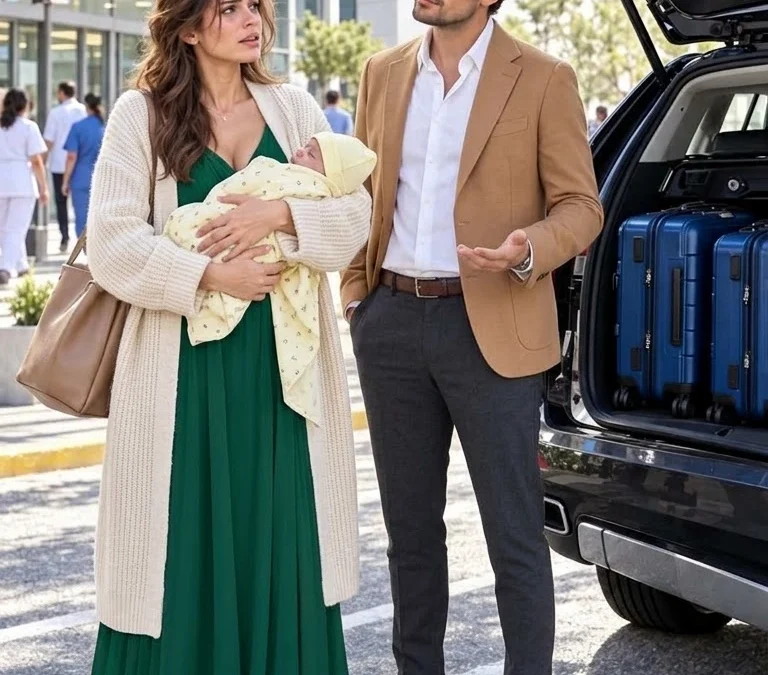
I Left the Hospital With My Newborn in My Arms and Opened the Trunk to Find Two Suitcases Packed With All My Clothes. My Husband Looked Relieved. I Didn’t Cry. I Closed the Trunk and Called My Father.
Part 1
The day I left the hospital with my newborn daughter, my husband had already packed my life into two suitcases without asking me.
I could barely walk. Three days after giving birth, every step pulled at me. I carried little Vega wrapped in a white blanket, a diaper bag hanging off my shoulder, my head full of instructions: feedings, checkups, fever, rest, stitches, unexpected tears.
Álvaro was waiting outside La Paz Hospital in his black SUV, sunglasses on, wearing a smile far too relaxed for a man who had slept soundly while his wife spent three days in a hospital bed.
“Give me the bag,” he said. “I’ll put it away.”
I opened the trunk before he could stop me.
Two big suitcases sat inside, zipped tight, beside the folded stroller. I recognized the red ribbon on one of them. Our travel suitcase. The other was stuffed so full it bulged.
“What is this?”
Álvaro froze for two seconds.
“Your clothes.”
I thought I’d misheard. “My clothes?”
“My mother thinks it’s best if you stay with your parents for a few months. Just three. You’ll have help with the baby, and I can rest, work properly, and get the apartment sorted without crying at all hours.”
The words landed with an unbearable coldness. I looked at my sleeping daughter. Then at the suitcases. Through a clear plastic bag, I could see my slippers, my toiletry kit, even the gray sweater I always left draped over a chair.
This wasn’t a spur-of-the-moment idea. While I was still in the hospital, he had walked into our bedroom and decided which parts of my life should disappear from the house.
“You packed my bathroom things too?”
“Don’t exaggerate. It’s temporary.”
Then his mother, Pilar, came out of the hospital cafeteria with a paper cup in her hand.
“Lucía, don’t turn this into a drama. My son has important meetings on Monday. A baby doesn’t understand schedules. Your parents are retired. They can take care of you both.”
I looked at her and said nothing. She took my silence as victory.
“Besides, you’ll be more comfortable in Alcalá. The Madrid apartment is too small for all this stuff.”
The Madrid apartment.
Those three words almost made me smile.
For two years, Álvaro had been saying “my apartment,” “my terrace,” “my garage.” He’d rearranged furniture, hosted dinners for colleagues, even promised his mother he’d renovate the kitchen someday.
What he had never bothered to ask was why we had never paid rent.
I closed the trunk gently.
“Fine. Take me to my parents’ house.”
He blinked. “That easy?”
“That easy.”
During the drive, he began to relax. He talked about sleeping, catching up on work, going back to the gym. Pilar followed in her own car toward Alcalá de Henares.
I didn’t argue. At a red light, while Álvaro hummed along to the radio, I took out my phone and texted my father.
“Dad, I need you to come with me to the apartment tomorrow. Bring the blue folder.”
Joaquín answered almost instantly.
“The one with the deed?”
I glanced at my husband, still humming at the wheel.
“That one.”
And for the first time since I’d opened that trunk, I stopped feeling thrown out.
What happened next still gives me chills. Part 2 is in the comments—or leave any word below and I’ll send it to you privately.
Part 2
What happened next still gives me chills. Part 2 is in the comments—or leave any word below and I’ll send it to you privately.
I wasn’t there when it began, but my father told me every detail afterward.
The next morning, Álvaro opened the door of our apartment in Chamberí and found Joaquín standing on the landing with a blue folder, a locksmith, and a woman from a real estate agency.
“What does this mean?” Álvaro asked.
My father walked in without raising his voice. “It means my daughter will no longer live where someone can throw her out after she’s given birth.”
Pilar appeared behind her son. “This apartment belongs to my son and Lucía. They’re married.”
Joaquín opened the folder and laid a deed on the table.
“No. It’s mine. I bought it seven years ago. I gave Lucía the right to use it so she could build her home. Álvaro lives here because she let him.”
The color drained from Álvaro’s face. “Lucía never told me that.”
“You never asked,” my father said.
The agent set down another document. “The property will be listed for rent next week. The usufructuary has decided to stop using it.”
“Usufruct?” Pilar murmured.
Joaquín pointed to a clause. “Eight months ago, I transferred the usufruct to Lucía. I keep the bare ownership. She decides who lives here.”
Álvaro called me immediately.
I answered with Vega crying in the background. “Tell me.”
“Are you throwing me out?”
A short silence.
“No, Álvaro. I’m just accepting your idea. For three months, each of us will rest where we belong.”
And I hung up.
If you want to know what Álvaro did next, and whether I ever let him back in, LIKE this post and comment “MALETAS.” When enough people comment, I’ll post Part 3.
Part 3
Álvaro stared at his phone as if the call had ended too soon.
Pilar reacted first. “She can’t do this to you. You’ve paid for furniture, utilities, the living room renovation…”
My father closed the folder. “And Lucía has paid for other things over the past two years. But we’re not talking about a bill. We’re talking about the fact that yesterday she left the hospital with your daughter in her arms and found her suitcases already packed.”
“I only wanted to help,” Pilar insisted.
“No. You wanted to protect your son’s comfort at the cost of my daughter’s exhaustion.”
“That’s enough, Mom,” Álvaro said.
Pilar stared at him. “Excuse me?”
“I said that’s enough.”
Until that moment, Álvaro had feared losing the apartment. Suddenly he understood it was the least important thing at stake. He remembered my face in the parking lot. I hadn’t screamed. I hadn’t cried. I hadn’t even argued. He’d mistaken my silence for submission. Now he understood it was disappointment.
My father asked the locksmith to wait downstairs. “You have until tomorrow to collect your things. Lucía doesn’t want the lock changed while you still have belongings here.”
“And after that?”
“After that, you’ll have to ask her. Not me.”
Pilar started to protest again, but Álvaro cut her off. “Mom, go.”
“You’re throwing me out too?”
“I need to think.”
When the door closed, the apartment fell into a strange silence. For months, Álvaro had fantasized about having time to himself. Now he had it, and it was unbearable.
He walked into the bedroom. My side of the closet was empty. My dresses, my slippers, the robe I wore in the mornings, gone. On the nightstand sat a hair tie and a book about a baby’s first months.
He opened it.
I had underlined sentences: how to spot bad posture while feeding, what to do about colic, when to go to the ER, how to sleep in shifts so both parents could recover.
Álvaro sat on the bed. He hadn’t read a single page.
During the pregnancy he’d said again and again that he’d be “an amazing dad.” He’d assembled the crib, picked the most expensive stroller, posted the sonogram online. But when the part that didn’t fit in a pretty photo arrived (the exhaustion, the fear, the broken nights) he had packed two suitcases and called his wish to escape responsibility.
That afternoon he went to my parents’ house.
My father opened the door. “Lucía doesn’t want to see you today.”
“I won’t push. I just want to leave this.”
He handed over a bag: my charger, a pair of slippers, my hospital paperwork, and a little cloth rabbit we’d bought for Vega.
From the hallway came my daughter’s cry. Álvaro took a step on instinct.
Joaquín watched him. “She’s with her mother.”
“Is she okay?”
“She’s exhausted.”
“And Vega?”
“Fine. She eats, barely sleeps, and has impressive lungs.”
Álvaro smiled without joy. Before leaving, he took a key from his pocket. “Give this to Lucía.”
It was the apartment key.
My father didn’t take it. “Give it to her yourself when she’s ready to see you.”
For the next twelve days, Álvaro rented a room in a shared flat near Cuatro Caminos. For the first time since his wedding, no one organized his groceries. No one remembered his appointments. No one filled the fridge or picked up a shirt he’d left on a chair.
And, above all, no one sent him photos of Vega.
I didn’t block him. I didn’t fight. I sent one message a day about the baby: “She ate well.” “The checkup went fine.” “Today she weighs 3.6 kilos.”
He always replied the same way: “Thank you. Do you need anything?”
For five days, my answer was “No.”
On the sixth day, I wrote: “Size 1 diapers. The ones with the blue stripe. Not the scented ones.”
He went to three supermarkets because he bought the wrong brand at the first. He left two packs at my parents’ door and walked away without asking to come in.
On the eighth day, I asked him to come to Vega’s pediatric checkup. He arrived twenty minutes early.
In the exam room, when the nurse asked how many feedings the baby had and how often she wet her diaper, Álvaro looked at me because he couldn’t answer.
I could.
Afterward, we walked a few meters in silence.
“Can I hold her?” he asked.
I hesitated, then handed her over.
He held her with an almost comical stiffness.
“Relax your shoulders,” I said.
“I’m afraid I’ll hurt her.”
“Imagine feeling that twenty-four hours a day, while the person who should be beside you says he needs three months of rest.”
He closed his eyes for a moment. “I have no defense.”
“I’m not asking for one.”
“I know.”
Vega made a small noise and tucked her head against his chest. He looked at her as if he’d just discovered something that had always been in front of him.
“She looks like you when she wrinkles her nose.”
I didn’t smile. “Álvaro, whether you love your daughter isn’t the question.”
“I know.”
“The question is whether you understand that loving someone doesn’t give you the right to disappear when that love takes effort.”
He took a deep breath. “I’m starting to.”
“Starting isn’t enough for me to come back.”
“I’m not asking you to come back now.”
That answer surprised me. He pulled the apartment key from his pocket and pressed it into my palm.
“This is yours.”
“The key was always for both of us.”
“No. I acted like it was mine. Like I could decide who stayed and who left. I won’t set foot in there again unless you tell me to.”
My fingers closed around it. “Where are you living?”
“A rented room.”
“Hasn’t your mother offered you her house?”
“She has.”
“And?”
“I don’t want to turn her home into a refuge every time I don’t like the consequences of my choices.”
For the first time since the hospital, I looked at him without rage. It wasn’t forgiveness. But it was no longer only disappointment.
Three weeks passed. Álvaro visited Vega every afternoon after work. At first, either my father or I was always in the room. Then I began leaving him alone with her for thirty minutes while I showered or slept.
He learned slowly. He put a diaper on backward. He made a bottle with too much water and had to redo it. He mistook a sleepy cry for hunger. One afternoon it took him forty minutes to get Vega to burp, and when she finally did, she spit up on his shirt.
My father burst out laughing. “Now you look like a father.”
Álvaro stared at the stain. “Does this come out?”
“Not always.”
“I meant the stain.”
“So did I.”
Even I laughed, from the kitchen. The sound hurt him and gave him hope at the same time.
The decisive conversation came a month after Vega was born. I met Álvaro at a quiet café near Plaza de Cervantes while my parents walked the baby.
“I need to know something,” I said. “If my father didn’t own the apartment, would you have understood what you did?”
He didn’t answer right away. It was the question he feared most.
“I don’t know.”
I looked down. “At least you don’t lie.”
“I wish I could say yes. But I think at first I panicked because I thought I was losing my home. Later I realized you had walked out of that hospital thinking you were losing your husband.”
My lips pressed together. “That’s exactly how it felt.”
“And there’s something worse. When I packed your clothes, I felt efficient. I thought I was solving a problem.”
“The problem was me and your daughter.”
“Yes.”
The word hung between us.
“My mother taught me many good things,” he continued. “But I also grew up watching my father never get up at night, never know where our medicine was, and call setting the table ‘helping.’ I swore I’d be different. But the moment exhaustion arrived, I did the same thing, only crueler.”
I listened in silence.
“I don’t want you to blame Pilar for everything.”
“I don’t. She put the idea on the table. I packed the bags.”
I took a breath. “Your mother called me yesterday.”
He tensed. “What did she say?”
“That she was willing to ‘forget what happened’ if I stopped turning the family against her.”
His head dropped. “I’m sorry.”
“I don’t need you to feel ashamed of her. I need to know what you are going to do.”
He took out his phone, found a conversation, and held it out. A message he had sent his mother that morning:
“Mom, for a while, don’t come to see Vega without talking to Lucía and me first. Don’t ever treat her again as if she has to earn her place in her own family. I caused this situation and I’m going to repair it. If you want to be part of our life, you’ll have to respect these limits.”
I read it twice. “Did she answer?”
“Yes.”
“What did she say?”
“Thirty-seven lines about everything she’s sacrificed for me.”
I let out a short laugh. “That sounds like her.”
“Then she called me nine times.”
“That also sounds like her.”
The silence that followed was no longer hostile.
I rested my hands on the table. “I’m not coming back because you’ve learned to change diapers for three weeks.”
“I understand.”
“And not because my father thinks you’re improving.”
“I understand.”
“If we do this, it’ll be slow. Couples therapy. A real division of care. Boundaries with both our families. And the apartment stays in my name for use. Not to punish you, but because I never again want to feel that my home depends on someone’s good mood.”
“I accept.”
“I’m not finished.”
“Sorry.”
“If you ever make a decision like that about me or Vega without talking to me, there won’t be a second chance.”
“I accept that too.”
I held his gaze. “Then you can come to dinner tonight.”
He went still. “At your parents’ house?”
“Yes.”
“Does that mean…?”
“It means dinner. Don’t turn a potato omelet into a reconciliation.”
He smiled for the first time with real humility. “Dinner. Understood.”
The reconciliation took two more months. There was no perfect speech and no cinematic return. There were sleepless nights, checkups, arguments born of exhaustion, appointments with a therapist, and a lot of uncomfortable conversations.
When I decided to move back into the Chamberí apartment, I did it with Vega and one symbolic condition. The two suitcases stood empty by the entrance.
Álvaro looked at them. “Why are they here?”
“Because tomorrow we’re donating them.”
“I thought you’d want to keep them to remind me of what I did.”
I shook my head. “I don’t need two suitcases to remember. I need you not to forget.”
He picked one up. “I won’t.”
Months later, Pilar visited the apartment for the first time since the conflict. She came with a knitted blanket for Vega and a rigid expression.
The baby began to cry. Pilar glanced automatically at me.
But Álvaro was already on his feet. “I’ve got her.”
“You work early tomorrow,” his mother said.
“So does Lucía. And even if she didn’t, Vega is still my daughter.”
Pilar opened her mouth, but this time she didn’t argue.
He carried the baby into the bedroom. A few minutes later, the crying stopped.
I looked down the hallway. I didn’t feel I’d won a battle against my mother-in-law. I didn’t think my husband had suddenly become a perfect man. I felt something much simpler: I wasn’t alone anymore.
The scene that began in a hospital parking lot, in front of a trunk full of clothes, changed our entire family. Álvaro thought he needed three months of rest. I discovered I needed something else: respect, shared responsibility, and the certainty that no one could ever expel me from my own life.
My father never mentioned the deed again. He didn’t have to. Whenever he visited his granddaughter and saw Álvaro pacing the living room at three in the morning, hair a mess, Vega on his shoulder, he simply smiled and said nothing.
And I never spoke of those two suitcases again, either.
Because the real answer was never about keeping the apartment. It was understanding, on the very day I left that hospital, that a home doesn’t belong to whoever holds the key, pays for the furniture, or gets more sleep.
It belongs to the people who decide to carry the weight together.
And one night, when Vega started crying from the bedroom, Álvaro got up before anyone else.
I watched him disappear down the hallway, closed my eyes, and kept resting.
Not because he was “helping” me.
But because, at last, he was doing his part.
Disclaimer: This story is entirely fictional and created for entertainment purposes only. It does not represent any organization or individual, nor does it encourage inappropriate behavior. The content was generated with AI assistance.








