I Pulled a Stranger Out of a Ravine and Let Him Sleep in My Home. Weeks Later, a Rich Landowner Came to Take Everything. Then a Carriage Pulled Up. 😳
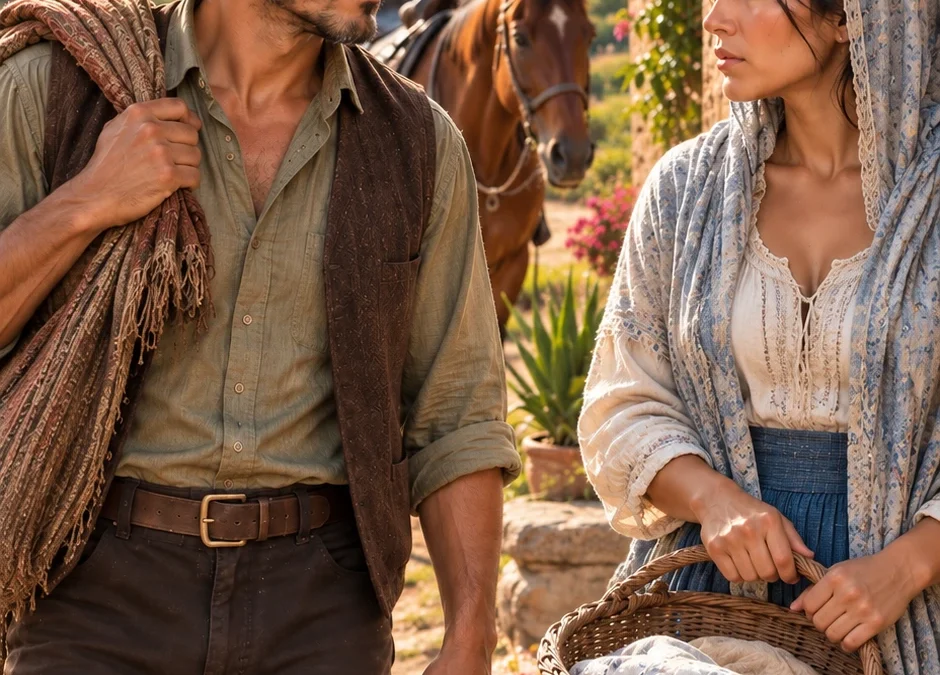
I Pulled a Stranger Out of a Ravine and Let Him Sleep in My Home. Weeks Later, a Rich Landowner Came to Take Everything. Then a Carriage Pulled Up. 😳
Part 1
I should have been afraid of him.
That’s what everyone said afterward. A widow alone with a little girl, taking a strange man into her home. But the night I found him at the bottom of that ravine, I wasn’t thinking about fear. I was thinking about how I would have wanted someone to stop for my husband.
My name is Elena Salgado. I live on the edge of San Miguel de las Flores, in Guanajuato, in a small adobe house my parents left me.
Since my husband died, I’ve held our life together with my own hands. I sew for other families. I bake bread before sunrise. I wash clothes until my knuckles crack in the cold.
My daughter Marisol is small, but she already understands why her mother counts coins twice before going to the market. 💔
That afternoon we were walking home through a storm. The rain came down so hard the road turned to mud under our feet.
Marisol saw him first.
“Mamá. There’s someone down there.”
A horse had slipped on the wet slope. The man lay at the bottom of the ravine, soaked and pale, one leg bent wrong. He was barely conscious.
Two riders had passed that road ahead of us. I saw their hoofprints. They hadn’t stopped.
I stood there with the rain running down my face and every sensible thought telling me to keep walking. I didn’t know who he was. I didn’t know what trouble he carried. I barely had enough food for the two of us.
Then he opened his eyes and looked at me, and something in my chest gave way.
We dragged him up that slope together, my daughter and I. I don’t know how.
He said his name was Esteban. No last name. His clothes were a day laborer’s, but his hands were too smooth for a man who worked the fields. And the way he spoke… I noticed it the first night. Careful. Educated.
I decided not to ask.
I gave him my only cot. I heated water, cleaned his leg, and made soup from almost nothing.
“Will he pay us for staying?” Marisol whispered in the kitchen.
I looked at my daughter and gave her the only answer I’ve ever believed in.
“When someone needs help, you help them first. Everything else comes later.”
I expected him to leave the moment he could stand.
He didn’t.
He started carrying firewood. He mended the fence the goats had broken. In the evenings he sat beside Marisol while I sewed and taught her to write her own name on scraps of paper he brought back from the village.
He could read as easily as breathing. And he never once made me feel small for the things I couldn’t.
One night he carved a little wooden horse for my daughter. She slept with it beside her pillow from then on.
I told myself not to get used to it.
But without meaning to, I started trusting him. 🕯️
One evening I was putting away my silver thimble, the only thing I have left of my mother, when he asked a quiet question.
“Why have you never sold this land, Elena? It seems to cost you more than it gives.”
My fingers closed around the thimble.
“Because what a person inherits with dignity isn’t sold out of fear.”
He didn’t answer. He only looked at me for a long moment, as if I’d said something he’d been waiting years to hear.
The next morning, everything started to fall apart.
A new fence had been built across the path to the stream where I do my washing. Overnight. No warning.
By noon, two clients had cancelled their sewing orders. By afternoon, the baker told me he wouldn’t be buying my bread anymore. He wouldn’t look me in the eye.
I went to Doña Mercedes, the old neighbor who has known me since I was a girl. She listened, set down her cup, and didn’t hesitate for a second.
“This has Rogelio Barragán’s name on it, mija.”
My blood went cold.
Don Rogelio owns half the valley. For months he had been trying to buy my land. I’d said no every time. Politely. Firmly. Every time.
I walked home with my stomach in knots, thinking that a man like that doesn’t take no for an answer.
I was right.
Before Esteban even came back from the village, a horse stopped outside my door. Don Rogelio Barragán stepped down with a folded paper in his hand and a smile that made my skin crawl.
And I understood, in that instant, that he hadn’t come to buy my home.
He had come to take it.
What happened next still gives me chills. Part 2 is in the comments—or leave any word below and I’ll send it to you privately.
Part 2
What happened next still gives me chills. Part 2 is in the comments—or leave any word below and I’ll send it to you privately.
Don Rogelio didn’t raise his voice. That was the worst part.
“An old registry error, Elena,” he said, holding up the paper. “It seems your little plot has always belonged to my hacienda. Naturally, I’m a generous man. I’ll pay you something so you can leave quietly.”
I barely glanced at the document.
“This land belonged to my grandparents, then my parents. Now it belongs to my daughter and me.”
He smiled that calm, terrible smile.
“You have a few days to think. After that, we’ll see the judge.”
He mounted his horse and rode off. I stood in the doorway until my hands stopped shaking.
When Esteban came back, I tried to act as if nothing had happened. I didn’t want him to know the work was disappearing. Or that my neighbors were suddenly “too busy” to speak to me.
But he saw the paper on the table.
In the end, I told him everything.
He went very quiet.
“Maybe I can help.”
“How?”
He took too long to answer. “I know people. I have more resources than I seem to.”
Something cold and familiar went through me.
For weeks this man had slept under my roof, eaten at my table, and become part of my daughter’s days. And I still knew nothing about him. Not where he came from. Not who he really was.
“I don’t want charity,” I said. “I don’t want favors that come with secrets. I want the truth.”
He lowered his eyes. He said he’d tell me. But he asked for time.
That hurt more than I wanted to admit.
When I woke up the next morning, his cot was empty. All he’d left was a short note promising to come back.
Three days passed with no word.
Meanwhile, Don Rogelio closed another door on me. A neighbor who had always lent me his cart suddenly stopped. Marisol kept asking where Esteban was, and I told her maybe he’d found his own road.
But inside, I felt like the biggest fool alive.
At night, my daughter held that little wooden horse and asked if he’d return to teach her a new word. I wouldn’t promise her anything.
The truth is, it wasn’t only his help I missed. It was his voice in the courtyard. His clumsy attempts at kneading dough. The strange calm he’d brought into a house that had learned only to survive.
On the fourth night, Marisol woke up burning with fever.
I sat beside her for hours, wiping her forehead, remembering how Esteban had once handed her water and told her stories until she fell asleep. His absence filled every corner of that house.
By morning the fever broke.
But Don Rogelio’s deadline didn’t.
That afternoon a wagon rolled up to my door. Several men climbed down, and with them a clerk carrying official papers. Don Rogelio stepped out last, smiling like a man who had already won.
“Time’s up, Elena.”
I took Marisol’s hand. I put my back against my own front door. I didn’t cry. I didn’t beg.
My heart was hammering so hard I thought everyone could hear it.
Then I heard hooves behind us.
A dark carriage rolled to a stop on the road. The door opened. A man stepped out in an impeccable suit, flanked by a lawyer and two officers of the law.
It took me several seconds to recognize his face.
It was Esteban.
But everyone else around me was already whispering a different name.
Don Esteban Cárdenas. Owner of the largest hacienda in the entire region.
If you want to know what I said to him, LIKE this post and comment “DEDAL.” When enough people comment, I’ll post Part 3.
Part 3
My first feeling was relief. My second was shame for feeling relief at all.
Esteban walked toward Don Rogelio with a certainty I had never seen in him, not once, not while he was hauling firewood in my yard. His lawyer opened a leather folder and spoke clearly, so the clerk and every neighbor in that crowd could hear.
The title Don Rogelio had shown me was forged. There was a certified copy of the original land registry, recognizing the Salgado family as owners for decades. There were sworn statements from people who had watched the boundaries since before Don Rogelio was born.
The eviction was stopped, right there on my doorstep. An investigation was opened.
Don Rogelio tried to protest. The officers told him to step away.
I barely heard the rest. I was staring at Esteban like I was seeing two men laid over each other. The awkward laborer who had learned to use my grinding stone. And the powerful man everyone suddenly treated with instant respect.
When the crowd finally thinned and we were alone, I didn’t thank him.
“Who are you?”
He took off his hat. “My name is Esteban Cárdenas. The hacienda El Encino is mine.”
The words fell between us heavier than any threat Don Rogelio had made.
I thought of the soup we’d shared. The cot I gave him. The afternoons Marisol learned to write with him. My mother’s thimble in my hands while he asked me why I never sold.
None of it had felt false. That was exactly why the lie hurt so much.
“I opened my door without knowing if you had a single coin,” I said. “I don’t care about your money. I care that you knew who you were while I trusted a man who wasn’t whole.”
He didn’t argue.
He told me he had been a widower for years. That he was tired of people approaching his surname before they ever approached him. So he had left his hacienda dressed as a common worker to find out how the world would treat him without privilege.
“The storm was real,” he said. “The fall was real. The days in your house were real. The man you met wasn’t an act. But hiding my name was a failure of trust.”
I was grateful he didn’t dress up a bad decision as something noble.
“I need you to go,” I said.
He nodded.
Marisol appeared from behind the door, her eyes full of questions. My heart cracked watching her look for him. But I didn’t change my answer.
For weeks, I didn’t see him.
The investigation into Don Rogelio moved forward. My land was legally protected. A few merchants came back to my door, embarrassed, offering work. I accepted only when the terms were fair. I didn’t want pity to replace respect.
Then, one Monday, a man named Anselmo, the administrator of El Encino, arrived with a letter. No money. No gifts.
It was a job offer.
The hacienda was opening a community sewing workshop and a small bakery for women who needed steady income. There would also be a school for the children of workers and nearby families. Esteban was asking me to coordinate the workshop, with a fixed salary and full authority to choose who worked there.
I nearly tore the letter in half.
Doña Mercedes stopped my hand.
“If he offered you jewels, tell him to keep them. But if he offers you work so other women don’t suffer what you suffered, don’t confuse pride with dignity.”
That night I read the letter three times. There were no personal conditions. Nothing about forgiveness. Nothing about marriage or gratitude. Only duties, wages, hours, and decisions.
I accepted.
But I watched him carefully.
I needed to know whether the kind man from my house survived when nobody was forcing him to be humble. So I watched him listen to a seamstress who needed her hours changed. I watched him correct an administrator who had humiliated a farmhand. I watched him sit in the new school, teaching letters to children the way he’d once taught my daughter.
Still, I kept my distance.
Marisol started school and flew ahead. One afternoon she ran home with a book pressed to her chest.
“Mamá, Don Esteban said someday I can read every book I want. I already started.”
I smiled. Then I had to turn around so she wouldn’t see my eyes.
The months passed. The workshop began with six women. Soon there were many more. The bakery sold at fair prices, and families who used to live off favors began living off their own work.
I realized it looked a lot like the dream I’d kept since I was young: helping other people learn, organize, and stand without bowing their heads.
One evening I found Esteban under a mesquite tree, carving a small wooden horse.
“Another one for Marisol?”
He smiled. “For a worker’s son. His birthday is tomorrow.”
I sat beside him. For a while we only listened to the knife moving against the wood.
“I miss him,” I admitted.
He stopped carving. “Who?”
“The man who showed up drenched at my door and couldn’t cut firewood without hurting his hands.”
“I’m still that man.”
“I know. But now I also know you could have told me the truth, and you chose not to.”
He didn’t look for an easy answer.
“Yes.”
That single word, with no excuses attached, gave me something I hadn’t expected. Peace.
“I haven’t fully forgiven you.”
“You don’t have to. Not today.”
After that, we began talking again. Slowly. No hiding behind an unfinished identity this time. He told me about his late wife, and about the loneliness that had turned distrust into a habit. I told him about my marriage, and about my fear of depending on someone and losing the ground beneath my feet again.
Things changed between us because, for the first time, neither of us was trying to impress the other.
Almost a year after the storm, I was going over the workshop accounts when he walked in carrying a small wooden box.
I eyed it. “If that’s jewelry, it can go right back where it came from.”
He laughed and opened it.
Inside was my mother’s silver thimble. He hadn’t replaced it. He hadn’t polished away its scratches. He had only added a small base so I could wear it as a brooch without losing its shape.
I touched it with trembling fingers.
“Why?”
“Because it was the first thing that taught me some things are worth what they’ve carried, not what they cost.”
I looked up.
He didn’t kneel. He didn’t make a speech in front of anyone. He simply asked if I wanted to build a life with him. No tests. No disguises. No promises neither of us could keep.
I didn’t answer right away.
I thought of the ravine. The soup divided three ways. The rage of discovering his lie. And all those months afterward, when he had more than enough money to buy my comfort, but chose instead to earn my trust slowly.
“Yes,” I finally said. “But on one condition.”
“Anything.”
“Never again decide for me which truth I can handle.”
He held out his hand.
“Never.”
We married in the village church. Marisol carried the rings. I wore the thimble as a brooch on a dress I had sewn myself. ❤️
I kept running the workshop. I expanded the school. I insisted that work be paid with justice.
Years later, El Encino was known for its school, its workshop, and its bakery. Marisol grew up surrounded by books and decided she wanted to study law, to defend families who had no one. As for Don Rogelio, he left the region after his abuses were exposed.
But I never told our story as the tale of a poor woman rescued by a rich man.
Every time someone told it that way, I corrected them. Yes, Esteban protected my land when he finally had the means. But before he ever carried a famous last name, I was the one who lifted him out of the mud when everyone else rode past.
Maybe that’s why our marriage survived something that could have destroyed it from the start. We both learned that helping someone doesn’t give you the right to decide for them. And that loving someone doesn’t mean hiding the truth “for their own good.”
On quiet nights, I still keep the thimble in a little box beside my bed. Sometimes I hold it and remember that storm.
I don’t think about the fortune that arrived later.
I think about my front door. A nearly empty pot. And the choice to share the little I had with a stranger.
Because in the end, Esteban’s money saved a piece of land.
But my dignity saved the man he had forgotten how to be. 🕯️
Disclaimer: This story is entirely fictional and created for entertainment purposes only. It does not represent any organization or individual, nor does it encourage inappropriate behavior. The content was generated with AI assistance.








