I Walked Into Court 8 Months Pregnant, Ready to Give Up Everything While My Husband’s Mistress Smiled at Me. Then My 8-Year-Old Stepdaughter Whispered, “There’s a Recording.”
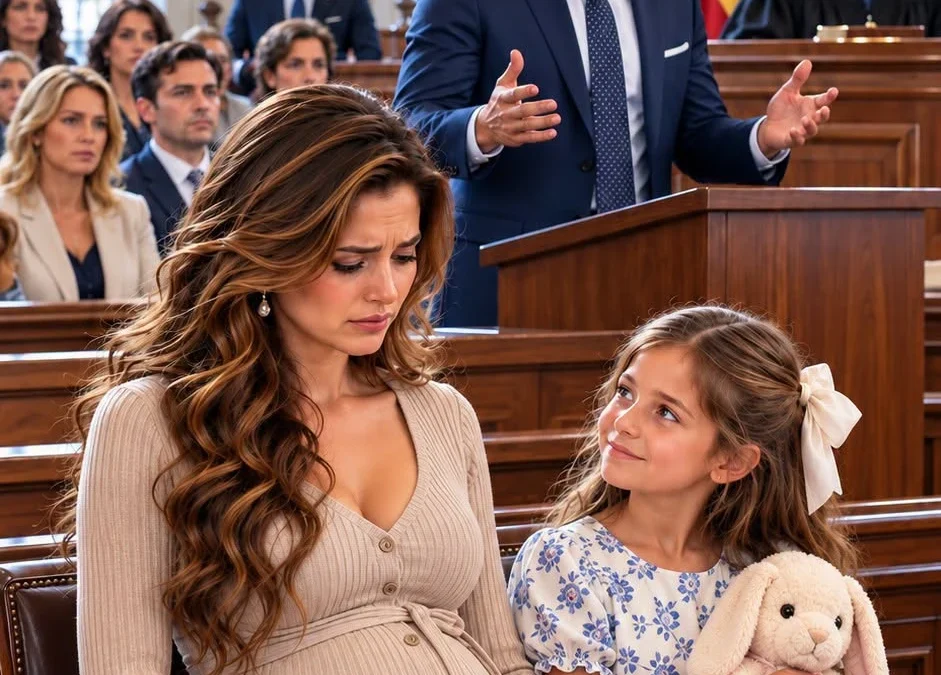
I Walked Into Court 8 Months Pregnant, Ready to Give Up Everything While My Husband’s Mistress Smiled at Me. Then My 8-Year-Old Stepdaughter Whispered, “There’s a Recording.”
Part 1
At 9:42 a.m., eight months pregnant, with swollen ankles and a heart that had stopped arguing, I stood up in front of the judge and said I was willing to give up everything.
The apartment in Pozuelo. Two cars. Almost every share I had built up over six years of marriage.
Across the room, the woman sleeping with my husband smiled as if she’d just heard a verdict in her favor.
I saw that smile.
And I kept going anyway.
“I just want this over before my son is born,” I said.
My husband, Sergio Alcázar, runs a family renovation and property development company. He tilted his head with practiced sadness.
For months, he’d repeated the same line to everyone who would listen: Adriana is too sensitive because of the pregnancy. I forgot things. I misread messages. I mixed up schedules. I got upset for no reason.
Every time I asked about his dinners with Verónica Ledesma, the company’s financial advisor, he’d end up saying the same thing.
“You can’t keep putting the baby through this stress.”
And it worked.
Every single time, I stopped arguing. 💔
That’s why I’d walked into the Family Court of Madrid that morning convinced that giving in was the only way to buy back my peace.
The judge, Irene Valero, looked over the document.
“Mrs. Salvatierra, it says here you’re also waiving your right to request an immediate review of certain corporate transactions. Do you understand what you’re signing?”
“Yes.”
“Are you making this decision without pressure?”
I opened my mouth.
Sergio looked at me.
I knew that look. I had known it for months.
Don’t make another problem.
He didn’t say it out loud. He never had to.
“I want to finish this as soon as possible,” I answered.
The judge didn’t sign.
She closed the folder.
“First I need to resolve an incident.”
Sergio shifted in his seat. “What incident?”
Judge Valero pointed to a side door.
“A minor delivered something to this court this morning, related to these proceedings.”
A sharp twinge ran through my belly.
The door opened.
Paula walked in. Sergio’s daughter. Eight years old.
She wore a red jacket over her school uniform, and she held a stuffed fox against her chest, one ear coming unstitched.
I had known her since she was three.
I never asked her to call me Mamá. I never tried to replace anyone. But I was the one who sat beside her bed when she had a fever. I made her sandwiches for school trips. I knew she needed her door left slightly open during thunderstorms.
Paula looked at her father.
Then at me.
She crossed the courtroom and sat down beside me.
Sergio stood. “My daughter shouldn’t be here.”
“Which is exactly why we’re going to be very careful,” the judge replied.
Paula pulled a folded sheet from her pocket.
“I found it in Papá’s car.”
“Paula,” Sergio said.
She flinched.
Judge Valero raised a hand. “Do not address her that way again.”
My lawyer unfolded the paper.
The handwriting was Sergio’s. I recognized it before I read the first word.
Verónica: don’t push in front of Paula. Adriana already thinks she can’t manage anything alone. We need to close the deal before the birth. After that, it’ll be much harder to move the company and the apartment.
For a few seconds, I forgot how to breathe.
Verónica’s smile disappeared.
Sergio muttered that it was taken out of context.
Then Paula leaned toward my ear.
“There’s something else.”
“What?”
She glanced at her father.
“A recording.”
Inside me, the baby moved.
“What can you hear?”
Paula squeezed her stuffed fox.
“Papá. Saying what he’s going to do after the baby’s born.”
What happened next still gives me chills. Part 2 is in the comments—or leave any word below and I’ll send it to you privately.
Part 2
What happened next still gives me chills. Part 2 is in the comments—or leave any word below and I’ll send it to you privately.
The judge suspended all signatures.
Sergio protested at once. “We’re talking about a private note found by a child. This is absurd.”
“We are talking about whether a pregnant woman was waiving financial rights voluntarily,” Judge Valero said, “while someone designed a strategy to convince her she was incapable of defending them.”
Verónica crossed her arms.
For the first time, she looked nervous.
Paula told the court she’d been hearing conversations from the kitchen for weeks. Sergio thought she was watching cartoons in the living room, but one night she had turned the volume down.
“Verónica said they had to take ‘the important things’ out before the baby was born.”
“That’s a lie,” Sergio snapped.
Verónica turned on him.
“Don’t call it a lie. You said Adriana would never ask to review the accounts if she signed first.”
Silence. Immediate.
His own lawyer put a hand to his forehead.
Verónica realized too late what she had just admitted.
“You told me it would be legal,” she added, no longer looking at anyone. “That she wanted to leave and you were only speeding things up.”
Sergio clenched his teeth. “Shut up.”
“I’m not carrying this alone.”
I was watching Paula. Her face had gone pale.
“Why didn’t you tell me?” I asked her.
“Papá said if you got nervous, the baby could get sick.”
That hurt more than the affair.
Sergio had turned a little girl’s fear into a tool.
I took her hand. “Listen to me. You are not responsible for the baby or for what grown-ups decide.”
Paula started to cry.
“I thought staying quiet was helping.”
The judge asked a member of the court’s psychosocial team to accompany her. Before leaving, Paula turned around.
“The recording is in my room.”
Sergio stepped forward. “What recording?”
Paula backed away. “The one on the tablet.”
Something changed in Sergio’s face.
It wasn’t surprise.
It was fear.
My lawyer, Tomás Beltrán, saw it too. “What’s in that file?”
Paula hesitated. “I was recording a song for school. They came into the kitchen and didn’t know the tablet was still on.”
Verónica covered her mouth.
Sergio turned to her. “You told me you’d deleted everything.”
I lifted my head.
Verónica answered in a whisper: “I deleted my messages.”
The judge called for silence.
Paula added one last sentence before she left the courtroom.
“On the recording, Papá says that when the baby is born, Adriana will be too tired to defend herself.”
I looked down at the papers I’d been seconds from signing.
Then I looked up at the judge.
“I withdraw my waiver.”
If you want to know what that recording really said, LIKE this post and comment “FOX.” When enough people comment, I’ll post Part 3.
Part 3
The tablet arrived two hours later.
It wasn’t Paula who went back for it. The judge felt the girl had already endured enough pressure, so an authorized adult retrieved the device through proper channels.
While we waited, I sat in a side room with my sister Celia.
I couldn’t stop staring at my own hands.
For almost a year, Sergio had made me doubt every memory.
When I found a hotel reservation, he said it was a work meeting. When an unknown transfer appeared, he said I’d never understood the company’s accounts. When I asked about Verónica, he’d answer with fake concern.
You’re mixing things up again.
Then he’d make me an herbal tea. Stroke my belly. And tell me I needed to rest.
Celia had tried to warn me months earlier. I got angry with her.
“I don’t want you turning my marriage into something it isn’t.”
Now I understood why I’d clung so hard to that version. Accepting the truth meant admitting the person I slept beside hadn’t just been cheating.
He had learned to use my insecurities.
Tomás came in with a stack of documents.
“I went through the movements you gave me again.”
He laid out transfers from the last five months. Money was leaving a company the marriage held shares in and landing in another one called Horizonte Centro Patrimonial.
I knew the name. Sergio had always called it a vehicle for future projects.
“Its administrator is his cousin,” Tomás said. “And there are movements involving assets that could affect the division.”
“Can he keep everything?”
“I won’t jump to conclusions. But we have more than enough grounds to request a full review.”
I rested a hand on my belly. “I was going to sign.”
“Because you wanted to escape.”
“Because I thought if I kept fighting, I could hurt my son.”
Tomás didn’t answer right away.
“That idea didn’t appear on its own.”
Those words stayed with me.
When we returned to the courtroom, Sergio was no longer sitting beside Verónica. Three empty seats separated them.
Judge Valero made clear the file would be examined following proper procedure, and that she would not turn a family hearing into a spectacle. Still, to assess urgent measures, the court took the material and other evidence into account.
Verónica asked to speak.
“I want to clear something up.”
Her lawyer tried to stop her. She continued.
“Sergio said Adriana wanted to leave everything. He said she was the one who couldn’t handle the pressure, and the sooner the marriage ended, the better for everyone.”
“And you believed him?” I asked.
She lowered her eyes. “At first.”
“And then?”
“Then I understood he was pushing her.”
Sergio let out a dry laugh. “How convenient to play innocent now.”
She turned to him. “You showed me edited messages. You told me she’d agreed to sell her share.”
“Because she had.”
“No. You said she would agree.”
“Mrs. Ledesma,” the judge cut in, “answer only the questions asked.”
Verónica took a deep breath.
“Sergio said there were two moments when Adriana would be easiest to convince. Before the birth, because she’d be afraid of any argument. And after, because she’d be exhausted with a newborn.”
I closed my eyes.
It matched what Paula had said far too well.
The audio file wasn’t perfect. You could hear dishes, a chair scraping, children’s music from the living room.
Then Verónica’s voice:
“And what if she decides to stay in the house?”
Sergio: “By then the situation with the house will have changed.”
“And the baby?”
A few seconds of silence.
“The baby is exactly our advantage.”
I opened my eyes.
Sergio shook his head. “That doesn’t mean what it sounds like.”
The audio went on.
“When he’s born, she’ll sleep badly, she’ll be exhausted, she’ll be afraid to do anything that might look unstable. If we get her to believe now that she can’t handle money, the company, or lawyers, it’ll be much easier afterward.”
Verónica asked something I could barely hear.
Then came the sentence that broke the version of events Sergio had spent months building.
“What matters is that she reaches the birth convinced that without me she can’t cope with anything.”
I didn’t cry.
I didn’t even look at Sergio.
I looked at the waiver.
That paper had been presented as my decision. Now it looked like the last step on a road someone else had marked out for me.
Verónica’s eyes were wet.
“I never knew you planned to use the baby.”
Sergio rounded on her. “Don’t be ridiculous. You wanted that house as much as I did.”
“I wanted you to leave her. Not this.”
“It suited you not to ask.”
And I understood something uncomfortable in that moment.
Verónica had taken part. She had accepted silences she shouldn’t have. She had smiled minutes earlier while I was giving everything away.
But she didn’t seem to have been given the full story either.
Sergio hadn’t built a new relationship. He had handed out different versions of the truth to keep each person exactly where he needed them.
The judge imposed provisional measures while the documents and financial operations were studied. My waiver was frozen. Recent transactions would be reviewed, and the circumstances in which the agreement had been prepared would be examined.
As for Paula, she was clear.
“No adult will use this child again as a messenger, a source of information, or a tool in this conflict.”
“She’s my daughter,” Sergio protested.
Judge Valero looked at him steadily. “Which is precisely why you should protect her from matters that should never have fallen on her.”
When the hearing ended, I found Paula in the hallway, the stuffed fox under her arm.
“Are you going to be mad at me?”
I crouched down, awkwardly.
“Why would I be?”
“Because I heard things.”
“You didn’t cause what you heard.”
She looked toward the door. “Papá said telling problems makes the problems bigger.”
“Sometimes telling them is how we finally get to see them.”
Sergio appeared.
“Paula.”
She went rigid.
“We need to talk.”
I stepped aside. I didn’t want to use her against him.
But she reached for my hand.
Sergio saw it. “Now you’re turning her against me too?”
I spoke slowly. “I’m not making her choose anyone.”
“She’s already choosing.”
“Because she’s scared.”
“Because you’ve spent years trying to take her mother’s place.”
A few weeks earlier, that would have destroyed me.
Not this time.
“I never wanted to replace anyone. I only wanted there to be one adult who wouldn’t ask Paula to lie when she was afraid.”
He lowered his voice. “You don’t know what you’re saying.”
Paula looked up at him.
“She does.”
Sergio went still. “Paula, let’s go.”
She squeezed my hand. “You told me that if I talked, I could hurt the baby.”
“I never said that.”
Paula went pale.
I recognized the mechanism immediately. First something happens. Then Sergio denies the exact words. Then he makes the other person wonder if they misunderstood.
Paula started stammering. “Yes… yes, you did say it.”
I stepped to her side. “You don’t have to argue about it now.”
Sergio pointed at me. “See what you’re doing? You’re manipulating her.”
For the first time, I felt no need to prove anything.
There were professionals. There were documents. There were messages.
There was an audio file.
And most of all, I was no longer alone inside Sergio’s version of reality.
I left the courthouse with Celia into the dry December cold of Madrid. Paula stayed with the court professional while measures were arranged. Before we parted, she hugged me.
“When he’s born, can I meet him?”
“Of course I want you to meet him. We’ll do it however we’re told, so everything’s okay.”
“Will I still be his sister?”
My throat tightened. “That doesn’t change just because the grown-ups have problems.”
She laid a hand on my belly.
Mateo, the name I had picked months earlier, kicked.
Her eyes went wide. “He kicked me!”
I smiled. “Maybe he was saying hello.” 🥹
That night I moved into Celia’s place in Argüelles.
At 10:06 p.m., I got a message.
Verónica.
I don’t expect forgiveness. But I have conversations you should give to your lawyer.
I took several minutes to answer.
Finally I wrote: Send them.
Fourteen screenshots arrived.
In one, Sergio wrote: Once she has the baby she’ll be tied to Madrid. Right now we need her to sign without reviewing the numbers.
In another: Paula is too attached to her. That will have to change.
And in a third, Verónica asked: When do we start our life together?
Sergio had replied: Don’t turn this into something sentimental. First we sort out the money.
I put the phone down.
I didn’t feel pity for Verónica. I didn’t feel satisfaction either.
I only understood that Sergio’s promises changed depending on who was standing in front of him.
Four days later, he called me nine times.
I didn’t answer.
The tenth ended in voicemail.
We can fix this without destroying the children. Think about Mateo. Think about Paula. Don’t turn a couple’s crisis into a war.
I listened twice.
Once, those words would have drowned me in guilt.
Now I recognized the trap. The children always appeared when Sergio needed someone to stop asking questions.
I sent the audio to Tomás.
Then I blocked the number.
The process was slow. There was no magic solution. For weeks, corporate movements, documents, and communications were analyzed. Verónica handed over additional information. Paula began receiving professional support so she could understand something essential: carrying the adults’ problems had never been her job.
Five weeks later, I gave birth.
Mateo was born healthy.
Celia was with me in the hospital.
Sergio was informed, and all contact was handled following the legal and family guidelines. I didn’t want revenge. I wanted limits.
Paula was able to visit the baby, accompanied.
She walked into the room with the same stuffed fox and approached the crib slowly.
“He’s tiny.”
“Babies usually start out that way,” I joked.
She smiled for the first time in weeks. “Can I touch his hand?”
“Yes.”
Mateo closed his fingers around her index finger.
Paula began to cry.
“I thought because I told about Papá, he’d be born without a family.”
Something broke inside me. Not for Sergio. For that eight-year-old girl who had carried a guilt that never belonged to her.
“Look at me.”
She lifted her face.
“Families don’t fall apart because someone tells the truth. They get hurt when someone is forced to live inside a lie.”
“So I didn’t do anything wrong?”
“No.”
“And I’m still his sister?”
I looked at Mateo. Then at Paula.
“Always.”
Months later, the divorce was still moving forward.
I didn’t get everything. I didn’t want everything. I claimed what was mine and let the professionals do their work.
Several of Sergio’s financial operations had to be explained. The original agreement never came back in its old form. Verónica vanished from his life before spring.
Paula kept her relationship with her father under the arrangements made in her best interest. But Sergio lost something he’d considered his for years.
The right to decide which version of reality counted.
He could no longer say I’d imagined the transfers. He could no longer claim Paula hadn’t heard anything. He could no longer present a signature obtained through fear as a free decision.
Almost a year later, Paula spent an afternoon with Mateo and me in our smaller apartment near Casa de Campo. No garden. No marble kitchen like the old house.
And I had never slept better in my life. 🤍
She pulled a drawing from her backpack. Three people in front of a house. A woman. A girl. A baby.
“That’s not the old house,” she explained.
“I see.”
“It’s a new one.”
“Where is it?”
She shrugged. “I don’t know. It’s not a real house. It’s anywhere nobody has to keep secrets so everyone else can feel calm.”
I didn’t answer. I hung the drawing on the fridge.
Mateo babbled from a blanket on the living room floor. Paula sat beside him and placed her worn old fox between them.
I thought back to that morning in court. My light-colored dress. The papers waiting for a signature. Verónica’s smile. Sergio’s confident stare. And Paula’s small hand finding mine.
I had walked in believing that losing meant giving up an apartment, a bank account, some shares.
It took me months to understand that wouldn’t have been the real loss.
The real loss would have been disappearing, little by little, into the story Sergio had written for me. It would have been teaching Mateo that controlling someone can be mistaken for protecting them. It would have been teaching Paula that silence is the price of keeping a family together.
When I opened the fridge, the drawing shifted slightly.
That’s when I saw the line written at the bottom in tiny letters.
In this house, if something hurts, you can say it.
I ran a finger across the paper.
I hadn’t won a war. I hadn’t destroyed anyone. I hadn’t gotten back the life I thought I had.
I had done something much harder.
I had learned to trust my own voice again.
And it all began the day an eight-year-old girl with a worn-out stuffed fox decided that protecting a family didn’t mean keeping its secrets, but stopping its lies from deciding everyone’s life.
Disclaimer: This story is entirely fictional and created for entertainment purposes only. It does not represent any organization or individual, nor does it encourage inappropriate behavior. The content was generated with AI assistance.








