I Was Hiding in a Restaurant Storeroom When a 6-Year-Old Boy Proposed to Protect Me, While My Stepmother Planned to Hand Me Over for a €50,000 Debt. I Didn’t Cry. I Took the Boy’s Hand and Walked Out With His Father.
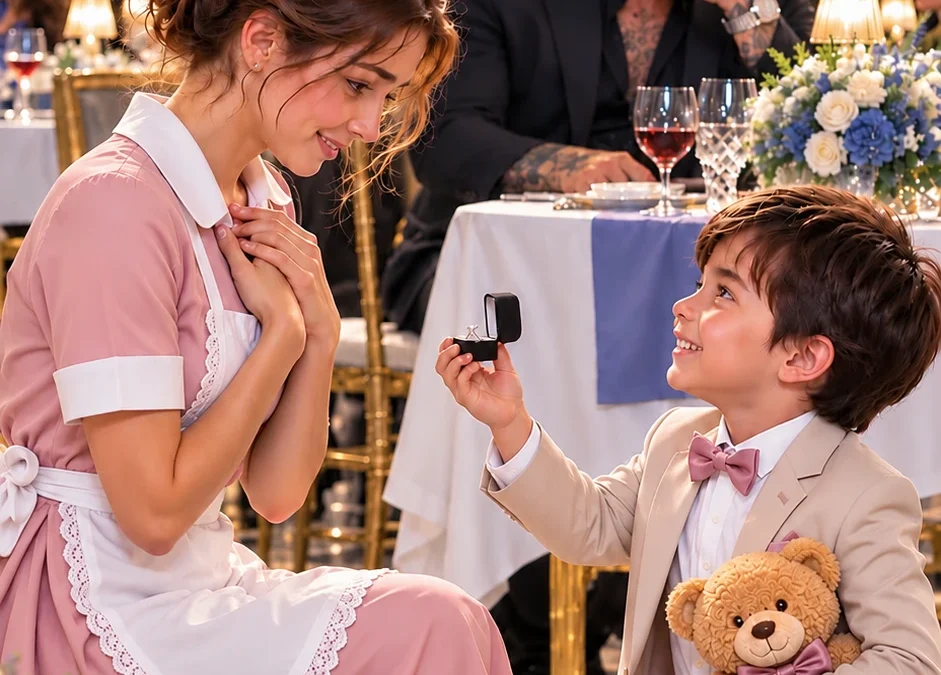
I Was Hiding in a Restaurant Storeroom When a 6-Year-Old Boy Proposed to Protect Me, While My Stepmother Planned to Hand Me Over for a €50,000 Debt. I Didn’t Cry. I Took the Boy’s Hand and Walked Out With His Father.
Part 1
A six-year-old boy proposed to me while I was hiding from the men my stepmother had sent to collect me like a debt.
My name is Alba Serrano. I had been locked in the storeroom of a small restaurant in Lavapiés for almost twenty minutes, my back pressed against a metal shelf, a dented frying pan clutched in both hands. On the other side of the door, Mónica was knocking with her knuckles.
“Come out already. I’m not losing fifty thousand euros because you’ve suddenly decided to have dignity.”
I still couldn’t accept that this was the price my stepmother had put on my life.
After my father, Joaquín, died, Mónica turned our family home into a chain of bets, loans, and lies. First she sold the jewelry. Then she mortgaged our apartment in Alcalá de Henares. Finally she borrowed from Tomás Salvatierra, a man nobody in certain neighborhoods of Madrid wanted to owe anything.
When she couldn’t pay him back, she promised him me.
For four months, I had changed boarding houses, jobs, and phone numbers. Mónica always found me.
A rustle behind some flour sacks made me raise the pan.
Out of the darkness stepped a little boy in a coat far too elegant, worn over dinosaur pajamas.
“Don’t hit me,” he whispered. “I’m hiding too.”
His name was Hugo. He was six, and he had run away from home because the next day he was supposed to see a psychologist. He was convinced that if he went, everyone would think something was wrong with him.
Despite the fear, I laughed.
“Then we’re two fugitives.”
Another bang rattled the door.
“Alba!” Mónica shouted. “Tomás has men waiting. Don’t make me do this the hard way.”
Hugo looked at the dark marks around my wrist, and he stopped smiling.
“In stories, when a witch chases someone, a knight shows up.”
“Well, they’re in short supply around here.”
He pointed at his own chest. “Me.”
With the unbreakable confidence of someone who doesn’t yet know how badly the world can bend, he explained that his dad had money, cars, security men, and a strange talent for making adults stop arguing when he entered a room.
“If you marry me, you’ll be part of my family. And nobody touches my family.”
Something inside me cracked.
I crouched in front of him. “And you’ll protect me from the witch?”
“A hundred percent.”
He held out his pinky.
I hooked mine around it. “Then I accept.”
He grinned as if he’d just closed the most important deal in Europe.
At that exact moment, the storeroom door burst inward.
I stepped in front of Hugo and raised the pan.
The man in the doorway wasn’t Tomás Salvatierra. He was tall, in an immaculate black suit, with two men behind him. I recognized him from newspaper photos and the whispers I’d heard for years.
Adrián Valcárcel. The man who ran one of the most feared criminal networks in Madrid.
He looked at my split lip, then my wrists, then his son.
“Hugo,” he said, with a calm scarier than any shout. “What did I tell you about running away?”
Hugo took my hand and stepped forward.
“Dad, this is Alba.”
Adrián’s eyes dropped to our joined fingers.
Hugo beamed with pride.
“And she just agreed to marry me.”
What happened next still gives me chills. Part 2 is in the comments—or leave any word below and I’ll send it to you privately.
Part 2
What happened next still gives me chills. Part 2 is in the comments—or leave any word below and I’ll send it to you privately.
For three seconds, nobody spoke. Then Mónica appeared behind Adrián and lost all color when she recognized him.
“It’s a family matter,” she stammered.
“No,” I said, for the first time not obeying her. “She owes Tomás Salvatierra fifty thousand euros, and she offered me as payment.”
Adrián’s eyes went to the marks on my wrist. “You offered her?”
Mónica tried to cry. I knew that performance by heart.
Hugo squeezed my hand.
Adrián ordered his son taken to the car. Then he made it clear Mónica would never go near me again. She protested that she was my family.
“Being family doesn’t make you someone’s owner.”
That sentence hit me harder than any threat.
Adrián offered me protection. I told him I wouldn’t take orders from him either. He pointed toward the exit.
“Then you decide.”
I looked at Mónica, at Salvatierra’s men outside the restaurant, and at the little boy waiting in the car.
“I’m coming with you.”
Hours later, in a fortified house in La Moraleja, I plugged in my phone. Forty-three missed calls. One voicemail from Tomás.
“Your father understood debts. You will too.”
I stopped breathing.
My father had been dead for sixteen years.
When Adrián appeared in the doorway, I held up the phone.
“You knew my father.”
He didn’t deny it. “He worked for my family.”
“And his accident?”
Adrián’s silence was answer enough.
I understood I had just stepped into a story that began long before I was born.
If you want to know what Adrián’s silence was hiding, LIKE this post and comment “MEÑIQUE.” When enough people comment, I’ll post Part 3.
Part 3
My father had never been just a neighborhood accountant.
For eleven years he had managed companies tied to César Valcárcel, Adrián’s father. Some were legal. Others hid money and operations that were never meant to appear on a tax return.
I got the truth in the library at La Moraleja, a cold coffee in my hands.
“My father trusted Joaquín,” Adrián said. “Until eight million euros vanished from several accounts.”
“Did my father steal it?”
“No.”
“How can you know?”
“Because he’s the one who found the hole.”
Adrián told me my father had begun to suspect someone inside the organization. He’d copied bank movements and given part of the information to an investigator to identify the culprit. César thought he was being betrayed. Adrián, very young then, stopped his father from making an irreversible decision about Joaquín.
The night before his supposed accident, my father had asked for help getting me out of Madrid under a new identity.
Only me. Not Mónica.
That opened a new crack in me.
“Why did he want me away from her?”
“I don’t know. But I think Mónica does.”
Before I could demand more, a shout tore down the hallway. Hugo had locked himself in his room, remembering the psychologist appointment.
Adrián could silence a room with a glance, but he couldn’t get a six-year-old to open a door.
I sat on the floor. “Hugo, people who are engaged tell each other the truth.”
A small voice came from inside. “Are you still my fiancée?”
Adrián looked at the ceiling. “For now.”
The door opened a few centimeters. I admitted I was scared too.
“Being brave isn’t not being afraid. It’s doing what needs to be done while your legs shake.”
Hugo opened up. He’d go on one condition: I had to come with him, and there had to be pancakes afterward.
Adrián agreed to both.
That morning I watched the most feared man in my world behave like an exhausted father. Then an anonymous message arrived.
“ASK VALCÁRCEL WHAT HAPPENED THE NIGHT BEFORE JOAQUÍN DISAPPEARED.”
Adrián went rigid. I understood he knew more than he’d told me.
Hugo walked proudly out of the appointment. We never made it home.
On the M-30, two vehicles blocked our convoy. Glass shattered. Shots rang out. Adrián covered Hugo; I wrapped my arms around the boy until the bodyguards pulled us out and took us to a safe house near Chamartín. I ended up with a cut above my eyebrow. Hugo was unharmed.
Adrián looked calm until I saw his hands shaking.
Hours later, they identified one of the attackers. He’d worked for Salvatierra, but the money that hired him had passed through an account in Mónica’s name. It had received four hundred thousand euros the day before. Mónica, who owed fifty thousand, had never had that kind of money.
The captured attacker changed the meaning of everything: I had never been the target.
Hugo was.
The plan was to blame Salvatierra and ignite a war between two organizations. The money came from Gabriel Serrano, my father’s brother.
I’d grown up believing Gabriel died before I was born. He was alive, and Mónica had spent six months selling him every address and every job I took.
Mónica finally confessed. Gabriel paid her to frighten me and force me back to Madrid. He’d even arranged my job at the Lavapiés restaurant.
“Was Tomás really going to take me over the debt?” I asked.
Mónica lowered her eyes. “The debt was real. The rest was theater.”
“You sold me to push me toward a specific place.”
“I needed the money.”
“You always need money.”
Then Adrián asked something that changed the air in the room. “Why that restaurant?”
Mónica swore she didn’t know.
Hugo, listening from the door with Rosa, the woman who’d looked after him since he was small, answered without grasping the weight of it. “Because a nice man told me they made superhero pizza there.”
Adrián crouched. “Which man?”
Hugo pointed at a photograph of Gabriel. “That one.”
Coincidence stopped existing. Gabriel had steered me to the restaurant. He’d steered Hugo there too. He wanted us to meet. He wanted Adrián to find me.
The explanation lay in a file my father had left behind. One photo showed César, Joaquín, Gabriel, and Elena Romano, Adrián’s mother. Another folder held letters between Elena and Antonio Salvatierra.
For years Adrián had believed Joaquín and Elena had an affair, and that Joaquín might be his real father. That suspicion was a trap.
That same night, the safe house lost power. Someone had handed over the codes. Mónica had escaped.
Adrián, Hugo, and I fled through a service tunnel. The final door wouldn’t open. A voice came over the speakers.
Gabriel. “Together at last.”
The hatch revealed Gabriel, Mónica, and several armed men. Adrián stepped in front of Hugo and me.
Gabriel smiled. “You’ve believed for years Joaquín might be your father, Adrián. Your mother did have a secret relationship, but the child of that relationship wasn’t you.”
He held up a photograph: Elena in the arms of Antonio Salvatierra.
“Elena had a daughter. César would never have endured the humiliation. Joaquín took the girl, registered her as his own, and raised her with his wife.”
The floor disappeared beneath me. “No.”
“Joaquín wasn’t your father,” Gabriel went on. “He was the man who decided to be.”
Adrián looked at me.
“Elena was your mother. That makes Adrián your brother.”
Hugo’s eyes went wide. “So Alba is my aunt?”
Nobody answered. Gabriel laughed.
But in the middle of that blow, I felt something unexpected. Joaquín didn’t share my blood, but he had chosen to soothe my fevers, teach me to ride a bike, and keep my drawings. The truth didn’t erase him. It made him bigger.
“And Antonio?” I asked.
“Your biological father. Tomás Salvatierra’s older brother.”
Tomás had never wanted to buy me. He was trying to control the inheritance Antonio had left protected in his daughter’s name. Gabriel wanted Valcárcel and Salvatierra to destroy each other so he could keep whatever survived. Mónica had helped for money.
One truth was still missing. Adrián asked why Gabriel had once mentioned the loss of Isabella, Hugo’s mother.
The smile left Gabriel’s face. I saw Mónica look at the floor, and I understood. “She knows something.”
Mónica began to cry. Gabriel ordered her to be quiet. For the first time, she didn’t obey.
She confessed that Gabriel had ordered Isabella followed. Isabella had discovered his transfers and meant to give them to Adrián. Gabriel made her death look like the work of Valcárcel’s enemies.
Adrián didn’t raise his weapon. That surprised everyone.
“If you shoot,” Gabriel said, “Hugo pays first.”
Adrián slowly lowered his hand. Gabriel smiled, certain he’d won.
Then I took my phone from my pocket. The screen showed an active call.
Before the tunnel, I’d sent my location and a recording to Adrián’s lawyer, with instructions to hand everything to the Guardia Civil if I didn’t check in within ten minutes. I didn’t fully trust Adrián. That was exactly why I’d thought like my father.
Gabriel went pale. Sirens began to sound in the distance.
His men hesitated. Some dropped their weapons. Others fled through side exits. Mónica stood frozen. Gabriel tried to run, but Adrián caught him before he reached the door. There was no execution, no settling of scores.
I stepped between them. “If Joaquín risked his life to get me out of this world, I’m not going to start my new family by repeating its rules.”
Adrián stared at me for several seconds. Then he let Gabriel go.
The Guardia Civil handled the rest. The investigation tied Mónica to extortion and surveillance, Gabriel to hidden accounts, the convoy attack, and Isabella’s death, and Tomás to his own threats and business.
Adrián handed over documents implicating his own organization. It was the most dangerous decision of his life, and the first he made thinking of Hugo’s future instead of the Valcárcel name. He sold off opaque companies, shut down illegal operations, and kept only the legitimate ones. For months he lived among protection details and lawyers.
I didn’t move in with him. I rented an apartment in Chamberí and started working at an advisory firm for victims of financial abuse. I didn’t want anyone confusing protection with ownership.
Adrián learned to call me before sending a car. I learned I could say no to him without the world ending. And Hugo kept going to therapy.
Six months later, for his birthday, Hugo got a dinosaur cake and no giant party. Just Rosa, me, Adrián, and two friends from school.
When I gave him a present, he pulled me aside. “We need to talk about our engagement.”
I put on a serious face. “It was inevitable.”
“Dad says I can’t marry my aunt.”
“On that, for once, your father is completely right.”
He sighed. “Then are you still my family?”
I looked across the garden at Adrián. My brother, whom I’d first known as a threat, then as a refuge.
“Yes. But this time with no contracts, no debts, and nobody belonging to anybody.”
Hugo held out his pinky. “Promise?”
I hooked mine around it. “Promise.”
Adrián set a box on the table. It was my father’s. Inside were photos, letters, and an envelope for me. The letter said a family shouldn’t be measured by blood, but by who stays when leaving would be easier.
I read that line three times. Then I hugged Hugo. Then, a little awkwardly, I hugged Adrián.
Neither of us said anything. We didn’t have to.
That first night, I’d accepted an absurd wedding with a six-year-old just to survive a door about to break. Months later I understood that raised pinky had never been a marriage promise.
It was the first door toward a family that didn’t want to buy me, collect on me, hide me, or own me.
Only stay.
And for the first time in many years, I stopped keeping a suitcase packed in case I had to run.
Disclaimer: This story is entirely fictional and created for entertainment purposes only. It does not represent any organization or individual, nor does it encourage inappropriate behavior. The content was generated with AI assistance.








