I Went to the Gala to Tell My Husband I Was Pregnant. I Found Him Dancing With Another Woman, Smiling the Way He Hadn’t Smiled at Me in Months. I Didn’t Cry. I Left My Ring in His Mother’s Hand and Walked Out.
I Went to the Gala to Tell My Husband I Was Pregnant. I Found Him Dancing With Another Woman, Smiling the Way He Hadn’t Smiled at Me in Months. I Didn’t Cry. I Left My Ring in His Mother’s Hand and Walked Out.
Part 1
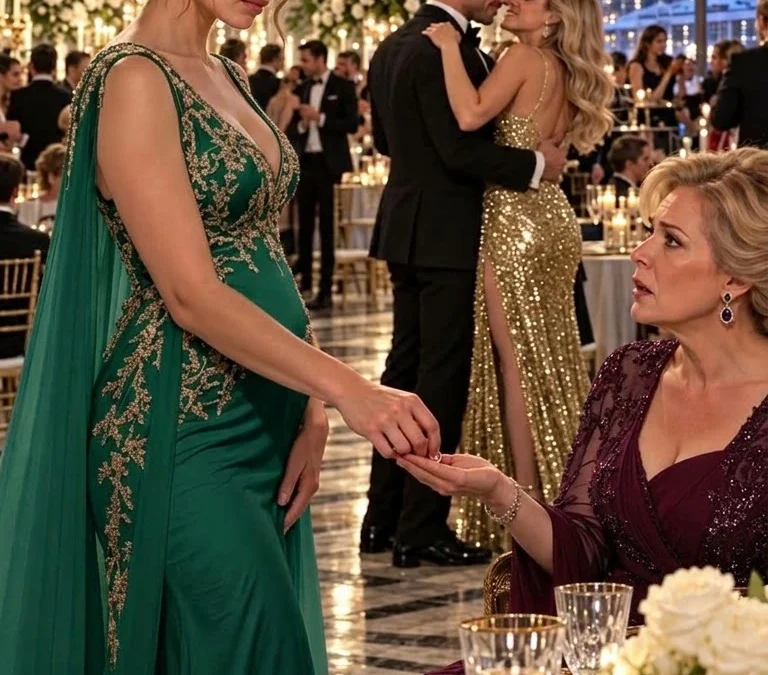
The night I planned to tell my husband I was pregnant, I found him dancing with another woman while his mother watched, smiling, a few feet away.
My name is Vera. I was four months along, and I had been carrying that secret for weeks like a candle I was afraid to let the wind touch.
The Rivas Foundation gala filled the main ballroom of a historic hotel in Madrid. Crystal chandeliers. Executives, journalists, familiar faces raising glasses while an orchestra played beside the tall windows. In my purse was an ivory envelope holding a sonogram and one handwritten line:
“Álvaro, we’re going to be parents. Maybe we still have time to remember why we started.”
I never handed it to him.
My husband, Álvaro, thirty-nine, founder of a logistics tech company, stood in the middle of the dance floor with Clara Montalbán. The communications director he’d hired seven months earlier. She wore a silver dress and a confidence that felt painfully familiar to me.
Clara whispered something in his ear. He laughed. A real laugh, the kind I hadn’t heard in our home for a very long time.
Then she rested her head on his shoulder.
He didn’t pull away.
For months I’d collected small signs that he turned into explanations. Messages at midnight. Work trips that happened to include Clara. Dinners canceled. His phone always face down on the table.
“You’re imagining things,” he’d say. “Nothing is happening.”
Maybe that was even true. But standing there, I stopped caring. I understood something that night: betrayal doesn’t always begin behind a closed door. Sometimes it begins when a person hands someone else the time, attention, and tenderness they stopped offering at home.
My mother-in-law, Carmen, noticed me from across the room. She crossed over quickly.
“Vera, you’re pale. Are you all right?”
I looked down at my left hand. The engagement ring was an antique that had belonged to Álvaro’s grandmother. I slid it off slowly, and my finger felt strangely light without it.
I placed it in Carmen’s palm.
“Tell him I chose peace.”
Her eyes widened. “Vera, talk to him before you do something rash.”
“Nine years, Carmen. I’ve been trying to talk to him for nine years.”
I handed her one more envelope. Inside were a lawyer’s business card and a short note. Nothing about the baby.
Across the ballroom, Álvaro saw the ring. I watched his smile fall off his face. He started toward us, but Carmen stepped into his path.
“Let her go.”
“What’s happening?”
“Not today, Álvaro.”
I was already walking. By the time he reached the doors, I was in a car. He called twelve times. I turned off my phone.
At 6:10 the next morning, I boarded a train to Santander, then a bus to Comillas, where an old university friend knew a woman who rented a small apartment above a bookshop. I took a deep breath of sea air and felt, for the first time in years, that I was not waiting for anyone.
Álvaro got back to our penthouse before sunrise. Clothes were missing. Books. My passport. On the table he found my letter.
I know because he read it aloud to me years later, with his voice breaking:
“I spent years waiting for you, even when you were in the same room. I’m not leaving because of Clara. I’m leaving because, while I waited for you to come back, I was disappearing.”
He sank into a chair.
He didn’t know I was carrying his child.
And he didn’t know that weeks earlier, I had tucked another copy of that sonogram into a closet in the guest room, a small, quiet time bomb waiting for someone to find it.
What happened next still gives me chills. Part 2 is in the comments—or leave any word below and I’ll send it to you privately.
Part 2
What happened next still gives me chills. Part 2 is in the comments—or leave any word below and I’ll send it to you privately.
Comillas gave me what Madrid never could: silence.
I rented the apartment above the bookshop from Teresa Llorente, a sixty-three-year-old widow who never asked a question I didn’t want to answer. Some afternoons I worked among her shelves, breathing in paper and salt air. My lawyer kept telling me I couldn’t hide the pregnancy forever.
I nodded every time. And I never found the courage.
In November, Nicolás was born. Small, furious, and perfect. Legally, Álvaro was still my husband. I wrote him a letter to tell him, and then I put it in a drawer.
I only learned what happened on his side later, in pieces.
He’d stopped using Clara as an excuse. “I never slept with you,” he told her when he let her go, “but I gave you time, trust, and attention that belonged to my marriage.” It was the first honest sentence he’d said about it.
Eight months after the gala, his mother found a folder in the guest room closet. Inside was the sonogram, and a note I’d never finished: We’re going to be parents.
Carmen put it in his hands. Álvaro went from disbelief to collapse in the space of a breath.
For five years, he hired legal investigators. He searched public records and old contacts. Nothing. I had made sure of that.
Meanwhile, Nico grew up among books and the sea. When he was five, he looked at me over his cereal and asked, “Does Dad know my name?”
I started crying right there at the table.
That same week, Álvaro traveled to Cantabria for work. After his meeting ended, he stopped near Comillas beach to clear his head.
A gust of wind tore a red kite out of a little boy’s hands. Álvaro lunged and caught the spool just before it hit the water.
The boy looked up at him.
Álvaro saw his own eyes.
Then a voice cried out, “Nico!”
I was running down the sand. I froze when I saw them.
Álvaro looked at the child. Then at me.
“Is he my son?”
I closed my eyes.
“Yes.”
If you want to know what happened on that beach, and what my son said when he learned the truth, LIKE this post and comment “KITE.” When enough people comment, I’ll post Part 3.
Part 3
For several seconds, Álvaro said nothing. I’d imagined this moment so many times that I expected anger. But what crossed his face first was a sadness so deep he had to turn toward the sea to breathe.
“I missed his birth.”
“Yes.”
“His first steps.”
“Yes.”
“His birthdays.”
I looked down. “Yes.”
“Did you know I was looking for you?”
“I found out about a year after he was born.”
He looked at me as if that answer hurt more than the rest.
I told him the truth. At first I’d been afraid of his money and his lawyers. Later, once Nico had a stable life here, that fear turned into an excuse. And after that, the shame of having waited so long became one more reason to stay silent.
“You had the right to leave me,” Álvaro said quietly. “You didn’t have the right to erase me from my son’s life.”
“I know. And you had the right to know he existed. I was wrong.”
He looked at Nico, who was waiting beside Teresa, hugging the red kite. He could have called twenty lawyers and made it a war. Instead, I watched him understand that winning a battle might cost him a child.
He asked for a DNA test, separate lawyers, a child therapist, and absolute discretion.
“And I’m not taking Nico to Madrid,” he added. “This is his home.”
The next day, we met with a child psychologist in Santander. I took a breath.
“Nico, remember I told you your dad lived far away? Álvaro is probably your biological father.”
Nico stared at the man from the beach. “The kite man?”
Álvaro almost smiled. “That’s me.”
“Did you abandon us?”
Álvaro didn’t hide. “I hurt your mom before she left. I didn’t know she was pregnant. When I found out there might be a baby, I tried to find you both.”
Nico turned to me. “So you hid me?”
Tears filled my eyes. “I thought I was protecting you. I was scared. But I should have found a safe way to tell him you existed.”
Nico frowned. “So you both messed up.”
“Yes,” I said.
“A lot,” Álvaro added.
The psychologist set one uncomfortable condition: neither of us could turn the other into the villain in front of Nico. I had to admit I’d stayed silent too long. Álvaro had to admit his behavior had destroyed our trust before I ever left. We couldn’t compete over who had suffered more.
That rule changed everything.
In one session, Nico asked if he’d have been happier had we done everything right from the start. I opened my mouth, but Álvaro answered first.
“Nobody can promise you how another life would have been. All we can do is not repeat what hurt you in this one.”
Nico looked at me. “And you?”
I stroked his hair. “I can stop calling it protection when it was really fear.”
He sat quietly for a moment. Then he pushed our hands together on the table.
“Then start with that.”
The test confirmed it. The first visits were supervised. Álvaro arrived that first Saturday with no expensive toys, only water, sunscreen, and a cap.
Nico looked disappointed. “I thought rich people bought you stuff.”
“Your mom has an excellent lawyer.”
They flew the kite for almost an hour. Later they built a model boat, and one weekend they joined a beach cleanup. A photo of the two of them laughing with mud on their pants became the first picture of Nico Álvaro put on his office desk.
A few months later, he rented a small apartment in Comillas. He restructured his company and discovered something uncomfortable: it didn’t collapse when he missed a meeting.
I watched from a careful distance. Grand gestures didn’t impress me anymore. I wanted to see whether he could show up on a rainy Tuesday, remember a parent-teacher meeting, wait in a clinic hallway, accept a change of plans without controlling everything.
He learned.
It took eighteen months before the visits included nights at his place. Nico picked dinosaur sheets and hung the old red kite over his bed.
One Sunday, when I brought him home, he ran inside and came back with a drawing. Three figures under a kite. Above Álvaro’s figure, in crooked letters: PAPÁ.
Álvaro went completely still.
“Can I hug you?”
Nico rolled his eyes. “You’re my dad. Obviously.”
Álvaro hugged him and wept.
From the porch of the bookshop, I realized this man was no longer the husband I’d run from. He wasn’t someone I could fully trust yet, either. He was a man trying to change without demanding a reward.
Our divorce, pending for years, was finalized soon after. No battle. Nico kept living mainly with me, and Álvaro’s time grew gradually.
Outside the courthouse, he said, “I’m sorry our marriage ended this way.”
“Our marriage ended at that gala,” I said. “Today the paperwork just caught up with reality.”
Two years after that day on the beach, Álvaro was in Madrid closing a deal worth more than six hundred million euros when his phone lit up.
VERA.
He answered before the second ring. “What’s wrong?”
“It’s Nico. He fainted at school. He was struggling to breathe. We’re in the ER.”
He stood up. “I’m coming.”
He handed authority to his team and caught the first flight to Santander.
By the time he reached the hospital, Nico was stable. The doctors suspected a severe nut allergy reaction. They wanted him overnight for observation.
Nico opened his eyes. “Dad.”
Álvaro sat beside the bed. “I’m here.”
“Mom said you had an important meeting. Did I ruin it?”
The question went straight through him.
“No. You’re not an interruption in my life. You’re part of the reason it makes sense.”
I turned away so Nico wouldn’t see me cry.
At 12:17 a.m., his chief operating officer texted that the deal had closed. Álvaro read it and set the phone face down.
“Did it go well?” I asked.
“Yes.”
“And you weren’t there.”
He looked at Nico. “For years I thought being indispensable proved I was successful. Now I know it can also mean you haven’t learned to trust anyone.”
The next morning, he learned to use the auto-injector Nico would have to carry. He spoke with the school and studied the safety protocols.
I waited to see how long the effort would last.
It lasted. Three months later, he was still checking expiration dates. Six months later, he carried spare medication in his car. A year later, he still asked about ingredients before ordering food.
That kind of consistency began to change something in me. I didn’t fall back in love with him because of one night in a hospital. I began to trust him more. That’s different.
When Teresa announced she wanted to retire, she offered to sell me the bookshop. Nico told Álvaro.
“You can pay for it.”
“I could.”
“Then do it.”
“No. It’s your mother’s project.”
I secured financing on my own. The day I signed, Álvaro arrived with flowers.
“No giant check?” I teased.
“I’m trying to be less insufferable.”
“You still have work to do.”
The bookshop grew. We added a children’s section and free reading afternoons. One Saturday a month, Álvaro helped out, sometimes sitting on the floor in a pirate hat, reading picture books.
One night after closing, we sat on the steps watching the sea.
“I’m ready to tell you something,” I said. “I forgive you.”
He didn’t move.
“It doesn’t mean I want to get back together.”
“I know.”
“And it doesn’t erase what happened.”
“It shouldn’t.”
I took a breath. “I’m sorry I didn’t tell you about Nico.”
“I forgive you.”
For the first time, we could talk about the past without using it as a weapon.
Months later, I invited him to dinner. Not as Nico’s father. As Álvaro. At a small restaurant near the harbor, he switched off his phone before he sat down.
We started seeing each other slowly. The psychologist insisted our romance stay separate from parenting, so that if it failed, Nico would never become our messenger or our judge. We waited six months to tell him.
“Are you getting married?” Nico asked.
“No,” I said.
“Are you moving in together?”
“No,” said Álvaro.
“Then what are you doing?”
“We’re dating.”
He frowned. “But you already know each other.”
We both burst out laughing.
The relationship survived because we stopped treating every problem like a threat. When Álvaro took a work call during dinner, I told him it hurt. He apologized and changed his boundaries. When I made a school decision without consulting him, I admitted it before resentment could grow. We no longer waited for cracks to become walls.
Three years after that day on the beach, we walked along the same shore where the red kite had changed everything. Nico ran ahead with Teresa.
Álvaro stopped.
“I still have my grandmother’s ring.”
I raised an eyebrow. “I hope you didn’t bring it.”
“No. And I’m not asking you to marry me today.”
“Good.”
“I just want to know if you can imagine me asking again someday.”
I looked at the sea. Once, certainty had felt like safety. Now I knew real safety was being able to say no without fear.
I took his hand. “Yes. I can imagine it.”
He waited six months.
When we returned to the beach, he held a small box. Inside wasn’t the antique diamond. It was a simple ring with a red stone.
“The other ring belongs to a marriage that ended,” he said. “This one has no history. It will only have one if you want to give it one.”
He knelt. Nico stood a few meters away holding the kite. He didn’t shout or try to persuade me. Álvaro had explained that the answer belonged to me alone.
“Vera Salcedo, will you marry me again? Not to fix the past, but to build something new with the people we are now?”
I looked at Nico, then at Álvaro.
“Yes.”
Nico threw his arms in the air. “I knew it!”
Our second wedding wasn’t in a grand Madrid hotel. It was in a small garden behind the bookshop, facing the Cantabrian Sea. Beforehand, we signed financial agreements, protected the bookshop, and put everything about Nico in writing. We also stayed in therapy.
Carmen returned the antique ring to me. I decided to keep it for Nico, not as a symbol of a broken marriage, but as part of a story he could one day understand without having to carry it.
After the ceremony, the wind picked up.
Nico raced to the beach with the red kite, repaired so many times that almost none of the original pieces remained.
Álvaro and I followed.
The kite struggled upward. Álvaro tightened the string. I put a hand on his arm.
“Not too much.”
He loosened his grip.
The kite climbed.
The three of us watched it etch itself against the sky.
Because some families aren’t saved by going back to the place where they broke.
They’re saved when each person learns to hold the same string without pulling so hard that it snaps.
Disclaimer: This story is entirely fictional and created for entertainment purposes only. It does not represent any organization or individual, nor does it encourage inappropriate behavior. The content was generated with AI assistance.








