I Woke Up to a Stranger Sleeping by My Dead Fire… She Whispered, “Just One Night.” Three Days Later, Five Riders Came to Take Her Back
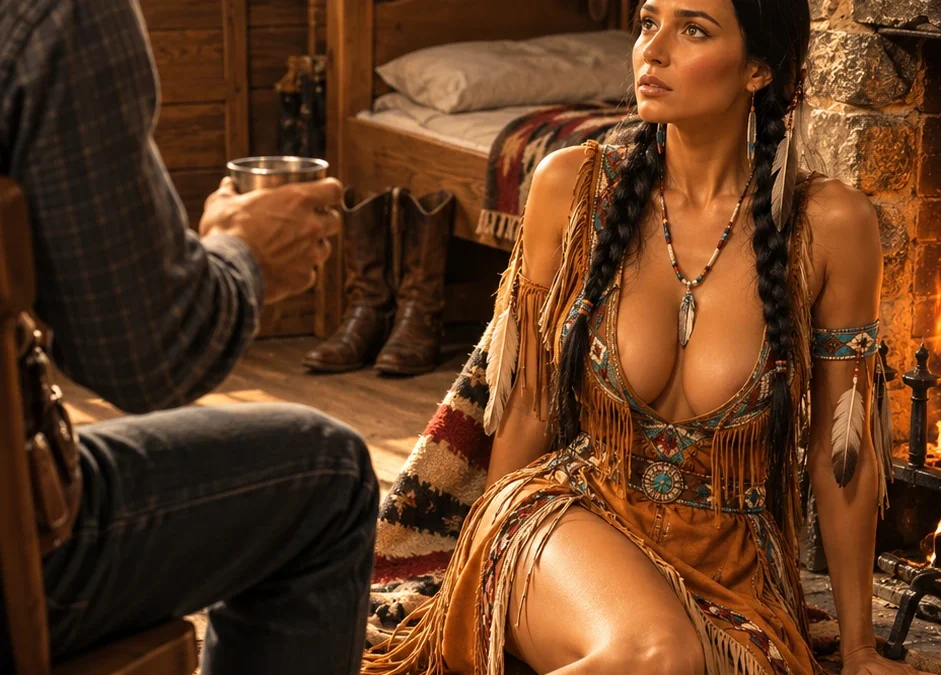
🔥 I Woke Up to a Stranger Sleeping by My Dead Fire… She Whispered, “Just One Night.” Three Days Later, Five Riders Came to Take Her Back 😱
PART 1
Bram Wexler’s cabin stood at the frayed edge of a frontier town that hardly earned its name. 🌾
Pale plowed fields gave way to dry scrub, and the scrub slowly surrendered to Apache land, unmarked by fences but defined by silence and distance. Folks in town talked about that boundary like it was fixed and certain. Bram knew better. Out here, lines moved with the wind, with blood, and with memory.
He was a cowboy because he had to be, and a carpenter because he chose to be. His hands were hardened by splinters and calluses, marked by years of hammer strikes and bitter mornings gripping stubborn wood. He built the things other men depended on but preferred not to dwell on: barn doors to stand against winter storms, fences to hold cattle in and trouble out, roofs patched just enough to last another season.
He didn’t talk much. Not out of coldness, but because wood spoke clearer. Grain had direction. Cracks told the truth.
People were harder to read. 🪵
His cabin mirrored him perfectly. One table. One chair. One narrow bed pushed against the wall. A blackened hearth of river stone. No photographs, no keepsakes, nothing that hinted at a life shared.
Once, long ago, there had been a woman. Elvira Venn. She hadn’t left in anger. No slammed doors, no shouting, just a quiet unraveling. Fewer words. Longer silences. One morning, while Bram worked two valleys over, she packed up and walked away. He didn’t chase her. He didn’t ask why. In time, the absence settled into routine, a quiet weight he carried without complaint.
He wasn’t bitter. He simply bent, like a beam under strain that never snaps. 💔
Then came the night the storm rolled in.
Cold rain lashed the plains, driven sideways by a wind that howled like it had teeth. Bram came home soaked, boots thick with mud. He lit the fire, hung his coat to dry, and ate a plain meal of bread and beans while the rain hammered the walls. The sound pushed back the silence he’d grown used to.
The door stayed unlocked. Out here, locks were more habit than protection. Anyone determined to get in didn’t need permission, and anyone passing through usually needed warmth more than trouble.
He lay down fully clothed and slept the way a man sleeps when he expects nothing. Deep. Heavy. Unguarded.
He never heard the footsteps in the mud. Never heard the door ease open under a careful hand. He didn’t know that while the storm clawed at his walls, something fragile and desperate had crossed into his life. 🌧️
Dawn came pale and uncertain. Bram woke slowly, but alert before his eyes even opened. The storm had passed, the cold had stayed, and something felt off. Not danger, exactly. Just different.
He swung his legs off the bed. That’s when he saw her.
She lay curled on the floor beside the hearth, still as death, the ashes beneath her cold and gray. One of his blankets was pulled halfway over her shoulders. Her dark hair spread across the floor, damp and tangled. A weather-beaten cloak wrapped her, stitched with beadwork. Her lips were faintly blue. 😨
Bram recognized the signs without thinking. Apache. And the way she’d curled inward, as if even unconscious she was bracing for a blow.
His first instinct wasn’t sympathy. It was caution. Out here, kindness could get a man killed. A stranger in your home might be a thief, a scout, or bait for something worse waiting in the dark.
He stayed where he was, eyes sweeping the room. Nothing disturbed. His tools lined up against the wall. The door shut, just as he’d left it.
Slowly, he crouched. She was breathing, shallow but steady. On her wrist, barely visible beneath her sleeve, were bruises. Old ones, yellowing at the edges.
Not the kind you get from falling.
He stirred the ashes and fed the fire until a steady flame took hold. He set water to boil, pulled another blanket from his chest, and eased it over her. No questions. No shaking her awake. Fear wakes quicker than comfort ever could. 🔥
Her eyes snapped open. She scrambled backward, heels sliding across the floor, searching frantically for a way out.
“Easy,” Bram said, lifting one hand. “You’re safe. For now.”
She froze, dark eyes taking in his size, the tools, the door behind him.
“I didn’t mean to come here,” she said quickly, her voice soft and careful. “I was freezing. I saw the fire. I just needed one night.”
“What’s your name?”
She hesitated. “Asha.”
“I’ll leave once the sun’s up, I swear,” she added. “I won’t take anything.” Her eyes searched his face. Not for kindness, but for permission. For survival.
He slid a tin cup of hot water across the floor. “Drink. Slow.”
Her hands trembled as she lifted it. When she pulled her sleeve down over her wrist, Bram noticed. He always noticed.
He could send her away. Open the door. Step aside. Let the land decide her fate. That would be the smart choice. The safe one.
But something in him resisted. 🥺
“You can stay till morning,” he said at last.
Relief swept across her face so fast it caught him off guard.
But by midday, the truth began to spill out. Asha raised her sleeve and showed him the bruises. “I ran,” she said quietly. “From my husband. His name is Razan. His word is law in my tribe. Staying meant I’d disappear.”
She didn’t cry. She didn’t ask him to understand. And Bram could tell by the way her hands tightened that she wasn’t telling him everything.
“They’re still tracking you,” he said.
“Yes.”
“How close?”
“Close enough.”
Bram set down his chisel. “You can stay a few days. Sleep by the fire. Don’t step into my room, don’t touch my tools. When you’re ready to leave, you go at first light.”
“I won’t cause trouble,” she whispered.
“That’s not how trouble works,” Bram said. “It finds you whether you ask for it or not.” ⚡
Three days passed in uneasy quiet. Asha mended his torn shirts, swept the floor, and pressed wild seeds into a strip of hard earth near the cabin. She fixed the shattered western window with careful hands. The place no longer felt empty. It felt tended.
Then, on the fourth morning, Bram stepped outside with his coffee and stopped cold.
Hoof prints. Fresh. Not his.
They circled his cabin once, wide and deliberate, then turned back toward the hills. When he looked up, Asha stood in the doorway, her face drained of color.
“They’re close,” she whispered. “Closer than before.” 😰
Bram barred the door and wedged the shutters tight. He set an old scarred axe beside the doorframe. Asha grabbed his sleeve. “You shouldn’t do this. This isn’t your fight.”
“It is now.”
He pushed open the door. And there, cut against the gray sky on the ridge, sat five riders.
They didn’t move. They just waited. Watching. 👀
By noon, they came down.
Five Apache men on broad, calm horses. The oldest nudged forward, his posture easy, his eyes sharp. “This woman belongs to us,” he said. “She belongs to her husband by our law.”
Bram stood firm, boots planted, hands empty. “No.”
“You’re a white man,” the rider said. “This is not your concern.”
“She’s here because I allow it,” Bram said evenly.
Behind him, Asha gasped. No one had ever claimed her so plainly.
The rider’s thin smile held no humor. “You think that gives you authority?”
“No,” Bram said. “It gives me responsibility.”
“Responsibility ends when blood is spilled.”
Bram didn’t flinch. “Then you’ll have to decide whose.”
The silence turned razor sharp. Then the old rider straightened. “We will leave. For now.” His eyes never left Bram. “But she won’t stay behind you forever.”
They rode away. No rush. No backward glance.
Asha stepped out into the light, pale and trembling. “You shouldn’t have done that. They’ll come back.”
“I know.”
“Why?”
Bram looked out across the wide, unforgiving land. “Because walking away costs more.”
That night, Asha finally told him the whole truth. The marriage. The control. The way permission became a cage. And then, in a voice barely above a whisper, she said the one thing she had never told anyone:
“Razan isn’t the one who’s been tracking me. The man leading those riders… is my father.” 😱
PART 2
Bram said nothing for a long moment. The fire popped softly between them. “Your father,” he finally repeated. Asha nodded, her fingers knotted in the blanket. “He’s the one who arranged the marriage. He’s the one who told me that duty was my honor. He rides with them because he truly believes he is bringing me home.” Her voice cracked. “That’s what makes it worse. He doesn’t think he’s hurting me.” Bram studied the fire. He thought of Elvira, of silences he’d mistaken for peace, of how a man could hurt someone without ever raising his hand. “Then he’ll have to learn something,” he said quietly. 💔
She shifted closer, not touching him, just near enough that the space between them began to narrow. When her breathing slowed, her head dipped once, then again, and finally settled against his shoulder. She froze, waiting to be pushed away. It never came. Bram sat motionless as the tension left her piece by piece, the way a person only lets go when they finally believe the ground beneath them won’t give way. For the first time in years, someone trusted him enough to sleep beside him. And for the first time in just as long, he didn’t pull away. 🥹
Weeks passed. Asha began carving with one of his chisels, and Bram only said, “Just don’t dull the edge.” Her work wasn’t straight or square. She followed the grain, carving flowing shapes and patterns that carried memory instead of purpose. “It’s not meant to mean something to you,” she told him. “It’s meant to remember where it came from.” Soon her curves were showing up in his chair backs and cabinet doors. The cabin filled with mismatched, solid furniture. Bram started taking shorter jobs, riding home before dark, telling himself it was practical. He didn’t look too closely at that lie. 🪑
But the town noticed. Conversations stopped when they entered the general store. Jobs dried up. A rancher who’d offered him work suddenly found reasons to wait. When Garrick Voss asked how long the Apache woman planned to stay, Bram answered, “Long enough.” Then a man named Dax Maron stopped him on the road and spoke low. “They’re talking. Both sides. They don’t like where you’re standing. You’d be smart to step off that line.” Bram rode home with the warning pressing on his chest like a stone. 😰
That night, Asha spoke first. “I’m not running anymore. I know what staying costs. You lose work, maybe more. I won’t ask you to choose me.” Bram walked to the door and stared at the cold stars. Then he turned. “I’m not choosing you over them. I’m choosing not to turn away.” Two days later, the elders came, calm and deliberate. Men from town gathered at a distance, watching. And at the head of the elders rode a gray-haired man Asha had not seen in two years. She went rigid. Her father dismounted slowly, looked at his daughter, and said four words that made her knees nearly give out: “Come home, my daughter.” 😱
PART 3
Asha stood beside Bram, not behind him. She had promised herself that.
Her father looked older than she remembered. His shoulders sagged beneath his buckskin coat, and deep lines framed his eyes. He didn’t look like a tyrant. He looked like a tired man who had ridden a long way to bring something back.
“Father,” she said, her voice steady. “Why have you come?”
“To bring you home.” He glanced at Bram, then back at her. “Razan has promised to treat you with respect. The elders have spoken to him. This can be mended.”
“Mended.” Asha repeated the word slowly. She lifted her sleeve and held out her wrist, the faded bruises still visible in the sun. “Is this what you want mended, Father? Or is this what you want hidden?”
A murmur rippled among the elders. Her father stared at the marks, and something in his face flickered.
“You told me it was duty,” Asha said. “You told me obedience was honor. I believed you, because you were my father, and I loved you. But I was never asked what I wanted. Not once. Not when you chose my husband. Not when I begged you to listen.” Her voice trembled but did not break. “I am not property. I am your daughter. And I am asking you now, for the first time, to hear me.”
Silence.
The older of the elders shifted. “Tradition holds that a wife belongs to her husband’s household,” he said.
“Tradition,” Bram said quietly, “also holds that a father protects his child.”
Every eye turned to him. He kept his hands open at his sides, his voice steady. “I won’t raise a hand against any of you. But I won’t step aside, either. She stays where she chooses to stay. That’s all I’m asking.”
Her father stared at him for a long moment. “You are a white man,” he said at last, not with anger now, but with something closer to confusion. “Why do you care?”
Bram thought of Elvira. Of empty rooms. Of years spent avoiding everything that might ask something of him.
“Because I spent half my life stepping aside,” he said. “And all it ever bought me was silence.”
The old man turned to his daughter. The wind moved through the grass. Somewhere far off, a hawk screamed.
“Razan struck you,” her father said, very low. It wasn’t a question.
“More than once.”
“And you did not tell me.”
“I tried, Father. You told me to be patient.” Tears finally slid down her cheeks. “I stopped trying.”
Her father closed his eyes. When he opened them, the stern shield that had held his face for years had cracked wide open. “I thought I was protecting you,” he whispered. “I thought a strong husband meant a safe life. I did not see.” His voice broke. “A father is supposed to see.”
He stepped forward, slowly, as if afraid she might vanish. “Forgive me, child. I cannot undo what I have done. But I will not ask you to return to a man who hurt you.” He turned to the elders, and the authority returned to his voice. “My daughter has spoken. I will carry her words to the council. Razan will answer for what he did.”
The elders exchanged uneasy looks, but none challenged him.
Asha let out a shuddering breath and fell into her father’s arms. He held her the way he had when she was small, rocking gently, murmuring in their language. Bram stood silent, watching, a lump rising in his throat. 🥹
But the story wasn’t over. 🌅
The days that followed were not simple. Razan did not accept the council’s judgment quietly. He rode into town one afternoon with three men, loud and furious, his eyes burning. He found Bram at the livery, repairing a stall door.
“You took what was mine,” Razan spat.
Bram set down his hammer. “She was never yours.”
Razan lunged. Bram caught the first blow on his forearm and the second against his jaw, staggering back against the wall. For a moment, the world turned white. Then he planted his boots and stood. He didn’t strike back. He raised his hands, blocking, absorbing, refusing to fall.
“Stop!” The shout rang across the street.
Asha’s father rode in with six elders at his back. Behind them came Dax Maron, and old Briggs Nolan from the saloon, and even Luther Cade from the general store, all of them drawn by the commotion. Razan froze, fist raised.
“You have shamed our people,” her father said, his voice low and cold. “You struck my daughter. You struck the man who sheltered her. And now you raise your hand in a town where we are guests.” He dismounted. “The council has spoken. You are no longer her husband. And you will not ride within a day’s journey of this cabin again.”
Razan’s face twisted. For a heartbeat, it looked like he might fight on. Then he saw the elders’ faces, and the townsmen’s, and something in him deflated. He turned his horse and rode out of town without a word.
Nobody cheered. But a quiet settled over the street, the kind that comes when a long-held fear finally loosens its grip.
Briggs Nolan walked up to Bram, studied his bruised jaw, and slid a glass of whiskey across the livery bench. “On the house.”
Bram almost laughed. “I don’t drink much.”
“Drink this one,” Briggs said.
By autumn, the cabin had changed in ways no hammer could have built.
Two chairs sat at the table now, mismatched and solid. Two pairs of gloves hung by the door. The wild seeds Asha had pressed into the hard earth had grown into a stubborn green strip against the dust, and beside it, a small bed of herbs she’d carried from her childhood home.
Her father came to visit often, always alone, always carrying something: a sack of flour, a deer haunch, a woven blanket from her mother. At first he and Bram sat in awkward silence, like two old horses uncertain of each other. But one evening, as the sun bled red across the prairie, he looked at the carved chair back Bram had made and said, “My daughter’s hands. You let her work.”
“She doesn’t need my permission,” Bram said.
The old man nodded slowly. “No. She never did.” He ran a thumb over a curve in the wood. “I did not know how to see her. You did, in three days.”
“She was just being herself,” Bram said. “I only got out of the way.”
Her father smiled, the first real smile Bram had seen on him. “That is harder than it sounds.”
Soon, Asha’s carvings began to appear beyond the cabin walls. A rancher asked for a bench with her patterns. The town’s church ordered a small carved altar rail. Women from both sides, white and Apache, quietly began visiting the cabin, bringing cloth, asking for small pieces, and sitting for hours on the bench by the hearth. No one announced it. No one declared peace. It simply happened, one commission and one conversation at a time. 🌱
Jobs came back to Bram, slowly, from men who cared more about a straight fence and a solid beam than about lines drawn by fear.
One evening, as winter crept in early across the plains, Bram stood in the doorway watching the sky burn red. Asha stepped beside him, her shoulder brushing his.
“I never asked you something,” she said. “That first night. When I whispered that I was only staying one night.”
“You didn’t have to.”
“Why did you let me stay?”
Bram was quiet for a while. The wind rose softly through the grass, and a coyote cried far off in the dark.
“I thought I preferred being alone,” he said. “I thought it was peace. It wasn’t. It was avoidance.” He turned to look at her. “You didn’t fill the cabin, Asha. You just made it feel lived in. And I realized I’d been waiting my whole life for someone to make me want to come home.”
Her eyes shimmered. She reached for his scarred hand and held it, steady, deliberate, a choice made in full daylight.
“I came here for one night,” she said softly. “I stayed because I chose to.”
“I know,” Bram said. “That’s what makes it matter.”
They stood there as night settled over the land, the wind sweeping the plains, the fire glowing warm behind them. The land was still harsh. Winter was still coming. Trouble could still ride over the ridge tomorrow.
But Bram no longer shaped his life around avoiding loss. And Asha no longer ran from what had once tried to claim her. They were two people choosing, day after day, to remain where they stood.
Behind them, the cabin waited. Two chairs. Two lives. A window she had mended with her own hands. A door that no longer needed a bar.
Somewhere on the wind, a question drifted for anyone willing to hear it: Is staying the braver choice, or is walking away the truer way to survive?
For Asha and Bram, the answer was simple.
They stayed. 🌄
Moral of the story: Real strength is not found in control or in walls, but in standing beside someone and refusing to step aside. Sometimes the bravest thing a person can do is stop running, and the kindest is to let someone choose their own life. 💛
💬 Now it’s your turn: would you have stood beside Asha when the whole town turned its back? And do you think her father deserved a second chance? Tell us in the comments! If this story touched your heart, like it, share it with someone who needs a reminder that everyone deserves the freedom to choose, and follow the page for more unforgettable tales of the Old West. 🤠
Disclaimer: This story is entirely fictional and created for entertainment purposes only. It does not represent any organization or individual, nor does it encourage inappropriate behavior. The content was generated with AI assistance.








