“I’d Rather Marry a Chimney Sweep Than a Duke,” She Told a Stranger on the Coach. Then Her Father Bowed to Him in the Mud, and the Paper in His Pocket Had Her Name on It
😱 “I’d Rather Marry a Chimney Sweep Than a Duke,” She Told a Stranger on the Coach. Then Her Father Bowed to Him in the Mud, and the Paper in His Pocket Had Her Name on It 💔👑
PART 1
🚌 “I would rather marry a chimney sweep than a duke.”
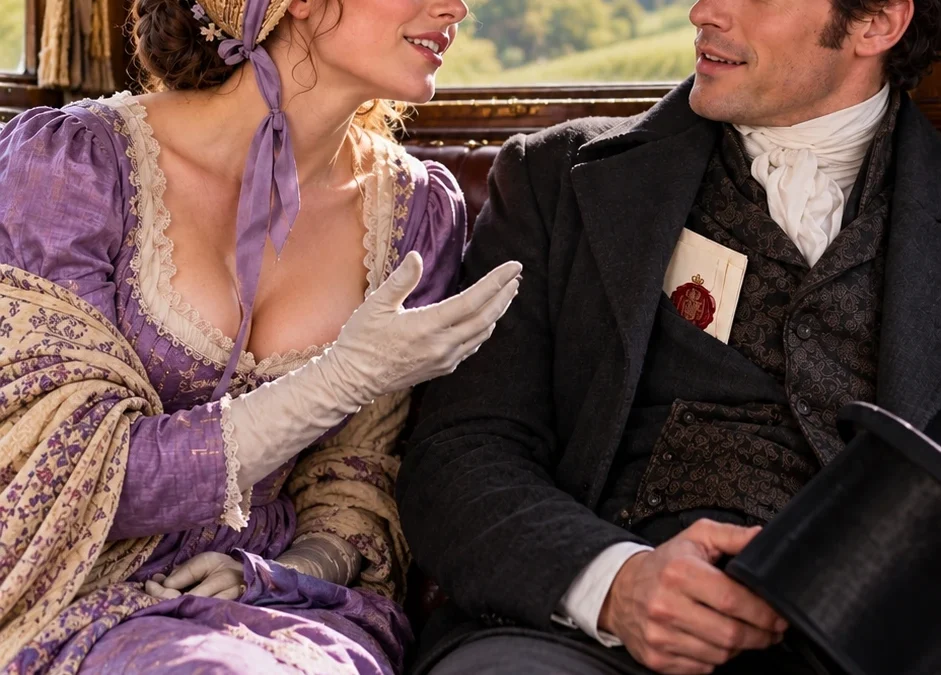
Miss Harriet Low said it loudly, on a rattling mail coach on the Hampshire Road, and the gentleman sitting across from her nearly dropped his hat.
He caught it an inch above the muddy straw and set it on his knee as though it had personally offended him.
Harriet had no idea that the betrothal papers in his coat pocket bore her name. 😳
“A chimney sweep, miss?” gasped the stout woman beside her, clutching a basket of eggs. “You cannot mean it.”
“I mean every word. A chimney sweep works for his bread. He climbs onto roofs in all weathers, and when he comes home at night, he has earned his supper.” Harriet lifted her chin. “A duke has earned nothing. He was simply born, which is not much of an accomplishment. Even kittens manage it.”
The stranger coughed. It might have been a laugh. It might have been the damp.
He was too tall for the narrow bench, his knees angled sideways to avoid hers. He wore a plain dark greatcoat and good boots that had seen a great deal of mud. His face ought to have been stern, with that straight nose and hard jaw, but his gray eyes were watching her with an expression she could only call fascinated.
“Forgive me,” he said, in a low, pleasant voice. “I have simply never heard anyone compare a duke unfavorably to a kitten. And what, may I ask, has a duke ever done to you, miss?”
She hesitated. Her aunt would have fainted to see her talking to a strange man on a public coach. But in two hours she would never see him again.
“Low,” she said. “Harriet Low.”
Something changed in his face. It was very small, a stillness, a flicker in those gray eyes, like a man stepping onto a stair in the dark and finding it one step lower than expected. Then it was gone.
“Miss Low,” he repeated slowly. “And I am… Ash. Mr. Ash.”
So Harriet told him. She told him about dukes who gamble away £30,000 at the tables while shopkeepers go unpaid. About dukes who vote against bills to stop small boys being sent up chimneys, because their own chimneys are swept so very well.
“And a duke,” she finished, “may court a girl all season in front of all of London, then drop her like an old glove when a richer bride comes along. And no one will say a word against him.”
The coach went quiet, save for the rain and the creak of leather straps.
“That last one,” Mr. Ash said gently, “was not from a newspaper.”
Harriet looked at the window. “No,” she said at last. “It was not.”
“I am sorry.”
“You need not be. It was not your doing.”
“No,” he said, looking down at the hat on his knee. “But I am sorry all the same.”
And then the woman with the eggs sniffed that she would marry a duke tomorrow, and so would any sensible girl, and Harriet wished her joy of him, and Mr. Ash laughed. It was a short, startled sound, as if he’d forgotten how it went. It changed his whole face. He looked younger, and very handsome indeed.
Something warm and foolish fluttered beneath Harriet’s ribs. 💓
“What takes you into Hampshire, Mr. Ash?” she asked quickly, because silence suddenly seemed dangerous.
“Family business. A promise my father made long ago. I have come to see whether it can be kept.” He looked at her, really looked, until the warmth climbed all the way into her cheeks. “I expected a dull journey, Miss Low. It has been the least dull hour of my life.”
For the rest of the ride they argued about the bill to protect climbing boys. He knew a surprising amount about it. He argued with her, not cruelly, not to win, but as though her opinion were worth testing. No man had ever spoken to her like that. Not one.
When the coach slowed outside Little Havsham, the rain had stopped and a weak gold sun had come out over the wet hedges.
“This is my stop,” Harriet said.
“Is it?” There was something odd in his voice. “How remarkable. It is mine also.”
The coach did not stop at the inn. It turned down the lane to Havsham House, a shabby, ivy-covered house with a sagging gate. On the front step stood her father, Sir Thomas Low, in the coat he kept for funerals and bishops. Beside him stood her sister Caroline, the maids, and old Hobbs the gardener, all lined up as if for inspection.
Harriet frowned. What on earth?
Mr. Ash stepped down first and turned to offer his hand. But before she could take it, her father hurried down the step, swept off his hat, and bowed so low that his white hair nearly brushed the gravel.
“Your grace,” said Sir Thomas. “Welcome to Havsham. We are honored. Truly honored.”
Harriet’s hand froze in midair. 😶
Slowly she looked from her father, bent nearly double, to the tall man in the plain greatcoat. He did not look away. That was what she would remember afterward. He did not look away, and he did not smile, and he did not pretend.
“Julian Ashcombe,” he said quietly. “Duke of Ravensworth.”
He drew a folded paper from his coat, creased and sealed with a great red seal.
“And I am afraid, Miss Low, that this has your name on it.”
The world went silent. A blackbird sang in the hedge.
“What is it?” Harriet whispered, though she already knew.
“A contract of betrothal,” said the Duke of Ravensworth. “Between you and me.”
Harriet Low did something no one in Little Havsham would ever forget. She snatched her hand back, turned around, and climbed straight back into the mail coach.
“Drive on,” she told the coachman. “Anywhere. Winchester. France. The moon.” 🌙
PART 2
The coachman, who had driven the Southampton Mail for twenty-two years and had never once been asked to go to the moon, looked to the Duke for instructions.
The Duke gave none. He simply walked to the window, folded his arms on the frame, and looked in at her.
“You lied to me,” Harriet said. “You let me say all those things about dukes. About kittens.”
“I did,” he admitted. “In my defense, I was enjoying them enormously.”
“You were laughing at me.”
“No.” His voice dropped. “I was not. You were the first person in eleven years who spoke to me as if I were a man and not a title. I wanted one more hour of it. It was selfish. I am sorry.”
Her anger faltered, just a little. She climbed out, but she did not take his hand.
In the faded drawing room, with a damp patch on the ceiling shaped like Ireland, her father stammered out the truth. Years ago, the old Duke’s horse had gone into the river at Havsham Ford, and young Thomas Low had plunged in after him. The old Duke, who could not bear to owe anyone, had promised that their children would marry, and had it drawn up by lawyers before he would let a doctor see his broken arm.
“The old Duke died in March,” Julian said. “I found the contract among his papers. But I want to be very clear. This paper means nothing without your consent. If you refuse, I will tear it in half in front of you.”
“Then tear it,” said Harriet.
He did not move. “Give me a fortnight. Let me stay at the inn and call on you as any other man might. If at the end you would still rather have the chimney sweep, I shall never trouble you again.”
Her sister Caroline drew her into the hall. Caroline had gone to London last spring, and the Duke of Selborne had sent her white roses every morning for a month. Then a banker’s daughter with £60,000 came along, and he looked straight through Caroline as if she were glass. London had laughed.
“It is a fortnight, dearest. Not a lifetime.”
So Harriet agreed. No roses. Three visits a week. And you will not expect me to like you.
But the fortnight was a disaster for her heart. He lost a battle with an inkwell. He ate two slices of the widow Daker’s famously unbiteable seed cake because “she was so pleased by the first.” He waded into the river in boots worth more than the Havsham silver to rescue Caroline’s bonnet, and Caroline laughed, for the first time since spring.
Then came the afternoon that changed everything. A seven-year-old climbing boy named Tom got wedged in a chimney, and the crowd was shouting about lighting a fire beneath him. The Duke tore off his coat and took the stairs three at a time, and when the owner shrieked about his precious chimney, Julian said in a voice like frost: “I shall pay for ten of your chimneys. Now get out of my way.” 🔥
Harriet watched him lie on an attic floor with his arm buried to the shoulder in broken brick, whispering, “I have got you, Tom. I promise I have got you.”
He came out black from head to foot, bleeding at the knuckles, looking exactly like the hardest-working chimney sweep in Hampshire. 😭
And Harriet knew she was in terrible trouble.
On the ninth day, at Lady Pembury’s ball, the Duke of Selborne sneered at Caroline in front of the whole room. Julian stepped out of the crowd and forced him to apologize. Then he held out his hand to Harriet. “Will you dance with me? Just once.”
Under the candlelight, he told her he wanted her, not because his father asked, but because she was the bravest, most maddening, most honest person he had ever met.
She meant to give him her answer the very next morning.
She walked into the village at dawn. Mrs. Puett at the inn said he was out riding and showed her into the back parlor. Among his letters about climbing boys lay a page in a different hand. Her own name leapt out at her.
“Marry the girl if you must, but do not pretend it is for sentiment. We both know the only reason your father wanted this match was the Havsham river meadows. Marry the daughter, and you have them for nothing.”
Signed by his aunt. Dated a month ago, before he had ever come to Hampshire.
Harriet felt the floor tilt. All those questions on their walks. Who owns this field? How deep does the river run?
At noon, when he came in with his face alight, she was waiting with the letter on the table between them, exactly where he had once laid the contract.
“Is it true?” she asked. “Did your father want this marriage for my meadows?”
“Yes,” said the Duke very low. “I believe he did.”
“And you knew.”
He did not look away. “I knew.”
And then, slowly, his hand went to his coat… 😱
PART 3
“You knew,” Harriet whispered, shaking. “You sat in this room and told me that paper meant nothing. You walked the lanes with me and asked about every field and every ditch, and I thought you cared about this place. All the time, you were measuring it.”
“That is not what I was doing.” It burst out of him. “I was learning what my father did to this valley. Harriet, listen. He spent twenty years trying to force your father to sell those meadows. He tried to buy the mortgage on the South Fields. He tried to have the ford declared a public nuisance. He tried everything a rich, cold, stubborn man can try to break a poor, decent one. I did not know any of it until I read his papers in March.”
“I do not want to hear about the letter.”
“It said he was sorry.” Julian was white to the lips. “That is the part I did not tell you. He was sorry for the meadows, for the mortgage, for twenty years of grinding down the man who saved his life. And he asked me to make it right, not by taking the land, but by giving it back.”
The room went silent.
He took out a second folded paper, plain and unsealed, written in a lawyer’s careful hand.
“My father bought the mortgage on your South Fields eight years ago, through an agent. Every letter from the bank that your father hides in his desk drawer came from my father’s lawyers. He was waiting for your father to default.” He set it beside his aunt’s letter. “This is a deed of release. The mortgage is cancelled. All of it. I signed it the week I arrived, at Mrs. Puett’s terrible table. I was going to give it to your father on the last day of the fortnight, whatever you decided.”
Harriet could not speak.
“It was never a bargain. I would not put a price on you.” His voice cracked. “I did not tell you about the meadows because I was ashamed. My father did a cruel, grasping thing to your family, and I bear his name. I did not want you to look at me the way you are looking at me now.”
She looked down at his signature. The ink had blotted at the end, where the table leg wobbled. Her eyes burned.
“I need,” she said, “to think.”
He nodded once. Then he bowed, a real duke’s bow, deep and formal, and walked out of the drawing room. She heard the front door close.
She did not call him back. 💔
Caroline found her at dusk, lit a candle, and sat beside her without a word while Harriet told her everything.
“Do you know what Selborne gave me?” Caroline said at last. “White roses every morning for a month, from a hothouse. I kept every petal. And when he left, I realized he had never once given me anything that cost him. Not a minute of comfort. Not one truth he did not want to tell. His man ordered the roses.” She turned the candle slowly. “Your duke climbed into a chimney. He made an enemy for me in front of the whole county. He gave away a mortgage worth thousands and did not even mean to tell anyone. And today he stood in this room and told you the most shameful thing he knows about his own family because you asked. He was afraid, Harriet, and he told you anyway. I would give anything for a man who would do that.”
Harriet put her face in her hands. “I have been such a fool.”
“A little,” said Caroline gently. “But so has he. You will be fools together. That is what marriage is, I think. Two fools who have decided to forgive each other in advance.”
Harriet laughed through her tears and stood up. “I must go to the inn.”
But Mrs. Puett met her at the door with red eyes.
“Oh, miss. You’re too late. He’s gone. Paid his reckoning two hours since and took the evening mail.”
Little Tom came running down the passage, crying, something clutched in his small fist. “He said I wasn’t to give it till tomorrow, miss, but I don’t want to wait.”
He opened his fingers. It was the betrothal contract, with its great red seal, neatly torn in half. On the back, in plain black ink, the Duke had written six words:
“I would not make you choose.” 🥀
Harriet stared at them for a very long time. Then she said, “When does the next mail leave for London?”
“Six tomorrow morning, miss. But you cannot go to London alone on the public mail!”
“I have done it before,” said Harriet. “That is how all of this began.”
She did not sleep. At five she went downstairs and found her father waiting in his dressing gown, white hair on end. “I am coming with you,” said Sir Thomas, his old eyes bright. “I have just learned who I owe for the South Fields, and I should like to shake his hand.”
The up mail left in a gray drizzle exactly like the rain on the day she had come home. At Basingstoke, while the horses were changed, Harriet began to be afraid. What if he had meant it? What if she reached London and found a butler who would not let her in?
The coach door opened. A gust of wet air blew in. A tall man in a plain dark greatcoat climbed inside, ducking his head, sat heavily on the bench opposite, looked up, and stopped.
They stared at each other.
He was soaked to the skin, shadows under his gray eyes, holding his hat in both hands as if it were the only solid thing left in the world.
“Harriet?” he said. “What are you doing here?”
“What am I doing here? What are you doing here?”
“I got as far as Basingstoke last night. I lay awake until dawn, and this morning I found I could not go on, so I bought a ticket back to Havsham.” He swallowed. “This is the down mail, isn’t it?”
“This is the up mail.”
He looked out the window at the guard blowing his horn, then back at her. “Then I have got on the wrong coach.”
“Yes,” said Harriet. “You have.”
Something in her chest cracked open. She did not know whether she would laugh or cry. It turned out to be both. 😂😭
“You fool. You great, ridiculous, impossible fool. I came all this way to find you, and you were coming back to me, and you got on the wrong coach.”
The coach lurched forward into the rain. Neither of them moved to stop it.
She opened her reticule with shaking hands and took out the two halves of the contract. “You tore it. I said you could if I did not want it. I never said I did not want it. I said I needed to think. You do not get to decide for me, Julian Ashcombe. You said it yourself. It is my choice. It always was, and you went away before I could make it.”
His face was very pale. “Then make it. Please, whatever it is. I have been in hell since yesterday afternoon. I would rather hear no from you than spend one more hour not knowing.”
Harriet looked at him, soaked and exhausted and frightened, sitting on the wrong road with his hat clutched in his hands, and every guarded, angry, careful thing in her heart gave way at once.
“I was wrong about you. I liked you on this coach when you were only Mr. Ash, and I have liked you more every day since. But I was so frightened of being Caroline. When I found that letter, I believed the worst of you because the worst was easier. It was easier than loving you.” She tore each half of the contract in half again, and again, and let the pieces fall into the damp straw. “I do not want to marry you because your father promised. I do not want to marry you for the meadows or the mortgage. I want to marry you because you are the best man I have ever met. So if you will still have me, you must ask again. Properly. Not with a paper. Just with you.”
For a moment he did not move. Then the Duke of Ravensworth set his hat on the bench and slid down onto one knee in the wet, muddy straw of the up mail to London. Across from them, Sir Thomas Low opened one eye, saw what was happening, and very tactfully closed it again. 🤭
“Harriet Low. I have no ring and no speech. I am soaking wet, and I am on the wrong coach. I am a poor dancer and worse at skipping stones, and I have a terrible aunt. I have never seen a husband do it well, so I shall have to learn. But I will spend my whole life learning if you will teach me, and I will never give you a single reason to be frightened of believing me.” He took her hand. “Will you marry me? Not the Duke. Just me.”
She was crying properly now, and laughing too. “Yes. Yes, you impossible man. Yes.”
He made a sound she had never heard a man make, half laugh, half something deeper, and pulled her down into his arms and kissed her. It was not a graceful kiss. The coach hit a rut and nearly threw them into the straw, and her bonnet rolled under the seat. But he kissed her as though he had waited his whole life to do it. 💍❤️
When they drew apart, he rested his forehead against hers. “One more question. Only one.”
“Only one?”
“Do you still prefer the chimney sweep?”
Harriet looked at the man who had climbed into the dark to save a boy he did not know, who had come out black and bleeding, and who had never once asked her to love him for anything he owned. She brushed the wet hair back from his forehead.
“Only,” she said, “if he looks like you.”
They were married six weeks later in the little church above the river meadows. Caroline was bridesmaid, Sir Thomas wept openly in the front pew, and the widow Daker, in the second, told everyone within reach about the horse that sneezed on her in 1779. Mrs. Puett made the wedding cake. It was nearly impossible to bite. The Duke ate two slices.
Little Tom, in a new blue coat with brass buttons, carried the ring on a cushion and did not drop it once, though he stared at it so hard he walked into a pew. When the couple stepped into the winter sunshine, old Mr. Grub and every sweep in the parish stood waiting on the green, holding their new jointed brushes in an arch. The Duke laughed out loud and kissed his wife beneath it in front of them all. 🎉
The following spring, the river did not flood, because the young Duke had spent his first winter of marriage beside Sir Thomas, building a stone bank along the ford with his own hands and a great deal of advice from his wife. That same year he rose in the House of Lords to speak for a bill against climbing boys. It did not pass. But when he described a small boy wedged in the dark with soot falling like black snow, the chamber went so silent you could hear the rain on the windows. He brought it again the next year, and the year after, and his duchess sat in the gallery every single time.
And each summer, on the journey home to Hampshire, the Duke and Duchess of Ravensworth send their fine carriage on ahead and take the public mail coach instead, sitting with their knees angled sideways on the narrow bench, arguing cheerfully about everything under the sun.
And if any stranger on that coach happens to remark that a duke must be the finest match in all of England, the Duchess smiles, looks across at her husband, and says:
“Oh, I would never marry a duke.”
And the gentleman across from her very nearly drops his hat. 🎩💛
💬 Which moment made your heart melt: the chimney rescue, the ballroom, or the wrong coach? Tell me below, and let me know where you’re reading from tonight! 👇
Disclaimer: This story is entirely fictional and created for entertainment purposes only. It does not represent any organization or individual, nor does it encourage inappropriate behavior. The content was generated with AI assistance.








