“IF YOU WANT HER INSTEAD, LET ME GO,” THE QUEEN SAID BEFORE THE ENTIRE PACK… She Dropped Her Wedding Cord on the Table and Walked Into the Snow. Then Every Wolf in the Kingdom Began to Howl
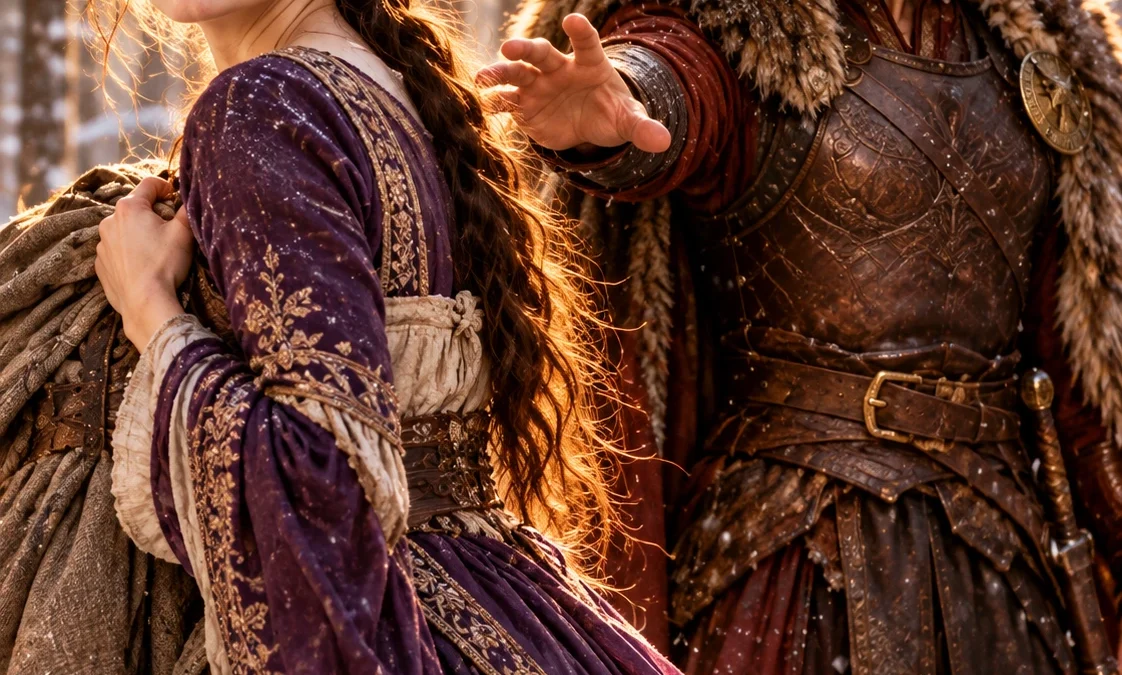
😱 “IF YOU WANT HER INSTEAD, LET ME GO,” THE QUEEN SAID BEFORE THE ENTIRE PACK… She Dropped Her Wedding Cord on the Table and Walked Into the Snow. Then Every Wolf in the Kingdom Began to Howl 🐺❄️
Part 1
The horn sounded while my hands were still buried in the bread dough, and that was how I knew the day would not belong to me. 🍞
No one blows the long horn before sunrise unless a banner is climbing the road. I stood in the bake house of Blackthorn Keep with flour to my elbows and listened to the sound roll down the valley. Once, twice, a third time, deep as a wolf’s complaint.
Around me, the kitchen women went still. Then everyone moved at once, the way sparrows scatter when a hawk’s shadow crosses the field.
“Wash your hands, my lady,” said Gwen, the undercook. And then, remembering herself, “Your Majesty.”
I smiled at her. I had learned to smile at that word. Two winters as queen, and it still sat on me like a borrowed glove, stretched in all the wrong places.
The bake house was my favorite room in the whole keep. It smelled of yeast and wood smoke and the sweet scorch of honey cakes left a moment too long on the stone. For the length of a kneading, I could pretend I was only Lena, the miller’s orphan from Ashford Veil, who had once been allowed to stay warm by working hard.
“Who comes?” I asked.
“The northern lords,” Gwen said, wiping her palms down her skirt. “Lord Aldis Vain and his household. And the lady.”
She said the last two words as if she were setting down something that might spill.
“Which lady?”
Gwen did not answer. Pip, the skullion, not yet twelve and with no instinct for silence, answered for her. “Lady Seline. The one the whole keep said would wed the king before…”
She saw Gwen’s face and stopped as though she had walked into a wall. She did not finish. She did not need to.
I rinsed my hands in the basin and watched the water cloud white.
“Then the east rooms must be aired,” I said. “The good linens put out, and a fire lit in the guest hall an hour before they arrive. The north is cold in autumn. They will have ridden hard.”
Gwen looked at me with something that was almost grief. “Yes, Majesty.”
That was how I had always been treated in that keep. With a gentle pity from a distance, like a lame hound dozing by the hearth.
I did not go to the courtyard to greet them. A queen should have. I knew that. But Ozrich, the steward, had told me in my first week that the king preferred the household assembled in rank, and in rank I had been placed at the far end, behind the Beta’s wife and before the stablemaster’s family.
So I climbed the back stair to the infirmary instead, where there was work that did not care what title I held.
Old Ma, keeper of herbs, was already grinding comfrey at the long table. She nodded without turning, which was the highest courtesy she had.
“Riders are in,” she said. “And the Vain girl with them.” She tapped the pestle against the bowl. “Don’t let your face do anything, child.”
“My face does nothing. It never has.”
I took my place beside a young guard named Tam, who had a gash across his forearm from a boar hunt gone wrong. When I unwound the old bandage, he flinched, and the pale wolf inside him, which I could feel the way one feels weather, bristled against the pain.
I laid my palm flat above the wound, not touching, and breathed out slowly.
The wolf lowered its head. His shoulders eased. By the time I had bound the arm, he was nearly asleep sitting upright.
I had never told anyone what happened when I did that. I did not know myself. In the world of Blackthorn, every child of the pack woke their wolf by sixteen and ran beneath the moon by seventeen. I was a woman whose wolf had never come. At twenty-four, I was still silent inside. 🌙
The healers called it a quiet blood. The court called it worse. The council had chosen me for the king because the Treaty of the Veil demanded a bride from the riverfolk, and because I was the only one of marriageable age whom no one would miss.
The winter the fever swept Ashford, I was fourteen. I sat three days in a cold cottage beside my mother’s pallet, holding a cup of water she could no longer swallow. The pack’s healers had barred the road, afraid of the sickness. No wolf came to help us.
Since that night, I had been unable to ask anyone for anything, because I had learned that wanting aloud is a door through which grief walks in.
So I did not ask my husband to look at me. I mended his men instead.
From the high window above the shelf of salve jars, I could see the whole courtyard. The northern company rode in beneath the gate with snow on their cloaks, a line of gray horses under banners of white and green. In the middle rode a woman on a chestnut mare, her back straight as a spear. She threw back her hood. Her hair was copper red, cut at the shoulder and left to fall loose, which no highborn lady of our keep would have dared. Her gown was deep forest green with a silver wolf’s head stitched at the collar.
Even from that height, I could see the small dark mark beneath her left eye, as though someone had touched it with a quill and thought better of wiping it away.
Lady Seline Vain. Twenty-six, they said. Fierce, clever, a wolf who had run at her uncle’s side since she was fifteen.
Then the great doors of the hall opened, and my husband came down the steps.
Reed, King of the Lykan Thrones, Alpha of Blackthorn, was not a man who entered a courtyard. He occupied it. Tall and broad through the shoulder, in the red-brown wool of his house beneath a carved leather cuirass, a heavy fur mantle across his shoulders. His dark hair fell past his collar in heavy waves. His eyes were a light hazel-gray, and I had never once seen them rest on me longer than courtesy demanded.
Seline dismounted and did not bow. She inclined her head, and then she smiled, and the whole courtyard seemed to lean toward that smile.
“Reed,” she said. Not Majesty. Not my king.
I watched him look at her. It was not warmth exactly. It was recognition, the kind a man gives a road he walked in his youth. And then he glanced up, only a little, as if something had tugged him toward the infirmary window.
I stepped back into shadow before he could find me. My heart was going like a rabbit’s. 💔
“Don’t let your face do anything,” Ma murmured behind me.
“I am not,” I said, and the salve jar in my hand cracked quietly down its side.
That night, the hall of Blackthorn blazed. Three hearths roared. The long tables sagged under roast venison, barley loaves, and pears baked with cloves. I sat where I always sat, at the king’s left hand. It sounds like an honor until one learns the high table was long, and Reed preferred his Beta close on his right, so that his left hand was nine feet of oak and silence away from me.
Tonight there was a new chair beside the king. Lady Seline sat in it as guest of highest rank, and old Torin, the Beta, was moved down one place without a word. I watched her tilt her head toward Reed and speak low. I watched his jaw shift beneath his beard in a way I had only seen when he was trying not to feel something.
The court did the hearing for me, the way a river carries news downhill. She has his ear again. She never lost it. Two winters and no heir. A queen with no wolf and a throne with no cradle.
I lifted my cup so my hand would have something to do. The wine was sour. I drank it anyway.
When the feast broke, Reed stopped behind my chair, close enough that I could smell cold air and wood smoke and leather on him. He did not touch me. He never did.
“The bread,” he said. “Was it yours?”
“Yes.”
He nodded once. Something moved behind his light eyes, quick as a fish beneath ice, and was gone. Then Torin called his name across the hall and he went.
That was the whole of our conversation. I carried it up the stairs like a coal in a cupped hand, afraid to breathe on it and afraid to let it go out.
We did not share a chamber. Our marriage had been sealed before the council with a cup of wine, a white cord binding our wrists, and nothing else. On the first night, Reed had stood at the door of my room, looked at me for a long moment, said, “You owe me nothing, Lena,” and left.
But the walls of old keeps are thin, and sleep was a thing the king could not seem to keep. Most nights near the third bell, I heard it through the stone. A sound like someone running in a dream, then a low raw breath, then a silence worse than either.
So I made him a tisane. Chamomile, lemon balm, a pinch of valerian root, a spoon of honey. Every night I set it on the sill of the narrow window in the passage between our rooms, a saucer over the cup to hold the warmth.
Every morning the cup was empty, washed, and set back upon the sill.
Neither of us had ever spoken of it. It was the most tender thing I had ever shared with another soul, and I would have died before saying so aloud. 🕯️
That night I carried the cup down the passage and found the sill already attended.
Seline stood there with a single candle, her dark fur-trimmed hood drawn over her copper hair. She looked at the cup, and then at me, and for the first time I saw that her amber eyes were tired.
“So it is you,” she said. “I have been asking the maids all day who leaves a light for the king. They all told me no one.”
“It is only an herb draft. It helps him sleep.”
“I know what it is.” She turned the candle in her fingers. “Listen to me, Majesty, because I will say this once and then deny that I said it. I did not come to take your husband. My uncle came to take a seat upon the council. I came because I was told to, as you were told to.”
“You are very frank.”
“I am not kind,” said Seline. “But I am honest, which is rarer.” She lowered her voice. “The council meets tomorrow before the noon bell. They mean to speak of succession. If you wish to hear it for yourself, the drying loft above the council chamber has a gap in its floorboards. Every child in this keep knows it.”
She walked away before I could answer. I stood a long time in the passage, holding the cup.
The drying loft smelled of lavender and dust and old rope. I lay on my stomach among hanging bundles of thyme with my cheek against rough boards, one eye to a gap no wider than a thumb, and felt like a thief in my own house.
Below me, eight elders sat in dark robes. At the head sat Reed. At his right, in the seat of a guest, Lord Aldis Vain, with a voice like a drawn bowstring.
“Majesty, we speak as friends of the throne. Two winters, no child. Your queen is gentle, I grant it, and the kitchens love her. But a pack follows strength, and the pack has begun to ask what strength a woman without a wolf can lend to a king who needs an heir. The old law permits you to set her aside with honor. A fair settlement, a house in the Veil. And my niece’s line goes back to the first kings.”
My fingers dug into the wood. A splinter went into my thumb and I did not feel it.
“Lena has done no wrong,” said Reed. His voice was low and rough. My heart did something foolish.
“No one says she has,” Aldis replied gently. “Only that the crown is not a place for wrongs and rights. It is a place for need.”
The silence that followed was the longest of my life. I counted the beams. I counted my breaths. I waited for my husband to say a single word. No. She is my wife. It is settled. Any of those small simple words every woman waits for.
Reed looked at the hearth. A muscle moved in his jaw.
“I will give the council my answer at the Frost Moon feast,” he said at last. “Not before.”
He did not say no.
That was all. He did not say no. 😢
I climbed down the ladder with my splinter and my cold hands and went straight to the infirmary, where Tam’s arm needed redressing. I redressed it with great care. I told myself a woman who has spent ten years not asking for anything has no right to be surprised when nothing is offered.
And so came the night of the Frost Moon feast, when the hall was crowded to the rafters and Lord Aldis rose and asked the one question that would break everything. When my husband went still, and opened his mouth, and I understood I could not bear to watch him choose out of duty…
I stood up.
And what I said next, before the entire pack, made a king stand with his mouth open and nothing coming out of it. 👑
👇 Want Part 2? Find it in the comments, or leave any word and I’ll send it to you privately!
Part 2
The Frost Moon feast came on a night of bitter clear sky, the moon swollen and white above the mountains, the first snow drifting against the high windows. Every wolf in Blackthorn would have felt it in the blood. I felt it only as a hollowness beneath my ribs, a room in my chest that no one had ever lit.
I had dressed with care. Not for him. For myself.
I wore my blue wool dress, the one I had worn the day I arrived, with the white cord still knotted loosely at my wrist, and braided my dark hair in a long plait down my back. Gwen had begged me to wear the queen’s gown of gray silk. I told her that tonight I wished to be myself.
The hall blazed. Garlands of pine and winter berries hung from the beams. Harps played. At the high table, Reed sat in his carved leather cuirass with the bronze brooch gleaming on his fur mantle, and Seline at his right in forest green. I walked to my chair, nine feet of oak away. I sat. I folded my hands. I waited.
It was Lord Aldis who rose when the second course was cleared. He struck his cup against the table and the hall hushed, wolves turning their heads like a field of grass in the wind.
“My lords, my ladies, people of Blackthorn. On this Frost Moon, the king has promised the council an answer. Let him give it before all who love him, that no whisper may hang over this house.” He bowed a little too deeply. “Majesty. Whom do you choose to stand beside you as the hearth of the pack?”
Silence. Every face turned to the high table. I felt the weight of those eyes the way a lamb feels the shadow of wings.
Reed had gone very still. His hands lay on the table, large and scarred and motionless. He was looking at his cup as if it held a face. I saw him draw a breath. I saw him open his mouth.
And I understood, with a clarity that was almost peaceful, that I could not bear to watch him choose. Not because I was certain which way he would go. Because I was certain that whichever way he went, he would do it out of duty.
And I had spent my whole life being the thing people did out of duty.
I stood up. My chair scraped on the stone. A harpstring faltered. A cup rang against the floor. I walked not toward the dais but around the end of the high table and down the whole length of the hall, past the Beta’s wife and the stablemaster’s family and the lords who looked away, until I stood in the open space before the dais with firelight on my face.
“Lena,” Reed said, very low, rising halfway from his chair.
“Please, Majesty. Let me speak. I have never asked the council or the pack for anything. I would like to ask for one thing tonight.”
My voice shook, then steadied. Then, to my own astonishment, it rang.
“You have been asked whom you choose. You need not answer. I will answer for you, so that you do not have to carry it.”
I turned and looked at Seline. She had gone pale, her amber eyes wide. For an instant I saw her as I had never let myself see her: a young woman with a candle in a dark passage, who had been brought here like a parcel.
“Lady Seline, I wish you no harm. You were honest with me, and I will be honest with you both.”
Then I looked at my husband, at his stricken light eyes, and I said what two years of silence had built inside me.
“If you want her instead, let me go.” 💔
The hall did not breathe.
“I will not be set aside like an old cloak, and I will not stand in your way. I am not asking for a settlement or a house in the Veil. I am asking for the door. If she is the one the pack needs, let her have the chair. If she is not, then it is not my place to make you say so. Either way, I cannot stay and be chosen out of kindness.”
I lifted my chin.
“I have been pitied enough.”
I unwound the white cord from my wrist. It had gone gray with two years of flour and bandage-washing. I laid it on the end of the high table, gently, beside his motionless hand.
“Lena.” His voice broke on it. He was on his feet now, and the whole hall saw the King of the Lykan Thrones stand with his mouth open and nothing coming out. “Lena, wait.”
“Good night, Your Majesty,” I said. And for the first time in two years, I did not lower my eyes.
I walked out through the great doors, past guards who would not meet my gaze, into a night full of snow. Behind me a chair crashed over. Someone said my name. Someone else, perhaps Seline, said Reed sharp as a slap.
I kept walking. If I stopped, I thought I would never begin again.
I did not sleep. I packed in the dark by one candle: two plain dresses, a wool cloak, the leather satchel Ma had given me for healing journeys, rolled linen, a small hoard of dried yarrow and willow bark. I left the gray silk gown on its peg and the queen’s chamber exactly as I had found it. It seemed wrong to carry away anything that had been given me for the wearing of a title.
Ma was waiting in the infirmary before dawn. She did not scold. She pressed bread and cheese into my hands and a small stoppered jar. “Salve for your feet. You walk like a girl who has never walked away from anything.”
“I haven’t.”
“Then walk slowly.” Her old eyes shone. “And child, the beasts of this keep have always been quieter around you. I never asked why. If ever you wish to know, come back and I will tell you what I think.”
Gwen wept openly in the kitchen doorway. Pip pressed a honey cake into my palm and ran off. Hobb, the stable master, who had not said ten words to me in two years, saddled a gray mare without being asked and led her to the postern gate himself.
“She’s yours. Has been since you came. No one told you.” Then, quieter: “The king hasn’t slept, Lena. He’s been in the war room all night with the door barred. Won’t see anyone. Not even her.”
I put my hand on the mare’s neck. The sky was the color of ash.
“It is not for me to know what he does behind a door. It is only for me to do what I should have done long ago.”
“And what is that?”
“Stop waiting to be chosen.”
I rode through the gate and out onto the open road, and the snow closed over the mare’s tracks behind me. I did not look back at the tower where one window glowed at the very top. The window of a king who had not slept. I told myself I did not see it.
I had gone perhaps half a mile when the sound began.
It started low, so low I felt it in the saddle before I heard it. A single howl rising from somewhere deep in the keep and climbing the gray air like smoke. It was not a call to hunt. It was not a call to war. I had heard both. This was raw and cracked and unguarded. The sound of a creature who had just discovered what it had lost.
One voice became ten. Ten became a hundred. Every wolf in Blackthorn took it up until the valley itself seemed to tremble, the pines shaking snow from their branches. 🐺
I was crying though I could not remember starting.
And then, beneath the howling, I heard the thing I had never in two years expected to hear. The drum of hooves. A single rider, coming fast. And a man’s voice, hoarse and desperate, shouting my name across the snow.
I should have kept riding. But the mare had stopped of her own accord, ears turning back toward the keep. He came down the road at a dead gallop on his great black warhorse, without his fur mantle, without his cuirass, in nothing but a brown tunic and a shirt open at the throat. Snow clung to his beard. His hair whipped loose about his face.
The king had come without a guard, without a crown, and with his hands open at his sides.
And what he confessed to me in that snow about a cup on a windowsill… and what I discovered in my mother’s village about the night the pack really turned its back… would change everything I believed about my own quiet blood. ❄️
👇 Want to know the truth about Lena’s hidden power? LIKE or COMMENT “REVEAL” to unlock Part 3, which will be posted once we have enough comments!
Part 3
“You came without your guard,” I said. It was the stupidest thing I could have chosen and the only thing my mouth could find.
“I came without anything.” He slid from the saddle and stood in the road with his hands open, as a man might stand before an enemy to prove he held no blade. “I did not answer them, Lena. I wanted you to know that first. I did not answer.”
“You did not answer me either. Not in two years.”
It struck him. I watched it land. His light eyes closed briefly, and when they opened, they were not the eyes of a king. They were the eyes of a boy caught standing over something broken.
“No,” he said. “I did not.”
The snow came down between us, soft and indifferent. I stayed in the saddle. It gave me height, and I needed every inch of it.
“Say it plainly. I have been given a great deal of silence and very little plainness.”
“Then plainly.” He forced his gaze up to my face. “I have been king thirteen years, and no one has ever asked what I wanted. When the council set your name before me, I thought, here is one more thing they have chosen, and I will honor her by taking nothing from her that she does not wish to give. So I took nothing. I told myself distance was courtesy. It was not courtesy. It was fear.”
His voice roughened. “And the answer I withheld in the council chamber was not a failure to choose. I was buying time. Aldis commands the northern houses. Four thousand spears, a third of our strength. Had I refused his niece before the whole council, he would have called those banners home and split the pack down the middle before the spring thaw. I thought I had days.”
“You thought you had days. I had two years.”
“I know.”
He did not defend himself. That undid me more than any excuse could have.
“There is something else,” he said, and now he would not look at me. “The cup on the sill. I drank it every night. Do you know that I slept? Not well, not long, but I slept, and I did not understand why, and it frightened me. I thought a man who sleeps because of a woman’s kindness owes her a debt he cannot pay. So I washed the cup and set it back and said nothing, because anything I said would have been too small.” 🕯️
The wind laid a strand of hair across my cheek. I did not brush it away.
“I did not leave to punish you. I left because I will not be a thing kept out of duty. If you want me, you must ask me as Lena, not as the queen the council handed you. And I cannot hear it asked on a road with a king half frozen in his shirtsleeves.”
“Then where?”
“Ashford. I have not stood at my mother’s grave in ten years. Do not send an escort.”
“I will not. I will not send my men, and I will not come after you unless you send for me. But take these.”
He pulled off his riding gloves, thick brown leather lined with rabbit fur, still warm from his hands. In two years he had never given me anything but space. I took them. My fingers disappeared inside to the second knuckle.
I touched the mare’s flanks and rode on. I did not look back, because I knew that if I saw him standing there alone in the snow, I would turn around.
Ashford Veil lies in a green fold between two ridges, and in winter it turns the color of old pewter. My mother’s cottage stood at the end of the lane with its roof falling in and a pale ash tree growing through the doorway as if it had always been invited.
I did not go in. I turned the mare toward the only lit window in the village, the Two Crows inn. The woman who opened the door was broad and gray-haired with forearms like a miller’s. She looked at me for the length of a breath, then put a hand to her mouth.
“Lena Miller’s girl. Gods preserve us. You have your mother’s way of standing in a doorway as if you’re about to apologize for it.”
That was how I met Hesper, the innkeeper, who had been my mother’s friend, and who put me by her kitchen fire with a bowl of barley broth before I could say a word. She had a grandson named Wick, nine years old and missing two front teeth, who stared at me over his cup as though I were a minstrel’s tale come down off the page.
“We heard the council sent for a girl from the riverfolk,” Hesper said. “We did not know she was ours. Had we known, I would have walked to Blackthorn myself with a rolling pin.”
I laughed. It came out rusty as an unoiled hinge.
The grave lay behind the village chapel under a yew gone white with frost. Someone had kept it. The mound was neat, the little stone scrubbed clean, a sprig of dried heather at its foot. I knelt in the snow in the king’s gloves and could think of nothing to say.
“I did not ask for help,” I whispered at last. “Not then, not since.”
Hesper stood a little distance off with her shawl pulled tight. “Lena, there is something I never told you. You were fourteen and there was no use. A healer did come from the pack. A young woman named Aldith, on the second day of the fever. She rode through the night. The northern wardens turned her back at the bridge.”
I turned my head slowly.
“It was Lord Vain’s order. He held the northern marches then. He declared the Veil unclean and forbade any wolf to cross. Aldith stood on that bridge and wept when they would not let her pass. She left a satchel of herbs on the milestone with a note on how to brew them. My husband carried it down. But by then the fever had gone too deep.”
For ten years I had believed that no one came. That the pack had looked at a village of riverfolk and turned its back. I had built my whole self upon that wall, and now it opened under my hands. What was behind it was not cruelty, but something almost worse. A woman had tried. A woman had wept. And a man in a fine coat had decided a village was worth less than a rule.
I put my face against the cold stone and cried for the first time since I was fourteen. 😭
Hesper did not hush me. She only stood there, a warm solid thing in the dark, until there was nothing left in me to spill.
“She would not have wanted you carrying that,” she said at last. “She wanted you warm.”
“I know,” I said. And for once, I think I did.
The winter cough came to Ashford in the second week of the new year. It began with Wick and spread through the cottages like damp through plaster. I knew that sound. It lived in my bones. This time there was no one to bar the road. I took Ma’s satchel in my own two hands and went from door to door. Coltsfoot and thyme, onion syrup, goose fat and camphor rubbed on small chests. I sat three nights with a weaver’s wife whose fever would not break, and when it did, she wept into my sleeve and called me a blessing.
And something strange began to happen. The old farmer’s hounds, normally snarling at strangers, crept to my feet and laid their chins across my boots. Sick children, fretful and burning, quieted when I laid my palm above their foreheads.
Then one evening, a gray wolf walked out of the black pines at the village edge. Not one of the pack. Only a wolf, lean and wary, with a bad forepaw dragging in the snow and yellow eyes that had given up on the world. The villagers drew back with pitchforks.
“Don’t,” Hesper hissed. “It’s starving. It’ll take a child.”
“It will not,” I said, though I had no reason to be sure.
I walked toward it with my hands out, empty in the king’s gloves. It bared its teeth. And I did the thing I had always done without knowing what it was. I breathed out slowly and let the fear drain from my shoulders, and I thought, quite clearly: I know. I know what it is to be alone with a hurt.
The growl faltered. The wolf lowered its head, then slowly lay down in the snow and let me kneel beside it. The paw was caught in a rusted snare wire. I worked it free with Ma’s little knife and bound the wound while the whole village watched in silence. When I stood, the wolf stood with me. It limped behind me all the way to the inn and slept across the threshold as if it had been there all its life. Wick named it Ash. 🐺
“Lena,” Hesper said, “I have lived sixty-one winters, and I have never seen a wild wolf do that.”
“Neither have I.” I thought of Tam’s wolf lowering its head. Of Reed in a passage between our rooms, drinking a tisane and sleeping when he could not sleep. “I think I have been listening to the wrong word all my life.”
On the twenty-sixth day, a gangling lad in the king’s brown livery slid from a lathered horse and stammered that he was Fen, a stable boy of Blackthorn, and that he had been told to put a thing in my hands and no one else’s.
It was a plain clay cup with a chip in its rim. I recognized it at once. Wrapped in linen beneath it was a folded paper, the hand heavy and slanting, the letters pressed deep as if each had cost an effort.
Lena,
I am no hand with words, and I have written this seven times. I will send the seventh. I have set this cup on the sill each night since you left. It is empty because I do not know what to put in it. Ma will not tell me. She says it is yours to teach and that I am a fool. I find I cannot argue with either.
I have not sent anyone after you. I have only stood at the north window each night and looked at the road. Torin says this is not a strategy. He is right.
I do not ask you to come back. I ask only whether I might learn.
Reed.
I read it three times. Then I wrote my answer on the back in my own small hand: Chamomile, lemon balm, a pinch of valerian root, a spoon of honey. Steep until the steam stops climbing. Cover it with a saucer. And beneath it: If you wish to learn the rest, come to the Veil and ask.
“That,” said Hesper from the doorway, folding her arms, “was the most dangerous thing I have ever seen a woman write on a recipe.” 😂
The storm came in the dead of that night, a howling black wall of wind off the northern ridge. Ash lifted his head from the hearth and growled at the door. Someone was pounding on it. Hesper took the cudgel from behind the bar. I took the poker. We opened the door a hand’s width, and a figure stumbled across the threshold in a cloud of snow, her dark fur-trimmed hood plastered to her head, her forest-green cloak torn at the hem.
“Lena,” said Seline Vain.
I had to look twice to be sure. Her copper hair hung in damp ropes. She had ridden two days without sleep and one horse into the ground. When she had drunk half a bowl of broth and her hands had stopped shaking, she drew from her cloak a flat leather packet bound in waxed cord.
“Read these. Then tell me whether I am a fool or a traitor, because I can no longer tell.”
Inside were a dozen letters on heavy cream paper, the green-and-white seal of House Vain pressed into the wax. They were in Lord Aldis’s own hand. They spoke with the dry carelessness of a man never accustomed to being read by anyone but friends. Of coin paid to raiders on the northern road. Of a forged letter naming the old king’s younger son as author of the plot. Of the convenience of a young heir with no allies and a brother driven into exile.
“My uncle did not merely take advantage of King Rodric’s death,” Seline said quietly. “He arranged it.”
“And my mother’s village,” I said. My voice sounded far away. “The closed road.”
Seline shut her eyes. “He considered it a small cruelty with a large use. The Veil treaty gave the river folk certain rights over northern trade. A fever that left a hundred widows and no one to argue for them made it simpler to ignore them.”
I thought of a woman weeping on a bridge and a satchel of herbs left on a milestone.
“Why bring these to me? You could have gone to the king.”
“Because the king would not have believed me. I am my uncle’s niece. I have sat at his right hand since I was fifteen, and I have smiled while he spoke.” She stopped, her fingers tightening on the bowl. “He wants a Vain in the king’s bed, so that when the king falls, the heir inherits Vain blood. Do you understand? He means to break your husband. He means to use your leaving as the crack.”
The crack. A king who rides into a blizzard in his shirtsleeves after a runaway wife. A king who failed to answer his council before the whole pack.
“The council meets at the next full moon. Aldis will move to declare him unfit and name a regency with himself at its head. The northern spears are already camped at the watchtowers.”
“Why?” I asked. “Why tell me?”
“I watched you at the feast. I watched you hand the king your cord and walk away without begging, and I understood I had never in my life done something so brave.” She lifted her chin, and I saw the tired girl under the proud woman. “I will not be the lock on that door, Lena. I would rather be a traitor to my blood than a jailer to a good man.”
I looked at her a long time, the woman I had hated from a high window and never once spoken to as a person.
“I have no army and no title,” I said. “Whatever I say in that hall will be the word of a miller’s daughter.”
“Perhaps. But the wolves of this keep have gone quiet around you for two years, and you have never once asked yourself why. Aldis has never been able to make a pack quiet. He can only make it afraid.”
Ash watched me with his old yellow eyes. I thought of Reed at the north window each night, looking at a road that would not give him an answer.
“Hesper. I need two horses and every bit of bread you can spare.”
“I knew you were going to say that,” she said, already reaching for her cloak.
We rode through the night and two days besides, Seline on a borrowed bay and I on the gray mare, Ash loping at our heels. On the second night, in a ruined chapel on the ridge road, Seline unrolled her cloak beside mine without a word and fell asleep at once. I found myself guarding the rest of the woman I had once thought of as my replacement.
“Why did you raise your cup to me?” I asked her the next morning. “That first night.”
“Because you were the only person in the room not looking at him. I thought, there is a woman who knows how to carry a thing alone. I wished you to know someone had seen you.” She smiled, tired and crooked. “I took it for a blade being sheathed.”
“It was.” Her smile turned wry. “But I was sheathing it against myself.”
On the morning of the third day, we saw Blackthorn Keep rising gray against the sky. And I knew at once that something was wrong. The gate stood shut. The great bell hung silent. And above the gatehouse, where for three hundred years the red-brown banner of the Lykan thrones had flown, there snapped in the cold wind a banner of white and green. 😨
“He has not waited for the full moon,” Seline whispered. “He has done it already.”
We left the horses in a thicket and went the last quarter mile on foot, through the orchard and along the ditch to the postern gate hidden behind dead bramble. A hand reached out and pulled me through by the sleeve. It was Hobb, looking ten years older than he had a month before. Behind him, in the shadow of the wall, stood old Torin, gray-faced and shaking.
“Majesty,” said Hobb.
“I am not…”
“You are to us,” said Torin hoarsely. His eyes fell on Seline and hardened. “And what is she doing here?”
“She is with me,” I said, with a firmness that surprised us all. “Tell me.”
“The council voted in the night. Lord Vain named the king unfit for riding out unarmed and abandoning his post. The elders were afraid to say otherwise with the northern spears at the gates. He has put the king under watch in the north tower. For his health.” He swallowed. “He asked after you every day. Right until they took him. The only thing he would drink was a tisane he made himself, badly. He burned the honey twice.” Something almost like a smile cracked his face and was gone. “He said you would come. I did not believe him.”
I looked up to the north tower, where for a whole winter a single window had burned through the night. The window was dark.
We went in by the kitchens, because the kitchens have always known everything first. In the infirmary, Ma barred the door behind us, and in the gray light I counted who was left. Torin, Hobb, Gwen with her sleeves rolled, Pip clutching a wooden ladle as if it were a sword, young Tam with his arm long since healed.
“Sit, child,” said Ma. Not as a keeper says it to an apprentice, but as one woman says it to another across a table where something heavy is about to be set down. “I have held this for two years, waiting for you to be ready to ask.”
I sat. Ash lay across my feet.
“There is an old word in the oldest pack rolls. The first kings of the Lykan thrones were not the strongest wolves in the pack. They were the wolves whom the pack would not turn against, because they never stood alone. At their side always stood a woman whose wolf had never woken. Every child of the pack wakes a wolf by sixteen. But once in a long age, a girl is born whose wolf sleeps on. Because the quiet she carries is not an absence. It is a gift she gives away.”
“The quiet blood,” I whispered.
“The pack forgot the meaning and kept the word.” Ma’s old eyes were very bright. “Where a hearth stands, wolves cannot be driven by another’s rage or fear. They remember their own minds. Lord Vain’s grandfather burned the rolls that said so, because a keep ruled by fear has no use for a woman who unmakes it. Within three generations, the hearth was a joke. A wolfless wife kept for pity.”
For the first time since I had met her, she smiled.
“Why do you think the king slept? A hearth beneath a roof brings the whole house its rest. He had one in the passage outside his door for two years and never knew its name.”
I looked down at my hands in Reed’s two large gloves. All my life I had believed I was a room no one had lit. It seemed I had been a fire all along, banked low, waiting for someone to stop covering it with ash. 🔥
“Tell me what we face.”
The council would gather in the great hall at the noon bell to swear the regency before the whole pack, with three hundred northern spears lining the walls. Every captain loyal to Reed had been ordered to stand down, and everyone had obeyed because none could see how to refuse without splitting the pack.
“I will not fight,” I said. “I am no use to anyone with a blade. But I will go to Reed first.”
“The herb stair,” said Ma at once. “It runs behind the old granary wall to the foot of the north tower. Only keepers of herbs ever use it.”
“And I,” said Seline from the wall, speaking for the first time, “will wait until the noon bell, and I will be where I am needed.”
Nobody argued. I think that was how I knew the keep had begun to forgive her.
Two northern guards stood at the foot of the north tower, spears lowered. “No one,” said the older one. “Lord Vain’s order.”
“Lord Vain’s order was that the king should rest,” I said evenly. “I am Lena of Ashford, and I have come to see that he does.”
I had no plan. I only did the thing I had always done. I breathed out and let the fear leave my shoulders, and I thought of the weaver’s wife and the old hound and the wolf in the snow.
The older guard’s spear sank an inch. The younger, a boy hardly past twenty with a nervous mouth, looked at his hands and found them shaking.
“You are tired,” I told him. “You have stood all night in the cold, and no one has brought you bread. Sit.”
He sat abruptly on the bottom stair as if his knees had made the decision for him. Ash padded over and lay across his boots with a great sigh, and the older man leaned his spear against the wall and rubbed his face.
“A man’s king is a man’s king,” he muttered. “And let me pass.”
“Then do not like it a little longer,” I said gently, and went up the stair.
The north tower room was small and plain, with a narrow bed, a table, and one tall window cut into the thickness of the wall. At the window, with his back to me and his hands braced on the sill, stood a man in a wrinkled shirt, thinner than I remembered, his beard untrimmed. On the table behind him sat the clay cup with its chipped rim, and beside it a pot of something that smelled very much like scorched honey.
“I told you,” Reed said to the window without turning. “I will not sign it. You may send the whole council up here and I will not sign it.”
“You burned the honey,” I said.
He went absolutely still. I watched his shoulders rise as he drew breath, and then, slowly, as if a hand might hold him together, he turned.
I have thought many times since about the look on his face. I had seen him angry and cold and weary and remote. I had never seen him afraid that he was dreaming.
“Twice,” he said hoarsely. “Torin told you.”
“Torin told me.”
He laughed. It was a startled, cracked sound, as if he were trying a muscle he had not used in years, and it broke something open in my chest so cleanly I had to put my hand on the door frame.
“Lena.” He stopped laughing. “I told you I would not ask until you sent for me. I have not kept that promise. I am asking now because I do not know what noon will bring, and I would rather you heard it from me before the bell than not at all.”
“Then ask.”
He did not kneel. He did not take my hand. He stood with his arms at his sides, tall and gaunt and honest, and spoke as if every word were being paid for out of his own purse.
“I do not ask you to return as the queen the council gave me. I do not ask you to save my throne. I have a locked tower and a crown that is no longer mine and no promise that this day will end well. But if you stand beside me, I will stand beside you. I will not be silent when it matters. I will ask you what you want every day of my life until you are tired of hearing it. And if you decide you want the Veil and a bridge and a quiet that has nothing to do with me, I will ride to the Two Crows once a month and ask whether you are warm.”
I could not speak for a moment.
“That is not a question,” I said finally.
“No.” His mouth bent ruefully. “I have never asked anyone a question that mattered. I am out of practice.”
“Then I will answer the part that is.”
I took off the king’s gloves and set them side by side on the table next to his chipped cup. Then I crossed the little room and put my bare hand into his. His fingers closed over it, warm and scarred and trembling very slightly.
“Walk down the stair with me, Reed. We will finish the rest in the hall.” 💕
His forehead came down against mine for a moment, a brief hard breath of contact. Then he straightened and was a king again.
“Aldis will have the spears,” he said.
“I know. I have a different sort of army.”
The noon bell had not yet rung when we reached the great hall, but it was already full, and not as Lord Aldis had planned. White and green banners hung from the rafters. Three hundred northern spears lined the walls. He sat at the head of the council table with his hands folded and a look of grave concern, as if a fallen king’s regency were a burden he bore only out of love.
Then the great doors opened, and Reed and I walked in together.
I do not think I will ever forget the sound. It was not a gasp. It was a rustle, a thousand wolves drawing a single breath as the pack saw its king come in on his own two feet with a miller’s daughter at his side. And behind us, filling the doorway and spilling down the length of the hall, came the keep. Gwen with her ladle. Pip with a honey cake in her fist for courage. Hobb and the stable lads. Tam and the young guards who had been told to stand down. Ma, small and furious, her pestle held before her like a mace. The weavers, the washerwomen, the bakers, the smiths, all the quiet people who had kept Blackthorn alive for two years while the great ones argued, and who had never once been asked to stand in the hall. 🥹
Aldis rose. “Majesty, you are unwell. Captain, escort the king back to his chamber and detain the woman for questioning.”
The spears came down along the walls with a sound like a harvest scythe. Three hundred northern wolves stepped forward, and the old fear rose through the hall like cold water through a cellar.
I stood very still and breathed out.
I do not know how to tell it better than I felt it. It was as though I had opened a door inside myself that I had thought was a wall, and the quiet came out in a long slow tide, moving down the hall from my feet outward. I felt it find the pack, then the elders, then the nearest northern wolves. I felt their fear unknot, and a hundred jaws unclench.
A captain with a scar on his chin stopped halfway through his step, and his spear point sank toward the floor as if it had grown too heavy to hold. Ash walked past me and lay down in the open space before the dais.
One by one, the spears came down. Not in surrender, I think. In remembering. A man who has been kept afraid for a long time forgets what it is to hold his own mind. And I had only given it back.
“What is this?” Aldis said, and for the first time his voice cracked. “What is she doing? Seize them!”
“It is not witchcraft, my lord,” said Ma from the front of the crowd, in a voice that carried to the rafters. “It is hearth.”
At the council table, the oldest of the elders, a thin bent man named Wistan, rose with both hands trembling on the wood. “The rolls. The old rolls speak of this. We were taught they were fable.” His eyes met mine, and there were tears in them. “They were not fable.”
Then Seline stepped out of the crowd. She walked up the center of the hall in her forest-green gown with her copper hair loose and the silver wolf at her collar catching the torchlight, and every eye followed her.
“Seline,” Aldis said. “Child, you are overwrought.”
“I have never been less overwrought in my life.” She drew from her gown the flat leather packet. “I am Seline of the Northern Marches, and I stand here as witness. These are my uncle’s letters in his own hand, bearing his own seal. I will read them.”
“You will not, Lord Vain,” said Torin, moving to stand beside her with the weight of the whole king’s guard in his shoulders. “You will let her speak.”
She read. Her voice did not shake, though her hand did. She read of coin paid to raiders on the northern road. Of a forged letter and a younger brother driven out under a false accusation, and a boy of nineteen left with no allies and a crown. Of a river road closed to a healer on the worst winter of the Veil. And the one line that made the whole hall stir like a field in the wind:
“A fever in the south will teach the river folk their place. We need not lift a hand.”
When she stopped, there was no sound at all.
“Aldith,” I said. I had not planned to speak. The word came up out of the quiet I carried. “There was a healer of the pack, Lord Vain, named Aldith, who rode through the night to my mother’s village when I was fourteen. Your wardens turned her back at the bridge. She left herbs on a milestone and wept. My mother is buried behind the chapel at Ashford beneath a yew, and a hundred others with her. You called it a rule.”
I did not raise my voice. I did not need to.
“I was a quiet little thing. Everyone says so. I have been quiet my whole life. But I have been listening. And I would like you to know that I heard all of it.”
He stared at me. Something moved over his face. Not guilt, but a kind of bewildered offense. The look of a man who has been told the furniture is speaking.
“Quiet enough to hear everything,” I said.
Reed stepped forward. He did not look at the spears or the elders. He looked at the whole waiting pack, and I saw him gather himself the way a man gathers himself to lift a burden he has carried so long he no longer feels it.
“At Frost Moon, the council asked whom I choose. I did not answer, because I was afraid, and I let a woman I loved carry the silence for me. She was right to leave.” A murmur ran through the hall. “I answer now. The hearth of this pack is not mine to choose. It is not the council’s. It is Lena’s to take or to leave. She stands here by her own will, and I will not have her chosen on her behalf again. The regency is void. The throne stands.”
He drew breath. “And I would be grateful, Wistan, if the council would remember that it exists to serve the pack, and not the reverse.”
The old elder bowed his head. “The council remembers, Majesty.”
Tam stepped out from the wall with the young men behind him and took his place at Reed’s back. Then the captains of the king’s guard, who had been told to stand down, followed. Then, to the stunned silence of the hall, the scar-chinned captain of the northern spears set his weapon on the stone, walked across the floor, and knelt.
“I took the oath to the Vain banner. I was not told what the banner cost.”
One by one, the green-clad wolves set down their spears. Aldis stood at the head of the council table with his hands open and nobody left to take his orders. He was only a thin old man in a fine coat, suddenly a long way from anywhere. ⚖️
Reed did not raise a hand against him. That was the part the pack spoke of afterward in the kitchens and the stables and later in the songs.
“Lord Vain, you are stripped of the northern marches and of every title and seat you hold. You will be conveyed to Ashford Veil, where you closed the river road. You will open it again. You will raise the bridge you barred and rebuild the cottages the fever emptied, with your own hands, under the eyes of the riverfolk, until the Veil itself says the debt is paid.” His light eyes did not waver. “I think you will find it a long work. I hope you find it a quiet one.”
There was in the weeks after a great deal of mending. Ozrich the steward appeared at the infirmary door with his hat in his hands and begged my pardon so thoroughly that Ma had to send him off with nettle tea. Hobb was named master of the king’s stables, with Fen as his apprentice. Tam was made a sergeant. Pip announced to the entire kitchen that she meant to be a healer, and Ma, who had never in forty years taken an apprentice, said gruffly that the girl could learn to grind comfrey if she stopped talking.
And Seline. I found her on the battlement on the morning she meant to leave, looking north.
“The king has given me the stewardship of the marches. Under his crown. Not my uncle’s. I am told I will be very bad at it for the first two years.” Her mouth lifted at one corner. “I asked him for nothing. He said that was why he had to give it.”
“You will not be bad at it. You will be honest at it. I think that is rarer.”
She turned, and I saw that she was crying and not ashamed of it. “I thought for years that I wanted a throne and a man and to be chosen. I think what I wanted was a door. You showed me where it was.”
“I only walked through mine. It is the same thing.”
She caught my hands, and then, awkwardly, as if neither of us had ever done it before, we embraced. “Do not make a queen of me in your stories. I would rather be your friend.”
“Then I will tell it truthfully. You raised your cup to me.”
“I did,” said Seline Vain, laughing, and went down the stair to her horse. 🥂
In the first week of the thaw, a gray-cloaked man came up the road to Blackthorn on a tired horse. He had Reed’s dark hair and the beginnings of Reed’s beard, and he stopped at the gatehouse as if the stones might refuse him. His name was Darrow. Reed had sent riders east with the proof and a letter in his own heavy hand. I stood in the courtyard with Ma and watched the two brothers look at each other across thirteen years of silence.
Neither of them spoke. Then Reed crossed the cobbles in four strides and caught his brother’s head against his shoulder. And what came out of him was not a word, but a sound, a low, raw, broken laugh that rang from the walls and startled the rooks off the tower.
In the kitchen, Gwen dropped an entire pot of barley. It was the first time the whole keep had ever heard the king laugh, and nobody pretended otherwise. 😭💕
By midsummer, the bridge at Ashford was finished. A broad, honest arch of gray stone with a low wall for children to sit on. Aldis had raised it with his own hands under the eyes of the riverfolk. I am told that in the first month he did not speak at all, that in the second he began to learn the masons’ names, and that by the third he had stopped looking at the ground. I do not know if a man like that is ever redeemed. I know the people who had lost the most were the ones who in the end brought him water.
The plaque in the keystone read, in plain letters: Aldith’s Bridge.
Aldith came herself, a small gray woman in a pack healer’s cloak, and stood at the mouth of the bridge with both hands over her face. Hesper put an arm around her shoulders. “You tried, lass. We never forgot that you tried.” And Aldith wept as if a weight she had carried sixteen years had finally been lifted.
I stood under the yew and watched, with Wick beside me and Ash at his heel. I had told no one I was waiting for someone. But I had been looking at the road all morning.
He came on foot at dusk. No guard. No cuirass, no fur mantle, no bronze brooch. Only a plain brown tunic, a leather belt, and worn boots with the dust of the long road on them. He stopped at the edge of the green with his hands open at his sides, and I thought I had never seen him look so entirely like a man who did not know what he was permitted to do.
I was wearing my blue wool dress and my linen apron. I had flour on my sleeve.
“I was told,” said Reed, when I reached him, “that if I wish to learn the rest, I should come to the Veil and ask.”
“You were told correctly.”
“Then I am here.” He drew a long breath that shook only a little. “Lena of Ashford. Will you have me? Not as a king. I am only a man who burns honey and sleeps badly and does not know how to do this. I will learn. I give you my word that I will learn.”
I looked at him in the gold light of the evening, with the new bridge shining behind us and the village laughing on the green and a chipped clay cup that I knew without being told sat in a satchel at his hip.
“I will,” I said. “But I would have one thing understood. I come back as myself, not as a gift of the council. I choose to.”
“That,” said Reed, and his voice caught, “is the only way I would have wished it.”
We were bound that evening at my mother’s grave, with Hesper and Wick and Ash for witnesses and no one else. No cup of wine. No gathering of elders. Hesper had braided a cord of plain white linen thread, and Reed tied it about my wrist with hands that shook, and I tied the other end about his. I said my mother’s name aloud, because I wanted her to hear it.
He kissed my forehead, briefly and gently, as if I were a thing too precious to rush. When I lifted my face, he kissed me once more, lightly, on the mouth, and it tasted of road dust and relief and something very like a promise.
“Is this all right?” he whispered.
“Yes. You asked. That is why I will always ask.”
“I know.”
Hesper blew her nose very loudly. Wick said, “Is it over? Can we eat?” And Ash lay down at the foot of my mother’s stone and sighed, as the evening light went gold, then rose, then a deep clear blue. 🌅
That was a long time ago now. I have lived in Blackthorn Keep for many winters since, and it has not always been easy. A pack is a living thing, and living things are difficult. But I have not once been silent when it mattered, and neither has he. In time there were small footsteps in the keep and the smell of honey cake in the passages. Ma lived to see Pip name her first apprentice. Gwen is still the best cook in the north. Darrow keeps the eastern watchtowers and laughs more loudly than his brother. Seline’s letters arrive every month, thick with the news of the marches.
I still bake in the mornings, because I have never been able to give up the touching. The bread is better than it used to be. The king says so, and he is a very bad liar.
And every night, when the third bell tolls and the old keep settles into its dark, there is a small clay cup on the sill of the window in the passage between our rooms, with a saucer over it to hold the warmth. Some nights I leave it. Some nights he does. Most nights now it sits there between us only as a habit, because there is no longer any distance in that passage to bridge.
At Frost Moon, the pack gathers on the high ridge and lifts its voice to the white moon as it has done for a thousand years. The howl that rises over the valley is not a call to war. It is not a lament. It is the sound of a great many creatures, each of them for a moment entirely unafraid.
I stand among them. I have no wolf of my own, and I do not need one. For all my life I believed the quiet inside me was an emptiness, a room no one would ever light.
I was wrong. I was the hearth. I was the thing they had all been walking toward in the dark. And I had only to stop apologizing for the warmth. 🔥🌕
The moon rises over Blackthorn, and I am home.
The End.
This story is entirely fictional and created for entertainment purposes only. It does not represent any organization or individual, nor does it encourage inappropriate behavior. The content was generated with AI assistance.








