“I’ll Pay You a Shilling to Walk Me Home,” She Told the Stranger. She Had No Idea He Owned Every Brick She Stood On, and the Man Following Her Wasn’t the Real Danger
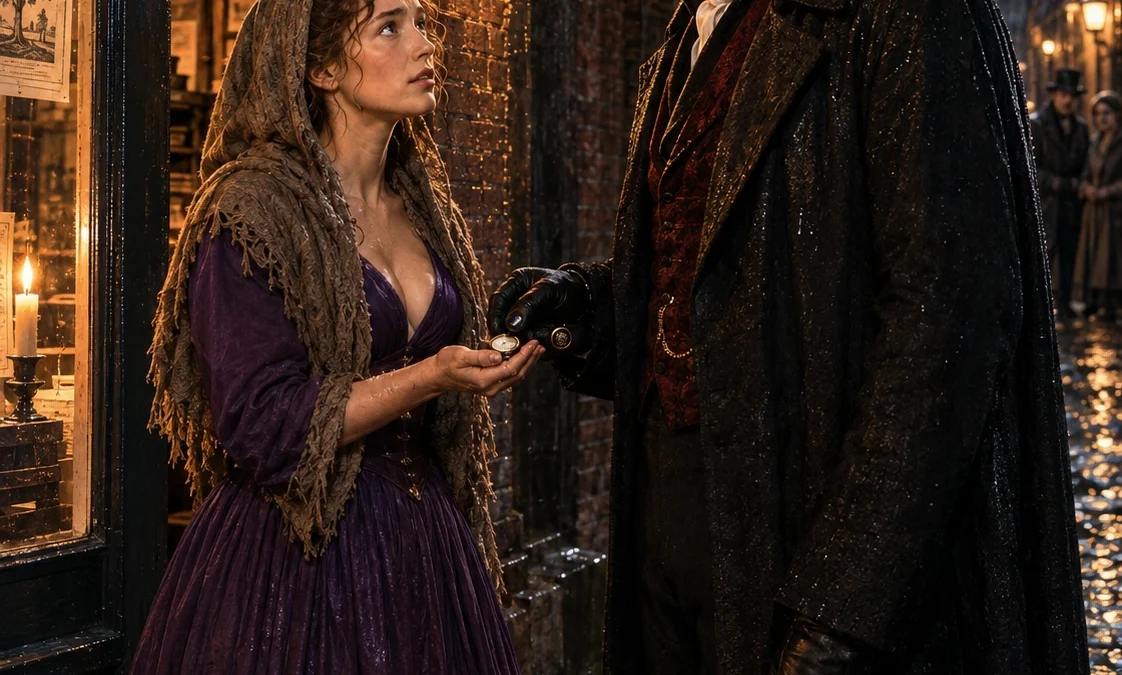
“I’ll Pay You a Shilling to Walk Me Home,” She Told the Stranger. She Had No Idea He Owned Every Brick She Stood On, and the Man Following Her Wasn’t the Real Danger 🕯️
PART 1
“There is a man behind me,” the woman said, “and I will give you a shilling to walk me home.”
The man at the end of the table looked up from a rent book he had no business reading in a public chop house. She stood there with her bonnet still wet from the lane, and she did not look frightened. That was the first thing he noticed. He had made a long study of fear, having caused a good deal of it. She looked like a woman doing arithmetic, and the arithmetic had come out at one shilling.
“How long has he been behind you?”
“Nine nights.”
“Why me?”
“Because you are the largest man in this room, and you have not once looked at me.” She set the coin down beside his cup. It rang, and two men by the fire turned their heads. She did not lower her voice. “The others look. You read. A man who reads is either a clerk or a parson, and you are too big for either, which means you can be useful. I have no time to be particular.”
He put his hand flat over the shilling. “Where?”
“Candle Lane. The press I run on Pie Row was my husband’s. It is mine now, until someone takes it off me.” Something moved in her face and was folded away, the way a woman folds a cloth she does not want anyone to see is worn through.
“I will walk,” he said.
What she did not know was that the book inside his coat was a copy of the Merestead estate rent rolls, 411 doors across eleven streets, and that on the second page, against the fifth entry, it read: Lidbury, press and dwelling, four shillings and sixpence the week. 📖
He was the Duke of Merestead. He had come down to Carrogate on the carrier’s cart, in a bad coat, under the name of a bird, because the money the book accounted for and the money that reached him were not the same money. Over nine years, the difference would have rebuilt every roof on his land twice over. He had told no one but his man of business, Garolin.
Outside, the rain had stopped and left the cobbles shining. At the top of Fettle Street, a heavy man in light boots straightened against the cooperage wall. Then he saw the size of what was walking with her, and he stayed where he was.
“That one,” she breathed. “I see him.”
“Do not look at him. He is a heavy man in light boots, and he has been paid to be seen. A man who meant you harm would have had you in the first week.”
She stopped dead in the street. “Say that again.”
“He is not following you to catch you. He is following you so you will know you are followed. Which means you have something, and someone would rather you carried it to him than have to come in and look for it.”
She stared at him. Forty yards behind them, the heavy man turned and walked away.
At her door, under a window card that read Lidbury, Printer. Bills, Sale Notices, Hymn Sheets, Black-Edged Work While You Wait, she turned and looked at him properly. Ink in the creases of her knuckles. A smudge on her jaw. Gray eyes, and a mouth that had grown firm because the alternative had proved useless.
“Your name?”
“Rook. Mr. Rook, if you like.”
“There is a bird on your ring. I shall not ask whether it is yours. A woman who hires a stranger at a chop house door has given up the right to be nice.” She opened the door. “Tomorrow. The yard gate on Pie Row, nine o’clock. A shilling a night.”
“A shilling a night,” said the Duke of Merestead.
The bolt went over. Then a second bolt, new and badly fitted, put on by a woman with a gimlet and no help.
He walked back along Fettle Street and stopped, as he always did, at the gap in the terrace. Three courses of new brick, abandoned. Number 9. The staircase had come away from the wall one wet March and taken the landing with it, and under the landing had been a woman named Peg Halleran and her two small children. The surveyor’s report had called the house sound. It had reached Merestead in a packet of forty-one papers, and a young man newly come into a dukedom had signed the lot in one morning without reading past the headings.
He had read everything since. It had made him a byword in three counties for a cold, exacting man, and he had let it, because the alternative was to be the sort of man who signed things. 💔
On the second night, she paid him another shilling. This one had a cross cut into the king’s cheek with the point of a bodkin.
“I mark them,” she said, “so I shall know if I am ever handed my own money back.”
On the third night, he arrived early and stood in her yard studying a gutter that stopped four feet short of its drain. Nine years of rain had been emptying itself against the foot of her wall, the very wall she had been fined two pounds for. The landlord carried the gutters, the roof, and the main walls. She had been fined for his fault.
“Mr. Rook,” she said quietly, “what were you before you were a man in a chop house?”
“A man who read papers. For somebody who was robbed and did not find out for nine years.”
And the next morning, he went door to door in the guise of an insurance surveyor. In a tin box in Cobb Street, he found a bundle of printed rent slips. The older ones were handsome work, headed Merestead Estate, with Lidbury, Printer, Pie Row in tiny letters at the foot.
The newer ones were poor, thin, and badly ruled. They said only Received for rent.
No estate named. No printer named. Nothing at all. 😳
He stood in a doorway in Cobb Street with those slips in his hand and his heart going like a hammer.
PART 2
That evening, he asked her one question. “Who printed the estate’s rent receipts?”
“We did. Lidbury’s, for nine years. Then, two springs ago, Mr. Dunnage, the agent, came himself and said the estate would be buying its stationery in Leeds. My husband was in a rage about it for a month. Not over the money. Something else. He wouldn’t tell me.”
“What became of the standing type? A form reprinted every quarter is never broken up. A printer ties it up and puts it on a shelf.”
She went very still. “Under the warehouse stairs. And a box of the overruns, the sheets that came out wrong. Ambrose never threw away paper in his life. And his daybook, every job since the year I came.” She gripped his sleeve, the first time she had touched him. “On Tuesday, a man offered me two pounds for those daybooks. He had a broken nose and light boots.”
“Nothing in this world is worth two pounds to Hesper Dunnage,” said the Duke, “unless it is worth two hundred to him to see it burned.”
Then they heard boots in the dark of Pie Row. More than one pair. 👢
Three men came through the gate that had no bolt. The Duke took off his coat, handed it to the boy Jem, and said, “Do not come forward, whatever you hear.” One of the men took hold of Selda’s arm. It did not take long. When it was done, the man called Ollie Stint lay in the slop by the blocked drain with the Duke’s knee on his chest and the Duke’s hand very deliberately not closed.
“Tell Mr. Dunnage the daybooks of the Lidbury Press are not for sale at two pounds, nor at two hundred. Tell him they have been read.”
Afterwards, in her kitchen, eight feet by ten, she cleaned the cut above his eyebrow with a thoroughness that had nothing gentle about it. He sat with his hands on his knees and did not say a word, in case she stopped. Nobody had tended him since he was nine years old with the measles. 🕯️
“It will mark,” she said. “People will think better of you for it, which is unjust, but there it is. Selda. If a man is knocked down in my yard, he may as well have my name.”
He mended her gutter on the Friday for four shillings and eightpence. By Sunday, he had thirty-one pages in a sevenpenny pocketbook, every page a fault reported to the Duke’s agent and never once reported to the Duke. That evening they read the daybook at her table by two candles. There it was, in Ambrose Lidbury’s careful hand: 2,000 receipt forms, charged to Mr. D. privately, no estate heading by his particular order. And in the margin, in pencil: Asked him would the Duke see these. He said the Duke sees what I send him. Keep the overrun. 😮
Then a boy knocked with a notice from the counting house. Her lease died with her husband. The rent would be ten shillings. The two-pound fine stood. And on Friday the 29th, Mr. Dunnage would seize her type and her press.
On that Friday, the Duke of Merestead stood in the rent queue in Gaunt Street for two and a half hours and listened. He heard eleven tenants pay more than the sums in the copy inside his coat. When her turn came, Selda put nine shillings on the counter. She had sold her husband’s watch to find it. Dunnage smiled and called her an arrangement: a woman alone, a stranger in her kitchen at midnight.
The Duke stepped out from behind her and leaned across the counter.
“Two questions. Read aloud what stands in the rent due column against Lidbury.” Silence. “Four shillings and sixpence. And you have written nine in the received column. Second: why does a landlord’s agent want two thousand receipts with no landlord’s name on them?”
Dunnage’s face went out like a lamp. “Stint! There is a man in here making a disturbance!”
They marched the Duke down the room, one man at each arm. At the door, Stint struck him hard under the ribs, and he went down the railed step on his knees with his hat in the gutter.
He got up. He wrote in his pocketbook in front of thirty people. And that night, thirty-one tenants carried their tin boxes to the Lidbury press, and by two in the morning the four great ruled sheets said the overcharge ran to thousands of pounds.
On the eleventh day, the constable arrived with Dunnage at his shoulder, to search the yard for “stolen estate property.” Selda stood in her doorway with Jem and Nat behind her.
“Where is your man, Mrs. Lidbury? Your Mr. Rook?”
“I am here,” said the Duke. He took off his hat. “My name is Hubert. I am the Duke of Merestead.”
The yard went silent. Dunnage laughed. The constable laughed.
Selda did not laugh. Across twelve feet of wet cobbles, her voice was very quiet.
“Say that again.”
“I am the Duke of Merestead.”
And she said the one thing in all the world he had not prepared for. 😶
PART 3
“You are the man who signed the paper about Fettle Street.”
Of everything she might have reached for, the rent, the fine, the watch, the shillings, she had reached for the gap in the terrace with three courses of brick in it.
“Yes,” he said.
Selda Lidbury turned, went into her house, and shut the door.
The next two hours happened without him. Dunnage left the yard in a hurry. By half past two, the London mail came in, and with it Garolin, sixty-one years old, in a good coat, with four boxes of books and a solicitor. Being constitutionally unable to be improper, he asked the whole inn yard where he might find His Grace the Duke of Merestead. By four o’clock there were sixty people in Pie Row staring at the door of a chop house.
At a quarter past four, Hesper Dunnage, who had seen which way the wind blew and meant to break something on his way down, walked into the press house. “Mrs. Lidbury, before you hear it from the street: do you know who you have been paying a shilling a night?”
At nine that night, a hundred people stood on the far side of Pie Row. The Duke waited by the gate in the coat Garolin had brought, which he had not wanted to put on. The works shut. Selda came out with her shawl over her head. She did not look at the crowd. She crossed the cobbles straight to him and held out her flat palm. On it lay a shilling with a cross cut in the king’s cheek.
“Night eleven.”
“Selda. Take it back.”
“If I give it in front of this town, you will take it in front of this town. I have never yet failed to pay a man what I agreed to pay him, and I am not going to begin with a duke.” Her voice carried, which was worse than shaking. “Take your wages, Your Grace, and walk me home.” 🌙
He took the shilling. Somebody in Pie Row made a sound that was not quite a cheer. A hundred people got out of the way, and the Duke walked a printer’s widow home for the eleventh time with half the town forty yards behind them and not a word said between them. It was the worst walk of his life. At the gap in Fettle Street, someone had stood a candle end on the brickwork and lit it. He never learned who.
In her kitchen, the jar on the mantel stood empty.
“Dunnage told me you have been amusing yourself among your tenants. That you will show my shillings at a club in London and they will laugh until they cry, and I shall be the printer’s widow who hired a duke for as long as I live. Is any of it true?”
“The shillings are in my waistcoat. The rest is a lie, and he knew it, because it was the only thing left he could take off either of us.”
“Then answer what is not a lie. On the first night, did you know my rent in your book was four and six?”
“Yes.”
“On the day I put nine shillings on his counter?”
“Yes.”
“I sold my husband’s watch on the Thursday. It was his father’s. I was sick behind the barrels afterward.” Her voice did not tremble. “You could have stopped it with one word.”
“I could. If I had spoken, Dunnage would have had six hours’ notice. The books would have vanished, the key to your warehouse would have reached your husband’s daybook before midnight, and I should have had a thief I could dismiss and nothing I could prove. He would have gone to another county with eleven thousand pounds and a character from me. There would have been another Peg Halleran under another staircase. So I let you pay. I stood in that queue and watched a woman pay fifteen shillings for my own ladder, and I wrote it down and did not stop it. I would choose the same again, and I must live with that.”
“Then I have no quarrel with you about the nine shillings,” said Selda. “I have a quarrel about the other thing.”
He looked at the fire. “On the fourth night, you stood over me with a basin and nobody had done that since I was nine. On the seventh, you took off your glove in Fettle Street to look at my hand. I could have told you who I was on either night without losing a line of proof, because I knew inside a week you would never carry it to Dunnage. I did not tell you. The reason was not the evidence, nor the tenants. It was that for eleven nights, one person in England spoke to me as if I might be useful, and said your boots are ruined and your hands are a disgrace. I wanted the eleven nights. I knew what they would cost you when the truth came, and I took them anyway.”
The clock ticked a long time.
“The worst of it,” she said at last, “is that I liked him. The big silent article off the carrier’s cart who could not pull a clean sheet to save his life. I had my habits settled, and then that man sat at my table and I let myself get used to him. Now there is no such man. There is a duke. And a duke cannot be liked. He can only be thanked, and I know exactly what that is worth.” Her voice caught once on the last word, and she took hold of it. “You were the man who could end it whenever he chose. That is a different creature altogether.”
“I am the same man.”
“You never were.” She lifted her chin. “Go and do your business. You have four hundred and eleven doors. Do not come to this door until every one of them has their money back in their own hand. And when you come, do not come as a duke, because I have nothing to say to a duke.”
He went. 💔
He worked until dawn in the parlor of the Ram and Anchor with the boxes open on the floor. A knock came at two in the morning. It was a thin, hatless nineteen-year-old named Thirkell Mabb, junior clerk at Gaunt Street, who had written the unsigned letter in May. “If I come in, sir, I shan’t be able to go back. And my mother’s in Husk Street.”
“Come in,” said the Duke, “and your mother will not pay another penny of rent while I live.”
At twenty past seven, they took Dunnage at his house in the Crescent, in his dressing gown, with his coffee poured. On his key ring were nine keys. The fourth opened Selda’s warehouse. The ninth opened a drawer, and in the drawer lay the book that hanged him: the real rents of 411 doors, week by week, against the sums rendered to Merestead, with the difference totted in a third column. £11,406, 9s 4d. “They always keep it,” said the attorney, almost gently. “It is the vanity of it.”
Mr. Pelham warned him plainly. “Dismiss him quietly, and nobody will ever hear of it. Or prosecute, and you must stand in open court while his counsel asks how a nobleman mislays eleven thousand pounds and never asks a question.”
The Duke went to the window. Down the hill, the roofs of eleven streets were coming up out of the dark. “Then let it be printed.”
That evening, he sent an order to the Lidbury Press: five hundred copies of a notice, on the best paper, at the full trade rate in advance, no abatement. Nat Crowder carried it to Selda. Over his own name, the Duke told the tenants that for nine years they had been overcharged and that he had not known, and it was my business to know. Every overcharge would be repaid with interest, with no proof needed but a neighbor’s word. Every unjust fine was void. And the gap in Fettle Street would be built up before winter, with a stone in the wall bearing three names.
Selda read it standing at the stone. Then she read it again. “Fetch the double crown from the second case. Tell Jem to wash his hands with the brush. I shall set every letter myself.” Old Nat read the proof, reached the line about the stone, set it down, and went out into the yard. He had known Peg Halleran.
She charged the Duke the full rate. On the receipt she wrote: Paid in full. Trade rate. No abatement. He kept it in his pocketbook ever after.
His aunt, Lady Hersilia Font, seventy-two and widowed three times with great competence, drove down to shout at him. “A chop house! Under the name of a bird!” She begged him to dismiss the man, pay the tenants triple, and not enter the witness box. “Dunnage’s attorney will plead to the embezzlement if you promise not to be examined about Fettle Street.”
“Because he wants the undertaking and not the mercy,” said the Duke. “The only thing he can still steal from me is that nobody will ever say in open court that nine… that three people died on my ground because of a report I did not read. If it is to be printed, it will be printed.”
She studied her nephew a long while. “There is a woman in this.”
“There is nothing else in it.”
For five weeks, he kept Selda’s terms. He did not go near her door. At the assizes, in a court so full that men sat in the window embrasures, Dunnage’s London counsel put the one question everyone had come to hear. Your Grace is a landlord of four hundred houses. How many times have you walked down Fettle Street?
“Eleven. Once a year, always at night, always alone.”
How many times have you entered your own counting house?
“Once. I stood in the queue for two and a half hours. It seemed the only place from which anything could be learned.”
I put it to you, Your Grace, that this whole business was made possible by your own neglect.
“That is correct.”
The court made a noise. The judge put down his pen.
“A man who signs what he has not read has consented to whatever is done with it. I was the only person in this room who could have stopped it in the first quarter of the first year, and I was prevented by nothing except my own convenience.” He looked at the lawyer, not the jury. “The report said the staircase at number nine was sound. It was not. It killed Peg Halleran, who was thirty-one. It killed Mary Halleran, who was five. It killed Thomas Halleran, who was two. I have carried those three names on a card for eleven years. The stone is paid from my own pocket, because the estate killed them, and I will not have the estate pay for the apology.”
Counsel looked down at his brief for a long time. “I have no further questions.”
The jury were out nineteen minutes. Hesper Dunnage was transported for fourteen years. The judge remarked that in thirty-four years on the bench he had never heard a prosecutor decline, at every chance, to be thought well of. ⚖️
The tenants answered in a way he had not foreseen. They gathered a penny from each of 411 doors and took it to the only press on the ground. They ordered a letter in the plainest type the house possessed, signed with the name of every street: You stood in the queue with us. You did not strike back. You told a court the fault was yours and cut three names in a stone you might have left out. We have paid for this ourselves, a penny the door, so that it shall be ours and not yours. Selda set it behind a shut door and took six hours over three hundred words.
The repayments took twenty-two days at the Assembly Rooms, and the Duke counted every sum into every hand himself. When the mayor’s brother suggested a clerk might do it faster, he agreed that one would, and went on counting. A man from Tanner’s Walk said to his face, “My wife died in that house in the bad winter, and the damp was yours.” The hall went still. The Duke stood and said, “Then say it again and I will write it down.” And he wrote it down.
On the twenty-second day, Garolin turned the last page. “That is four hundred and ten, Your Grace. The last is Lidbury. £119, 7s 4d.”
“She has not come.”
“She has said she will not stand in a queue to be paid by a man who is not allowed at her door.”
He walked up Fettle Street in the rain, past the mended lamp and the new house standing to its first floor, past a stone lying on trestles under a tarpaulin. The card was still in her window. He knocked.
She opened it with a pen behind her ear. “You are a month and two days.”
“Twenty-two at the tables and nine before. Four hundred and ten doors. Yours is the last.”
“Then come in. You are dripping on my step, and whatever we are to one another, I will not begin it with you catching cold in a lane.”
In the kitchen, eight feet by ten, he counted the gold and silver into small columns while she watched and touched none of it. She counted it after him, sweeping each column into her palm like a woman who has counted for a living.
“Forty of that is Pettifer’s. He shall have it before nine tomorrow, and then I expect I shall make an exhibition of myself in Lower Mill Street, and I would rather do it where you cannot see.” She looked at his pocket. “There is another paper. You have touched it twice.”
It was a conveyance, on good parchment, of the freehold of the press and the house to Selda Lidbury, widow, in fee simple, free of all rent. She read the line that mattered, and her face set. “The consideration is eleven shillings.”
“It is.”
“Then I shall not sign. That building is worth four hundred pounds and the house eighty. The whole town will say the widow got her freehold for the price of a pot of beer, and they will be right.”
“Then hear the rest, and if you still refuse, I will put it in the fire myself.” From his pocketbook, he took a twist of paper and untwisted it. Eleven shillings spilled onto her scrubbed table, and every one had a cross cut in the king’s cheek. “I have not spent one. I have never earned a penny in my life. I came into everything in one morning with forty-two papers to sign. I have been thanked by two governments and never once been paid by the person who wanted a thing done. Eleven times in this town, a woman came out of a yard gate and asked something difficult of me, and I did it, and she paid me a shilling. It is the only wage of my whole life. I should like to spend all of it on one thing: knowing that no one in this world can ever put you out of that press house. Not an agent. Not a committee. Not me.”
Selda stood across her own table with her hand over her mouth.
Then she took the pen from behind her ear, signed her name at the foot of the parchment, and pushed the eleven marked shillings back into his palm. “Paid. Receipt me.”
He wrote it, signed it, put the shillings back in their paper, and set the twist on her mantelpiece beside the empty jar. “That is not part of the bargain. That is my wages. I have nowhere I want to keep them but here.”
Her eyes were wet for the first time in all the weeks he had known her. “Say it properly. You have gone all round the houses like a man reading a lease.”
“Selda Lidbury. I am eight and thirty and not an easy man. I cannot be unmade a duke, and I will not pretend it lays down like a coat. You told me not to come to this door as a duke. I have come as the only other thing I am, the large awkward article who cannot pull a clean sheet in fewer than six attempts and mended your gutter for four and eightpence. He is asking you to marry him. And the press keeps its name over its door while there is a door.”
“The story,” she said. “The printer’s widow who hired a duke at a shilling a night. It will be told at every table in England.”
“I intend to tell it myself. For thirty years, in the right order, with the gutter in it and the watch and the queue and the four hundred and eleven pennies. The only part I shall leave out is where I was a fool for five weeks and could not think of a word to say.”
She came round the end of the table. “Then sit down in that chair, because I am going to put my hands on either side of your head, and I cannot reach you standing up.” 🔥
They were married five weeks later at nine in the morning, the hour the works opened, by her own particular wish. She would not be carried to church in anything with a crest on it. She walked, in a gray silk gown cut by a Blackbird Yard seamstress who had never cut silk before, on the arm of Nathaniel Crowder in a coat so new it creaked. Four hundred and eleven doors’ worth of people lined the way, and nobody cheered until she passed, and then every street cheered its own length and stopped, so that the noise went ahead of her like a thing being handed on. At the gap in Fettle Street, the new house was roofed, the stone was in the wall with three names cut into it, and there were flowers on the sill that nobody owned to. 🌸
Lady Hersilia wept in purple and told the porch, “I was against it, and I was wrong, and I shall say so in any drawing room in England.” She did, repeatedly, which settled the county faster than any threat could have.
The Lidbury press went on under its own name. Jem Hollis rose to foreman and then to partner, until the sign read Lidbury & Hollis. The Duchess of Merestead walked into that press house once a week for the rest of her life and laid her hand on the bar of the old wooden press as she passed, the way other women touch a font.
And in the last year of his life, when the eighteen yards from the orangery to the house were as far as he could go, she put her hand through his arm on the gravel terrace and said, “Walk me home.”
He walked her home. At the end of it, she pressed a shilling into his hand, and he took it, without one word of protest, because he was the only duke in England who had ever been paid for anything. 🤍
The eleven he earned first stayed in their paper twist on the mantelpiece, and then on the mantel of the brewhouse press. And when he was gone, they sat on the little shelf by her bed, where her hand found them in the dark. ✨
What would you have done in her place? Tell me in the comments. 👇
Disclaimer: This story is entirely fictional and created for entertainment purposes only. It does not represent any organization or individual, nor does it encourage inappropriate behavior. The content was generated with AI assistance.








