“I’m Marrying You Because No One Will Miss You,” the Duke Said to Her Face. But the Locked Door Between Their Rooms Was Hiding a Secret That Could Get Her Killed
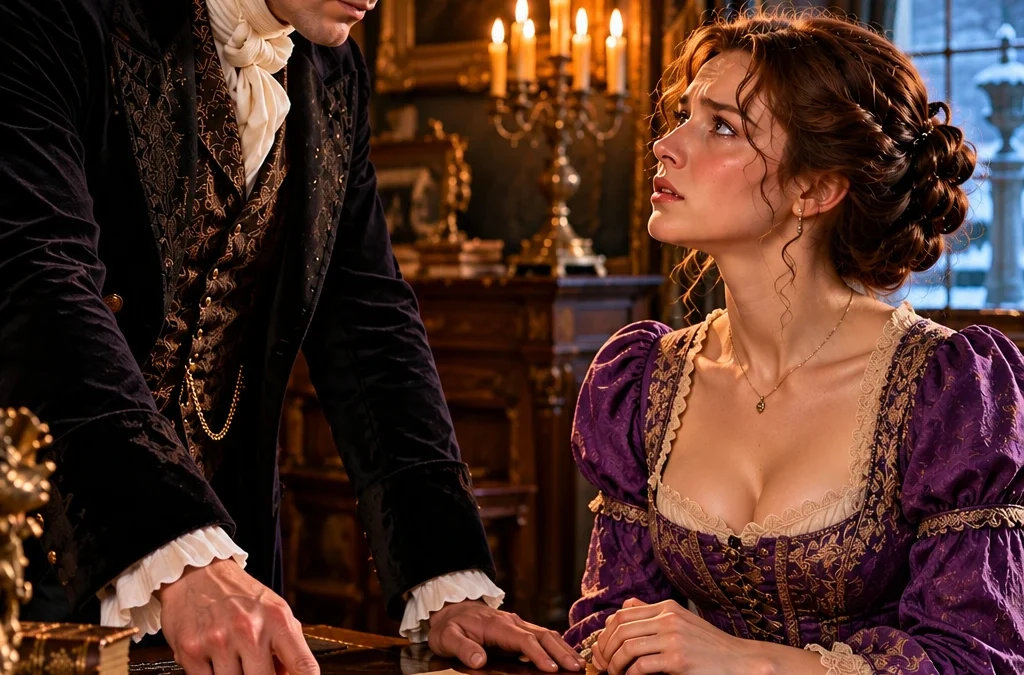
“I’m Marrying You Because No One Will Miss You,” the Duke Said to Her Face. But the Locked Door Between Their Rooms Was Hiding a Secret That Could Get Her Killed 🔒
PART 1
£400 a year. A small house in Wales for her lifetime. Nothing else.
That was the marriage settlement, signed and sealed on the 9th of October, 1821. Hester Quale read it twice by the window and believed she understood every word.
She was wrong about almost all of it. And she would stay wrong until the snow came and went again. ❄️
The library door at Ambry Court stood open when she arrived. The Duke of Ambry waited on the far side of a long table, a single paper laid between them like a wall. He was tall, perhaps thirty-four, dark-haired and very still, with the face of a man who had stopped expecting good news years ago.
He did not ask her to sit.
“I am asking you to marry me,” he said.
Hester did not move. She had been a paid companion for six years, and before that a charity-school girl in Shrewsbury. She had learned to stand perfectly still and wait for the rest.
“May I ask why?”
“You may.” For the first time, he looked at her properly. His eyes were gray and tired. “I need a wife with no father, no brothers, no cousins, no old friends who write to her, no debts, and no one waiting for her anywhere. I have made inquiries. You are the only woman in this county with none of those things.”
The words landed one at a time, like stones dropped into a pond.
“I will say it plainly,” he went on, “because I would rather you heard it from me. I am marrying you because no one will miss you.”
The library clock ticked.
Hester was twenty-seven. She had buried her employer three weeks before. She owned eleven pounds, four shillings, and a trunk. No one had written to her in four years. Everything he said was true, and he had said it in a quiet voice, as if reading out the price of coal.
She did not cry. She did not beg. She folded her hands and asked the only question that mattered.
“And what is the part you haven’t told me?”
He went still again, but it was a different stillness. For one moment, she thought he would answer.
“The part I haven’t told you,” he said at last, “is that you will be safe here. A home, an income, and my name. I will ask nothing of you that you do not wish to give.”
“That is not an answer, Your Grace.”
“No,” he agreed. “It is not.”
He said nothing more. Hester understood that whatever he was keeping back, he meant to go on keeping it.
She said yes in a letter of four lines, because she had nowhere else to go, and because some small, stubborn part of her needed to know what he had not told her. 💔
They were married on the 26th of October in the little church at Ambry Village. The only witnesses were the vicar, the Duke’s lawyer Mr. Danby, and an elderly woman in gray who wept quietly through the whole service. Nobody introduced them. There was no wedding breakfast.
Forty-one servants lined the gravel to stare at the new Duchess. The Duke handed her down from the carriage and let go of her hand the instant her foot touched the ground.
“Mrs. Begby will show you to your rooms. If you need anything, ask Pruitt, the steward. He knows everything, and he will tell you so.”
Then he bowed and walked away toward the stables.
“That’s a Duke for you, my lady,” said the round, flour-sleeved cook beside her. “Like a cat. Brings you in out of the rain, then goes off to sit on a wall.”
“Mrs. Begby,” sighed a gloomy man behind them, “I don’t think Her Grace wishes to hear about cats.”
And Hester, to her own astonishment, laughed. It was the first time in three weeks. 🌧️
Her rooms were lovely, with a fire already lit. But in the far wall, between her dressing room and the Duke’s, was a door. It was locked, and the key was on his side.
She had heard it turn at exactly 10:15, just after his footsteps climbed the stairs.
So that is how it is to be, she thought. He has bought a wife no one will miss, and he cannot bear to see her across a room.
She was wrong about that door. She would be wrong for fourteen weeks.
The days took on a shape. The Duke breakfasted before she came down and rode out before nine. He dined with her only because Mrs. Begby threatened to quit otherwise, and he sat at the far end of a table built for twenty, speaking of weather, roads, and the price of oats. Once, she walked to the little bridge over the stream, and he came riding along the lane on the other side. He saw her. She was certain. He held his horse still for three seconds, then turned and rode away.
That night she wrote in her daybook, as she had every night since she was twelve: November 9th. Walked to the bridge. Cold. Clear.
Nothing else. There was nothing else she wanted to read again.
Then, in the third week of November, the old woman in gray came to call. Mrs. Agnes Pellow had been the Duke’s nurse when he was a boy. She brought honey and knitted mittens, and she held Hester’s hand like no one had in years. She told stories of a little boy who climbed a stable roof to save a kitten, and who cried for two days when his pony died.
“He’s a good man, my dear,” she said softly. “But his heart is cold. Don’t hope for too much. Hoping is what hurts.”
Then came the 27th of November. Rain. A cup of tea going cold. Mrs. Pellow, strangely quiet, kept glancing at Hester and looking away.
“I was in Mr. Danby’s office this morning,” she finally confessed. “His clerk left a letter on the desk, and I’m afraid I read it upside down. It was to the agent at Carne Lodge in Wales. The house is to be aired and ready, with a cook and a maid, by the 25th of March. For Her Grace, who will be staying there for some time.”
The fire cracked. Hester sat very straight.
“I see,” she said. It was what she always said when she did not see at all.
“There was a young lady once,” Mrs. Pellow whispered. “Miss Louisa Corbin. He loved her. Then she was sent away, and he never spoke her name again. I think he married you because he needed a wife on paper, and you have nobody to make a fuss.”
That night, Hester counted the days in her daybook. 118 days until Wales. She wrote the number at the bottom of the page and underlined it. 📖
Everything the old woman said was true. The letter was real. The date was real. Louisa Corbin was real.
But Mrs. Pellow had left out the other half, the half that would have changed everything.
And the next morning, Hester went looking for the truth herself. 👀
PART 2
Hester did not weep. She did something far more useful. She marched down to the steward’s room and demanded every household ledger of Ambry Court.
Mr. Pruitt looked at her as though she had asked for one of his kidneys. “Have you ever examined the books of a house this size, Your Grace?”
“I have examined the books of a house of four servants, and a charity school of sixty girls where a candle end was worth fighting over. I imagine the principle is the same.”
Nine ledgers were laid on the table “like a man laying out a body.” She spread them across her sitting-room floor and worked for eleven days.
What she found was not wickedness, only habit. The coal merchant had billed for forty-two tons a quarter while the house burned thirty-four. Hester went down to the cellars with a lantern, in her second-best gown, and politely asked the coal man’s boy where the missing eight tons had gone. His father arrived the next morning, red to the ears, and the house paid for exactly thirty-four tons ever after. The merchant sent her a basket of walnuts as an apology. 🥜
She also found a deaf old gardener, seventy-eight, still paid to tend a melon house that had blown down in 1817. She did not take his wage. She gave him a chair in the sun and a boy to teach.
“You’re soft, Your Grace,” said Mr. Pruitt.
“I am careful,” said Hester. “It isn’t the same thing.”
On the 11th of December, the Duke was waiting by the fire with the coal ledger in his hand. “Pruitt says you went down to the cellar yourself.”
“I did.”
Something crossed his face, not quite a smile, but the place where one would have been. “Thank you,” he said.
She wrote it down that night: He looked at me for four seconds. She was furious with herself for counting. 😤
Then came the frozen night of the 19th of December. Unable to sleep, she slipped out onto the south terrace to look at the stars. A voice spoke from the dark.
“You’ll catch your death.”
He stood in his greatcoat and gray wool muffler. He came closer, and they stood in silence. When she turned to leave, her foot slid on the ice, and he caught her.
One second. Two. She could hear his heart pounding. Three. His hand spread flat between her shoulder blades, the way you hold something you are terrified of dropping. Four. She looked up, and his face was not cold at all. Seven seconds.
Then he froze and stepped away as if burned. “Forgive me. Go inside, Hester.”
It was the first time he had said her name.
In her room, she found his muffler still around her shoulders. She hid it in the bottom drawer, beneath her thirty-one old daybooks. 🧣
In January, Mr. Pruitt brought the estate accounts, at the Duke’s request. “She will find whatever Danby has missed.” And Hester found it: £50, on the 3rd of every month, for eight years, paid by the Duke’s own hand to “V.W.” No receipt. No explanation. £4,800 in total.
Mr. Cobb’s stable book revealed more. The Duke’s gray horse, Cinder, rode out on the Saltley Road in the dead of night, eleven times in November and fourteen in December. Always back before dawn.
Mrs. Pellow went white when Hester asked about Saltley. “Miss Corbin’s family took a house near there years ago. You mustn’t think about it.”
But Hester already was. She built her case line by line, every line true. On the 31st of January, she walked into his study and laid it out. Every lock, every ride, every payment. Her voice trembled once, and she steadied it.
“I don’t ask you to love me. But I worked it out, and I would like you not to think I am a fool as well as a nobody.”
He gripped the back of his chair. She waited, begged silently, for him to deny it.
“You are not a fool,” the Duke said quietly. “And you are not a nobody.”
“That isn’t an answer.”
“No. It is not. I’m sorry.”
That night, at two in the morning, she heard slow footsteps stop outside her door. They stood there for a very long time, then went away. And Hester opened her daybook again and noticed, for the first time, that the very first payment was dated February 1814. 🕯️
She crept down to the library to search the old newspapers. And what she found made her blood run cold…
PART 3
January 1814. A carriage accident on the Saltley Road. Miss L. Corbin, thrown and badly hurt. The horses were said to have been frightened by a gentleman riding close beside them.
Hester read it three times by candlelight. The payments had begun the month after.
A man does not pay £50 a month by hand, with no receipt, to a woman he loves in secret, she thought. He visits her. He writes to her. He pays that way only to someone he wants to keep away.
She looked at Mr. Cobb’s figures again. The night rides had not begun after the wedding. They had begun the second week of October, the very week Mr. Danby first called on her.
Then she thought of the door. She had always believed the lock kept her out. But the key was on his side, and his rooms opened onto the back stairs. Her rooms opened onto nothing but his. Anyone wanting to reach her in the night would have to come through him first.
The footsteps at two in the morning weren’t a man avoiding her. They were a man standing guard. 🛡️
And then the first sentence of all, the one she had carried since October like a stone in her shoe, turned over in her mind. I am marrying you because no one will miss you.
She said it aloud to the empty library, and for the first time she heard it differently. No father. No brothers. No friends who write. No one anywhere who could be frightened, hurt, or used to get at her husband.
Not a woman worth nothing. A woman nobody could reach.
In the morning, she asked Mr. Pruitt whether His Grace had any living relations.
“Only the one, Your Grace.” His face closed like a door. “A cousin. Mr. Vincent Ray.”
“Is he welcome in this house?”
“He is not.”
She sent the gardener’s boy to the White Hart at Saltley with a shilling. He returned before dinner. A gentleman had lodged there since the first week of October, and his man’s name was Strood.
That afternoon, Hester walked to the cottage at the edge of the park. Mrs. Pellow opened the door, saw her face, and began to cry before a word was spoken.
“You knew,” said Hester. “About Mr. Ray. You knew all of it.”
“I knew he hurt Miss Louisa,” the old woman whispered, “because Julian wouldn’t pay his debts. I knew he’s been taking money ever since to stay away. I knew he came back in October the minute he heard there might be a wedding. And I knew Wales was to keep you safe until it was settled.” She pressed her apron to her eyes. “I told you the half that would make you go quietly. I thought if you didn’t hope, you’d go and be safe. I thought if you didn’t love him, Mr. Ray would never trouble to hurt you. And I thought if Julian lost you, it wouldn’t break him the way it did last time. I did it for both of you. I swear I did.”
The canary sang behind her in the little room. Hester stood in the doorway for a long moment.
“I know you did,” she said at last. “That’s what makes it so hard.” 💔
That evening at nine, exactly as the night before, she knocked on the study door. He stood. This time, he did not knock over the chair.
“I was wrong,” she said. “Every fact I gave you was true, and I was wrong about every one. I worked it out myself. Vincent Ray. The carriage. The £50. The White Hart. The door. Your footsteps at two in the morning.” She held up the daybook. “I write everything down. I’m afraid you married the wrong woman to keep a secret from.”
He closed his eyes.
“Julian,” she said. It was the first time she had used his name. “I am not asking you to explain the facts. I know the facts. I am asking for the part you haven’t told me.”
For a long time, he did not speak. When he did, he looked only at the fire.
“I was twenty-six. Vincent had lost eleven thousand pounds at cards and wanted me to pay it. I refused, in front of other men, and I was proud of it. A week later, he rode beside Louisa’s carriage on the Saltley Road and shouted at her horses. She has not walked without a stick since. Nobody could prove a thing. But he made certain I knew.”
His voice shook. “He said to me, You have more people than you have money, cousin. I will take whichever is easier. So I paid every month, and I stopped having people. I let my friends go. I let her family take her away, and I never went to see her, because if I did, he would know I still cared, and he would do it again.”
“Twice in eight years, I let myself grow fond of someone. A godson. An old friend of my father’s. Both times, something happened. A fire in a hayloft. A horse gone lame on a bridge. Small things nobody could prove.” He drew a breath that trembled. “I have never said this to a living soul. I am afraid of caring for anyone, Hester. Not of being hurt. Of them being hurt, through me, because I looked at them too long across a room.”
“So you married a woman who had no one,” Hester said softly.
“So that no one could be used against me. So that if I kept my distance, he would see a duke who had married for convenience and leave you alone.” He laughed, quietly and without joy. “It was a good plan. It failed the first evening, when you asked what I hadn’t told you. It failed again in the coal cellar. It failed completely on the terrace.”
“Seven seconds,” she whispered. “Then why did you let go?”
“Because there was a light in Vincent’s man’s window at the lodge gate, and I had just remembered it.” He looked at her at last. “And because I did not want to let go. That was how I knew I had to.” 🔥
The fire settled. Hester set her daybook on his desk.
“Mr. Danby has gathered eight years of evidence. Witnesses, letters, the men Vincent paid. On Lady Day, the magistrates sit. Carne Lodge was never exile, Julian. It was meant to put me two hundred miles away when Vincent learned of it. You were going to tell me on the 24th of March. You thought I would be glad to go.”
“Hester—”
“I am not going. And I am not a woman no one will miss. I would like you to stop deciding things for me in rooms I am not in.” She stepped toward him. “May I?”
He did not ask what she meant. He stood at the edge of something, as he had on the terrace.
“Yes,” he said. “God help me. Yes.”
She laid her hand flat over his heart. It was racing, just as she remembered. And this time, he did not let go. He kissed her slowly, as if afraid she might vanish.
And Hester did not count the seconds. It was the first thing in her life she had ever let herself not count. 🌹
That night, the key in the door between their rooms did not turn at a quarter past ten. In the morning, she found it on her side.
On the 25th of March, the long upper room of the Ambry Arms was packed by ten o’clock. Half the county had come to see the Duke of Ambry, a man who had never brought a charge against anyone, accuse his own cousin.
Vincent Ray arrived smiling, shaking hands at the door like a host. He did not deny the money. He was far too clever.
“My cousin has paid me an allowance for eight years, out of family feeling. Now he claims I frightened him into it. Gentlemen, does he look like a frightened man?” A ripple of laughter. “He is a cold, lonely man. He drove away the woman he loved. Then he found himself a penniless companion with no family, no friends, and no name, and married her in a church with four people in it, so that nobody would ask why. Is that the act of an honest man?”
The room murmured. Every head turned toward Hester in the front row. Julian laid a hand on Mr. Danby’s arm. But it was Hester who stood.
“May I speak, sir?” she asked the chairman, Sir Walter Haverley.
“It is not usual, Your Grace.”
“Nor is any of this.”
To everyone’s astonishment, he nodded. 😮
She faced the room, the green daybook in her hand, the one she had finally begun on the 1st of February.
“Mr. Ray is quite right. I was a penniless companion with no family and no friends. My husband told me on the day he proposed that he was marrying me because no one would miss me. He said it to my face. I have never forgotten it.” She let the silence hold. “What Mr. Ray has not told you is why.”
She opened the book. “I have kept a daybook every day since I was twelve. Here is what I wrote in this one. The 2nd of February: a man in a brown coat at the lodge gate at eleven at night, watching the house. The 4th: the same man at the bridge at dusk. The 9th: the same man asked our gardener’s boy at the White Hart which window was mine. The 14th: a lame horse turned loose in our lane, exactly where I walk every afternoon.”
She turned a page. “The brown-coated gentleman is called Abel Strood. He has lodged at the White Hart since the first week of October, and his bill is paid every week by Mr. Vincent Ray. The landlord showed me his book. He keeps very good books. Better than most.”
Not a sound in the room.
“My husband married a woman no one would miss because every person he ever cared for, Mr. Ray found a way to hurt. He chose me because I was the one person in England his cousin could not frighten him through. He thought that made me safe. He was wrong.” She looked straight at Vincent Ray. “It made me the one person with nothing to lose by telling you the truth. So I am telling it.” ⚖️
Ray’s smile was gone.
Mr. Danby called Abel Strood. He called the landlord of the White Hart. He called a groom who had seen what happened on the Saltley Road in 1814. And last, he called a woman with a walking stick, who had traveled forty miles in a hired chaise and gave her name in a clear, steady voice.
“Louisa Corbin.”
It took the rest of the day. By evening, Vincent Ray was bound over to the Assizes, and every soul in the county knew him for exactly what he was. As they descended the stairs of the Ambry Arms, Julian took his wife’s hand in front of everyone and did not let go. He did not look over his shoulder to see who was watching. 🤍
Many years later, on a cold December night, a girl of eleven crept down to the south terrace of Ambry Court to look at the stars, because she could not sleep.
Her mother followed with a candle and a gray woolen muffler, old, soft, and a little worn at the ends. She wound it twice around the girl’s neck.
“It smells like the bottom of a drawer,” said the girl.
“It was in the bottom of a drawer for a very long time,” said her mother. “Under thirty-one old daybooks, and then under twenty more.”
“Whose is it?”
“Your father’s. He put it round my shoulders on this terrace on the 19th of December, a long time ago, and I never gave it back.”
Her father stepped out onto the terrace, as he often did when his wife and daughter went missing from the house. He looked at the muffler, then at Hester, and his face did the thing it had once never allowed itself to do. He smiled.
“Seven seconds,” he said.
“Seven seconds,” said Hester.
And this time, when he put his arm around her, nobody counted at all. ✨
Mrs. Agnes Pellow lived to be ninety-one. Hester visited her every week until the end, bringing honey from the Ambry hives. They never spoke again of the letter read upside down, or the half of the truth the old woman had kept back. But they both remembered it.
Mrs. Pellow had hidden the one fact that could have saved Hester months of grief. She believed a broken hope would hurt more than a long silence, and she wanted to protect the boy she had raised.
Some would call that loyalty. Some would call it the worst thing you can do to someone you love.
What would you have done? Tell me in the comments. 👇
Disclaimer: This story is entirely fictional and created for entertainment purposes only. It does not represent any organization or individual, nor does it encourage inappropriate behavior. The content was generated with AI assistance.








