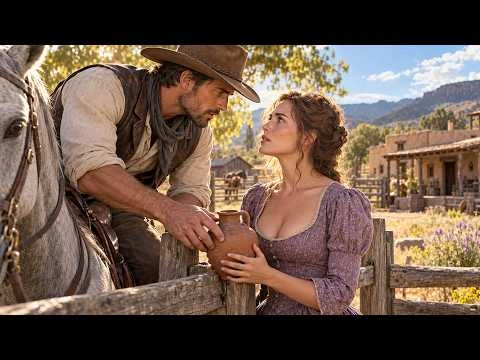
“I’M NOT ASKING YOU TO LOVE ME… JUST GIVE ME A BABY, THEN WALK AWAY,” SHE WHISPERED TO THE STRANGER
PART 2
Daniel’s refusal followed Eleanor everywhere.
It followed her into the barn while she checked the tack, across the south pasture while she counted calves, and back to the irrigation gate each morning as she measured the water level and carved another precise mark into the old wooden board.
Numbers behaved.
People did not.
That was what Eleanor had learned during her nine years of marriage to Henry Price.
Henry had not been cruel. Eleanor refused to turn a dead man into a monster simply because their marriage had ended badly. She had loved him once.
But Henry had believed that being her husband meant being right.
He decided when cattle should be sold, where money should go, which pasture needed changing, and what Eleanor ought to be grateful for. By the time he died, she had become so accustomed to his decisions that she sometimes struggled to remember what she herself wanted.
After his death, she made herself a promise.
No one would ever own enough of her life to make her disappear inside it again.
That was why Daniel unsettled her.
He never told her what to do.
He simply offered choices.
When Silas Ror tried to hire Daniel for several months of freight work on the condition that Daniel stop working for Eleanor, Daniel refused.
“You turned down months of work because of me?” Eleanor asked.
“No. I turned it down because I don’t let another man decide which customers I’m allowed to serve.”
She wanted to argue.
Instead, she understood.
Daniel wasn’t rescuing her.
He was respecting her.
A week later, when Eleanor’s north fence collapsed, she hired him again.
As they worked, she finally told him about Henry.
“He wasn’t cruel,” she said quietly. “He just believed being my husband meant being right.”
Daniel drove a staple into the post.
“And what did you think?”
Eleanor stopped.
“That was the problem,” she admitted. “I stopped knowing.”
Daniel didn’t tell her what she should feel.
He only said, “Then maybe you’re allowed to learn again.”
She looked at him for a long moment.
Then she almost smiled.
Daniel had secrets of his own.
He had once worn a deputy’s badge, but he had left after refusing to arrest a mining organizer whom he knew had been falsely accused of stealing payroll money.
“I stopped wearing a badge,” he explained.
He didn’t say it like a heroic story.
That mattered to Eleanor.
Meanwhile, Silas Ror’s pressure increased.
Cattle buyers began offering Eleanor slightly less than market value. One refused to buy altogether, claiming the trail conditions were unfavorable even though the sky was clear and the roads were dry.
Then Daniel discovered another route north.
It was longer, rougher, and more expensive, but it could bypass the canyon controlled by Ror.
He didn’t tell Eleanor to use it.
He simply showed her the option.
Three independent teamsters were already tired of paying Ror for access through Red Knife Canyon. If Eleanor chose the longer road, Daniel believed others might follow.
For the first time, Eleanor realized the difference between control and partnership.
Henry had called control protection.
Daniel offered help and left the decision in her hands.
Two days later, Eleanor rode the alternate trail with Daniel and Tom.
Near a shallow spring, Eleanor finally brought up the proposition she had made weeks earlier.
“I withdraw it.”
Daniel looked at her.
“You don’t owe me an explanation.”
“I know. That’s why I’m giving you one.”
She admitted that she had thought her arrangement was perfectly clean. No marriage. No promises. No man controlling her life.
But there had been another person in that arrangement.
The child.
“I never asked what kind of independence begins by deciding someone else’s father should disappear before they can even know him.”
Daniel looked toward the spring.
“You changed your mind?”
“Yes.”
“Because of me?”
“Partly.”
She warned him not to look pleased.
Then Daniel quietly admitted that he had been thinking, too.
“I came to Los Palomus expecting to finish some work and move west,” he said. “I’m not sure anymore.”
Neither of them turned that uncertainty into a promise.
Not yet.
Three mornings later, Silas Ror arrived at the Price Ranch.
He came wearing a clean coat and carrying another contract.
“Spring drive starts Monday,” he told Eleanor. “If you want your herd through Red Knife Canyon, sign over your eastern water allotment.”
“And if I don’t?”
“Turn them around.”
He gave her until sunrise Monday.
Eleanor looked toward the eastern hills, then back at the man who believed fear would eventually make her surrender.
“I’ve already chosen.”
Monday morning arrived cold and clear.
Ror’s men had stretched a chain across the entrance to Red Knife Canyon.
The contract was still in his hand.
“You’ve still got time,” he told her.
Eleanor looked at the canyon, then at her cattle.
Finally, she turned to Tom.
“Swing the lead cows south.”
Ror stared at her.
“You’re serious.”
“You were counting on me not being.”
The herd turned.
The alternate road was brutal.
One steer broke from the line. Tom’s horse threw a shoe. A dry wash took nearly an hour longer than Eleanor had calculated.
Every delay cost money.
But she kept going.
Near sunset, three freight wagons appeared ahead.
The drivers were men Eleanor recognized from Los Palomus, including Ruiz, the laborer whose stolen wages Daniel had once helped recover.
Eleanor looked at Daniel.
“What did you do?”
“Nothing,” he said. “I told them the road was passable. They made their own decision.”
One of the teamsters laughed.
“Mercer told us there’d be cattle ahead, so we brought spare water.”
Eleanor felt something loosen inside her.
Daniel had not rescued her.
She had already made the hard choice before knowing whether anyone would help.
He had simply chosen to walk the harder road beside her.
The wagons broke the worst ruts. Spare water kept the herd moving. Other ranchers joined the route.
By the third day, word had traveled.
Red Knife Canyon was no longer the only practical route.
It was simply the shortest.
Eleanor reached the northern sale yard nearly a day late. Her cattle had lost weight, and the price hurt.
But the herd sold.
The ranch survived.
Ror’s control had cracked.
Weeks later, Eleanor stood beside the irrigation gate measuring the spring runoff.
Six and one-eighth inches.
Daniel leaned against the post.
“You going to carve it?”
“In a minute.”
She looked at him.
“I don’t want you to leave.”
Daniel said nothing.
“That isn’t the same request I made the first time,” she continued. “I don’t want you staying because I need a ranch hand. Or because you think I need protecting.”
“I’ve seen you with a branding iron,” he said. “I value my life.”
She smiled.
Then the smile faded.
“I want you here because I choose you.”
Daniel stepped closer.
“And the child?”
“I still want one.”
“So do I.”
Eleanor held his gaze.
“But not as something you give me.”
“No.”
“If it happens, we raise that child together.”
“Yes.”
“And if it doesn’t?”
Daniel answered immediately.
“I stay.”
Her eyes filled.
“The ranch stays mine.”
“Yes.”
“Your wagon work stays yours.”
“Yes.”
“Big decisions belong to both of us.”
“Especially the ones we disagree about.”
“That sounds unpleasant.”
“Probably.”
Eleanor laughed.
Then she reached for his hand.
Months later, they married beneath a simple cottonwood arbor behind the ranch house.
There was no grand ceremony and no crowd large enough to impress anyone.
Tom stood beside Daniel. Ruiz brought his family. Eleanor wore a cream dress she had chosen herself, and Daniel wore a coat he had paid for himself.
Those details mattered.
Their marriage was not about Eleanor surrendering the ranch or Daniel becoming its master.
It was about two people choosing to build a life without either one disappearing inside the other.
By late summer, the irrigation board warped in the heat.
Daniel carried a replacement plank to the ditch while Eleanor stepped ankle-deep into the water.
“Higher on your side,” she said.
“It is higher.”
“It isn’t.”
Daniel adjusted it anyway.
She smiled.
Under the open ranch shed sat the unfinished frame of a small wooden cradle.
Daniel had begun building it without asking when they might need it.
Eleanor hadn’t asked him to stop.
Maybe a child would sleep there one day.
Maybe not.
For once, neither of them needed certainty before choosing what came next.
Daniel held the board steady.
Eleanor drove the first nail.
Water moved around their boots as they worked side by side.
They had learned that love was not ownership.
It was not control.
It was not one person surrendering while the other decided everything.
It was choosing each other freely, again and again, while still remaining fully themselves.
And perhaps that was the greatest thing Eleanor had gained from the stranger she once asked to give her a child and then walk away.
He had not walked away.
He had stayed.
And together, they built something neither of them had known how to ask for in the beginning—a home where love could exist without taking away either person’s freedom.








