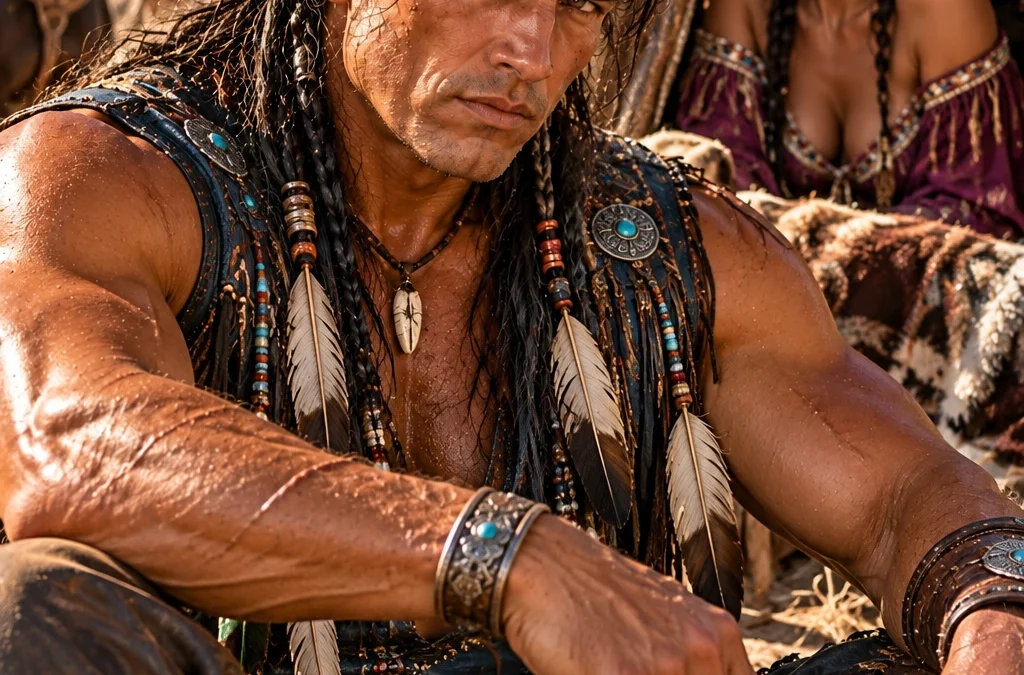
“I’M TOO OLD TO CHOOSE A BRIDE,” THE COMANCHE KING TOLD HIS COUNCIL… NOT KNOWING THE WOMAN HE’D IGNORED FOR TEN YEARS WAS STANDING BEHIND A TREE, HEARING EVERY WORD
“I’M TOO OLD TO CHOOSE A BRIDE,” THE COMANCHE KING TOLD HIS COUNCIL… NOT KNOWING THE WOMAN HE’D IGNORED FOR TEN YEARS WAS STANDING BEHIND A TREE, HEARING EVERY WORD 😱🔥
Part 1
He told his council he was too old to choose a bride. 🌅
He had no idea she was standing close enough to hear every word.
Ten years of silence. One confession by the horses. And a single sentence that would bring the Comanche King to his knees.
The last time Wakan had looked at Lenora Vale, she was a girl of eighteen, hiding behind her father’s ledger and pretending not to watch him.
Ten years later, she walked back into his world with dust on her riding boots, a streak of white in her dark hair, and a question in her green eyes that no girl had ever dared to ask him.
The heat lay over the upper Brazos like a hand pressed flat against the land. Lenora felt it through the canvas of the freight wagon, through the teal wool of her riding dress, through her gloves. She had forgotten this. Missouri had rain and green hills and rivers that behaved themselves. Texas had a sky so wide it made a person feel small and free at once.
She had not forgotten anything else.
“You holding up back there, Miss Vale?” called the driver, Amos Puit, who had talked about mules for four days.
“I’m fine, Mr. Puit.”
She pressed a gloved hand to the pocket where her father’s letter had lived for five weeks. His knee had gone bad. His eyes were worse. The summer trade was the largest the post had ever seen, and he could no longer keep the ledgers straight.
Come home, Nora. Just for the season.
She had told herself that on the steamboat, on the train, in every rattling mile of this road. That she was coming back for her father. For the business she had spent ten years learning in her uncle’s St. Louis warehouse.
All of that was true. It was simply not the whole truth.
The wagon crested the rise, and there it was. Vale’s Crossing. The long adobe trading house, the corral, the cottonwoods along the river. And beyond the corral, spread across the flat ground by the water, the lodges. Dozens of them, painted hides glowing pale in the sun, horses grazing in loose herds, children running between the tipis with dogs at their heels.
The Comanche had come for the summer trade.
Lenora’s heart did something she had not given it permission to do.
She was twenty-eight. She had managed accounts that would make her father’s eyes water. She had refused a banker with a mansion on Lucas Place and a railroad engineer who wrote poetry, and never once explained to her aunt why. She was not going to fall apart over a camp by a river.
And yet her fingers had tightened on the wagon seat, and she could not make them let go.
Ten years ago, on a morning much like this, a half-broken mare had thrown her in the corral. She had been showing off, if she was honest, because the Comanche traders were watching from the fence. Before she could catch her breath, a man had caught the mare’s bridle in one hand and stopped her dead.
He had been thirty-eight then. Tall, broad through the shoulders in a way that made other men look unfinished. Long black hair, a face carved from something harder than wood, eyes so dark they seemed to take the light and keep it.
He had looked down at her, sitting in the dust with her skirts tangled and her pride in pieces, and said only one thing.
“Your hands are too tight on the reins. The horse feels your fear.”
Then he had walked away.
Wakan. That was all. One sentence. In three summers he had nodded to her, stepped aside to let her pass, accepted the coffee she brought to the trading table with a courteous word. Perfect respect. Perfect distance. And she had loved him with the silent, burning helplessness of a girl who knew exactly how impossible it was.
When her mother died and her father sent her east, she had not said goodbye to him. She had not known how.
She had carried that sentence for ten years instead.
Her father came down the porch steps leaning on a hickory cane he clearly hated. Heavier. Grayer. But his face broke open when he saw her, and for a moment she forgot everything else.
“Look at you. Good Lord, look at you.”
“I look terrible, Papa.”
“Your aunt wrote that you turned into a businesswoman. She didn’t say you turned into your mother.”
Lenora’s throat tightened. His eyes went to the streak of white at her left temple, a narrow ribbon of silver that had come in after the fever she caught her second winter in St. Louis. Her aunt had begged her to dye it. She had refused.
“You kept it.”
“It’s mine. I earned it.”
“That you did.” He patted her cheek, then his face shifted to something practical. “I hate to do this with the road still on your boots, girl, but I need you. The big band came in yesterday. They brought sixty horses and more hides than I have room for, and my clerk can’t add a column without chewing his pencil to splinters.”
She had known this was coming. Still she heard herself ask it.
“Who is at the table?”
Her father gave her a look she couldn’t quite read. “Wakan. Who else?”
She nodded as if that meant nothing. She tugged her gloves straight. She shook the dust from the hem of her teal dress, which her aunt had called unsuitable and which fit her the way a dress should fit a woman who knew her own shape. She was tall, five foot eight, with a narrow waist and a figure that had made the St. Louis matrons whisper behind their fans. She had stopped apologizing for it years ago.
“Then let’s not keep him waiting.”
Inside, the trading house was cool and dim, thick adobe holding the heat out like a door shut against a crowd. It smelled of coffee, tanned leather, wool blankets, and gun oil. At the long table near the back, three men sat across from her father’s nervous young clerk.
She saw him before her eyes had fully adjusted.
Wakan sat at the head of the table with his forearms on the wood, and he seemed to take up the whole end of the room without trying. He was even larger than she remembered. His shoulders were enormous, his chest broad under a dark plain shirt, his arms thick enough that the sleeves strained. A long pale scar ran across his right forearm. Around his left wrist he wore a single bracelet of dark, aged silver.
His hair was still long and black. But now there were streaks of gray at the temples, bold and unmistakable, threaded through the length of it like frost in a dark river.
He was forty-eight. He did not look young. He did not look old. He looked like a man who had spent three decades riding, fighting, and carrying other people’s lives, and had come out of it with his strength not lessened but settled, the way a great oak settles into the earth.
Lenora had imagined this moment a thousand times. In none of them had her knees felt so unreliable.
He looked up when she entered, the way a man looks up at any movement in a doorway. Then she saw the exact moment it happened.
Recognition came first, quick and certain.
Then something slower. His gaze moved over her, not rudely, but carefully, as if reading a letter in a familiar hand and finding the words unfamiliar. The white streak. The line of her jaw. The teal dress. The height of her. The fact that she was not looking down.
It took him several seconds to understand.
Lenora noticed every one of them. She liked it very much.
She sat. She pulled off her gloves finger by finger, laid them beside the ledger, and opened it. “Forgive me for arriving in the middle of things. Henry, where were we?”
She listened, ran her finger down the columns, turned back two pages, then three.
“This is wrong.”
The table went quiet.
“Henry has these listed as common stock. I watched them come in from the rise. Half are Spanish-blooded, and at least ten are trained buffalo runners. You’d sell those to the army remount buyers at Fort Griffin for three times this figure.” She looked directly at Wakan. “If we cheat you on the horses this year, you’ll take them to the Comancheros next year, and then we’ll all be poorer. I’d rather pay a fair price and keep your trade for another ten summers.”
The young warrior beside the elder grinned outright. Wakan did not smile, but something moved at the corner of his mouth, and he leaned back and studied her with an attention so complete it felt like heat against her skin.
“And the kettles,” he said. His voice was deep, lower than she remembered, a rough, quiet voice that seemed to come from somewhere in the center of his chest. “Your father asks too much.”
“No,” said Lenora pleasantly. “He doesn’t. Those are Pittsburgh iron, not tin, and they’ll outlast every kettle in your camp. The price stands.”
For a long moment nobody spoke.
Then Wakan inclined his head, very slightly. “The price stands.”
When it was finished, the others drifted away. Lenora began slowly to draw her gloves back on. Wakan had not moved. He was still watching her, and in the dim quiet it was suddenly as if no one else existed.
“You’re staring,” she said.
He did not look away. Most men would have.
“I’m trying to find the girl I remembered.”
Lenora stood. She came around the table, not quickly, and stopped closer to him than was strictly proper. Close enough that he had to tip his head back to keep his eyes on hers. Close enough to see the gray threads in his hair, and a faint scar through his left eyebrow she had never noticed.
She leaned in just a little.
“She grew up.”
Then she walked out into the white afternoon sun and did not look back, because she knew that if she did, she would lose the only advantage she had ever had over him.
Behind her, the Comanche King sat very still. It was the first time in his life a woman had left him without an answer.
Two nights later, the summer trade was sealed with a feast. Great fires on the flat ground by the river. Buffalo hump roasting on spits. A fiddler from one of the freight crews playing beside Comanche drummers, the two kinds of music tangling together in ways that should not have worked and somehow did.
Lenora wore copper. A deep copper silk that caught the firelight and turned it liquid. She pinned her hair up, then after a long look in the small mirror, took half the pins out again and let the dark waves fall down her back, the white streak bright at her temple.
She told herself she had not done it for anyone in particular. She did not believe herself for a moment.
Across the largest fire stood Wakan, with a buffalo robe thrown over one shoulder, the firelight picking out every hard line of him. He did not look at her. Lenora noticed that he did not look at her with exactly the precision other men used when trying very hard not to look at something.
“Miss Vale.” It was the young warrior from the table. “I am called Quick Antelope. My uncle says white women dance when the fiddle plays. Will you dance with me?”
She looked past his shoulder. Wakan was still not looking at her.
“I would be delighted.”
They invented a dance somewhere between a reel and whatever he knew, laughing, turning, the drummers keeping a deeper rhythm underneath. People clapped. Someone whistled. Every time she turned, her eyes found the other side of the fire. Wakan was talking with the elders. His face was calm.
She began to feel foolish.
Then the music slowed, and Quick Antelope drew her in for the final turn and settled his hand firmly at her waist.
Lenora looked across the fire.
Wakan had not moved. His face had not changed. But his eyes were on that hand against the copper silk, and his jaw had gone hard as stone. She could see the sudden stillness in those enormous shoulders.
It lasted only a moment. Then he looked away.
But it had been there. 🔥
She left the firelight a little later and walked past the corral down toward the cottonwoods, where the music faded to a distant pulse.
He was there. She had hoped it, the way she had hoped for ten years. He stood alone at the edge of the trees with his back to the fires, looking out over the dark water, silver-edged in the moonlight.
He heard her. A man like that heard everything. He did not turn.
“You didn’t like him touching me,” she said.
A long silence. Only the river.
“You imagined that.”
His voice was perfectly calm. It was the voice of a man who had sat across from army officers and rival chiefs and never once given away what he was thinking.
Lenora stepped in front of him, slowly, deliberately, until there was nowhere for him to look but at her. Close enough to feel the heat of his body in the cool night air. In the moonlight his eyes were almost black.
“Then look at me,” she said quietly. “And say it again.”
He looked at her. She watched his mouth begin to form the words. She watched his gaze drop for an instant to her lips and come back up darker than before. His hands curled slightly toward fists, then forced themselves open.
He did not say it. He could not.
The silence stretched so long and so tight that she could feel her heartbeat in her throat.
Then Wakan stepped back, as if the ground where he stood had grown too warm.
“Good night, Lenora.”
He walked away along the riverbank and did not look back.
It was only later, lying awake in her old bedroom with the window open, that she realized what had happened.
In three summers, ten years ago, he had never once said her name.
He had just said it as if he had been holding it in his mouth for a very long time.
What Lenora did not know, as she lay listening to the last of the drums, was that at dawn the council would gather at the river and bring Wakan the name of a bride.
And that she would be standing close enough to hear his answer. 😳
Part 2
Lenora had not meant to hear it.
She had given up on sleep before the sky was even gray. She dressed in her deep brown riding habit and walked down to the corral to see the mare her father had set aside for her. The morning was cool and pale, mist lifting off the Brazos in thin white ribbons.
She took the long path along the river because it was quieter.
That was how she came around the bend in the cottonwoods and found the council.
Eight or nine men sat in a loose circle on buffalo robes near the water. Wakan sat at the head, back straight, forearms on his knees. Lenora stopped behind the trunk of a great cottonwood before any of them saw her.
She meant to turn around. She truly did.
Then she heard the name Morning Dove, and did not move.
They spoke in Comanche, and hers was the Comanche of a girl who had listened at the trading table for three summers and practiced alone in her room. She could not follow all of it. She understood enough. A widow. A good woman. Strong sons who needed a father. A lodge that had stood empty for twenty winters. A leader who should not grow old alone.
One man spoke, then another, then a third, their voices patient and insistent like water wearing at stone.
Wakan listened to all of them without interrupting. When the last had finished, he was silent a long moment.
Then he answered. In English. Deliberately, as if he wanted the words to be as plain and final as possible. As if he wanted even the river to understand.
“I’m too old to choose a bride.”
The circle went quiet. Behind the cottonwood, Lenora pressed her back against the rough bark and closed her eyes.
Relief came first, sharp and immediate. He had refused the widow.
But underneath it, something hot rose slowly from the center of her chest into her throat.
Too old.
She walked back to the trading house without seeing the path.
She found him that evening at the horse lines. The sun was going down red over the plains, and the herd had been brought in close for the night. Wakan stood among them alone, one hand on the neck of a tall gray stallion, murmuring in his own language.
He heard her coming. He did not turn.
“I heard the council this morning.”
His hand stopped on the stallion’s neck. “Then you heard a private matter.”
“I heard you tell eight men you’re too old to choose a bride.” She came around the stallion’s shoulder so she could see his face. “Do you actually believe that?”
In the red evening light, his face was calm, severe, and very tired.
“I believe a man my age should not bind a young woman to the winter of his life. The widow is thirty-five, and I am forty-eight.” His voice was patient, as if explaining the obvious to a child. “In ten years I will be an old man. In twenty I may be nothing at all. A woman should choose someone who will grow old at the same pace she does. That is not foolishness, Lenora. That is simply true.”
Heat rose in her face. It was not about the widow. It was that tone. That careful, reasonable tone, the same one he had used ten years ago when he treated her as something fragile, to be kept at a respectful distance for her own good.
He was doing it again. Deciding what was best for her without ever asking what she wanted.
“You are deciding for her.”
“For whom?”
“For whatever woman you think you’re protecting.” She took a step toward him. “You’ve decided what she should want. You never once thought she might be perfectly capable of deciding for herself.”
“Lenora.”
She took another step. The stallion moved away. There was nothing between them now but warm evening air.
“Stop,” Wakan said quietly.
She did not. She came closer until the front of her riding habit nearly touched his chest, until she had to tilt her head all the way back to hold his gaze, until she could smell horse and leather and woodsmoke on his skin.
And Wakan, the man who had never given ground to anyone, stepped back. Only half a step.
But Lenora saw it. And in that moment she understood what she had not understood in ten years of wondering.
The unshakable Comanche King was not indifferent to her.
He was running.
“I’ve waited ten years,” she said.
Wakan went completely still.
“I’ve waited ten years.” 💔
The words hung in the air, and she could not take them back, and she did not want to.
“I was eighteen when you caught that mare in my father’s corral. You told me my hands were too tight on the reins. It’s the only thing you ever said to me. One sentence, and I carried it ten years.”
“Lenora, let me…”
“I was too young then. I know that. And you never gave me one reason to hope. You were kind and careful and you looked through me like a window. So I left. I went to St. Louis. I learned my uncle’s business better than my cousins did. I had suitors. Good men. Men who could have given me a house and children and a comfortable life. Every chance in the world to forget you.” Her voice caught. She pushed past it. “I never did. Not for one day. So don’t you dare stand there and tell me what a woman should choose. I’m not offering you a girl’s infatuation, Wakan. I’m twenty-eight years old. I know exactly what I’m choosing.”
For a long time he didn’t speak. The last of the sun slid below the horizon and the sky turned deep blue, then violet. Somewhere in the camp a dog barked, and a child laughed.
When he finally spoke, his voice was rough, as if his throat had been scraped raw.
“Why did you never write to me?”
“Because I wanted you to see the woman asking you,” she said. “Not remember the girl.”
Something broke in his face. She saw the careful, patient control he had worn as long as she had known him crack straight down the middle, and what lay underneath was not calm at all. It was hunger and fear and a tenderness so raw it made her breath catch.
He lifted one hand slowly, as if approaching an animal that might bolt, and touched her face. His palm was enormous against her cheek, rough and warm. His thumb moved slowly along her cheekbone, and she felt it all the way down her spine.
“Do you truly know what you are choosing?”
She didn’t answer with words. She took hold of his wrist, the one with the old silver bracelet, turned his hand gently in hers, and pressed her lips to the center of his scarred palm.
She felt his whole body go rigid.
“You,” she said.
This time it was Wakan who closed the distance. He kissed her the way a man drinks water after crossing a desert. Deep and slow and utterly sure, as if he had been thinking about it far longer than he had ever allowed himself to admit. One huge hand slid around her waist and drew her against him. The other buried itself in her hair, sending the last of her pins scattering into the grass.
And yet he was careful. Even now his hand held her as if she might break.
Lenora would not have it. She fisted both hands in the front of his dark shirt and pulled him down to her, and kissed him back with ten years of waiting.
She felt the exact moment his restraint gave way. A low sound rumbled up from deep in his chest. His arm tightened until her feet nearly left the ground.
When they finally broke apart, both were breathing hard. Wakan rested his forehead against hers, eyes closed. Lenora drew her fingers slowly through the gray at his temple.
He shuddered.
A small, involuntary tremor ran through that enormous body, and he pulled her against his chest and held her there without a word, his heart pounding under her cheek, while the first stars came out over the plains. 🌌
For three days Wakan was careful. He did not hide what had happened by the horse lines, but he did not announce it either. At the trading table he sat where he always sat, spoke as he always spoke, and treated Lenora with the same grave courtesy as ever, so perfectly that anyone watching would have sworn nothing had changed.
Lenora found this absolutely intolerable.
She also found it the most entertaining thing that had ever happened to her.
On the fourth morning, an army remount buyer rode in from Fort Griffin. Captain Harland Doyle. Red mustache, loud laugh, and the firm conviction that he could buy Comanche buffalo runners for the price of mules.
The negotiation was hard. Doyle pushed. Wakan pushed back, calm and immovable, his deep voice never rising. Lenora kept the figures and said little.
Then, in the middle of Wakan’s patient explanation of why a trained buffalo runner outranked any horse in the United States cavalry, she reached beneath the table and rested her hand lightly on his thigh.
Wakan stopped speaking.
Perhaps two seconds. But in those two seconds, the Comanche King, who had negotiated with generals and outlasted Comancheros and never lost the thread of an argument in his life, simply lost it.
“You were saying sixty?” Lenora said pleasantly, without looking up.
He turned his head and looked at her. She kept writing. She did not remove her hand.
“Sixty,” he said in a voice very slightly rougher than before.
Doyle paid fifty-five, which was more than he’d ever paid for anything in his life.
When the door closed behind him, Wakan reached under the table, took her wrist, and lifted her hand from his leg. He did not let go.
“You are dangerous.”
“I’m a businesswoman. You got five dollars more a head than you would have. You should be thanking me.”
“I lost what I was saying.”
“I know.” She leaned in until her lips nearly touched his ear. “I felt it.”
His grip tightened. She heard his breath catch. For one long moment she was quite sure he would pull her across the table.
The storeroom door banged open and Henry came through with an armful of blankets.
Wakan released her wrist and rose with great dignity. At the door, he looked back at her over his shoulder, and the look made her toes curl inside her boots. 😏
It became a game. She discovered that if she leaned close and spoke against his ear while others were nearby, his whole body went still in a way no one else would notice, and his answer came a beat too late. She discovered he did not like to be surprised, and liked being surprised by her very much.
And she discovered that there was one place where the Comanche King was entirely without defenses.
The gray in his hair.
The first time she touched it, by the horse lines, he trembled. She thought it was the kiss. But it happened again the next evening, when she found him alone by the river and slid her fingers slowly into the silver at his temple. His breath went out in a long, unsteady rush. His eyes closed. He leaned, just slightly, into her hand.
“You like that?”
He did not answer. But he did not ask her to stop.
What Lenora did not know, and what Wakan would never have told her, was what was happening to him when she wasn’t there. He was forty-eight. He had buried his wife, Singing Water, twenty winters ago when the spotted sickness swept the camps. In the years since he had built his life around the things that did not die. Duty. Leadership. The discipline of a man who does not allow himself to want what he cannot have.
He had believed that part of his life was finished, simply, the way summer finishes and gives way to autumn.
And now he found himself waiting. For the trading table in the mornings, because she would be there. For evening, because she would come down to the river. He caught himself once standing at the horse lines at dusk with a bridle forgotten in his hand, watching the path from the post.
He had forgotten what anticipation felt like in the chest, like a second heartbeat.
It frightened him more than any battle ever had.
On the ninth evening, she did not come to the river. Instead a boy brought a message. The mare needed exercise, and Miss Vale would be riding out to the bend of the creek where the red cliff stood, and if someone who knew the country happened to ride that way, she would be grateful for the company.
Wakan read the message twice. Then he saddled the gray stallion.
He found her at the creek bend as the sun touched the horizon, the red cliffs glowing like coals. She sat on a flat rock at the water’s edge with her boots off and her feet in the stream, her copper riding skirt gathered to her knees.
“You took your time,” she said, smiling at the water.
“You sent a boy to tell me where you would be alone. Do you know what your father would say?”
“My father sent the boy.” Her green eyes were full of mischief. “He said, and I’m quoting exactly, that if you were going to court his daughter like a nervous colt, somebody had better give you a push.”
Wakan stared at her.
Then, for the first time since she had come home, she heard him laugh. Low and rough and startled, as if it had been locked away for a long time and had only just found the door. It changed his whole face. The severity dissolved. For a moment he looked like an entirely different man.
Lenora thought it was the most beautiful thing she had ever seen.
Far off in the west, a great bank of clouds was building, towering tops still lit gold, bellies dark and heavy. A warm wind moved down the creek, smelling of dust and distant rain.
“Storm coming. Should we ride back?”
He was quiet a long moment. “There is an overhang in the cliff. Deep and dry. We would not reach the post before it breaks.”
“Then we’ll wait it out.”
By the time his small fire was burning, the first thunder was rolling across the plains, low and long, like something enormous turning over in its sleep.
They sat close, her shoulder against his arm. After a while, without quite deciding to, Lenora began slowly to explore him. She traced the long scar down his forearm. She found the small one through his eyebrow, another along his jaw. She laid her palm flat on his chest and felt his heart beating, heavy and fast. She ran her fingers through the silver in his hair and watched his eyes close.
“Lenora,” he said, low.
He opened his eyes. In the firelight they were dark and searching, and for the first time since she’d known him, she saw something in them that looked like uncertainty.
“The marks. The years. The gray.” He hesitated. “Do they not trouble you?”
She went very still. She understood what it had cost him to ask. This man, who had never shown fear to anyone, who carried his whole people on those enormous shoulders, was afraid. Afraid she would look closely and see only what time had taken.
She drew her fingers gently through a silver streak at his temple.
“I waited ten years. Why would I want those years erased?”
He did not move. He did not speak. But she felt the words go into him. She watched them land somewhere deep behind his eyes, somewhere no one had reached in a very long time.
Then he turned his face into her palm and pressed his mouth to the inside of her wrist, where her pulse was racing.
What followed was slower than the first kiss. Deeper. A long, unhurried conversation between two people who had finally stopped pretending. Even now, with his breath ragged and his heart pounding against her, his hands paused at every new place, waiting until she answered by pressing closer.
It undid her more than anything. That a man so strong would move so slowly. That he would hold all that power in check for her.
Outside, the storm broke. A roaring curtain of rain turned the creek white and shook the cottonwoods to their roots. Lightning split the sky from end to end. The horses stamped and blew beneath the overhang. The small fire leaned and flared and leaned again.
And when the storm finally moved away east, grumbling, the air behind it was cool and sweet and washed clean, and the stars came out over a sky so clear it looked brand new. 🌌
They rode back to the post after midnight, slowly, side by side, their knees brushing. Neither spoke much.
Neither needed to.
Three days later, a letter came from St. Louis.
Lenora read it on the porch in the heat of the afternoon. Then she read it again. Then she sat down on the top step very slowly, as if her legs had decided the matter for her.
It was from her uncle Robert. He was retiring at last. His sons had no head for business, and he had watched her for ten years, and he knew what she was worth. He was offering her full partnership in Vale & Sons. The warehouse. The river contracts. The offices on Second Street. Everything she had ever dreamed of, sitting late at night over her ledgers while the city slept.
He needed an answer by the end of the month. He needed her in St. Louis by autumn.
And he needed her to stay.
Wakan found her there an hour later. He saw her face and sat down beside her without a word, and she handed him the letter. He read it slowly, working through every line.
When he finished, he folded it carefully and handed it back.
“This is a great thing.”
“Yes.”
“It is what you worked for all those years.”
“Yes.”
He looked out across the yard toward the camp beyond. His face had gone calm again. That old calm. The one she had fought so hard to break.
“Then you should go.”
Lenora turned and stared at him.
“I will not ask you to give this up,” he went on quietly. “Not for me. Not for a man who is already in his autumn. You have waited long enough for your life to begin. I will not be the reason it ends before it starts.”
She looked at him a long moment. At the gray in his hair, bright in the afternoon sun. At his big scarred hands resting open on his knees. At the jaw set hard against whatever he was feeling.
He was not pushing her away. He was sitting right beside her, close enough to touch.
But he was doing it again. He was deciding for her.
“And what do you want?”
Wakan did not answer.
The silence stretched between them, long and heavy and full of everything he would not say. The wind lifted the dust and let it fall again. Down by the river, someone was singing.
He opened his mouth. She saw him try.
Then he closed it, rose from the step, laid his hand very briefly on her shoulder, and walked away across the yard toward the camp.
The next stage east left Vale’s Crossing in five days.
And for four of them, Wakan did not come to the trading house. 💔
Part 3
For four days, Wakan stayed away.
He sent Sees Far to the table in his place. He sent Quick Antelope to settle the last of the horse accounts. He was seen at the horse lines at dawn and at the river at dusk, and once, Henry the clerk reported breathlessly, riding alone far out on the plains at midday, as if trying to outrun something.
Lenora did not go looking for him.
She packed instead. She folded the teal riding dress and the copper silk and the deep brown habit she had worn the night he kissed her. She wrapped her ledgers in oilcloth. She sat at the small desk in her old bedroom and wrote two letters to her uncle, read them both, sealed them both, and put them side by side in the pocket of her traveling dress.
On the evening of the fourth day, her father found her on the porch.
Thomas Vale lowered himself onto the bench beside her with a groan, propped his bad leg on a crate, and filled his pipe. For a while he said nothing. The sun was going down behind the corral, and the camp by the river was lit with a hundred small cook fires.
“Your mother made me wait two years before she’d marry me. Said she wanted to be sure I’d stop acting like a fool.” He smiled around the stem of his pipe. “I didn’t stop, of course. But I learned to say what I wanted out loud. And that turned out to be most of what she was after.”
“Papa…”
“I’m not telling you what to do, Nora. You’ve never once let me, and you’re too old to start now.” He puffed. “But a man who can’t say what he wants is going to lose it. And a woman who waits for him to say it had better decide how long she’s willing to wait.”
Lenora looked down at her hands.
“I’ve waited ten years.”
“I know you have.” He patted her knee. “The question is whether you’re going to wait eleven.”
Down by the river, in the circle of firelight before his lodge, Wakan sat alone and did not sleep.
He heard Sees Far coming long before the old man lowered himself onto the robe across the fire. They sat together in silence a long time, the way men who have known each other for forty years can sit.
“The stage leaves at sunrise.”
“I know.”
“And you will let her go.”
“I will not keep her.” Wakan’s voice was rough with exhaustion. “She has a whole life waiting in that city. Everything she worked for. What do I have to offer that is worth that? An old man’s lodge. An old man’s winters.”
Sees Far laughed softly and shook his white head.
“Singing Water would have hit you with a lodge pole for that.”
Wakan looked up sharply.
“You told the council you are too old to choose a bride. That is not true. You are not too old. You are afraid. You have been afraid since the spotted sickness took her. You have hidden that fear inside your duty for twenty winters, and you have called it wisdom.” The old man leaned forward, the firelight carving every line in his ancient face. “Hear me, nephew. A man who is afraid to say what he wants has already made his choice. He has chosen to lose it. And he will call it sacrifice for the rest of his life, and it will still be fear.”
Wakan said nothing.
Sees Far rose slowly, joint by joint, and stood looking down at him.
“She told you she waited ten years. Ten years for a man who never gave her one word of hope. And you cannot give her even one word now, when it costs you nothing but your pride.”
He walked away into the dark.
Wakan sat by the fire until it burned down to embers.
Then he stood, and went to find the gray stallion. 🐎
The stage was in the yard at sunrise. A battered Concord coach, red paint faded to rust, four mules stamping in the traces, and a driver named Ezra Coyle chewing tobacco on the box. Lenora’s trunks were already strapped on behind.
Half the post had come to see her off. More than a few from the camp had drifted up from the river to watch, because news traveled on the frontier faster than any horse.
Lenora stood beside the coach in her dark traveling dress and gloves, her hair pinned tight under a small hat, the white streak at her temple the only bright thing about her. She embraced her father. She shook Henry’s trembling hand. She smiled at Quick Antelope, leaning on the corral rail and looking unusually solemn.
She did not look toward the river.
“Ready when you are, Miss Vale,” Ezra called.
Lenora put her hand on the door of the coach.
That was when she heard the hoofbeats.
They came up from the river at a flat gallop, scattering dogs and chickens, and the whole crowd turned at once. The gray stallion burst into the yard with Wakan on its back, and he pulled it up so hard beside the coach that the mules shied and Ezra swore and grabbed for the reins.
Wakan swung down.
He looked terrible. He had not slept. His long hair was loose and wild, the gray in it bright as frost in the early sun. His dark shirt was dusty. His face was drawn and hard and utterly without its usual calm.
He walked straight to her. The crowd parted without a word.
He stopped in front of her, very close, close enough that she had to tilt her head back to meet his eyes.
“I said I would not ask you to stay.” His voice carried across the whole silent yard. “I was wrong.”
Somebody in the crowd drew a breath.
“I told myself it was for you. That you deserved a younger man, a longer life, a bigger world. I told myself I was being wise.” His jaw worked. “I was not wise. I was a coward. I was afraid that if I asked and you said no, I would lose you. And I was afraid that if I asked and you said yes, I would have to live with how much I want you.”
He took a breath. It shook, just slightly, and she saw what it cost him to let anyone see that.
“So I will say it now, where everyone can hear. I want you to stay, Lenora. Not because you waited ten years. Not because you owe me anything. Not because it is your duty to your father or to anyone.”
He lifted one enormous scarred hand and touched her face, the way he had by the horse lines.
“Because I love you.” 💔
“I have loved you since the day you corrected my price on the horses and looked at me like you had every right to. And I think some part of me loved you long before that, and was too proud to know it.”
For a long moment Lenora could not speak.
Then, slowly, she pulled off her right glove, finger by finger. She reached into the pocket of her traveling dress and drew out two sealed letters.
Wakan looked at them. Then at her.
“I wrote these three days ago,” she said, and her voice was not quite steady. “This one accepts my uncle’s offer. Full partnership. St. Louis. Everything.” She held up the other. “And this one proposes something else. That Vale & Sons open a western house. Here, at the Crossing. My father retires, and I take over the whole Texas trade under the family name, with my own contracts, my own accounts, my own authority. My uncle would be a fool to refuse, and he is not a fool.”
She looked up into his face.
“I couldn’t decide which to send. Because I was waiting to hear what you wanted. Not so you could decide for me. So I could decide knowing the truth.”
Then she tore the first letter in half. In half again. And let the pieces fall into the dust of the yard.
She held the second out toward the coach without looking away from him.
“Mr. Coyle. This goes to St. Louis. My trunks don’t.”
Ezra Coyle took the letter with a slow grin and spat over the side of the box. “Yes, ma’am.”
Then the whole yard was making noise at once. Laughing, shouting, someone whistling, the Comanche women trilling high and bright. Lenora did not hear any of it, because Wakan had pulled her into his arms and lifted her clean off the ground and was kissing her in front of every soul at Vale’s Crossing. 🌅
The council met that evening at the river. Same place, same circle of buffalo robes, same older men with their patient weathered faces. But this time the whole camp had come to listen, and half the trading post gathered in a loose crowd along the bank.
Thomas Vale sat in his camp chair with his leg propped. Lenora stood beside him in the copper silk.
Wakan rose in the center of the circle and spoke first in his own language, then in English so that everyone would understand.
“At this river I told you I was too old to choose a bride.”
The circle was silent. Sees Far’s eyes were glittering.
“I spoke the truth. I did not choose. She chose me ten years ago when she was too young to say it. And again this summer, when she was a woman, and said it plainly to my face. I only choose now to stop being a fool, and to say yes.”
He turned and held out his hand. Lenora crossed the circle and took it.
The old men looked at one another. Then Sees Far began to laugh, a high, wheezing, delighted laugh, and one by one the others joined him. At the edge of the crowd, the widow Morning Dove stood with her sons, smiling and nodding as if she had expected it all along.
Later, Lenora would learn that Morning Dove had her own eye on a widower from another band, and had been as relieved as anyone.
The next morning, according to custom, Wakan brought horses to her father’s door. Ten. The finest buffalo runners in the herd, the very ones Lenora had pointed out at the trading table on the first day. He tied them one by one to the porch rail while the whole post watched.
Thomas Vale came out on his cane and looked them over for a long time.
“Ten. Hardly the market price for a daughter like mine.”
“Papa,” said Lenora from the doorway.
“I’m only saying.” His eyes were wet and he was grinning like a boy. “Captain Doyle would have paid fifty-five a head.”
Wakan looked at him gravely. “Then I am getting a very good bargain.”
Thomas Vale laughed until he had to sit down on the steps. Then he untied the first horse himself and handed the lead rope back to Wakan, as custom required, and the thing was done.
They were married twice in the end, because her father insisted. Once in the way of Wakan’s people, simply and completely, with the horses given and accepted and the whole camp feasting until the stars came out. And once again three days later, when a circuit preacher rode through on his way to Fort Griffin and was persuaded with a good dinner and a new pair of boots to read the words on the porch of the trading house.
At the wedding feast, Wakan led her out to the corral behind the trading house. The same corral where a half-broken mare had thrown a girl into the dust ten summers before. Tied to the rail was a young sorrel mare with a white blaze and a new saddle of tooled leather.
“She is yours. Spanish-blooded. Very fast. Very stubborn.”
Lenora laughed and stepped into the corral. The mare tossed her head and danced sideways, testing her, and the crowd went quiet.
Lenora did not rush. She took up the reins, spoke low to the animal, and swung into the saddle in one smooth motion. When the mare tried to bolt, she simply let her run a single wide circle around the corral, then brought her back, easy and calm, to the rail where her husband stood.
Wakan looked up at her for a long moment. Then he said, so quietly only she could hear:
“Your hands are not tight on the reins anymore.” 🤍
Lenora’s eyes filled. She leaned down from the saddle and kissed him, and the whole crowd cheered.
That night, the women of the camp raised a new lodge for them in a grove of cottonwoods by the river, a little apart from the others. The hides were fresh and pale and painted with the signs of horses and stars. Inside, a small fire burned, and the floor was spread with thick buffalo robes and a Hudson’s Bay blanket her father had pulled from his own shelves.
Lenora stood just inside the entrance and watched her husband tie the door flap closed. When he turned, the firelight caught every line of him. The broad chest. The enormous arms. The gray in his hair turned to gold. His eyes, dark and steady and full of something she had waited ten years to see.
Very slowly, as if they had all the time in the world, he began to take the pins from her hair, one by one, each laid carefully aside. The heavy dark waves came down around her shoulders, and he buried his hands in them and breathed out long and unsteady, as if he had been holding that breath since the day she came home.
Her fingers found the fastenings of his shirt. They were trembling, and she did not care.
Wakan paused, holding her eyes. He unclasped the old silver bracelet from his left wrist, the one he had worn every day for more years than she had been alive, and laid it gently on the buffalo robe beside the fire.
The metal caught the firelight, dull and warm, and lay very still.
The fire burned lower, and then lower still, until the light inside the lodge was only a deep red glow on the painted hides, and the bracelet was a small, dim gleam in the dark. 🔥
A year later, the summer trade came again to Vale’s Crossing.
It was the largest the post had ever seen. Vale & Sons Western House was doing business now with three bands, two freight companies, and the army at Fort Griffin, and every contract bore the signature of Lenora Vale. Thomas Vale sat on the porch every afternoon with his leg propped up and told anyone who would listen that his daughter had the best head for business in the state of Texas and the worst taste in husbands, and then laughed until he coughed.
The feast went on late that night, longer than any before it. The fiddle and the drums played together until the fiddler’s arm gave out and the children fell asleep in piles by the fires and the stars wheeled slowly over the plains.
When it was finally over, Lenora walked back to the lodge in the cottonwoods and found her husband sitting outside it on a low camp stool, alone in the moonlight.
He was tired. She could see it in the set of his shoulders. He had one hand raised, slowly running his fingers through the gray at his temple, and he was staring at nothing.
“What are you thinking?”
Wakan did not look up. “That I am getting old.”
Lenora came up behind him. She slid her arms over his broad shoulders and down across his chest, bent her head, and pressed a long, soft kiss to his gray temple.
“Good,” she said.
He turned his head and gave her a look full of deep suspicion.
She came around the stool and sat on the low bench in front of him, close enough that her knees pressed against his, and looked him straight in the eye, the way she had on the very first day.
“I already wasted ten years waiting for you,” she said softly. “I’m not interested in a younger version.”
For a moment Wakan simply looked at her.
Then his big scarred hands found her waist, and he drew her forward off the bench into his lap until there was no space between them at all.
Lenora smiled against his mouth.
And this time the old Comanche King did not say a single word about being too old to choose a bride. Because at last he understood that the bride had chosen him ten years ago, and she had come back a woman to choose him all over again. 🌄
This story is entirely fictional and created for entertainment purposes only. It does not represent any organization or individual, nor does it encourage inappropriate behavior. The content was generated with AI assistance.








