Kicked Out At 18 With Nothing But 6 Potatoes — She Built A Home In A Cave.
Then The Great Freeze Came… And The Village That Cast Her Out Begged For Her Secret
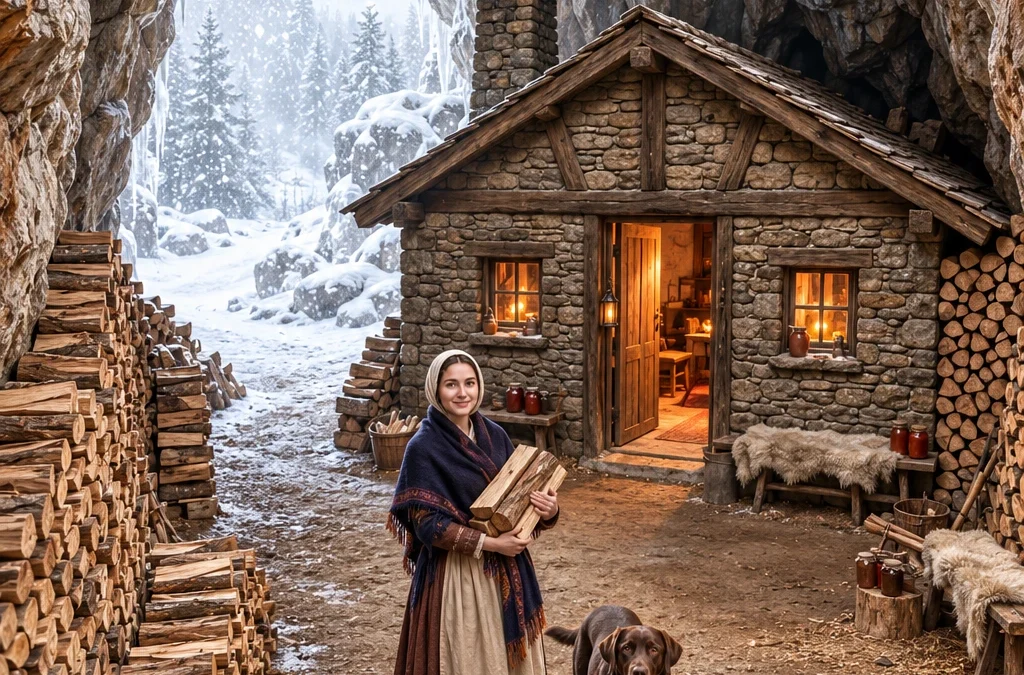
Kicked Out At 18 With Nothing But 6 Potatoes — She Built A Home In A Cave.Then The Great Freeze Came… And The Village That Cast Her Out Begged For Her Secret 🥶🔥
Part 1
The wind always came before the snow in Brennan Ridge — sudden, sharp, like a fist slamming against shuttered windows.
And it was in that cruel pre-wind chill, in November, that 18-year-old Sarah Hayes was told to leave.
Her mother had died the winter before, taken by consumption after years of mountain cold wore her down.
Her father was gone three years earlier, killed in a hunting accident when Sarah was just 15.
Now, the village rules — unwritten but iron-solid — said an orphan girl with no family and no dowry had no claim to the land.
Elder Boone stood before her in his worn wool coat, eyes fixed on the frozen ground, and pointed a crooked finger down the dirt road.
The house her parents built was going to his son William, who needed it for his new bride.
Sarah carried nothing but a rolled canvas blanket, six potatoes wrapped in burlap, and a silence so heavy it ached in her chest.
She didn’t look back.
At the fork in the road, one path led down to other valleys — where she would beg doors, work for scraps, and be seen as nothing more than a girl with nothing.
The other led up: into the limestone hills no one visited anymore, where the wind howled and the cold ruled.
She climbed upward.
It wasn’t bravery — it was exhaustion.
She didn’t want pity; she wanted to be left alone.
After hours of scrambling through brush and biting wind, she found it: a hollow in the rock face, sheltered by an overhang and two young pines, barely visible from below.
It was small — 12 feet wide, 10 feet deep — with dry leaves covering the floor and walls that blocked the gale.
It wasn’t a proper home.
But it was hers.
Night fell fast.
She ate one potato slowly, huddled in her canvas, listening to the storm rage outside.
And as the first snowflakes touched the ground, she made a promise to herself: she would not just survive — she would thrive, right here, where no one thought she could last a week.
Day by day, she built.
She stacked stones to block the wind, collapsing her first two attempts before her father’s voice came back to her: “First time you build something, it falls.
Second time, it falls different.
Third time, maybe it stands.
” She packed mud between the rocks, dug shallow foundations, and finally raised a low wall that kept the bitter drafts at bay.
She lined her sleeping spot with thick, insulating moss.
She used her father’s old flint to start small fires, heating flat stones to drag to her bed — remembering how her mother had warmed their feet the same way.
She found a hidden seep of unfrozen water trickling from the rock.
She learned rabbit trails and set snares, stretching meager meals into weeks.
December turned to January.
January turned to February.
The village below grew quiet and cold.
One day, a shepherd climbed high chasing strays and spotted a thin wisp of smoke rising from the ledge.
That night at supper, he told the others.
Elder Boone scoffed — “She’s dead.
That’s nothing but brush.
” But Martha, the woodcutter’s wife, said nothing.
She just listened, her hands folded tight.
By mid-February, the Great Freeze arrived — a blizzard unlike anything in 15 years.
Snow piled five feet deep.
Roofs groaned.
The Petrak family’s barn collapsed, burying their grain stores.
Pigs froze in their pens.
A pregnant goat perished.
And Elder Boone — the man who had sent Sarah away — was found dead in his cabin, alone, his fire long out.
The village ran out of wood.
They ran low on food.
Children coughed and shivered through nights that seemed endless.
No smoke rose from most chimneys.
Desperate, two men — Roddek the miller and Jonas the blacksmith — fought their way up the mountain through waist-deep drifts, guided only by that faint, stubborn smoke.
When they crested the ridge, they stopped in awe.
There stood Sarah — thin, but steady — beside a neatly built stone wall, a small fire crackling, a tin can steaming over the flames.
She didn’t look surprised.
She’d been expecting them.
Roddek spoke first, his voice raw.
“Boone is dead.
The barn’s gone.
We’re freezing down there… and we don’t know how to stop it.
”
Sarah looked at them — at the men who had said nothing when she was cast out, who had eaten bread in her old house while she dug roots in the snow.
And then she did something no one expected.
She stepped aside, and said calmly: “Come in.
Warm yourselves.
”
Part 2
They sat close to the fire, heads bowed, drinking broth made from rabbit bones and bitter herbs, their pride melting faster than the frost on their coats.
They had climbed half-hoping to find her frozen — to tell themselves the village had done nothing wrong — and half-terrified to find her alive, because that would mean everything they’d done was unforgivable.
Sarah didn’t speak of grudges.
She didn’t demand apologies.
Instead, she began to teach — slow, steady, matter-of-fact, as though explaining how to mend a fence or plant seed.
She showed them how to stack stones low at the entrance: block the wind near the ground, but leave space above so smoke could escape.
How to heat large flat stones in the fire, wrap them in cloth, and carry them to beds — holding warmth through the longest night.
How dark stones soaked up the sun by day and released it slowly after dark.
How moss trapped air better than straw, and mud mixed with ash sealed cracks against the cold.
They listened intently.
Roddek, who built mills, grasped the logic fast.
Jonas asked questions about which rocks held heat longest.
They left at dusk promising to return — and they did, the very next morning, bringing Martha with them.
She carried a scrap of cheese and a sliver of bread, all she could spare, and laid them on the stone without fanfare.
Then she looked Sarah straight in the eye and said the only thing that mattered: “Show me everything.
”
Word spread fast.
Villagers rebuilt walls thicker, sealed gaps with mud and ash, heated stones passed from house to house like a lifeline.
The Caldwell boy’s cough eased.
The animals stopped shivering.
The cold was still there — bitter and unforgiving — but it was no longer winning.
No one spoke Sarah’s name aloud in meetings.
No one thanked her publicly.
But everyone knew.
And one person knew it heavier than most: William Boone.
He had lived in Sarah’s house since November — slept in her bed, eaten at her parents’ table — and now every floorboard, every beam, every meal tasted like ash.
One evening by the fire, he turned to his wife and whispered: “We should give it back.
The house.
It’s hers.
”
Margaret nodded slowly.
“That’s not maybe wrong, William.
That’s certainly wrong.
”
The council met.
Half wanted to pretend nothing had changed.
But three voted yes: they would offer Sarah her home.
William hesitated — he thought she might refuse — so they sent Martha up the mountain with the message.
Sarah was tending her small garden plot when Martha arrived — turnips and carrots pushing through the soil, fed with ash and hope.
Martha delivered the offer simply: “The house is yours.
Come back whenever you want.
”
Sarah stood quiet for a long time, gazing down at the valley where smoke rose from every chimney.
Then she turned back to the hollow — the stone walls she had built with bleeding hands, the moss bed that had saved her life, the seep she had cleared, the lambs that would be hers by summer.
Part 3
Martha smiled gently.
“Then you don’t.
The choice is yours — the choice they never gave you before.
”
Sarah looked back at the hollow — not as a prison, not as a refuge, but as a home she had built entirely on her own.
Going down meant warm beds and familiar walls, but it also meant stepping back into rules that had discarded her.
Staying up here meant hauling water and trapping food and facing every winter alone — but it meant she was free.
“I need time to think,” she said softly.
Martha nodded.
“Take all you need.
The house will wait.
”
Spring unfolded slowly.
Tiny green shoots pushed through the soil.
Wild greens and ramps appeared on sun-warmed slopes.
Sarah expanded her garden, tended her traps, and built a small basin around the seep so water collected clean and easy.
Visitors came — not crowds, but individuals who wanted to learn.
She taught them freely, never asking for payment, never holding back.
One afternoon, a young shepherd named Daniel climbed the mountain.
He wanted to build a shelter higher up for summer grazing, and he offered Sarah two lambs and a share of wool in exchange for her guidance.
She agreed.
Together they built a second shelter further up the ridge — sturdy, warm, built to last.
As they finished, Daniel paused and asked the question everyone was thinking:
“Why did you help us? After they cast you out… you could have let them freeze.
”
Sarah looked out over the valley — the roofs she had helped save, the smoke rising from homes that would have been silent.
“Because children shouldn’t die for their parents’ mistakes.
Because knowledge that only helps one person isn’t worth having.
And because survival shouldn’t depend on who your family is — it should depend on what you know.
”
Sarah smiled.
“The hollow is my home now.
That hasn’t changed.
”
But things were changing in quiet ways.
People began leaving things at her wall — a sharp knife from Jonas, a coil of rope from Roddek, a thick woven blanket from Martha with a note that said “My daughter asked about you.
” Sarah left gifts in return: bundles of healing herbs, woven baskets, stacks of dried kindling.
It wasn’t charity — it was respect.
It was trade.
By late spring, the council invited Sarah to meet them.
They wanted to name her hollow official village property, give her supplies in exchange for managing it — and in return, they would decide what happened there.
Sarah stood before them in the same room where her exile had been decided seven months earlier.
“No,” she said clearly.
“I will share what I know with anyone who needs it.
But this place is mine — not yours.
You don’t get to claim what I built just because you’re sorry.
”
Silence filled the room.
Then Thomas Caldwell spoke — the man whose son had survived because of her.
“She’s right.
We overstepped.
The hollow stays hers — fully and always.
But we would still trade: supplies for teaching.
Equal, honest, no strings.
”
Sarah nodded.
“That I can agree to.
But I will not live in the village.
My home is on the ridge.
”
As summer deepened, the ridges began to change.
Families built their own emergency shelters — small stone hollows, warm and ready — scattered across the slopes.
Sarah helped where she could.
She built one extra shelter secretly, stocking it with flint, wire, and clear instructions carved into the ground with stones — a hidden lifeline for anyone cast out, anyone alone, anyone who needed to know they were not forgotten.
The lambs arrived — soft, warm, alive — and she named them Morning and Evening.
She planted again, harvested turnips that tasted like victory, and watched the seasons turn.
One day Martha climbed with her youngest daughter, now old enough to walk the path.
The little girl ran up to Sarah and pressed a smooth grey stone into her palm like a treasure.
Sarah knelt down and accepted it solemnly.
“They call it ‘The Girl’s Hollow’ now,” Martha said quietly.
“People will remember your name.
”
Sarah looked at the child, at the stone in her hand, at the ridges dotted with shelters that would keep families safe for generations.
“I didn’t do it for a name,” she said.
Martha smiled.
“I know.
That’s exactly why it will last.
”
Autumn came again — wind, crisp air, the first faint scent of snow.
Sarah stood on her ledge and looked down.
Smoke rose from every chimney.
Light glowed in every window.
Up here, her wall was strong, her wood stacked high, her moss fresh and thick.
She was ready.
She wasn’t alone anymore.
Not exactly.
She had chosen a different path — not exile, not return, but something new entirely: a bridge between mountain and village, between the old ways and the truth she had forged in stone and ice.
She had proven something stronger than winter: that you don’t need permission to survive.
That kindness is not weakness.
And that the home you build with your own hands will always be the one that truly belongs to you.
This story is entirely fictional and created for entertainment purposes only.
It does not represent any organization or individual, nor does it encourage inappropriate behavior.
The content was generated with AI assistance.








