“Kill Him Before He Talks!” the Tribe Screamed at the Wounded White Rancher They Dragged Through the Storm… But the Pouch in His Pocket Hid a Secret That Made the Fiercest Woman Among Them Hold a Blade to His Throat and Ask, “Why Are You Still Here?”
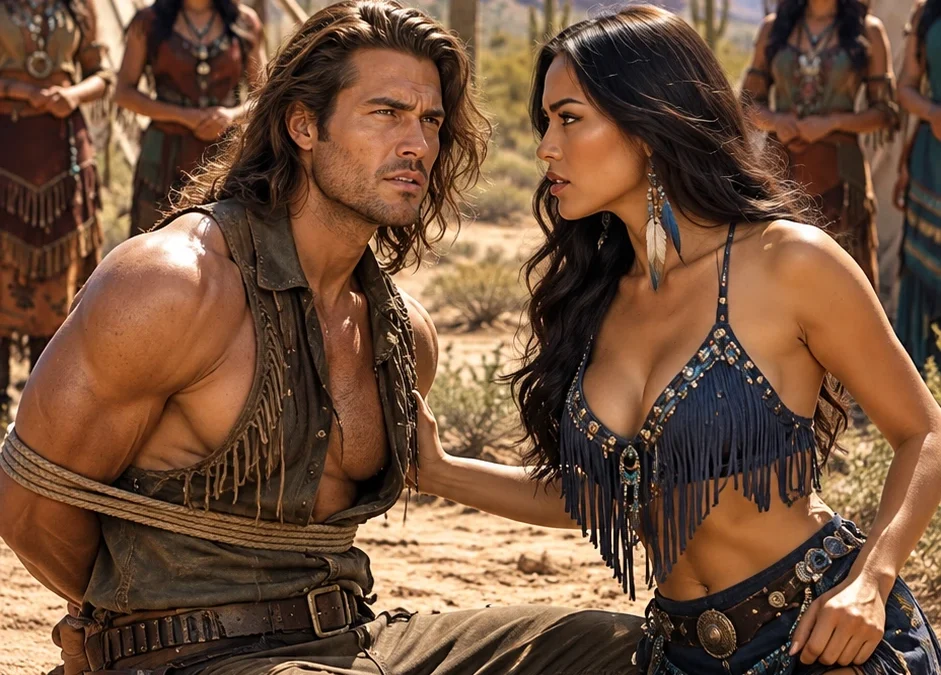
😱 “Kill Him Before He Talks!” the Tribe Screamed at the Wounded White Rancher They Dragged Through the Storm… But the Pouch in His Pocket Hid a Secret That Made the Fiercest Woman Among Them Hold a Blade to His Throat and Ask, “Why Are You Still Here?” 🔥
Part 1
The land did not care if a man lived or died. 🌵
It simply existed, vast and indifferent. Cracked hardpan, jagged red rock, and a sun that was not warmth but weight, pressing down on the earth until the soil turned to choking powder.
Caleb Walker wiped the sweat from his eyes with a gloved hand. He was thirty-two, but the sun and wind had carved lines around his eyes that made him look a decade older. He sat atop a sturdy bay gelding named Rusty, mending fence on the poorest corner of his ranch.
There was no one to talk to. He had long ago lost the habit of talking to himself.
Five years earlier, this place had been different. Curtains in the windows. The smell of baking bread drifting toward the corral. And Sarah, small, with hair the color of dried wheat and a laugh that startled the quiet air.
She died giving birth to their son.
The boy, small and fragile as a bird, followed her three days later, taken by a fever that burned hot and fast. Caleb buried them both on a rise above the creek, beneath a twisted cottonwood.
Since then, he had simply gone through the motions of living. 💔
When supplies ran dangerously low, he rode two days south to the town of Hollow Creek.
Inside the general store, he kept his hat low and his eyes on the floorboards. But the town was gripped by fear, and two men stood near the stove, talking loud enough for the whole room to hear.
One was a sergeant from the fort. The other was Silas Thorne, a cattleman with a voice like a gunshot.
“You hear about the raid near Benson? Took four horses, stripped the pantry bare. Didn’t kill a soul, though.”
“It’s that she-wolf pack,” the sergeant spat. “The widows.”
Caleb’s hand froze over a coil of rope.
“An Apache women’s tribe,” Thorne sneered. “Just women, roaming these hills like coyotes. They say they hate white men with poison in their blood. I heard they mutilated a prospector up near the rim.”
Then Thorne turned to Caleb.
“Those witches are moving your way, Walker. If you see dust, you shoot first. Don’t let them get close enough to talk.”
“I don’t shoot at what I can’t see, Silas,” Caleb said quietly.
He paid, walked out, and rode home with the words stuck in his mind.
Animals. Ghosts. Witches.
It unsettled him how easily the men in town stripped the humanity from people. He knew what grief did to a person. How it hollowed you into nothing but sharp edges and survival.
If those women were out there alone, mourning their dead…
Were they really so different from him? 🌄
Two weeks later, the air turned heavy and still, the sky a bruised purple over the mountains. The birds fell silent.
Caleb was riding the fence along Coyote Canyon when he saw a thin wisp of smoke rising from a cluster of boulders.
He approached on foot, rifle ready.
The camp was empty. The fire was cold, but the signs were fresh. A small, soft-soled moccasin print in the dust.
Then he spotted something near a juniper tree. A beaded leather pouch, no larger than his hand, tanned creamy white, covered in tiny glass beads in blue, red, and white. A pattern like mountains. Or lightning.
It was beautiful. A thing of care and patience, dropped in a moment of haste.
Caleb thought of the sergeant’s words. If we find their camp, it will be a short fight.
If he rode to the fort, soldiers would hunt down whoever had sat by this fire.
He looked at the pouch. At the darkening sky. He thought of Sarah’s locket in the tin box under his bed.
With a heavy sigh, he slid the pouch into his coat pocket.
He would not be the one to bring the soldiers down on them.
It was the kindest thing he had done in five years.
It was also about to nearly get him killed. 😨
The storm hit an hour later, and it did not come gently.
Wind flattened the sage. Rain fell in sheets, cold and hard as gravel. Lightning shattered a pine on the ridge. His cattle panicked and bolted blindly toward the steep drop of the canyon.
“Get back!”
Caleb spurred Rusty into the teeth of the storm to turn the lead steer. The ground turned to slick mud in seconds. As he cut in front of a terrified heifer, the bank crumbled.
Rusty’s leg plunged into a hidden badger hole.
The horse screamed.
Caleb flew through the air, slammed his shoulder into a rock, and cracked his head against the hardpan. White pain exploded behind his eyes. He slid down the muddy slope, his rifle lost, his leg twisted beneath him.
Through the curtain of rain, he saw them.
They emerged from the storm like spirits conjured by the thunder. Figures wrapped in blankets and buckskin, standing on the ridge. Six of them, bows drawn, two carrying rust-pitted rifles.
One slid down the embankment with fluid grace. A tall woman, a stripe of red ochre across her cheekbones, black hair braided tight against her head. She stopped five feet away and leveled a Henry repeating rifle at his chest.
Her eyes were dark as obsidian. Absolutely unreadable.
“Who are you?”
“Caleb Walker,” he rasped. “I’m a rancher. I live north of here.”
“You are a scout. You come before the blue coats.”
“No soldiers. Just me. My horse fell.”
She signaled the others. Two younger women searched his coat, and one of them pulled out the beaded pouch.
She cried out in Apache. Sharp. Accusatory.
The tall woman looked at the pouch, then at Caleb, and her face turned to cold fury.
“It is ours. You stole it.”
“No! I found it by the rocks. I was keeping it safe.”
“Liar.”
The rifle barrel cracked across his face.
“Bind him.”
Rawhide bit into his wrists. Somewhere above him, a single gunshot rang out, and the screaming of his horse stopped.
They had put Rusty down.
A mercy, he knew. But in the storm, it felt like murder. 💔
They dragged him through canyons he had never seen, a rope around his waist, through rain that turned the world into a freezing gray purgatory. At nightfall, they slipped through a narrow fissure in a canyon wall and into a hidden bowl.
Caleb lifted his head.
It was not a war camp. That was the first thing his fevered mind grasped. No rows of warriors. No herds of war ponies. Only brush shelters huddled against the stone, children peering out from behind leather flaps, old women tending smoky fires, a few old men leaning on sticks.
A refuge. A hiding place.
The army the men in town feared. The she-wolves they wanted to slaughter.
Starving women and children, trying to stay invisible.
But understanding brought him no safety. To them, he was the monster.
They hauled him into a circle of firelight. Scarred faces. Grief. A deep, simmering anger.
“He is a spy,” the tall woman declared. “He will bring the others.”
“Kill him now!” a younger woman shouted, her hand on a knife. “Before he talks!”
The tall woman, Atsa, pressed the tip of her blade against his throat. He could feel the cold steel and the warmth of her hand.
“Not tonight,” she said, though her eyes promised violence. “The storm hides tracks, but gunfire carries. We decide his fate when the sun returns.”
She shoved him into a low shelter and tied him to the central pole.
In the darkness, Caleb listened to the rain drum against the brush roof.
He thought of Sarah. And for the first time in years, the memory brought no comfort.
Only a sharp, biting fear that he was about to join her before he had ever figured out how to live again. 😰
👉 Want to know what the tribe decided at dawn, and what a white prisoner did that silenced the whole camp? Find Part 2 in the comments, or leave any word and I’ll send it to you privately! 👇
Part 2
Outside, the wind howled through the canyon like a chorus of mourning women.
Dawn arrived as a pale gray bruise across the rim. Caleb woke with a gasp, his leg throbbing, wrapped in pungent herbs and rough linen. Someone had tended it during the night.
He listened for the sounds of a war camp. Iron sharpening. Men shouting.
Instead he heard stone grinding on stone. Corn being crushed into meal. Women murmuring. A baby crying, quickly hushed.
It smelled of home. 🏡
The flap flew open. Atsa stood silhouetted in the gray light.
“Get up.”
They shoved him to the central fire, where an older woman with gray-streaked hair sat in a faded calico dress. Naomi. She spoke his language better than any of them.
“You are the rancher from the north. The one who lives alone.”
“I am.”
“We know many things, Caleb Walker. We know soldiers water their horses at your well.”
“I cannot stop them. It is the law of the territory.”
Naomi scoffed. “The law is a piece of paper that says we are wolves to be shot on sight. Why were you tracking us?”
“I wasn’t. I found a pouch. That’s all.”
“He lies,” Atsa snapped. “A man does not carry such a thing unless it is a trophy.”
Caleb heard how thin his story sounded in a land where every meeting between white and Apache ended in blood.
“I had a wife,” he said, and the words tasted like ash. “She died. She liked beautiful things. When I saw the beadwork, I thought of her. It was a moment of weakness. Nothing more.”
The mention of a dead wife sent a ripple of silence through the circle.
Grief was a language they all spoke fluently.
The women argued in Apache. He caught gestures toward the canyon entrance, then toward him, then a pantomime of a hanging rope. A woman with a scar from lip to chin made a slashing motion across her throat.
Then Atsa spoke. A single low command.
The arguing stopped.
“Some say we should kill you and put your head on a stake,” she told him. “I say dead men cannot carry water. Dead men cannot dig in hard earth.”
Naomi translated the verdict. “You will live for now. But you are not a guest. You are a pair of hands. If you try to run, we will not kill you quickly.”
They tied a tether to his ankle, bound to a heavy log.
“Go,” Atsa said, pointing to a pile of empty water jars. “The spring is up the trail. Fill them.”
And so Caleb Walker’s life as a rancher ended.
His life as a captive began. ⛓️
The work was brutal. The spring lay a quarter mile up a steep incline, and each full jar weighed as much as a calf. Young boys with small bows watched his every move, and if he rested too long, a stone skittered near his boot.
But as he worked, Caleb watched them too.
He saw how they rationed every drop of water. He saw the women giving the best meat to the children and elders while they themselves ate only broth. He saw saddles repaired with strips of raw sinew and an ingenuity that commanded respect.
They were not the demons Silas Thorne had described.
They were tired. They were hungry. They were terrified.
On the third day, he was sent to repair the corral. A commotion broke out. A young mare, half-broken and wild-eyed, reared and struck a small woman in the shoulder, sending her sprawling. The mare began to buck and kick, threatening to smash the fence and the other horses.
Two boys ran toward her with sticks.
“Stop!”
Caleb’s voice froze the entire camp.
He limped toward the mare, dragging his log. He didn’t shout. He hunched his shoulders to make himself smaller, and began to hum, a low sound that resonated in his chest.
“Easy, girl. Just the wind. Just the wind and me.”
The entire camp went silent as the white prisoner approached the maddened animal.
He let her smell the sweat on his skin. Slowly, agonizingly slowly, he moved his hand to her neck. Then he stopped.
“There’s a burr under the saddle blanket,” he said, loud enough for the women to hear. “That’s why she fights.”
He reached under the loose cinch and pulled out a wicked, spiny goathead thorn that had been pressing into her skin.
The mare let out a long shuddering breath and lowered her head until her nose touched his chest. 🐎
“She’ll ride now,” he told the staring boys. “But check the blanket next time.”
He walked back to his fence, dragging his log.
He did not look at Atsa. But he could feel her eyes on his back, heavy and assessing.
That night, the hostility was still there, thick as the smoke. But the contempt had thinned.
Naomi sat near him, working leather with an awl.
“You have good hands with the beasts.”
“Animals make more sense than people. They don’t hate you for no reason.”
“You think we hate you for no reason?”
“I think you hate me because I’m white.”
Naomi put down her work and stared into the fire.
“We hate you because our world is empty. Look around this circle. Do you see my daughter?”
Caleb looked. No.
“She was taken two winters ago. The soldiers came to the agency where we tried to live in peace. They said the children must go to school, to learn to be civilized. They put her in a wagon. She screamed for me until the wagon was gone.” Her voice was flat. “They say she has a new name now. Mary or Susan. A white name for a white life.”
She nodded toward a woman with cropped hair. “That is Ilta. Her husband was shot by ranchers. They said he stole cattle. He had only a bow. They cut off his hands and nailed them to a fence post.”
Caleb’s gaze drifted to the tall leader sharpening a knife.
“And Atsa?”
“Atsa had a brother. When he surrendered, they promised him safety. They put him in chains and sent him to a place called Florida. He died of the coughing sickness in a stone cell, far from the red earth.”
Caleb looked down at his rough hands. He thought of the empty crib gathering dust in the back room of his house.
“I am sorry,” he whispered.
“Your sorry does not bring them back.”
“No. It doesn’t.” He met her eyes. “My wife died birthing our son. The boy lived three days. I held him while he burned with fever. I prayed to that Jesus you talked about. I begged. The room just stayed quiet. And when he died, I dug the hole myself. I don’t know your pain, Naomi. But I know what it is to look at a horizon and see nothing but empty space where people used to be.”
The fire crackled. Sparks drifted toward the stars.
“You are a ghost too,” Naomi said softly. “You walk and you work, but your spirit is half in the ground.”
Caleb nodded slowly.
It was a small bridge, fragile as a spiderweb.
But it was there. 🕸️
A week later, he noticed the stolen cattle in the box canyon were starving.
“These cows are sick,” he told Atsa bluntly. “That one has bloat. The grass is too dry, the water muddy. Keep them here another week and half will be dead.”
“It is the only safe place,” Atsa said.
“I know a valley. Four hours’ ride. Hidden. High walls, good water. It’s on the edge of my land, but I never graze it.”
Atsa’s eyes searched his face for the lie. For the twitch of a man plotting betrayal.
“If you lead us to soldiers,” she said, her voice quiet and deadly, “I will cut your heart out while you still breathe.”
“I know.”
They rode under a moonless sky, Caleb’s feet tied beneath his pony’s belly, Atsa’s knee brushing his, her hand never far from her knife.
At sunrise they reached the valley.
It was a hidden jewel. A bowl of green grass fed by a spring that came straight out of the rock, shaded by cottonwoods. Invisible from the plains below.
The cattle lowered their heads and tore at the lush grass. The tension in Atsa’s shoulders dropped. Her expression softened into something like wonder.
“It is good.”
She stood by the water, washing the dust from her face. Then she came and crouched before him, close enough that he could see golden flecks in her dark eyes.
“Why help us? You are a white man. These are stolen cows.”
“Cattle are just cattle. They don’t deserve to starve because men are fighting.” He held her gaze. “I’m tired of being an enemy.”
“Do not think this makes us friends,” she whispered, her voice husky. “If the soldiers come, if I think you signaled them, I will kill you. I will not hesitate.”
Caleb saw the threat. But beneath it, he saw a desperate need to protect what was hers.
And he felt a sudden, unexpected pull in his chest. A warmth he hadn’t felt in five years.
It terrified him more than her knife. 😳
“I believe you,” he said. “I won’t give you a reason.”
Atsa held his gaze one second longer than necessary. Her lips parted as if to speak.
Then she stood abruptly, breaking the spell.
“We go back. We must move the rest of the herd before the moon rises.”
Weeks passed. The ankle rope was replaced by a simple warning. A shy girl of fourteen sat beside him and asked him to teach her the diamond knot. That night, he found a piece of golden honeycomb on his blanket.
Sitting in the dark, licking honey from his fingers, Caleb realized something with a jolt.
He wasn’t planning his escape anymore.
He was thinking about the irrigation ditch that needed digging.
For the first time since Sarah died, he was needed. And that, he discovered, was a harder chain to break than any rope.
👉 But what happens when soldiers show up at his ranch, and the tribe turns on him? Like or comment “REVEAL” to unlock Part 3, which will be posted once we hit enough comments! 🔥👇
Part 3
The trail to the hidden valley was never meant for cattle.
On one of their trips, it narrowed at a place called Devil’s Elbow, where the rock hung low and the path crumbled into a sheer drop. A heifer, spooked by the shadow of a hawk, slipped over the edge, her hind legs scrambling. She threatened to drag the horse behind her, ridden by a young woman named Connie, into the ravine.
“Hold!”
Caleb didn’t think. He dropped from his saddle, ignoring the flare in his ankle, grabbed the heifer by the tail and flank, and dug his heels into the gravel.
Atsa was off her horse in a second, gripping the horns. White man and Apache woman, wrestling the terrifying weight of a falling animal between rock and void.
Then, with a final scramble, the heifer lunged back onto the trail.
Caleb collapsed against the wall, chest heaving.
“You are a fool,” Atsa said, but the lethal coldness was gone from her voice. “You could have fallen.”
“Better a cow than the girl.”
She stared at him. Then she reached out and gripped his shoulder.
A warrior’s gesture. Firm. Acknowledging.
“Ride. We lose the light.”
That evening, a rusted buckle sliced a deep gash across his thumb. Atsa was beside him before he could wrap it. She took his wrist, her fingers calloused from bowstrings but surprisingly gentle, and packed the wound with a yellow powder from her pouch.
“Hold still.”
She tore a strip from her own hem and bound his hand. He looked at the part in her hair. The curve of her neck. The smell of sage and rain.
She looked up and found him watching.
Neither moved.
The contact was practical, medical. Yet it felt as if a current ran from her skin to his.
She pulled her hand away as if burned.
“Keep it clean. If it festers, you cannot work.”
She walked quickly toward the fire, leaving him with his heart hammering against his ribs like a trapped bird. 🔥
The peace shattered two days after they returned to the main canyon.
A scout named Elu came thundering into the village on a lathered horse. “Soldiers! And men in long coats! They are at the white man’s ranch!”
The village erupted. Women grabbed their children. Eyes that had begun to soften turned hard as flint.
“Kill him!” a woman screamed. “Leave his body on the trail!”
“They will kill us anyway! We must run!”
Caleb stood still. If he ran, he’d be dead in ten steps.
The scarred woman pushed through the crowd, a rusted butcher knife in her hand. “He is death!”
She lunged. The blade slashed his sleeve. Caleb didn’t strike back. He caught her wrist and held it firm.
“I am not your enemy.”
“My brother is dead because of men like you!”
Atsa stepped in, seized the woman’s wrist, and wrenched the knife away. It clattered on the stones.
“Enough!”
She turned to the circle, chest heaving, eyes blazing.
“We are Apache. Are we coyotes now, turning on each other because we smell fear? Yes, his face is the face of those who killed our families. But look at his hands. They are covered in our dirt. He watered your horses. He saved Connie from the cliff. He gave us the valley.” Her voice dropped. “To kill him now because we are afraid is the way of the soldiers. The way of cowards. I will not lead a tribe of cowards. If we die, we die standing.”
The silence was absolute.
The scarred woman sank to her knees, weeping.
Atsa turned back to Caleb. Her eyes held a desperate plea: Do not make me a fool.
“Go to the rim. Watch for dust.”
That night, she sat beside him on the ledge.
“Why did you not break her arm? You are strong.”
“She was hurting. You don’t hit a horse when it’s scared. You don’t hit a person when they’re grieving.”
Atsa let out a long, shaky breath. Then she told him of the winter village. The white flag. Her father shaking the soldiers’ hands. The leader dropping his hand, and the shooting that did not stop until the snow was red.
“I’m sorry,” Caleb whispered. “It’s not enough. But I’m sorry.”
“Why did you bury your heart, Caleb?”
“Because it hurt too much to keep it beating. If you don’t hope, you can’t be disappointed.”
“I have turned mine to stone,” she said. “If I cried for every loss, I would have drowned long ago.”
“The stone is cracking, Atsa.”
They were very close now. The wind howled, but between their bodies the air was still and charged with terrifying heat. Her hand lifted, hovering inches from his face. It trembled.
Caleb stopped breathing. Every instinct screamed at him to close the gap.
But he saw the fear in her eyes warring with desire. The weight of the tribe on her shoulders. If they crossed this line, there would be no going back.
He stayed still, offering her the choice.
Her fingers curled into a fist. She pulled her hand back.
“We cannot,” she whispered.
“No,” Caleb rasped. “Not yet.”
She fled down the trail, leaving him shivering in the cold wind, his heart beating harder than it had in five years.
He was alive again.
And it terrified him. 💔
Scouts brought the news: thirty men from town and the river ranches were coming, riding with a lawman wearing a star. Thorne. Sheriff Miller. They weren’t looking for cattle.
They were looking for blood.
“I must go look,” Caleb said. “I need to know their numbers. And there’s powder hidden under the floor of my tack room.”
Atsa chose Connie and the fierce tracker Ilta to ride with them. When they reached the overlook above his ranch, Caleb felt a physical blow.
The front door hung off its hinges. The windows were smashed. The corral had been torn down out of pure spite. His good saddle lay slashed to ribbons in the yard.
And in the bedroom, the feather bed Sarah had sewn herself was ripped open, feathers everywhere.
The small wooden crib in the corner, the one he had kept covered with a sheet for five years, lay overturned. One rocker snapped off.
This wasn’t a search. It was a message.
You are no longer one of us. You are a traitor, and we will erase you.
He sank to his knees among the feathers and flour, a sound escaping his throat that was half growl, half sob.
Atsa knelt beside him. She opened her palm.
On it lay a small, tarnished silver locket, its chain knotted, but whole. It had slid beneath the wardrobe.
“Is this her?”
He pressed the catch. Inside, a tiny hand-painted portrait of Sarah, smiling, her hair caught in sunlight.
“Yes,” he whispered. “That is her.” 😭
Atsa didn’t tell him it would be all right. She simply stayed, her shoulder brushing his, as a counterweight to the emptiness of the room.
That night, by a small fire in the stone hearth, she asked, “Why did you come back to us? You could have gone to Mexico. You are a free man.”
“I thought this was home,” Caleb said, turning the locket over in his fingers. “For five years I sat in this room, pretending that if I stayed still enough I could keep the past alive. But it wasn’t a home. It was a tomb. I was just the caretaker.” He looked at her. “When I’m in the canyon, hauling water, fixing the corral, watching you argue with Naomi, I don’t feel like a caretaker. I feel like I’m waking up.”
“You are saying we are your home?” Her voice trembled. “We are the savages, Caleb.”
“I don’t see savages.”
He knelt before her and, this time, did not stop. He touched her cheek.
“I stayed because of you, Atsa. When I look at you, I feel something I thought was dead and buried. I feel like I want to live.”
She turned her face into his palm, her eyes slipping shut.
“You are a fool. A dangerous, stubborn fool.”
She pulled him toward her with the fierce desperation of someone starved for a lifetime.
“If we do this, there is no going back.”
“Let it change.”
He kissed her. Not tentative. A collision. Salt and smoke and weeks of fear and grief and tension finally breaking. Amid the scattered feathers of his past life, it felt less like pleasure and more like defiance.
Two broken things fusing to make something whole. 🔥
At dawn, he splashed kerosene across the floorboards. He looked at the locket in his pocket, then at the house.
“Goodbye.”
He dropped the match. The flames roared up, devouring the past. Black smoke billowed into the sky.
He did not look back.
“Let’s go home.”
The women saw them ride in together, knee to knee. Naomi’s lips curved in a small sad smile. But others stared with open hostility. A white lover was a violation of the blood.
Atsa walked into the center of the camp, head high.
“The soldiers are coming. But we know where they are, and we are ready.”
Caleb stood beside her, hand near his gun belt, not as a threat but as a promise.
He had burned his life to the ground to stand here.
He would do it again.
But the fragile peace didn’t last. The fiery young Beia and her followers rode out in the night to raid a supply wagon against all warnings. They returned laughing, waving a sack of flour.
Caleb looked at the ground. The tracks were deep in the moonlit dust, a visible scar leading straight from the canyon mouth to the heart of the village.
“You didn’t bring supplies,” he said hollowly. “You brought a road map.”
Beia had stayed behind to decoy the soldiers. But the trail was signed. They would be here by sunrise.
“There is one chance,” Caleb said, saddling his horse. “I’m going to talk to them.”
“They will kill you on sight!”
“They are not soldiers. They’re businessmen. They want land, cattle, and to feel safe. They don’t want to die in a rock slide.”
He tied a white shirt to his rifle barrel. “If I don’t come back, blow the slide at the narrows the moment the first horse passes the ironwood tree. Do not wait.”
Atsa touched his face, her thumb tracing his jaw.
“Come back.”
He met them at the dry riverbed at sunrise. Thorne, Sheriff Miller, and an irritable lieutenant in blue.
“Well, I’ll be damned,” Thorne sneered. “The ghost of Caleb Walker.”
“They’re women and children, Silas. There are no warriors in that canyon. Turn around.”
“Betray them,” the lieutenant said, “and you live. Give us the tall woman and the raiders.”
Caleb saw the hunger in the men’s eyes. He knew the offer was a lie.
“No.”
“What did you say?”
“I said no. I remember who shot down the peaceful camp at Warm Springs. I remember who poisoned the water holes. You are the savages, Thorne. And I am done with you.”
He wheeled his horse and spurred into a gallop. A bullet whistled past his ear. He braced for the second to tear into his back.
Crack!
A shot rang out, but not from behind him. From the cliffs above. Thorne’s horse screamed and reared, throwing him into the sand.
Ilta. She had followed him.
Caleb raced into the narrows and fell from his horse into Atsa’s arms.
“You are hit?”
“I am whole.” His eyes were wild. “They know I am with you. There is no going back for me.”
She held him tightly, her face pressed into his dusty shirt.
“Good,” she whispered fiercely. “Good.”
That night, in the shadow of the coming battle, they built a fragile, beautiful dream out of words.
“If we live through tomorrow, we should go to the valley. Not to hide cattle. To live. We could build a cabin, a real one, with windows.”
“And a garden?”
“Corn. Squash. And maybe a rocking chair.”
Caleb laughed. “A rocking chair for an Apache warrior?”
“Even warriors get tired, Caleb.”
She leaned her head against his shoulder.
It was a house made of words. But it was strong enough to hold them. 🏡
Dawn came as a pale steel light. No birds sang. The earth held its breath.
Caleb lay on a limestone ledge thirty feet above the canyon floor. Beside him, Atsa crouched with her bow strung.
They heard the jingle of bit chains. The creak of saddle leather. The thud of iron-shod hooves. The sound of confident men riding toward a massacre of helpless women.
Thorne rode in first, a cigar clamped in his teeth. Then Miller. Then the blue uniforms. Thirty men squeezed into the bottleneck.
“Wait,” Atsa hissed. “Let the tail of the snake enter the hole.”
When the last soldier, a young private no older than eighteen, passed the twisted ironwood, she raised her arm and brought it down.
On the opposite rim, Naomi slashed a rope with her knife.
A grinding roar seemed to come from the center of the earth. Tons of red sandstone crashed down behind the soldiers, sealing the exit in a choking cloud.
The trap snapped shut.
Arrows rained down like angry wasps. Muzzle-loaders barked. The soldiers fired blindly at the cliffs, their bullets chipping harmlessly against stone.
Caleb worked the lever of his rifle with grim, mechanical rhythm. He shot to wound. He shot to disable horses. He shot to terrify.
But he shot. He had chosen his side.
Then the lieutenant saw her.
The tall woman with the braid. He raised his heavy Colt, steadied it with both hands, less than fifty feet away. He couldn’t miss.
“Atsa!”
She didn’t hear him. She was drawing her bow.
Caleb did not think. He threw himself across the gap, placing his body between the gun and the woman he loved.
The impact hit like a sledgehammer. It punched the air from his lungs and spun him around. The world went gray. The sound of battle receded as if underwater.
He saw Atsa’s face above him, screaming. A look of shattering terror he had never seen in the fierce warrior. He tried to speak, but only a wet cough came out, tasting of copper.
Then the terror in her eyes vanished, replaced by a rage so pure it seemed to scorch the air.
She stood, fully exposed to enemy fire, and let out a cry that was not human. The shriek of a wounded mountain lion. She seized Caleb’s rifle and fired, screaming with every shot, driving the soldiers back by sheer will.
Inspired, the women surged forward. Rocks rained down. Arrows flew thicker. The enemy broke.
“Retreat!”
Within minutes, the firing stopped. Only the groans of the wounded remained.
Atsa dropped the rifle and fell to her knees, her hands pressing against the hole in his chest.
“Do not go. You are not allowed to leave me. Not now. Do you hear me, Caleb Walker?”
He looked at the brilliant, blinding sky. So cold.
“The valley,” he murmured. “We have to plant the corn.”
Then darkness took him. 💔
For days, Caleb floated on a river of fire. He saw Sarah smiling and waving him away. He felt a cool hand on his forehead, heard a voice singing soft songs that anchored him to the earth.
The fever broke on the fourth night.
Atsa was there, gaunt and shadowed with exhaustion, her hand holding his.
“You stayed.”
“I promised you a garden.”
She smiled, and tears tracked through the dust on her cheeks.
Three women had died in the battle. The army would return, and next time they would bring cannons. Five ranchers had been captured, and Beia wanted them hanged.
Naomi stood in the center of camp, leaning on her staff. “If we kill them in cold blood, we become what they say we are. We have defended our home. That is enough.”
All eyes turned to Atsa, still cleaning Caleb’s blood from her knife.
She looked at the prisoners. At the fresh graves of her sisters. At the wikiup where the white man who took a bullet for her lay healing.
“Let them go. Take their horses, their guns, their boots. Let them walk back to town barefoot across the cactus. Let them tell the others that Apache women gave them their lives. That is a heavier burden than death.”
The prisoners stumbled out of the canyon, shamed and broken, carrying a story that would change the way the territory spoke of the women’s tribe. 🕊️
Two weeks later, they moved to the hidden valley. Caleb rode in the center of the column, pale, his chest bound tight with linen, but upright. Atsa rode beside him, knees touching.
“I am not glass.”
“You are cracked glass. If you break again, I cannot fix you.”
When they crested the final ridge, the emerald grass and sparkling creek looked like a painting of paradise. A collective sigh rippled through the tribe.
They descended not as refugees, but as settlers.
The sound of gunshots gave way to axes and hammers. Caleb taught the younger women how to breed cattle and treat hoof rot. They taught him the language of the land, the prayers for the deer, the songs for the corn. The children who had once thrown stones at him now followed him like ducklings. They carved wooden horses together. He taught them the diamond knot.
One autumn evening, the tribe gathered around a great fire for a feast. Naomi stood.
“A stranger came to us. A man of the enemy. We put a rope on his leg. We called him spy. But the heart is not judged by the skin. The heart is judged by what it bleeds for.” She gestured to Caleb. “This man bled for us. He burned his own house for us. He gave us this valley. He is no longer white-eyes. He is Apache.”
A murmur of agreement went around the circle.
Atsa stood in a new dress of soft buckskin, beaded with the patterns of her family. She walked to Caleb and held out her hand. He took it, wincing as the scar on his chest pulled tight.
“He is my heart,” she told her people. “He is the father of the children we will have. He is the wall between us and the wind.” Her eyes were fierce and shining. “And I am his.”
Caleb looked at the faces around the fire. He saw Beia nod at him with respect. The children. Naomi.
“I am yours,” he said, his voice thick. “Until the last star falls.”
The women cheered. It was a sound of pure joy, missing from their lives for far too long.
In that moment, surrounded by the people who had once been his captors, Caleb Walker knew he was richer than any rancher in the territory.
He had won every woman’s heart. Not by conquering them, but by letting them conquer his loneliness. ❤️
Later, they walked to the edge of the meadow, where the grass moved in the wind with a soft hushing sound.
He pulled her back against his chest.
“We’ll have to build that cabin soon. Before the snow flies.”
“And the rocking chair.”
“And the rocking chair.”
“I want a daughter first,” Atsa said, turning in his arms. “A girl with eyes like yours, but a spirit like mine. God help the world.”
Caleb smiled and kissed her, slow and deep, a kiss that tasted of the future.
They stood together on the edge of the wild. Two survivors who had found a way to bloom in the desert.
And as the moon rose over the rim of their valley, it shone down on a love as enduring and as dangerous as the West itself. 🌙
This story is entirely fictional and created for entertainment purposes only. It does not represent any organization or individual, nor does it encourage inappropriate behavior. The content was generated with AI assistance.








