“MADAM, I HAVE NEVER WRITTEN TO YOU,” THE DUKE DECLARED BEFORE 300 GUESTS… BUT WHEN SHE PLACED A YEAR OF LOVE LETTERS IN HIS HAND, HE TURNED WHITE, BECAUSE HE KNEW THE HANDWRITING
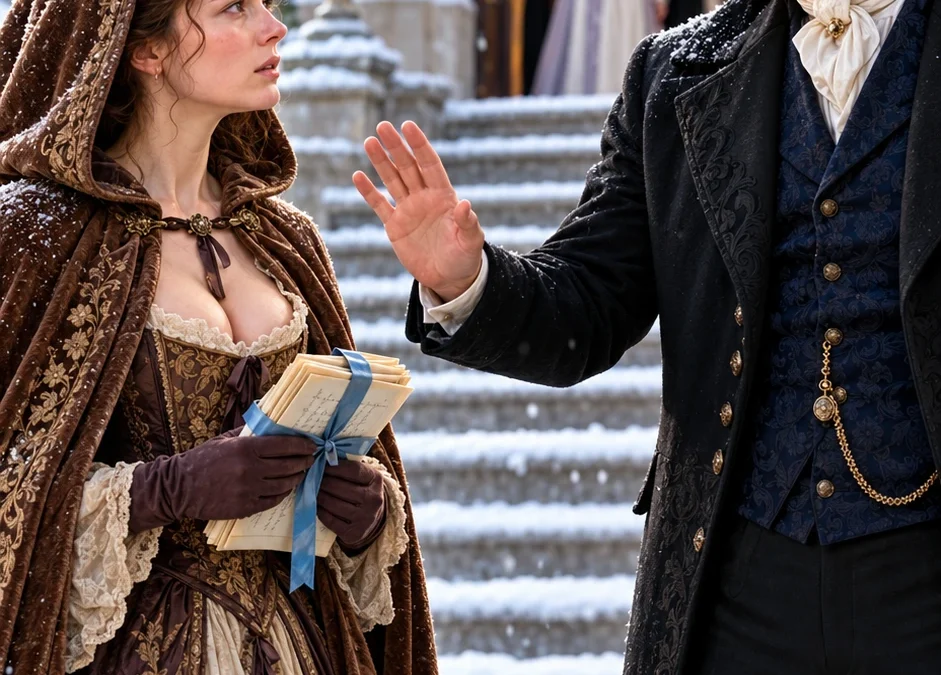
“MADAM, I HAVE NEVER WRITTEN TO YOU,” THE DUKE DECLARED BEFORE 300 GUESTS… BUT WHEN SHE PLACED A YEAR OF LOVE LETTERS IN HIS HAND, HE TURNED WHITE, BECAUSE HE KNEW THE HANDWRITING 😱
Part 1
She had crossed half of England through a blinding snowstorm to marry a duke who had promised her everything in his letters.
But when Evelyn Hartmere walked into his candlelit Christmas gathering, the Duke of Ravensworth looked at her like a stranger.
“Madam,” he declared before three hundred guests, “I have never written to you.”
Their laughter followed her across the frozen ballroom. 💔
On the first Tuesday of December, snow lay over the churchyard at Whitcombe and drifted between the rows of fruit trees that ran down the hill behind it. Evelyn Hartmere stood on the fourth rung of a wooden ladder with a grafting knife in her right hand, cutting a strip of cankered bark from a pear tree older than anyone in the village.
The wind came off the moors sharp enough to numb her fingers. She worked slowly, paring the wood back to clean green, then pressing warm wax into the wound with her thumb.
She was twenty-two, with brown hair pinned beneath a wool hood, hazel eyes, and hands so scarred by thorns and frost that no fine lady would have claimed them. Old Thomas Pryor, the gardener who taught her the trade, used to say a tree did not need a miracle. It needed a chance, and someone patient enough to give it one.
Evelyn had built her whole life on that sentence.
A post boy came stumbling up the lane through the drifts, and she knew the raven seal on his envelope before he reached the ladder. She gave him a penny she could not quite spare, waited until his footsteps faded, and broke the seal.
Something heavy slid into her palm.
An old iron key, black with age, its bow shaped like a leaf.
The letter was in the same graceful, slanting hand she had come to know better than her own. It invited her to Ravensworth Hall before Christmas. The key, it explained, belonged to the fruit house in the walled orchard, a door locked for many years. The writer wished her to be the one who opened it.
Then came the final lines, and Evelyn had to grip the ladder to steady herself.
My name is Nathaniel. No one has spoken it with tenderness in years. I should like to hear it in your voice. 🥹
It had begun almost exactly a year before, with a letter addressed not to Evelyn, but to Thomas Pryor. Someone at Ravensworth Hall, far to the south, wished to know whether an abandoned apple orchard could still be saved. Thomas was too ill that winter to hold a pen, so Evelyn answered in his place.
Her first letter spoke only of trees: canker and frost crack, how to take scion wood in the cold months and keep it alive until spring. But the replies kept coming, and slowly they changed.
The writer spoke of long gray afternoons. Of a great house too quiet for its size. Of a mother gravely ill, and the terror of losing the last person who truly knew him. Evelyn wrote back about her parents, buried in the churchyard below the orchard when she was six. About the hungry years. About things she had never said aloud to anyone.
When the proposal came in autumn, written with a tenderness that made her weep at the kitchen table, Evelyn believed with her whole heart that she had found a soul that matched her own.
Her aunt did not.
“A duke does not fall in love with a girl he has never seen, Evelyn. And he certainly does not marry one by post.”
The village agreed. At the baker’s counter and outside the chapel, women whispered that the Hartmere girl had read too many novels.
Evelyn argued with none of them. That night she opened the tin box beneath her bed and counted four years of savings from pruning, grafting, and restoring other people’s orchards. It was just enough for the coaches, the inns, and a few coins left over. The letters had offered to pay her passage.
She had refused. If she went to Ravensworth, she would go on her own money and her own decision, or not at all.
The next morning, in falling snow, she climbed aboard the southbound coach with one small trunk, her grafting knife, a jar of wax, a bundle of letters tied with blue ribbon, and the iron key on a cord around her neck.
She believed a man was waiting at the end of the road to marry her.
She did not yet know he did not even know her name. 😨
The journey took nine days. Snow buried the roads through Lancaster. Beyond Birmingham, the coach stopped twice so the men could break ice from the wheels. At every inn Evelyn took the cheapest room, always the coldest, and slept in her cloak with her trunk pushed against the door.
Somewhere past Oxford, a widow in black crepe asked kindly where so young a woman was traveling alone at Christmas.
“I’m going to be married.”
The widow’s eyes moved over the brown traveling dress, the hem stiff with dried mud, the gloves mended so often the darns had darns. She said nothing at all.
That silence followed Evelyn for miles. Instead of shaking her, it set her jaw harder.
She reached Blackmere Valley on a snowy evening, after dark. At the top of a long drive stood Ravensworth Hall, a great house of gray stone with every window blazing. The Duke was holding his winter feast for the people of the estate. Lanterns hung from the beams. Long tables groaned with roast goose and plum pudding. Fiddlers played by the fire, and nearly three hundred tenants, servants, and neighbors filled the room with noise and warmth.
Evelyn stepped into that light with snow on her shoulders and mud on her skirts.
The butler, a tall gray man named Mr. Hollis, stared in disbelief when she asked to see his grace.
The Duke sat at the high table. He was taller than she had imagined, with copper-brown hair and cold blue eyes, and he held himself with a stillness that made the noise around him seem smaller. At his left sat a woman of about thirty in pale gray silk, elegant and composed, her hand resting near his sleeve. Lady Cecily Harcourt. The chair at his right stood empty, kept for the dowager duchess, too ill to come down.
Evelyn walked the length of the hall. Conversations faltered as she passed. She stopped before the high table and curtsied low.
“Your grace. I am Evelyn Hartmere of Whitcombe. I have come because you asked me to. I have come to marry you.”
Nathaniel looked at her for a long moment. There was not a flicker of recognition in his face.
Then he rose.
“Madam,” he said, in a voice that carried to every corner of the hall, “I have never asked you to come here. I have never written to you in my life.” 💔
Evelyn could not breathe.
She told him quietly that they had written to one another for a full year. That he had asked for her hand. Lady Cecily smiled, a small and pitying smile, and remarked to no one in particular that country girls sometimes read so many stories about dukes that they began to believe themselves inside one. From the far end of the table, a red-faced squire called out that the young lady had crossed all of England to hunt herself a coronet.
Laughter broke across the hall like a wave.
Her face burned. Her eyes stung. But she did not cry. She thought of four years of savings in a tin box, of nine freezing nights in strange inns, of every letter she had read by candlelight. She would not give these people her tears.
Instead, she reached inside her cloak, drew out the bundle, and untied the blue ribbon with steady fingers. She took the first letter from the top and held it out to him.
“Then perhaps your grace will tell me,” she said, “who wrote these?”
Nathaniel took the page with obvious impatience. He glanced down. He read one line, then another.
And his hand went perfectly still.
The color drained from his face until he was as white as the snow on her shoulders.
“Bring all of them,” he said in a low voice. “Please. Come with me.”
He left the high table without another word, and the laughter died behind him into a confused murmur. He took the stairs two at a time, straight toward his mother’s rooms.
Because he knew that handwriting. He had known it since he was a small boy, learning his letters at her knee… 😱
👉 Want Part 2? Find it in the comments, or leave any word and I’ll send it to you privately!
Part 2
It was his mother’s.
The Dowager Duchess’s bedchamber smelled of medicine and lavender water. Lady Margaret Ashcombe lay propped against a mountain of pillows, her once-handsome face hollowed by illness, her legs so swollen she had not stood unaided in months.
Nathaniel stopped at the foot of the bed and held up the letter without a word.
His mother looked at it. Then at him. Then at the young woman in the muddy cloak who had followed him to the doorway.
She did not pretend. She closed her eyes a moment, and when she opened them, she said:
“I wrote them, Nathaniel. Every single word.”
She told it plainly, pausing often for breath. For six years she had watched her son live like a man walled inside his own house. After Lady Rosalind Tremaine broke their engagement with a single cold letter, Nathaniel had stopped writing anything that was not business. He refused invitations. He did not look twice at any woman in any drawing room in England.
Then the London physician told Lady Margaret she might not survive the winter, and the thought of leaving her son alone in that vast stone house frightened her more than death itself.
A year ago she had written to an old gardener in Whitcombe about the ruined orchard. The answer came in a young woman’s hand.
“You wrote about those old trees as though they had souls,” she said, looking at Evelyn. “I could not stop reading.”
So she kept writing, and somewhere along the way she began to pour into those letters everything she knew of her son’s heart, the loneliness, the kindness he never showed, signing only the name of the house. She had not planned a proposal. But when she understood this girl might be the one person who could reach him, she sent the key.
Evelyn stood in the doorway and heard every word.
She understood, slowly and completely, what it meant. Every secret she had confided across the year, her parents’ graves, the hungry winters, the nights she felt like the loneliest creature in the north of England, every hope she had put on paper for the man she loved, had been read by an old woman in a sickroom.
Nathaniel had never read a single line. He had not known she existed until an hour ago. 💔
“I will leave in the morning,” she said quietly.
Lady Margaret caught her wrist with surprising strength and begged her to stay, only until the winter work in the orchard was done. She would take the blame for everything, and pay every penny of the journey home if Evelyn still wished to go.
Evelyn drew her hand back gently. “I did not take money from you to come here, my lady. I will not take it to leave.”
“Mother,” Nathaniel said roughly, “I will not marry anyone simply because you wish it.”
Evelyn met his eyes. “Nor do I wish to be courted, your grace, because a sick woman begged you to.”
For the first time that night, Nathaniel truly looked at her. She was nothing like the grasping creature he had imagined at the high table.
Nothing at all.
She was given the East bedroom, a pretty room with rose-colored hangings, aired and prepared, she realized, for a bride. She lay awake all night listening to the wind throw itself against the glass.
Before dawn she put on her work dress and heavy boots and slipped out into the dark. In the walled orchard, beneath fresh snow, the old trees stood black and crooked, canker gnawing at the limbs. But Evelyn saw more than ruin. She saw the careful spacing of the rows, the old espaliers trained flat against the south wall, the stone-laid bowls half buried at the foot of each tree.
Someone had loved this place once, deeply and patiently.
As the sky turned gray, she made her decision. She would stay. Not for Nathaniel. Not for a title. She would stay to save this orchard.
Walter Finch, the old head gardener, found her at first light, knee-deep in snow with a grafting knife. He was a small, bent man past seventy with a white beard and a face like a walnut, and he looked at her with plain suspicion. She did not try to charm him. She walked him to an old Ribston Pippin, showed him where the canker had girdled half a limb, and explained how she would cut back to living wood without killing the tree.
He took off his cap and scratched his head. “Well. You’re not a lady playing at gardening to catch his grace’s eye. That much is certain.”
He showed her the late harvest, hundreds of apples piled in a damp potting shed, already sweating and spotting. “They need a proper store,” said Evelyn. Walter nodded toward a squat brick building in the far corner, its oak door gray with age.
“The fruit house. Locked these many years. Nobody has the key.”
Evelyn drew the iron key from beneath her collar. The old man went very quiet. He touched it with one finger, and his eyes filled.
“Her ladyship gave you that. She would never let any of us so much as hold it.” 🥹
The lock was stiff, but it turned. Inside, the fruit house was dark and cold and thick with dust. Long wooden racks ran floor to ceiling, slotted so air could move between the apples. On a slate board by the door, chalk letters had faded almost to nothing, names of old varieties in a careful hand.
Evelyn tied up her skirts and went to work. She swept the floors, replaced broken slats, laid fresh straw on every shelf, and sorted the apples one by one, setting aside every bruised fruit, placing each sound one so that not a single apple touched another. Each had to be handled as though it might break.
She did not think about why that felt so familiar, or what else in her life she was learning to hold that carefully.
At midday, Nathaniel found her on a ladder in the snow, cutting dead wood from an old Blenheim Orange. He apologized for the great hall, for allowing her to be laughed at before three hundred people. He would not pretend he had written the letters, because he had not. But he should have spoken to her privately. He should have been kinder.
Evelyn came down slowly. “Being truthful and being kind are not the same thing, your grace.”
She picked up her knife and went back to work.
Nathaniel walked back to the house with those words lodged in his chest like a splinter. That evening, Lady Margaret placed a rosewood box in his hands. Inside were all the letters Evelyn had written, a full year of them, every one kept and smoothed flat.
He carried the box to the library and set it on the desk, and for a long time he did not open it. Lady Rosalind had written that being engaged to him was like being engaged to a ledger. He had burned every letter between them and promised himself he would never again put his heart on paper where someone could hold it up to the light and find it lacking.
Near midnight, he lifted the lid. 🕯️
When dawn came gray through the windows, he was still there, surrounded by pages. He had read about the pear tree in Whitcombe she had kept alive for nine years. About the nights she sat by a single candle and wondered whether anyone in the world would ever choose her for herself.
She had written to a stranger and somehow understood the loneliest part of him without seeing his face.
And he had stood before three hundred people and made her a joke.
After that morning, Nathaniel began coming to the orchard before the servants woke, in an old riding coat, asking permission before he touched anything. And Evelyn did not yet know that someone in that house was watching, terrified of being replaced… 😳
Part 3
Evelyn did not trust it at first. She wondered whether his mother had sent him, or whether this was guilt wearing a working coat.
She showed him how to lift a late apple from its spur with a gentle upward twist, so the fruiting bud beneath was not torn away. She explained that a bruise no bigger than a fingertip could rot an apple through within weeks in the store. Nathaniel turned the apple slowly in his hand and thought of the words he had spoken in the great hall.
He understood perfectly.
They checked the racks together, replaced damp straw, wrapped young trees in sacking before the heavy snows, and cleared ice from the wall where the older espaliers grew. There were no compliments and no pretty speeches. Sometimes an hour passed without a word, and the silence did not feel empty.
One gray afternoon, sorting the last pippins, they reached for the same apple at the same moment, and their fingers closed over each other’s around it.
Neither moved. The fruit house was so quiet Evelyn could hear snow settling on the roof.
Nathaniel let go first. “It is yours,” he said quietly.
She did not look at him for the rest of the afternoon. But that night, alone in the rose-colored room, she could still feel the warmth of his hand. 🥹
A few days later, Lady Cecily came to the orchard in gray fur, stepping through the snow as though it had personally offended her. She mentioned that some of the servants believed Miss Hartmere had known the truth about the letters all along, and had come anyway, hoping a duke might be shamed into keeping a promise he had never made. She merely thought Evelyn ought to know what was being said.
Evelyn kept pruning. “People are often cruel when they are frightened, Lady Cecily. I try not to hold it against them.”
Cecily’s mouth tightened, and she left. But Evelyn had seen the flash in her eyes. Behind the silk and the cool manners stood a woman terrified of being replaced.
At the end of the week, Lady Margaret insisted Nathaniel take Evelyn to the winter fair in the river town of Ashford Bridge, with Cecily as chaperone. The stalls stood in rows along the frozen riverbank, hung with greenery and lanterns. When Nathaniel stopped at a stall of garden knives and asked her opinion, Evelyn tested an edge with her thumb and declared it useless.
“The steel is soft, and the handle will split by spring.”
Nathaniel laughed. Then he smiled, a real smile, the first she had ever seen on his face. It changed him entirely.
On the old stone bridge above the river, he stopped.
“I have read every one of your letters. All of them.”
Evelyn’s face went hot to the roots of her hair.
“They are the most beautiful things ever sent to Ravensworth Hall,” he said quietly. And said nothing more.
They stood at the parapet and watched the gray water moving beneath its skin of ice, snow falling softly on both of them. Evelyn remembered writing in one of those letters that what she longed for most was to stand beside someone she loved and not need to say anything at all.
She began to believe that Nathaniel might be exactly the man she had hoped for. 🤍
Three days later, the Ravensworth ring disappeared.
It had belonged to Lady Margaret’s own mother, a band of old gold set with a square sapphire the color of a winter sky at dusk. Lady Margaret had written about it in one of her letters and confessed she hoped to see it on Evelyn’s hand. Now, propped against her pillows on a bright frozen afternoon, she simply wished to show it to her. She asked Cecily to fetch it from the jewel case.
Cecily went without a word. When she returned, she opened the little velvet box at the bedside.
It was empty.
Lady Margaret stared at the bare satin. Evelyn stood very still by the window. And Cecily, after a long moment, said only that she could not imagine where it had gone. 😶
By evening the whole house knew. And by evening the whole house had remembered that Miss Hartmere had sat alone with the Dowager for an hour, two days before.
No one said a word to Evelyn directly. No one needed to. Conversations in the servants’ passage stopped dead when she passed. Housemaids who had smiled that morning found sudden reasons to study the floor. A poor girl from the north, laughed out of the great hall, in the house barely two weeks, had become, without a single accusation spoken aloud, the person everyone suspected most.
Evelyn did not sleep.
At eight the next morning, she dragged her trunk to the head of the grand staircase and brought it down step by step, letting it fall heavily from stair to stair. The iron corners struck the stone like a hammer on an anvil, and it rang through the whole house.
By the time she reached the great hall, more than forty people stood around her in silence. She knelt, unbuckled the straps, and threw back the lid. One by one, she laid her possessions on the cold flagstones.
Two brown wool dresses, both turned and mended. A nightgown patched at the elbows. Her mother’s old Bible, its spine cracked with use. Her grafting knife. A jar of wax. The bundle of letters tied with blue ribbon.
Then she lifted the empty trunk, turned it upside down, and shook it so everyone could hear there was nothing left. She turned out the pockets of her cloak and apron.
No ring.
A young footman near the back muttered, just loudly enough, that the fruit house was locked and that Miss Hartmere was the only one who held the key.
Evelyn rose. She lifted the cord over her head, walked to where Nathaniel stood at the foot of the stairs, and held out the iron key.
“Then search it, your grace. Search it before anyone else you like.”
Nathaniel looked at the key in her open palm. He did not take it.
“I will not search the fruit house,” he said quietly, but every person in the hall heard him.
He turned and looked slowly around the room, from face to face, and one by one the servants found they could not hold his gaze. He said nothing more. He walked out and down the long cold corridor to the small sitting room where Lady Cecily kept her sewing and her accounts.
She sat by the window. He closed the door behind him and stood by the fire, and spoke to her the way he might have fourteen years before.
He reminded her that he had been standing on the front steps the day she first came to Ravensworth, an orphan of sixteen with a single trunk and a black ribbon on her bonnet, and that he had carried that trunk upstairs himself. He reminded her she had been family to this house ever since.
Then he held out his hand.
“Cecily. Give it to me.”
For a long time she did not move. Then she rose, crossed to her sewing box, and lifted the tray of needles. Beneath it, in a nest of silk thread, lay the sapphire ring.
Her hands shook as she gave it to him, and then the words came out all at once. Lady Margaret had promised her that ring when she was sixteen, sitting by this very fire, the first winter after her father died. For years Cecily had nursed her aunt, sat up through the long nights, measured out the drops, read aloud until her voice went hoarse. And then a stranger arrived, and suddenly the ring was meant for someone else, and so was everything else.
She had hidden it in a moment of jealousy she could not explain even to herself. She had never meant to accuse anyone. But when the whispers turned toward Evelyn, she said nothing.
Nathaniel looked down at the ring in his palm.
“Silence does not make a wrong any smaller, Cecily. It only lets someone else carry it.” 💔
That evening he ordered every servant in Ravensworth Hall to gather in the great hall. Evelyn came down the stairs with no idea what he meant to do. All she could see was the blue stone shining in his hand.
Nathaniel stood at the foot of the great staircase and held up the ring. It had not been stolen, he told them. It had been put away by a member of the family, and had now been returned to its proper place. He gave no other name. He would not hand her to the household to be torn apart, and he would not let Evelyn carry one moment more of what was not hers.
Then he turned to Evelyn, and the silence grew so deep the hiss of the fire seemed loud.
“In the two weeks Miss Hartmere has been under this roof, she has been insulted twice. The first time was at the winter feast, before three hundred people, and it was I who did it. What I said that night was true. I had never written to her. But I said it to wound, and to be rid of her, and I was wrong. Tonight I ask her pardon before every one of you.”
And the sixth Duke of Ravensworth, who had never in his life bowed to anyone but the crown, bowed his head low before a gardener from Whitcombe.
Not one servant dared make a sound. 😭
Evelyn stood motionless. She could have emptied that trunk a hundred times on the flagstones, and not one person would have believed her. A few quiet words from him had given her name back in less than a minute. And he had done it without destroying Cecily, though that would have been far easier.
When the hall emptied, she found him by the cold hearth and thanked him. Nathaniel took her hand in both of his.
“My name is Nathaniel,” he said softly. “You have never once said it.”
Later that night, she went out to the fruit house with a lantern. The racks were full now, row upon row of sorted apples resting on golden straw, the air smelling sweet and cold and faintly of wine. She heard the door open behind her. Nathaniel stood there, snow in his hair.
She looked at him a long moment.
“Nathaniel,” she said. Just his name, for the first time, spoken exactly as the letter had once asked.
He crossed the floor between the racks, lifted her face in his cold hands, and kissed her, there among the apples they had saved together, while the snow went on falling outside. 💋
In the days that followed, she would come out each morning to find a single winter rose laid across the second rung of her ladder, pale pink and edged with frost, cut from the old bush beneath the library windows. She pinned each one at the collar of her work dress, and every time he saw it there, the Duke of Ravensworth turned faintly red and found something urgent to study in the branches.
And it was just then that Lady Margaret’s health began to improve, so suddenly and so steadily that even her physicians could not explain it. The mother Nathaniel had been preparing to bury might live for many years. The credit belonged to young Dr. Samuel Whitlow of Ashford Bridge, who treated her with a tincture of foxglove, measuring each dose with painstaking care and watching her pulse as though his own life depended on it. Week by week the swelling in her legs went down. Her breathing grew steady and deep. By mid-February she could walk from her bed to the window with a cane.
One bright morning, she appeared at the top of the grand staircase and announced to the astonished household below that she had no intention whatsoever of dying this year.
The house erupted in joy. Evelyn was glad with her whole heart. But that night she lay awake for hours, and the gladness had turned into something colder.
She had stayed because a dying woman begged her. Nathaniel had come to the orchard because his dying mother wished it. Now his mother was not dying. There was no longer any reason for him to fulfill her last wish.
He had defended her name before his household. He had kissed her among the apples. But not once had he said he loved her. Not once had he told her what he wanted. And she was terrified she was about to do it again, to give her whole heart to a promise Nathaniel had never made himself. 💔
Before the month was out, Cecily left Ravensworth. On the morning of her departure, Lady Margaret placed the sapphire ring in her hand, admitting before them all that she had promised it to Cecily years ago and had been wrong to forget. Evelyn stood beside the orchard wall and watched the carriage roll down the long white drive. At the turn by the gatehouse, Cecily looked back and lifted her hand. Evelyn lifted hers in return. She felt no triumph. Only sorrow for a woman who had spent so many years afraid of losing the one place she belonged.
By the last week of February, the final apples were counted and laid in the fruit house. Walter stood in the doorway looking at the long racks of neat fruit and had to wipe his eyes on his sleeve.
Evelyn had kept her word. She had stayed until the work was done.
Nathaniel found her there that afternoon, dressed with unusual formality, his coat brushed, his cravat tied precisely, his face pale and set. He said his mother had asked about their marriage. There seemed no reason to delay. The banns could be read in the valley church on Sunday, if she was agreeable.
His voice was grave and careful and completely flat, the voice of a man settling the terms of a lease.
Evelyn felt something inside her chest give way. She set down the apple she was holding.
“Nathaniel. What do you want?”
He did not answer.
“Your mother has told me what she wants. This house has told me what it needs. The orchard has told me what it needs. I have told you what I want. But you have never once told me what you want.” She looked at him with her heart in her eyes. “I love your silences. I truly do. But I cannot marry a man who has never once chosen me for himself.”
His lips moved. No words came.
She lifted the cord from around her neck, placed the iron key in his palm, and gently folded his fingers over it.
Then she turned and walked out into the snow. 😭
Before dawn the next morning, her trunk was strapped onto the carriage that would take her up the valley road to meet the northbound coach. Walter waited by the orchard gate in the dark, breath steaming, and pressed a golden apple into her gloved hand.
“Some trees,” he said, “must go through a very long winter before they can flower.”
She could not answer. She climbed into the carriage and left Ravensworth Hall through a thin falling snow.
In the library, Nathaniel sat before a blank sheet of paper and an open bottle of ink. For the first time in six years, he was trying to write a love letter. Page after page ended torn in half on the floor. He wrote her name at the top of a page, crossed it out, and began again. He wrote that he held her in the highest esteem. He tore it up. He wrote that a union between them would be sensible and agreeable to all parties.
Every sentence came out cold, correct, and lifeless.
And sitting among the torn pages, he finally understood what six years had done to him. Lady Rosalind’s letter had not merely ended an engagement. It had taught him that whatever he felt, the moment he tried to say it, it would turn to ash in someone else’s hands. So he had stopped trying.
And now the one woman who had ever truly seen him was riding away because he could not say three words.
Near dawn, the library door opened. Lady Margaret stood there in her dressing gown, leaning on her cane. She looked at the torn paper scattered across the carpet, at her son’s gray face, and did not need to ask.
She lowered herself slowly into the chair across from him.
“I was wrong, Nathaniel. I thought I was giving you a gift, and I was taking your voice. I will not write a single word on your behalf again. Not one.”
“Then tell me what to say to her.”
She shook her head gently. “She does not need a perfect letter. She has had a whole year of beautiful letters, and they broke her heart. She needs to look into your eyes and hear you say it.”
His voice was barely audible. “And if I cannot?”
She laid her thin hand over his. “Then you stand in front of her and you try. You try, and you fail, and you try again. That is all anyone has ever done.”
For the first time in his life, Nathaniel understood that love did not ask him to be perfect. It asked him to be brave.
He was out of the library before the clock had finished striking. He ran to the stables without coat or hat, threw a saddle onto the big gray gelding himself before the groom was awake, and rode out into the dark. The northbound coach would change horses at Street Alden’s coaching inn, high on the ridge above the valley, and if Evelyn’s carriage reached it before he did, she would be gone.
The wind came over the ridge like a blade. Snow caked his shoulders and froze in his hair. He drove the gelding harder than he had ever driven any horse, and with every stride he feared he would arrive to find only wheel tracks in the snow. 🔥
In the yard of Street Alden’s, Evelyn stood beside the waiting coach while the ostlers heaved her trunk onto the roof. The golden apple sat in her cloak pocket, cold against her hand. The sun was rising pale over the hills, and far below, Ravensworth Hall had shrunk to a small gray shape in the snow.
She was looking at it for the last time when she heard hoofbeats on the frozen road.
Every head in the yard turned.
Nathaniel came through the gate at a gallop, hatless, coatless, hair wild, boots splashed to the knee with mud and slush. He reined in so hard the gelding nearly sat down in the snow. He swung out of the saddle and stood before her, breathing hard.
He reached inside his waistcoat and drew out a crumpled sheet of paper.
Evelyn lifted her hand at once. “No, Nathaniel. Not another letter. I have had a year of letters.”
He looked down at the page for a long moment. Then he folded it carefully and put it back in his pocket. He stepped closer, until there was nothing between them but cold air, and did not look at the coach or the staring passengers or the innkeeper in the doorway. He looked only at her.
“I am not good at this,” he said, his voice rough and unsteady. “I have never been good at it. Six years ago, a woman told me I had no more feeling than a ledger, and I believed her. I decided that if I never said anything, no one could tell me it was not enough.
“I have hurt you, Evelyn. I stood in my own hall and let them laugh at you. And yesterday in the fruit house, I spoke to you as though you were a contract. My mother went looking for someone who could see past the title to whatever is left of the man underneath. She found you. But I did not love you because she found you. I loved you from the morning you taught me to take an apple from the branch without hurting the tree.”
He drew a breath that shook all the way through him.
“I want you, Evelyn. Not because my mother wishes it. Not because this house needs you. I want you because I love you. I may be clumsy at saying it for the rest of my life. But I will say it every single day, if you will let me.”
Evelyn looked at the man in front of her. For the first time since she had known him, he was not hiding his fear behind a title or a silence. It was all there in his face, open and naked in the cold morning light.
She turned to the coachman on the box.
“Would you bring my trunk down, please? I will not be going north after all.”
Nathaniel let out a breath he seemed to have held for six years. He told her he had chosen an inn yard full of strangers on purpose, because she had been shamed before a crowd, and she deserved to be loved before one. 🥹
Her eyes filled.
“I love you, Nathaniel. I fell in love with a man in a bundle of letters, and then I learned he did not exist. And then I found him after all, out in a frozen orchard, working beside me in the snow without saying a word.”
Only then did she hold out her hand for the crumpled letter.
He gave it to her, and he kissed her there in the middle of the inn yard while the passengers cheered and the ostlers whistled, and neither of them heard a sound. 💍
On the ride back down into the valley, sitting in front of him on the gray gelding with his arm around her waist, Evelyn unfolded the letter. It was very short. Half the lines were crossed out, and the ink had blotted in three places where his hand had stopped too long. It said he did not know how to begin. That the house had gone quiet since she left, and the quiet had her shape now.
She folded it against her heart and told him it was the most beautiful letter she had ever read.
They were married in the little stone church at the bottom of Blackmere Valley in the first week of March. A plain wedding, without show or splendor. Lady Margaret walked up the aisle on her own two feet with her cane, refusing every offered arm, determined to see her son married standing as straight as she could stand. Walter sat in the front pew in his old brown coat, washed and brushed, twisting his cap in his hands. Aunt Edith had come all the way from Whitcombe on the coach, and wept through the entire service while insisting to anyone nearby that she had always known Evelyn could take care of herself.
Evelyn Hartmere did not become a duchess through borrowed promises. She married Nathaniel because, at last, he had chosen her himself.
When spring came, she began grafting new wood from the old trees of the walled orchard. Nathaniel held the ladder, handed her the knife and the wax, and learned the name of every apple and pear that grew there. Not every tree could be saved. The oldest pear in the orchard, hollow to its heart, had to be felled in April. Walter stood bareheaded and silent as the great trunk came down across the grass.
But Evelyn had taken scion wood from its strongest branches the winter before, and on a row of young rootstocks along the south wall, small green buds had already begun to open. The death of one tree, she told Walter gently, was not the end of everything it had ever made. 🌱
A letter arrived from Bath in May. Cecily wrote that she was settling into her new life, that the waters agreed with her, and that a certain quiet gentleman, a widower with a library of his own, had begun to call on Tuesdays. It closed with her affection to everyone at Ravensworth, and to Evelyn by name. Evelyn read it twice and laid it in the rosewood box with all the old letters.
By the second spring, the walled orchard was green again from wall to wall. The grafted branches burst into blossom, white and pink against the old red brick, and the bees came back to the trees. Evelyn still climbed the ladder most mornings to tend them.
Nathaniel still held it for her.
And somewhere along the way, he had fallen into a habit. She would find small handwritten notes tucked onto the rungs of her ladder, wedged between the racks in the fruit house, or folded beside her jar of grafting wax. They were short. They were clumsy. They were nearly always smudged with ink.
But every one of them began with the same words.
My name is Nathaniel.
It was the very first thing Evelyn had ever longed to hear from the man she loved. This time there was no mother writing in his place, no mistaken name, no borrowed hand, no promises made by someone else.
Every word was finally his own. ✨
Tell me in the comments: would you have stayed in the orchard, or gotten on that coach? And share this with someone who deserves to be chosen for themselves. 👇
This story is entirely fictional and created for entertainment purposes only. It does not represent any organization or individual, nor does it encourage inappropriate behavior. The content was generated with AI assistance.








