“Marry Me Before I Die,” the Duke Whispered, Blood on His Handkerchief… But His Final Secret Left Her Speechless
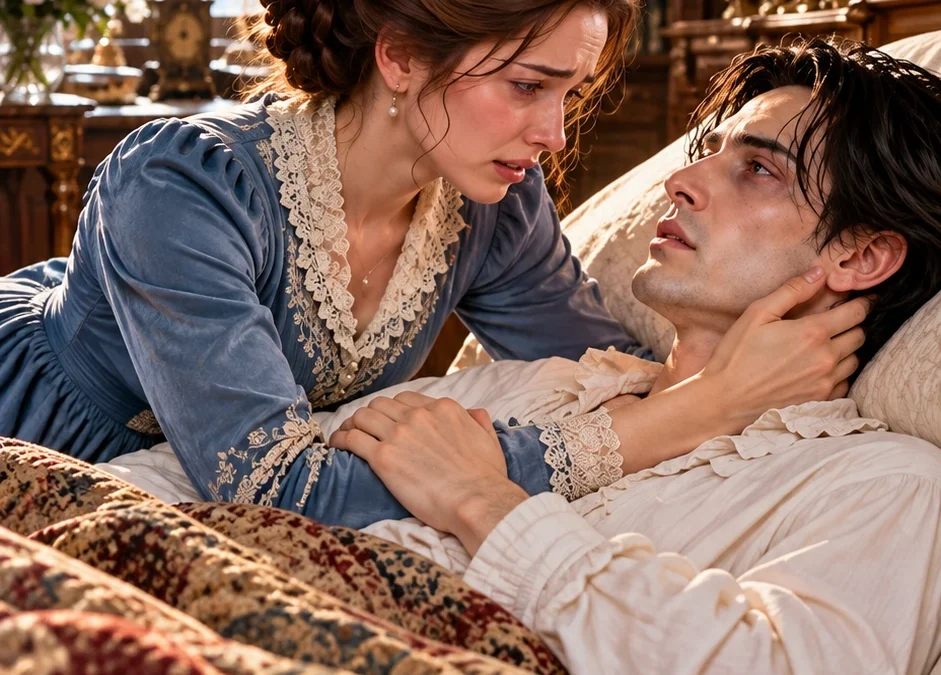
💔 “Marry Me Before I Die,” the Duke Whispered, Blood on His Handkerchief… But His Final Secret Left Her Speechless 😱
PART 1
Snow buried the whole valley the night Duke Edmund Blackwood summoned Clara Whitmore to stand before him.
Blood had soaked through the white handkerchief trembling in his hand.
“I am dying. Marry me. When I am gone, you will inherit everything.”
Clara did not cry. She only asked, “How long must I endure you?”
“Six months. A cold marriage. A perfect contract.” ❄️
She believed she was simply waiting for a man to die so she could buy back her freedom. But through the long, snowbound nights at Blackwood Manor, something in Edmund’s eyes began to change. And on the very last night, his confession would leave her breathless.
The winter that year came down from the northern hills like a judgment. It buried the roads, silenced the rivers, and turned the old stone city of York into a pale ghost of itself. Snow piled against the iron railings of the Blackwood townhouse until the front steps disappeared beneath it. Inside, a single fire burned in the study.
Edmund Blackwood, Duke of Blackwood, was twenty-nine years old. Tonight he looked older. His dark hair fell across a face carved too sharp by illness, and his long fingers gripped the arm of the chair as though the room might tilt beneath him.
Clara Whitmore stood just inside the doorway, still wrapped in her damp wool cloak. She was twenty-six, the orphaned daughter of a baron who had gambled away his name, his land, and finally his life. She had been summoned without explanation. A footman had appeared at the house of Lady Pembroke, where Clara served as a paid companion, and pressed a note into her hand bearing the Blackwood seal. Three words: Come tonight, please.
Edmund began to cough before he could greet her. It was not a polite cough. It tore through him, bent him forward, and went on so long that Clara took half a step toward him without meaning to.
When it finally stopped, he drew a white handkerchief away from his mouth. It was red. He folded it calmly, the way a man might fold a letter he had no intention of answering, and looked up at her.
“I am dying.”
Clara did not move. The fire popped.
“The physicians have given me a few months. Six. If I am obedient, fewer if I am myself. I did not ask you here for pity, Miss Whitmore. I find pity exhausting. I asked you here because I need a wife. Marry me.”
For one long moment, Clara wondered whether the fever had reached his mind. A dying man had no use for a bride.
“Why would a man in your condition need a wife?”
Edmund nodded toward the papers stacked on the desk. “Because of my cousin, Victor. When I die, the title passes to him by the law of male succession. I cannot stop that. The dukedom, the name, the seat in the House of Lords. All of it goes to Victor. But a title is not a fortune. The coal mines in the north are mine to give. The houses in London, the hunting lodge, the cash in the bank, the investments, Blackwood Manor itself, and every candlestick inside it. None of that is chained to the title. All of it can go to my widow.”
Clara understood. And something cold and practical inside her stood up a little straighter. “Why me?”
He studied her for a long time. “Because you are not a fool. Because you do not weep in public. Because you have already lost everything once, and you survived it without becoming either bitter or stupid. Victor bullies people. He would devour a softer woman. He would choke on you.”
It was not a compliment. It was an assessment. Clara found she preferred it that way.
She thought of her life since her father’s ruin. The silk dresses sold one by one. The narrow rented room above a chandler’s shop, where frost grew on the inside of the window and she slept in her stockings. Lady Pembroke, who threw teacups when the tea was weak and introduced Clara to guests as “the beggar baron’s girl.”
Edmund slid a document across the desk. A contract. Six months, or however long he lasted. She would become his wife, live at Blackwood Manor, learn the estate and manage it because he no longer could. When he died, she would inherit everything the law allowed him to give.
“How long must I endure you?” Clara asked quietly.
Something flickered at the corner of his mouth. “Six months, Miss Whitmore. Perhaps less, if you are lucky.”
She looked down at the contract. Then at the bloody handkerchief on the arm of his chair. She thought of the frost on her own window.
She picked up the pen. Her signature was neat, firm, and entirely without hesitation. ✍️
“Tomorrow,” Edmund said, his voice barely louder than the fire, “we marry.”
The wedding lasted fourteen minutes. Clara counted them on the clock above the vestry door of a small gray chapel at the edge of the city. There were no guests, no flowers, no music. There was only an elderly priest with chapped hands, Edmund’s valet Hughes standing as witness, and the two of them before the altar like strangers who had wandered into the wrong ceremony. Outside, snow fell in heavy, silent sheets.
Edmund wore black. He stood without his cane, though Clara could see what it cost him. When the priest asked for the ring, he drew from his pocket a band of old gold set with a single dark sapphire, deep as winter water. His hand was so cold and unsteady that the ring trembled against her knuckle, and for one terrible second she thought he would drop it onto the stone floor.
Without thinking, she closed her fingers around his and held them still. Together, they slid the ring into place. 💍
There was no kiss. There was no promise of love. There was only a signature in a parish register and a contract folded in Edmund’s breast pocket.
They left for Blackwood Manor within the hour. The journey north should have taken two days. It took four. The snow had swallowed the roads, and the carriage crawled through white valleys where the wind howled like something alive. Edmund lay across the opposite seat beneath a mountain of blankets and furs, his face gray, his eyes closed. Clara sat upright and watched his chest rise and fall. She told herself she was only checking whether her investment would survive the trip.
On the fourth evening, the carriage rounded a final bend, and Blackwood Manor rose out of the storm. Clara caught her breath. Towers and chimneys and long rows of mullioned windows stretched across the hillside, black stone against white snow. A fortress built by men who had expected to rule forever.
But as they drew closer, she began to see the truth. Snow lay unshoveled across the courtyard. Half the windows were dark. Ice clung to the gutters in thick gray fangs. When the great doors opened, cold air rolled out to meet them, colder even than the night. Inside, the halls smelled of damp plaster and neglect. The fires were small and smoky. Servants lounged in doorways and straightened only slowly when the Duke was carried past.
The housekeeper, Mrs. Harrow, a tall woman with a ring of keys at her waist and a face like a closed door, looked Clara up and down. “Her Grace will want to rest,” she said, in a tone that suggested Her Grace would want to go back where she came from.
Clara removed her gloves one finger at a time. “Her Grace will want the coal stores inspected tonight. I want the flue in the east wing cleared by morning. I want the courtyard shoveled so a physician’s carriage can actually reach the door. And I want every ledger, every account book, every rent roll in this house brought to the library before breakfast.”
Mrs. Harrow’s mouth tightened. “His Grace has always preferred that the household be left to my discretion.”
Clara met her eyes. “His Grace is dying, Mrs. Harrow. I am not.”
The great hall went completely silent. Mrs. Harrow lowered her eyes first. 😤
By dawn, the library table was buried beneath ledgers. What Clara found made her hands curl into fists. Rents collected and never recorded. Coal bought at twice the market price from a merchant who happened to be the steward’s brother-in-law. Wine vanishing from the cellars by the case. Every person around the dying Duke had been quietly helping themselves, certain that a man with so little time left would never notice, and that whoever came after would never care.
Clara cared. Every stolen shilling was hers now, or soon would be.
That night, exhausted, she climbed into a vast, cold bed in the west wing and listened to the wind scream across the moors. She had almost fallen asleep when she heard it, faint and far away, drifting down the long corridor from the east wing. A cough. Then another. Then a third, harsher, deeper.
Clara opened her eyes in the dark. She waited for it to stop.
It did not stop. 🌙
They lived in separate wings of the house, and Clara intended to keep it that way. She took her meals in the small morning room off the library. Edmund took his on a tray in the east wing, when he took them at all. Days passed without their exchanging more than a few sentences, and those concerned drainage, rents, and the price of coal.
Clara told herself this was exactly right. This was a transaction. She was not his nurse. She was not his sweetheart. She was a woman protecting property she was about to own.
She threw herself into the work. She dismissed the steward and his brother-in-law in the same afternoon, and found a cheaper coal merchant in the market town of Asheford. She learned the names of the tenant farmers, which families had sick children, which fields flooded every spring. Mrs. Harrow still disliked her, but now it was a quiet, careful dislike, the dislike of a cat that has learned where the broom is kept. The fires burned hotter. The house slowly began to breathe again.
But every night, the coughing came. It drifted down the corridor at ten, at midnight, at three in the morning. Sometimes it was brief, a few dry rasps and then silence. Sometimes it went on so long that Clara found herself sitting upright in bed, her fingers knotted in the blankets, counting. She told herself it was only the noise that troubled her. She pressed a pillow over her ears and did not think about blood on a white handkerchief.
Then came a night when the storm was worse than any before it, and down the corridor Edmund began to cough. One minute. Five. Ten. Clara lay rigid in the dark. Fifteen minutes, and the sound grew ragged and desperate, the sound of a man trying to breathe through water. Twenty.
Clara threw off the blankets. She pulled her dressing gown around her, lit a candle with shaking fingers, and walked barefoot down the long freezing corridor toward the east wing.
His door was ajar. Inside, a dying fire threw red light across the walls. Edmund sat on the edge of the bed in his shirtsleeves, bent nearly double, one hand braced against the bedpost. The handkerchief in his other hand was soaked through. When he heard her, he lifted his head. His eyes were bright with fever and something like fury.
“Go away.”
Clara set the candle on the table. “I cannot sleep. Your coughing is keeping the entire west wing awake. If you insist on dying, Your Grace, I would appreciate it if you did so more quietly.”
She poured water from the pitcher and held the glass out to him. He stared at her. Then, unbelievably, he laughed, a short broken sound that turned into another cough. His hand shook so badly that water spilled down his chin and onto his shirt.
“You are a cruel woman, Clara Whitmore.”
“Clara Blackwood. You saw to that yourself.”
“Remind me never to make another contract while feverish.”
“You would not live long enough to sign it.”
They glared at each other across the glass. It was almost comfortable, this sharpness, like two blades testing each other’s edges. Then, without thinking, Clara reached out and wiped the water from his chin with the edge of her sleeve. Her fingers brushed his jaw. His skin was burning.
Both of them went perfectly still. The wind moaned against the window. Edmund did not move away, and neither did she. For one suspended moment, they were not a duke and his hired wife. They were simply two people alone in a cold room in the middle of the night, close enough to hear each other breathe. Something unfamiliar tightened in her chest. 🕯️
Edmund looked away first. “Go back to your room, Clara.”
She went. She walked back down the black corridor with the candle guttering in her hand, and she did not look back. The coughing had stopped. The silence that replaced it was somehow worse. Clara lay awake until the windows turned gray, and in those slow hours before dawn, she discovered something about herself that she did not like at all.
She was no longer afraid of the noise. She was afraid of the night when it would stop.
👇 Part 2 is in the comments. Can’t find it? Leave any word below and I’ll send it to you privately.
PART 2
She was afraid of the night when it would stop.
In the second week of January, the great storm came. It rolled down from the high moors for three days and three nights without pause. When it finally passed, the world beyond the windows was gone. The drive had vanished. The road to Asheford lay somewhere beneath twelve feet of drifted snow, and no horse in the county could have found it. No physician could reach them. No letters could arrive. No one could leave. Whatever happened now, it would happen inside these walls.
On the fourth morning after the storm, Edmund came down to the library. He arrived slowly, one hand on the banister and the other on Hughes’s arm, and lowered himself into the deep leather chair beside the fire as though it had been waiting for him for years.
Clara looked up from her ledgers. “You should be in bed.”
“I am tired of my bed. It has begun to look at me like a coffin.” He nodded at the papers spread across the table. “Carry on. Pretend I am furniture.”
She tried. She could not. Every few minutes she felt his eyes on her, steady and curious, watching the way she frowned at columns of numbers and tapped her pen against her lip.
“You look,” he said finally, “like an angry owl.”
Clara did not lift her head. “Your tenant at Low Farm has not paid rent in eleven months, and your former steward wrote him off as deceased. He is not deceased. He is selling your timber to the next valley.”
Edmund’s mouth twitched. “A very angry owl.”
“Your hounds eat better than your tenants’ children.”
That silenced him. He was quiet for a long while. Then he said, “Fix it.”
And she did. That became the shape of their days. Every morning Clara worked at the long table, and every morning Edmund came down a little slower, and settled into the chair by the fire with a book. The snow fell, the fire crackled, and when Edmund grew too weak to hold the book steady, when his hands began to tremble and the pages slipped, Clara took it from him without a word and read aloud. Never poetry. Never romance. She read him history, philosophy, dull treatises on agriculture and the decline of empires. He listened with his eyes closed and his head resting against the leather. 📚
One evening in late January, she was reading about the fall of Rome when his hand moved. It was so sudden that she nearly dropped the book. His fingers closed around her wrist.
“I remember the first time I saw you,” he said. His eyes were still closed.
Clara went very still.
“Years ago. A ball in York, the winter before your father lost everything. You were wearing a terrible yellow dress. Truly dreadful. Someone ought to have been arrested for it.”
“It was my mother’s,” Clara said stiffly. “Altered.”
“It was a crime.” His thumb moved very slightly against the inside of her wrist. “But I do not remember the dress so well as your eyes. Everyone in that room was pretending. And you stood by the wall and watched all of it, and you were not fooled by any of it.” He opened his eyes and looked at her. “I thought, there is a woman who sees the world exactly as it is.”
Clara could not breathe. The room seemed to have shrunk to the space between his hand and her wrist.
Then, just as suddenly, the door inside him slammed shut. He let go. His face went smooth and cool and distant. “Forgive me. The laudanum makes me sentimental. Good night, Clara.”
She closed the book. She rose. She walked out of the library with her back straight and her chin high, and she did not run until she reached the stairs.
In her room, she stood in front of the cold window and pressed her palms against her burning cheeks. She was furious with him for saying such things and then taking them back, and furious with herself for wanting him to say them again. Six months. A man who was dying. A woman who had already lost everything once and had sworn never to be that foolish again.
“I will not,” she whispered to her own reflection. “I will not fall in love with a dying man.” 💔
The next morning she came down to the library at eight, as always. She opened the ledgers. The chair by the fire stayed empty. Nine o’clock came. Then ten. Clara read the same column of figures six times and understood none of it. By eleven, she had stopped pretending to work.
Hughes met her in the corridor outside the east wing, his old face drawn and gray. He did not need to say anything. Clara pushed past him and opened the door.
The room was stifling. The curtains were drawn, the air thick with the smell of camphor and sweat. Edmund lay twisted in the sheets, his face flushed a dull, frightening red, his lips cracked. When Clara laid her hand on his forehead, she nearly snatched it back. He was burning alive.
Dr. Pierce, the elderly physician who had been trapped at the manor since the storm, stood by the window wiping his spectacles. He would not meet her eyes. “The disease has gone deep into the lungs, Your Grace. I have done what I can. Now it is in God’s hands.”
Clara looked at the maids hovering in the corners, at Mrs. Harrow standing stiffly by the door, at Hughes wringing his hands. All of them had already decided how this would end.
“Get out,” Clara said.
They stared at her.
“All of you. Hughes, I want cold water from the well, as much as you can carry, and clean linen, and willow bark tea. Doctor, leave your medicines on the table and write down the doses. Nobody enters this room unless I call them.”
There was a pause. Then, one by one, they obeyed. The door closed. Clara rolled up her sleeves.
For three days and three nights, she did not leave him. She soaked cloths in icy water and laid them across his forehead, his throat, his chest, and when they grew warm, she soaked them again. She held his head up and coaxed bitter medicine between his lips, drop by drop, wiping away what he could not swallow. She changed the sweat-soaked linen with Hughes’s silent help. She sat in the hard chair beside the bed through the long black hours while the wind moaned outside, and she watched his chest rise and fall, rise and fall, as though she could keep it moving by force of will alone. 🕯️
Edmund drifted in and out of a world she could not follow. He spoke to people who were not there. He called for his mother, dead fifteen years. Then his face darkened and he muttered Victor’s name over and over with a hatred that frightened her.
“He will take them. The hounds. He will sell them. Hector and Brutus.”
Clara pressed a cool cloth to his temple. “No one will touch your dogs. I promise you. No one.”
On the second night, in the darkest hour, his hand shot out from beneath the blankets and seized her wrist with a strength she did not know he still possessed. His eyes were open but unseeing.
“Don’t go. Please, don’t go.”
Clara covered his hand with her own. “I am here. I am right here.”
Somewhere in those three days, the contract disappeared from her mind. She did not think about the coal mines. She did not think about anything at all except the rasp of his breathing and the heat of his skin and the terrible, simple wish that rose up in her again and again until it became a kind of prayer.
Live. Please, just live.
On the morning of the fourth day, the fever broke. Clara had fallen asleep in the chair, her head resting on the edge of the mattress, her hands still wrapped around his. She woke to the feeling of fingers moving gently in her hair. She lifted her head. Gray winter light slanted through a gap in the curtains. Edmund was looking at her. His face was pale and hollow and drenched in sweat, but his eyes were clear.
“You stayed,” he said hoarsely.
Clara sat up straight at once and smoothed her hair. “Of course I stayed. You are a considerable investment, Your Grace. I could hardly let you die before the paperwork was properly settled.”
Edmund smiled. It was the first real smile she had ever seen on his face, slow and tired and devastatingly warm.
“Liar,” he said softly.
Clara opened her mouth to argue. Nothing came out. For the first time since she had known him, she had no answer at all. She looked at him lying there, alive, impossibly alive, and her throat closed. She reached out and laid her palm against his cheek. Edmund closed his eyes and turned his face into her hand, the way a man turns toward a fire after a long walk through the snow.
Outside, the sun broke through the clouds for the first time in weeks. And Clara Blackwood understood, with a clarity that terrified her, that she was no longer waiting for her husband to die.
She was afraid of losing him. 🥺
For a few weeks, the world was kind to them. The fever left Edmund weaker, but it left him. By the middle of February, he was coming down to the library again, slower than before, leaning on Clara’s arm instead of Hughes’s. They did not speak of the three days. They simply resumed their old rhythm, the ledgers and the fire and the dull books read aloud. But something beneath it had shifted, the way a frozen river shifts before the thaw. When their eyes met across the room now, neither of them looked away quite so quickly.
Then, on a gray afternoon, when the snow had begun to soften and drip from the eaves, a carriage came up the newly cleared drive. Clara watched it from the library window, and something cold settled in her stomach.
The man who stepped down was handsome in a florid, overfed way, wrapped in a fur-lined greatcoat, his boots polished to a mirror shine. He smelled of brandy before he reached the top of the steps.
Victor Blackwood had arrived.
He did not wait to be announced. He strode into the great hall, shaking snow from his shoulders, and looked around at the restored fires, the scrubbed floors, the fresh candles, with the satisfaction of a man inspecting a house he had already bought. His gaze fell on Clara as she came down the stairs, and his lip curled.
“Ah. You must be the bride. The little baron’s daughter. I heard my cousin had purchased himself a wife on his deathbed.” He looked her up and down with lazy contempt. “Tell me, madam, what does it feel like to be the hired wife of a corpse?”
Clara reached the bottom step and folded her hands calmly before her. “Mr. Blackwood, you will find tea in the drawing room. I’m afraid we were not expecting you.”
“No, I imagine not.” Victor pulled off his gloves. “I have come to see to my inheritance. I will want the keys to the strong room, the jewel cases, and the plate.” He held out his hand.
Clara did not move. “No.”
Victor laughed. “Perhaps you misunderstand your position. I am the heir to the Duke of Blackwood. When my cousin dies, and from what I hear that will be very soon, everything in this house becomes mine.”
Clara tilted her head. Her voice stayed perfectly level. “You may inherit the title, Mr. Blackwood. I do not dispute it. You may inherit the name and the coronet and the seat in the House of Lords. But the coal mines are not entailed. They are not yours. The houses in London are not yours. The investments, the bank accounts, the hunting lodge are not yours. This house and every key in it is not yours.” She took a single step closer. “You will be a duke, sir. A duke with nothing at all.”
The color drained from Victor’s face, then rushed back twice as dark. He stepped toward her, one hand rising. “You grasping little…”
“Victor.”
The voice came from above them, quiet and cold as the wind off the moors. Everyone turned. Edmund stood at the top of the staircase. He was gripping the banister so hard his knuckles were white, and he was so thin that his dressing gown hung from him like a sail from a broken mast. But his eyes burned, and when he spoke, every word fell like a blade.
“While I still draw breath in this house, you will address my wife as Her Grace, the Duchess of Blackwood. Or you will leave.”
Victor snatched his gloves from the hall table, muttered something foul under his breath, and stalked out into the dripping afternoon. 😤
Clara climbed the stairs. She reached Edmund just as his knees began to buckle, and caught him beneath the arm, taking his weight against her shoulder. He was trembling.
“You defended me,” he said, low enough that only she could hear.
“I defended the estate,” Clara said briskly. “Victor would have stolen the silver.”
Edmund looked at her. She looked back. Neither of them believed a single word of it, and both of them knew it.
That night, Clara sat in the library with a book open in her lap, not reading. Near midnight, the coughing began again in the east wing, deep, wet, endless. When Hughes came down an hour later carrying a basin, she saw that the water inside it was pink.
Clara closed the book. She sat very still in the firelight and understood something she had spent weeks refusing to see. The fever had not been an ending. It had only been a warning.
Their time was running out.
👇 Want to know what Edmund confessed on that last night… and what Clara discovered when the will was read?
LIKE ❤️ and COMMENT with any word you choose to unlock Part 3. Once we reach enough comments, I’ll post it!
PART 3
The knock came a little after midnight, three nights later. Clara was awake. She was always awake now. She opened the door to find Hughes standing in the corridor with a candle, his white hair rumpled, his face carefully blank.
“His Grace asks for you, ma’am.”
Clara’s heart lurched. She did not stop for slippers. She followed Hughes down the long cold corridor, her dressing gown clutched around her, toward the single strip of firelight glowing beneath Edmund’s door.
The room was dim. The fire had burned down to embers, throwing a low red glow across the walls. Outside the tall windows, snow was falling again, slow and soft and endless. Edmund was propped against the pillows. He looked worse than she had ever seen him, his skin like paper, his eyes sunk deep in shadow. But he was awake, and he was watching the door.
Hughes withdrew without a word. They were alone.
“Sit.”
Clara sat on the edge of the chair beside the bed.
“I have made a mistake,” Edmund said.
Her mind leapt at once to the contract. “Victor. He has found something. Some flaw in the settlement…”
“Clara.” Edmund shook his head slowly on the pillow. “I am not speaking of the estate.” He looked at her in the red light of the dying fire. His eyes were very dark. “I am speaking of you.”
She went still.
He drew a careful breath, testing how much his lungs would allow. “When I asked you to marry me, I meant every word of that contract. I wanted a transaction, nothing more. I chose you because you were strong. Because you would not cry. Because you would not squander my fortune on bonnets and card tables and fortune hunters. I thought, here is a woman who will be perfectly well when I am gone. She will take what I leave her and build something sensible with it, and in a year she will barely remember my name. I believed that. I truly did.”
“Edmund…”
“Then tell me something, Clara.” His voice dropped. “If this was only ever a transaction, why did you sit beside this bed for three days and three nights without sleeping? Why did you wipe the sweat from my face with your own hands? Why did you promise a dying man in a fever that no one would ever touch his dogs?” He paused. “And why, when Victor called you the hired wife of a corpse, did you look at him as though you wanted to put him in the ground before me?”
Clara said nothing. She could not. Her throat had closed completely.
Edmund reached across the blankets and touched the back of her hand with one finger. “Don’t lie to me anymore. Please. There isn’t time.”
The snow whispered against the glass. And then Edmund Blackwood, who had spent his whole life saying cruel and clever things so that no one would ever hear the true ones, said the truest thing of all.
“I love you.”
Clara stopped breathing.
“I love you,” he said again, as though once was not enough, as though he had been holding it so long that it had to come out twice. “And I am dying. God forgive me. Clara, I am so sorry. I meant to leave you rich. I did not mean to leave you grieving.” 💔
Something inside Clara broke open. She slid from the chair onto her knees beside the bed, and took his thin, cold hand in both of hers and pressed it against her cheek. The tears came before she could stop them. They ran down her face and over his fingers, hot and silent, and she did not care. For years she had not cried. She cried now.
“Don’t you dare,” she whispered fiercely. “Don’t you dare apologize for teaching me how to love someone.”
His fingers moved weakly against her wet cheek. “I have nothing left to give you. No years. No future. Nothing worth having.”
Clara lifted her head and looked at him through her tears. “Then give me what you have. Whatever is left, give me that.”
For a long moment, he only looked at her, as though trying to memorize her face. Then Clara leaned forward and kissed him. It was not the perfect kiss of a storybook. His lips were dry and cracked. Her face was wet with tears. But it was the kiss of two people who knew exactly how little time they had, and who had decided together in the dark not to waste another second of it. 🥹
The next morning, Clara had her trunks carried from the west wing to the east. The maids whispered behind their hands. Clara did not care. She walked into her husband’s bedroom, crossed to the tall windows, and flung the heavy velvet curtains wide open. Winter sunlight poured across the floor for the first time in years.
Edmund squinted up at her from the pillows. “Good God, woman, are you trying to kill me faster?”
“This room looks like a tomb. You are not dead yet. I refuse to live in a mausoleum.”
She ordered the fire built high. By evening, the room smelled of woodsmoke and pine, and it was warm.
What followed were the strangest and most precious months of Clara’s life. Spring came late to the high moors that year, but it came. The snow retreated from the hills in long gray stripes, and Edmund, against every prediction Dr. Pierce had made, kept living. On his good days, they ate breakfast together at the little table by the window. They played cards in the evenings, and he cheated shamelessly, and she caught him every time. When the paths dried, she walked beside him in the garden, slowly, his arm through hers, Hector and Brutus trotting ahead with their tails high. On his bad days, she read to him, and he lay with his head against her shoulder and listened. 🐕
Their love was never sweet in the way of novels. It lived in small things. She measured out his medicine every morning and stood over him until he swallowed it. He reached for her hand under the table at supper without looking up from his plate. She sat by the fire and read him dull essays on crop rotation, and he leaned his head back and smiled at the ceiling. She corrected the ledgers, and he sat beside her and explained which tenant was proud and needed to be asked rather than told, which one was lazy and needed a firm hand, which widow could not pay this year and must not be pressed.
“They are not numbers, Clara. They are people. Remember that when I am not here to remind you.”
She hated when he said things like that. And he said them often. He spoke about her future the way other men spoke about the weather. He wrote letters of introduction to bankers in London. One evening in early summer, he began explaining how she ought to arrange the London house for the season after next, when she would be out of mourning, and Clara put down her teacup so hard it cracked.
“Stop it.”
Edmund looked up, startled.
“Stop preparing my life for a world without you in it. I do not want it. I do not want a single day of it.”
Edmund was silent for a long time. Then he set aside his papers and held out his hand. After a moment, she crossed the room and took it.
“You must live, Clara,” he said quietly. “That is the only thing I truly want. Not the estate. You, alive, laughing at someone wearing a dress less dreadful than that yellow one.”
She tried to laugh and could not. “I don’t know how. I don’t know how to live without you anymore. You have ruined me for it.”
He pulled her down beside him, and she rested her head on his chest and listened to the ragged rhythm of his heart, and neither of them spoke again that night. 💛
The six months came and went. The contract expired quietly in the middle of a warm June afternoon while they sat in the garden watching swallows dive over the lake. Neither of them mentioned it. Summer turned golden and then rust-colored, and Clara let herself believe, just a little, just for a while, in a kind of miracle.
Then the leaves fell.
One morning in late November, Clara woke to a strange, heavy silence and went to the window. The first snow of the new winter lay across the lawns, thick and white and absolute, exactly as it had on the night she signed her name. Behind her, Edmund began to cough.
She knew the sound at once. She turned and saw him bent forward in the bed, the handkerchief pressed to his mouth. When he drew it away, it was soaked in red. He looked up at her.
Clara stood in the cold white light of the window and understood, with a certainty that turned her blood to ice, that there would be no miracle this time. ❄️
By the second week of December, Edmund could no longer leave his bed. Dr. Pierce came up from Asheford every few days through the snow and went away again with nothing to say. On his last visit, he took Clara aside in the corridor and held her hands in his own.
“There is nothing more I can do, Your Grace. Keep him warm. Keep him comfortable. Stay with him.”
Clara nodded. She had not needed to be told. She had already moved the armchair to the side of the bed, and she slept in it now, every night, wrapped in a shawl, waking at every change in the rhythm of his breathing.
The snow fell without stopping. Day after day it came down soft and gray, filling the courtyard, burying the garden paths where they had walked in the summer, piling against the windows until the room glowed with a strange, pale, underwater light. The house grew quiet around them. Even the dogs lay outside the bedroom door with their heads on their paws, as though they too were waiting.
Then one afternoon, a few days before Christmas, Edmund woke clear and lucid, more himself than he had been in weeks. He turned his head on the pillow and looked at her.
“Clara. Listen to me. In the library, behind the portrait of my father, there is a panel in the wall. Inside you will find a strongbox. In the strongbox is my will. The new one. Harrington drew it up in October and witnessed it himself. Victor does not know it exists.” He paused to breathe. “He will fight you. The moment I am in the ground, he will come for everything. You must be ready.”
Clara smoothed the hair back from his forehead. “Let him come. I will deal with Victor.”
Something lit in Edmund’s tired eyes, a flash of his old wicked humor. He smiled up at her. “My ruthless duchess. God help him.”
Then the smile faded, and he was quiet. He lay looking at the ceiling for a long time. Clara thought he had drifted back toward sleep. When he spoke again, his voice was so low she had to lean close to hear it.
“Clara. I am afraid.”
The words went through her like a knife. In all the months she had known him, he had never once said such a thing. Not when he coughed up blood in front of her on the night of their contract. Not when the fever burned him half to death. He had mocked his illness. He had pretended, with every sharp word and cool glance, that death was a minor inconvenience, an appointment he would keep with a shrug. And now, at the very end, the mask had fallen away, and beneath it was only a frightened man who did not want to go. 💔
Clara climbed onto the bed beside him. She gathered him into her arms, his head against her heart, the way one holds a child who has woken from a nightmare. She pressed her lips to his hair.
“I am here. I am right here. I won’t let go. I promise you, Edmund, I won’t let go.”
His thin hand found hers and held on. They lay together while the light faded from the windows and the room filled with blue winter shadow. After a long while, he turned his face and pressed a kiss to her temple, slow and soft.
“Thank you,” he breathed. “For staying. For all of it. Thank you, my love.”
Then he closed his eyes.
Clara listened to him breathe. Each breath came slower than the last, a long pause between them like footsteps moving farther and farther down a corridor. She counted them. One, a pause. Two, a longer pause. She held her own breath and waited for the third.
Outside, the snow kept falling. She waited and waited.
The third breath did not come.
Clara lay perfectly still, her arms around him, her cheek against his hair, listening with every part of herself for a sound that would never come again. The room was so quiet she could hear the snowflakes touching the glass.
Edmund Blackwood was gone. 🕊️
They buried him four days after Christmas in the family cemetery on the hill behind the manor, where seven generations of Blackwoods slept beneath the yews. The snow had not stopped. It lay deep across the graves and weighted the branches until they bowed, and the wind that came up off the moors cut through Clara’s black veil as though it were made of paper.
The tenants came. Clara had not expected that. They stood in their patched coats, their wives in knitted mufflers, dozens of them, hats in their hands, heads bowed against the cold. The widow from Low Farm wept openly. Hector and Brutus lay in the snow at Clara’s feet and would not be moved.
Victor arrived late in his glossy black carriage, wearing a mourning band on his sleeve and a look of barely concealed triumph. He stood across the open grave from Clara and did not lower his eyes once during the prayers. When the first handful of earth struck the coffin lid, he smiled.
That afternoon, the family solicitor, Mr. Harrington, a small, precise man with silver spectacles, gathered them in the drawing room. Victor lounged in the best chair by the fire with a glass of the late Duke’s brandy. Clara sat very straight on a hard-backed chair by the window, her hands folded, her face pale and unreadable. Mr. Harrington broke the seal on the document Clara had taken from behind the portrait of Edmund’s father, cleared his throat, and began to read.
The title, the coronet, and the seat in the House of Lords passed to Victor Blackwood as the law required.
Then Mr. Harrington turned the page. “To my beloved wife, Clara, Duchess of Blackwood…”
The late Duke left Blackwood Manor and all its lands and contents. The coal mines in the northern valleys. The houses in London. The hunting lodge. The cash held in his banks. Every investment, every share, every stick of furniture and piece of silver and painting on the walls. Everything in the world that was his to give, he had given to her.
Victor received the title, and very nearly nothing else. 😶
The brandy glass stopped halfway to his lips. Then he rose to his feet so violently that the chair scraped across the floor. “This is a fraud! She bewitched him! She crawled into a dying man’s bed and twisted his mind while he was too weak to see it. I will take this to every court in England. I will prove undue influence!”
Clara did not rise. She looked at him across the room with eyes as cold and gray as the sky outside.
“Then sue me.”
Victor faltered.
“Sue me, Your Grace,” Clara went on, in the same calm, even voice. “Hire every lawyer in London. I will hire better ones. I have the coal mines and the banks and all the time in the world. You have a title, a pile of debts, and a carriage you cannot afford to feed. I will drag the case out for ten years if I must, and when it is over, you will be the poorest duke in England, and you will have spent your last shilling learning exactly what Edmund knew about me from the beginning.”
The room was silent. Victor’s face went white, then red, then white again. Then he snatched up his hat and walked out of the house, and the door of Blackwood Manor closed behind him for the last time. ⚖️
The guests drifted away. Mr. Harrington left his papers on the table and bowed himself out. Clara had won. She had everything. Every acre, every coin, every key.
Slowly, she climbed the great staircase alone, her black skirts whispering against the steps, and walked down the long corridor to the east wing. She opened the door to Edmund’s room. The maids had already cleaned it. The bed was stripped and made up with fresh linen. The bottles of medicine were gone. The room smelled of nothing at all. No camphor, no woodsmoke. No him.
Clara sat down in the armchair by the cold fireplace, the chair where she had slept for so many nights. She looked out the window. The snow was still falling, soft and gray and endless, exactly as it had on the night she signed her name.
And in that silence, she finally understood the cruelest truth of all. She had inherited everything he left behind. The mines, the houses, the money, the power to destroy Victor, and the freedom never to be poor or afraid again. And she would have given every last bit of it, every acre and every coin and every stone of this enormous house, just to lie awake one more night in the west wing and hear him coughing down the hallway.
Edmund’s old wool shawl still hung over the arm of the chair. Clara pulled it into her lap and pressed her face into the soft gray wool. It still smelled faintly of him, of woodsmoke and ink and something she had no name for.
And there, in the cold, quiet room at the top of the house, with the snow falling past the window and the whole of the Blackwood fortune waiting downstairs, Clara wept. She did not weep because she was poor. She would never be poor again. She wept because for the first time in her life, she had everything.
And still, without him, she had nothing at all. 🕯️
💬 Have you ever loved someone knowing your time together was limited? Would you have signed that contract? Tell me in the comments. I read every one. ❤️
Disclaimer: This story is entirely fictional and created for entertainment purposes only. It does not represent any organization or individual, nor does it encourage inappropriate behavior. The content was generated with AI assistance.








