“Marry the Cursed One, and Death Rides Beside You.” Every Warrior Refused Her… So the Chief Handed Her to a White Rancher Sight Unseen, and Her Eyes Held a Secret That Would Cost Him Everything
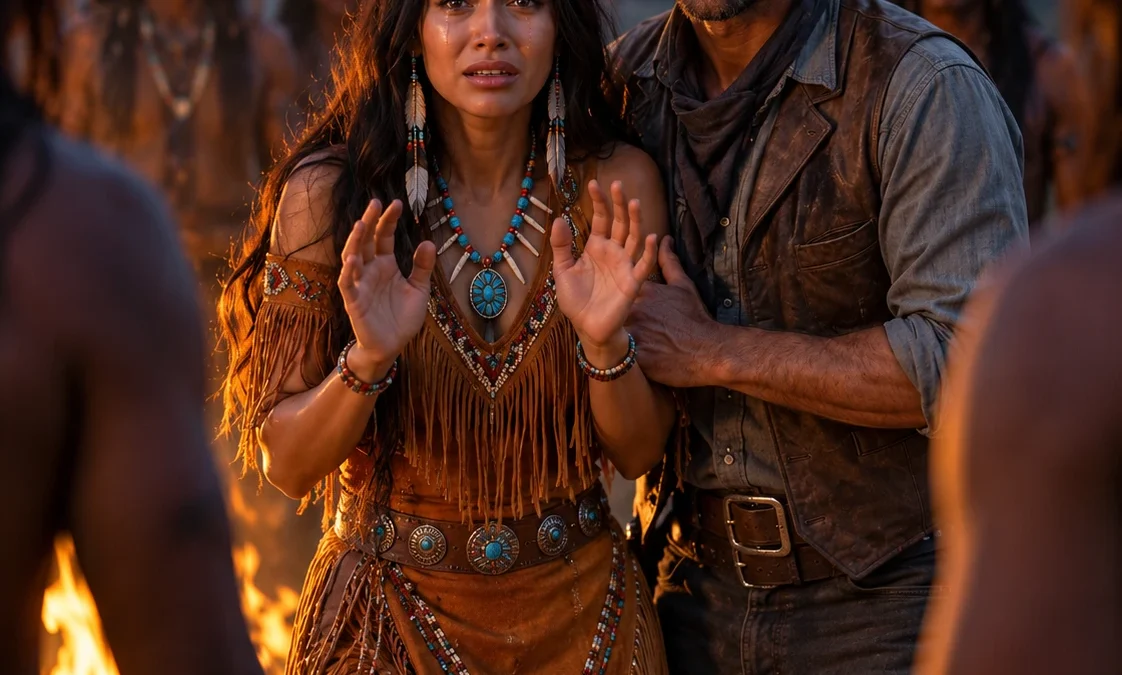
🔥 “Marry the Cursed One, and Death Rides Beside You.” Every Warrior Refused Her… So the Chief Handed Her to a White Rancher Sight Unseen, and Her Eyes Held a Secret That Would Cost Him Everything 😱
PART 1
Caleb Wade had buried three people on the rise above Sulphur Springs Creek. 🌵
His father first, taken by lung fever the winter Caleb turned nineteen. His mother two summers later. Then his younger brother Tom, who never woke from the same sickness that swept through the valley and up into the Chiricahua foothills.
By the autumn of 1884, in the Arizona Territory, Caleb ran four hundred head of cattle on land that once needed six hands and now got by on two. Word had traveled that the Wade ranch sat too close to Apache country for comfortable company. His foreman, Otis Pruitt, a leathery Missourian who had ridden with Caleb’s father, was the only one who never asked for extra pay despite the risk.
Caleb ate supper alone at a table built for eight. The house that had once rung with his mother’s cooking and his brother’s arguing now held nothing but the tick of a clock nobody bothered to wind on time.
He supposed he didn’t mind. A man got used to almost anything, given enough winters to practice. 🕰️
But seven years back, something had happened that he no longer let himself remember clearly.
The same fever that took his mother had torn through the Chiricahua camps below Cochise’s Stronghold. The post surgeon at Fort Bowie had orders not to spend army quinine on people the army didn’t consider its own to save. Caleb, twenty-two and half out of his mind with grief, went into the surgeon’s stores at night with a borrowed saddlebag and rode the medicine himself into a camp full of dying children.
He didn’t know a word of the language. He didn’t care whether he was welcome.
He remembered a fire built too high against the cold. Women singing low over cradleboards. An old man watching him from the dark with an expression Caleb couldn’t read, and would spend seven years failing to forget.
He remembered handing the last bottle to a little girl no older than six, burning so hot he could feel the fever through her wrist. Then he rode home before sunrise so no one at the fort would know where the medicine had gone. 💊
He hadn’t thought about that night in years. Until the morning a Chiricahua rider came down out of the Dragoons alone, sat his horse at the edge of the yard, and said that Nantan Halcon wanted to see him.
Caleb knew the name. A chief who kept his people fed and out of the newspapers. He had never exchanged two words with him.
He rode up anyway.
Halcon received him seated on a woven mat outside his wickiup, gray-braided, with the stillness of a man who had buried more than Caleb ever would. He did not offer coffee. He did not waste time.
“Seven winters ago, a white boy rode into my camp with medicine no agency doctor would spare. He saved fifteen lives. One was my youngest daughter’s.”
That debt, the old man said, had sat on his chest every day since. No horse, no rifle, no season of labor could balance a life saved. He had spent seven years looking for an answer.
“I have found one. I give her to you. In marriage. This week.”
Caleb sat with that a long moment. “A man doesn’t hand over his daughter to settle a debt. Not to a stranger.”
“Her name is Sikya. She is two years past the age most girls in my band are married. No warrior among my people will take her. Not for land. Not for horses. Not for anything I could offer.”
“Why?”
Halcon looked past him, toward a hawk circling slow over the rocks. “It is not a story that is mine to tell.”
It cost him to say it. Caleb understood that whatever kept the warriors away from this woman was no small thing, and that the old chief was ashamed of it in a way he couldn’t put into English. 😔
Otis argued against it that evening, plainly and more than once. A ranch already short of hands didn’t need a wife nobody in the valley would want under its roof.
But Caleb thought of a six-year-old burning with fever under his hands. He thought of empty rooms. And he heard himself say yes before he’d decided to say anything at all.
Halcon pressed him once more. “This is not a woman who will soften herself to be easily loved. Whatever gentleness she shows you will have to be earned.”
“I’ve never much cared for things that came easy,” Caleb said.
Halcon nodded once, like a man finally setting down a stone. 🪨
They brought her down out of the Stronghold on the appointed morning. Two aunts walked beside her horse with the careful attention of women guarding something precious and combustible. Sikya sat straight in the saddle, wrapped shoulder to knee in a bright blanket, her face turned away from the ranch hands and neighbors who had come to watch a white man marry a woman none of them had ever seen.
When the aunts lifted the blanket, the yard went quiet enough to hear the wind in the mesquite.
She was the most beautiful woman Caleb had ever seen. Dark hair past her waist. Skin like something poured from copper. A face that would have stopped conversation in any room in the territory.
But it was her eyes that held him. Amber, near gold in the morning light, and utterly without warmth. They measured him the way a woman prices a man for the fight she expects to have with him later. 😳
He had braced himself for some visible mark of whatever frightened off every warrior in her band. He found nothing. No scar. No missing finger. And he understood that the thing they feared in her wasn’t written on her skin at all.
“I did not ask for this,” she said in English, clipped and careful. “My father did the asking. I am here because I would not shame him twice.”
She looked at him like a debt she intended to pay off quickly.
“Do not mistake this for gratitude. And do not mistake my staying for surrender. I have not surrendered to anyone in a long time.”
On the ride home she corrected her own cinch before he could offer. She noticed his gelding favoring its near foreleg two full minutes before he did. When his wagon wheel caught in a rut deep enough to snap the axle, she had already wedged a flat stone under the rim and had it rolling again before either man decided what to do.
She didn’t wait for thanks.
But the valley was not so quiet. Two of his hands quit within the week. At the mercantile, women drew their children closer, and one voice, low but not low enough, wondered what kind of Apache girl her own tribe wouldn’t have. 😠
Sikya stood through all of it with her chin level. Caleb understood this was not the first time she’d been stared at like something dangerous.
And the whispers found their way to a man who knew exactly what to do with them.
Emmett Sharpe owned the biggest spread west of the creek and had wanted Caleb’s water rights for three years. He began buying rounds at a saloon he never frequented, asking in a voice pitched to carry whether decent folk oughtn’t be concerned about the sort of woman Caleb Wade had let into that house.
That night, Caleb woke to a sound in the dark kitchen. He found Sikya sitting at the table, a knife laid before her, staring at nothing.
“They are not afraid of what I am,” she said quietly, without turning. “They are afraid of what I did.”
“What did you do?”
She finally looked at him, and for the first time, her amber eyes were not cold. They were terrified.
“I killed three men. And my own people believe I was not alone when I did it.” 😨
PART 2
Caleb did not move. He didn’t dare.
“Not alone?” he said carefully.
“The old ones say something walked with me that day. Something not of this world.” Sikya’s voice was flat, but her hands trembled against the knife. “They say no girl of seventeen fights like that without help from things better left sleeping.”
She told him nothing more that night.
The truth reached him sideways, the way most truths in that country did, through a ranch hand’s cousin who traded with the Chiricahua. Two years earlier, raiders out of Mexico had come up through the foothills after the band’s horses and, failing that, its women and children. Sikya, seventeen and never trained for war by anyone the elders would have sanctioned, had put a knife into a man’s ribs when he grabbed her youngest sister. She kept fighting with whatever came to hand until three raiders lay dead and the rest broke and ran.
She had saved the camp. And in the same hour became a problem no warrior knew how to solve.
No man wanted a wife who might, in some quarrel or some fear, prove herself the stronger hand. They had named her cursed because it was easier than naming her formidable and admitting what that cost their pride. 💔
Caleb turned that story over for days before he raised it. He caught her mending a bridle by firelight and told her plainly that it sounded less like a curse than the bravest thing he’d heard in this territory.
Her hands went still over the leather.
“My aunt Ishton was a fighting woman,” she said at last, quietly. “She trained me in secret behind the wickiups for two winters. My father never once named me cursed.”
It was the first time he saw something in her face that wasn’t measuring him for a fight. 🌙
The nights turned colder. A storm blew in one evening hard enough to scatter half the herd and strand Caleb and Otis mending fence a mile past dark. Sikya came looking for them on horseback, in weather that kept every sensible soul indoors, and found Caleb with a gash torn along his forearm from loose wire.
She didn’t ask permission. She packed the wound with yucca root and something bitter from her saddlebag, bound it with a strip of her own shawl, and told him without warmth that a man who bled that easily over barbed wire had no business getting killed defending a wife he barely knew.
“Then I intend to get a lot better at not bleeding,” Caleb said, “seeing as you seem inclined to stick around and keep having opinions about it.”
She rode home with the corner of her mouth doing something not quite a smile. 🥹
After that, supper ran longer. She taught him the Apache words for wound and fool, laughing under her breath at his terrible attempts. He taught her ranch words, cinch and heifer and drought, and she echoed them with a seriousness that made him suspect she was memorizing more than the words.
The knife moved from under her bedding to the shelf by the door, sitting openly now, the way a tool sits when its owner has stopped expecting to need it in a hurry.
Then Ishton rode down alone, claiming she needed salt. She spent an afternoon watching Caleb work a green colt and watching her niece move around the yard with an ease that hadn’t been there before. She pressed a string of turquoise beads into Sikya’s hand and told her she was proud of her.
Sikya took him out past the north pasture one clear morning to a seep spring she’d found in a dry wash where Otis swore blind water had never been. She taught him to read a deer track’s age and to tell, from thirty yards, whether a rattler was coiled to strike.
“I was wrong,” Caleb told her, “to think I was the one doing you a favor.”
“My father says a debt paid honestly sometimes turns into something owed the other way around.”
Then came the evening he finally told her everything. The fever. The stolen quinine. The ride into a Chiricahua camp seven years before he ever imagined marrying into it.
Sikya went very still. When he described the fire, the women singing over cradleboards, the last bottle handed to a burning child no older than six, she pressed her hand flat against her collarbone as though she could feel the fever through seven years of distance. 😳
“I was that child.”
She remembered almost nothing. Only a stranger’s hands. A smell like horse and gunpowder. She had grown up believing that man was dead, or gone east, or just a story the old women told to make a hard winter sound less cruel.
Neither of them said the word love that night. But the room had changed its weight, and they both knew it. ❤️
The ranch began to thrive. She spotted blackleg in two calves a full week before anyone noticed. When a storekeeper’s wife went into labor with the child turned crosswise and the doctor two days away, Sikya walked in unbidden and turned the baby with her own hands. Mother and child both lived.
A jar of preserves arrived that evening with a note in shaky handwriting: Thank you.
But Sharpe felt the doubt turning against him, and moved faster.
When a neighbor’s cow died of bad forage, he wondered aloud at the mercantile whether trouble didn’t seem to follow wherever that Apache woman put her hands. He never said witch. He let the silence say it.
A week later, three of Caleb’s calves lay slaughtered in the north pasture, and a painted warning was nailed to the gatepost.
Send her back, or worse comes calling.
Word reached the Chiricahua camp too. It reached a warrior named Tazhi, who had once offered horses for Sikya’s hand and never forgave Halcon for refusing. He saw an excuse. Not to save her, exactly. To ride down and take her back by force.
Two threats, one night, neither man aware of the other.
On a moonless evening in late November, Caleb heard riders a quarter mile off. Eight, maybe nine, torches blazing, rifles ready. He got Otis to the gate and a rifle into his own hands, but not enough time to get Sikya anywhere but standing beside him, which was exactly where she chose to stand. 🔥
“Hand over the Apache witch!” a voice roared from the dark.
“You’ll come through me first,” Caleb answered, steadier than he felt.
A torch arced toward the porch roof. He knocked it from the air with a fence post. A bullet tore across his shoulder. He went down.
And then, from the ridge road above, came hoofbeats. Fast. More torches. A second army descending on the ranch from the opposite side. 😨
Sikya, with her husband bleeding behind a water trough, lifted her rifle toward the new riders.
And froze.
PART 3
She knew the man at the front.
Tazhi. The warrior who had spent two years calling her cursed to save his own pride. Now he was riding down the ridge, believing he was rescuing her.
Sikya turned her rifle on him for a heartbeat. Then she shouted in Apache, sharp enough to carry over the noise.
“I need no rescue from a man who has named me cursed! If you mean to help, turn your rifle on the ones who came to burn me out!”
Tazhi pulled his horse up short, stunned. He had come to reclaim a woman from a white mob. He found a woman already fighting for her life and her husband’s, blood on her hands that was not her own, refusing to be reclaimed by anybody.
Meanwhile, Sikya knelt beside Caleb and dragged him bodily behind the water trough, pressing the wound with the same flat competence she had used on a torn forearm. Otis fired from the barn loft and dropped a horse out from under one rider, scattering two more toward the road. Her own rifle cracked twice, past two riders’ ears close enough to end their nerve entirely.
“Keep your eyes open,” she said in his ear, no room for argument. “Keep your hand where mine was.”
“I trust you,” Caleb breathed, “more than my own legs.”
Sharpe’s riders broke and scattered into the dark. 💥
Then, in the gray edge of dawn, a third group arrived, larger, slower, with more authority than haste.
Halcon.
The old chief had heard of the trouble from the same trader who carried word to Tazhi. He had ridden most of the night to reach his daughter before either danger could.
What he found was Sharpe’s men already fleeing, Tazhi standing apart with his plan rendered pointless, and his daughter standing over her wounded husband with a rifle still in her hands.
Halcon looked at her a long moment in that thin gray light. At the blood on her hands. At the steadiness of her stance.
Then, loud enough for every man present to hear, he spoke.
“I was once ashamed to admit what my daughter could do.” His voice did not waver. “I am not ashamed now. Any man in my band who still names her cursed may say so to my face instead of behind it.”
Nobody said a word. 🌄
Tazhi, to his credit, kept quiet, and rode home with his men before the sun cleared the ridge. It would be several winters before he found the humility to say to Sikya’s face what he owed her that morning.
Caleb lived. The bullet had passed through muscle and missed anything that would have killed him, but it kept him abed a slow, aching week.
And Sharpe’s crime did not stay quiet. Enough of his own men, sobered by daylight and by the sight of a woman who had fought harder than most of them, were willing to say plainly who had gathered them and why. A federal marshal riding circuit that winter took far more interest in Sharpe’s water-rights ambitions than Sharpe had ever wanted any lawman to take. Within a month, his credit dried up faster than his cattle’s water, and he left the valley for good. ⚖️
Mrs. Hollis came out twice that week with soup and a second jar of preserves. She sat at the kitchen table while Caleb slept off the fever and admitted that half the valley owed Sikya an apology it hadn’t worked up the nerve to give.
“An apology matters less than the next kindness given honestly,” Sikya said. “I would rather be judged going forward than argued over looking back.”
“That seems a fairer standard than most of the valley has ever held itself to,” Mrs. Hollis said, and the two women sat a while longer in a silence far more comfortable than their first. 🤝
Sikya sat with Caleb through most of that recovery, and it was there, in the same slow firelight that had first taught them each other’s words, that he finally said what he’d been slow to say.
“Whatever debt first brought you to my gate, I don’t want you for the debt anymore. I haven’t for weeks.”
He told her he had never, in seven years of grief and empty rooms, expected a woman to bleed for him the way she had. No one had ever risked so much to keep him alive. Not even blood kin.
Sikya, who had spent two years hearing from her own people that no man would ever want what she was, sat with that a long moment. 😭
“When my father named this marriage,” she said slowly, “I expected to be tolerated by a stranger out of obligation. I prepared myself for that and nothing warmer. I did not prepare for a man who would take a bullet for a wife nobody thought worth defending.”
Her voice cracked.
“I did not know what it felt like to matter to someone not blood-bound to say so. I love you. And it frightens me more than the mob at the gate, because a bullet I know how to fight. This I do not.”
On the porch step, Otis Pruitt, who had taken to keeping half an ear on the house, later told anyone who’d listen that he’d never heard two people say something that plain sound so much like a wedding vow already spoken. ❤️
Halcon rode down from the Stronghold one final time that winter, not to collect on any debt, but to see his daughter married properly, in whatever fashion two worlds could agree on.
At sunrise, Ishton spoke a Chiricahua blessing over them and tied a strand of turquoise beads around their joined wrists as the sun cleared the ridge. Later that same day, they exchanged a simple vow before the circuit preacher, with Otis standing witness on one side. On the other stood Neka, Sikya’s youngest sister, the very child she had once fought three raiders to protect. Grown taller now and grinning through the whole ceremony like she’d known this was coming since the day the medicine bottles emptied into her small hands.
A handful of the neighbors who had once whispered at the mercantile came too, quiet and a little sheepish, bringing preserves and blankets the way frontier folk apologize when they’ve got no better words. Sikya accepted every gift with the same level composure she’d worn the day the blanket first came off her. But Caleb noticed her eyes were considerably warmer doing it. 💛
They stayed in the valley the rest of their lives, and by most accounts, those were happier and more prosperous years than either the ranch or the band above the Stronghold had known in a long while.
The Hollises came to supper most Sundays. Otis never left the outfit, growing old on the porch, telling anyone who’d sit still the story of the night Sikya Wade dragged her husband behind a water trough and held off eight armed men.
Two summers later, a fever less merciful than the one Caleb once rode medicine into took Neka’s parents in a single week. Sikya raised her as though she’d always had two daughters instead of one sister, teaching her the same plants and tracking signs Ishton had once taught behind the wickiups in secret. 🌿
Tazhi kept his distance for three years, pride being slower to heal than most wounds. But he rode down eventually, alone, on an errand that took him a whole morning to work up the nerve for. He told Sikya he had misjudged her twice, once for what her people named a curse, and once for assuming a woman who needed no rescue from him would want nothing more to do with him either.
She heard him out. Gave him coffee. And said that misjudging a person was forgivable, so long as a man eventually owned it to the person’s face.
It wasn’t quite friendship after that. But it was no longer enmity, and in that country, Caleb liked to say, that counted for a good deal more than it sounded like it should.
Sikya kept riding out to the seep spring behind the north pasture every spring, checking the birds and the grass color from habit more than need, and taught her own daughters, in time, everything Ishton had once taught her in secret.
Halcon lived long enough to see two grandchildren born at Sulphur Springs Ranch. He liked to sit on the porch with one on each knee and remind whoever would listen, in his slow, careful English:
“A debt paid in fear becomes a burden. But a debt paid in honesty sometimes becomes a family instead.”
Caleb heard it so many times that he eventually caught himself repeating it to his own children as though he had thought of it first. 🌅
And travelers passing through in later decades sometimes heard, from whoever was pouring coffee at the mercantile, that the rancher’s wife out at the Wade place had once held off a mob of armed men to save her husband’s life.
And that nobody in that country ever again made the mistake of calling her cursed within earshot of anyone who had actually seen her fight.
THE END 🌵
💬 Have you ever judged someone as “cursed” or “too much” because their strength frightened you? Tell me in the comments what you learned. 👇
Disclaimer: This story is entirely fictional and created for entertainment purposes only. It does not represent any organization or individual, nor does it encourage inappropriate behavior. The content was generated with AI assistance.








