“MOMMY, PLAY OUR SONG,” THE LITTLE GIRL SAID IN A FREEZING MARKET SQUARE. THE LYCAN KING FROZE, BECAUSE NO ONE ALIVE SHOULD HAVE KNOWN THAT SONG… AND THEN THE CHANCELLOR SAID HER NAME
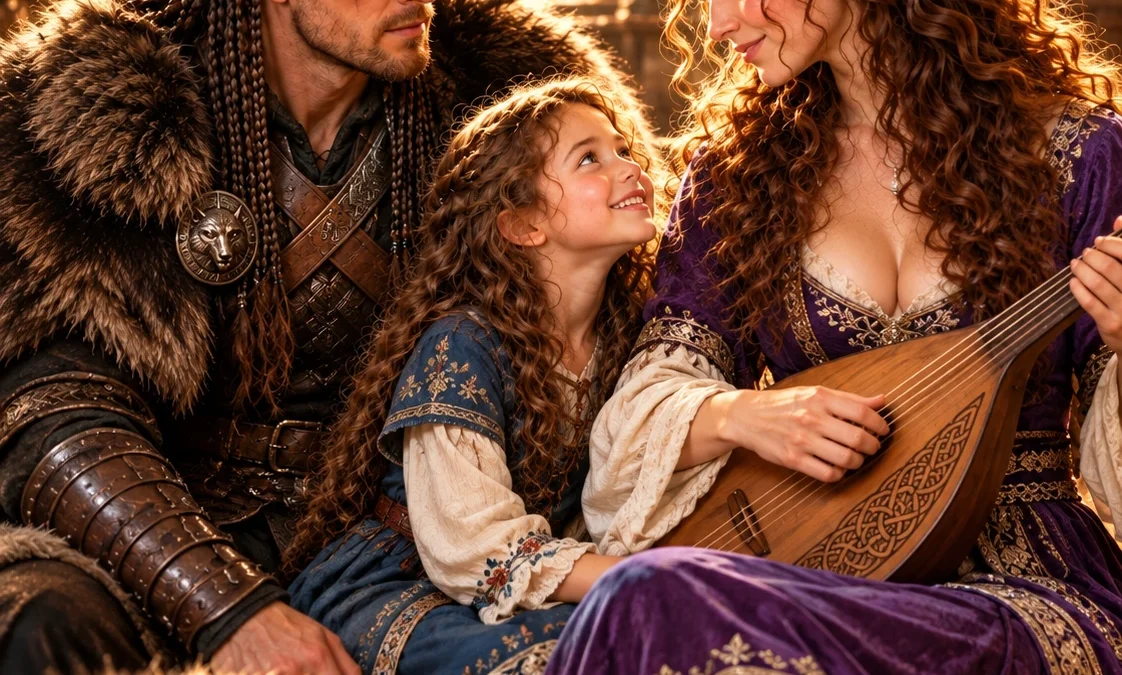
“MOMMY, PLAY OUR SONG,” THE LITTLE GIRL SAID IN A FREEZING MARKET SQUARE. THE LYCAN KING FROZE, BECAUSE NO ONE ALIVE SHOULD HAVE KNOWN THAT SONG… AND THEN THE CHANCELLOR SAID HER NAME 😱🎶🐺
Part 1
“Mommy, play our song.”
Willa’s fingers stopped on the strings.
All around her, the market square of Holland’s Crossing was folding itself away from the cold. Merchants dragged stiff canvas over their stalls. A carter swore at a mule that refused to move. Snow fell in thin, stinging flakes, as it had since dawn, and in the tin cup at Willa’s feet lay exactly three coppers.
A loaf of barley bread cost two. A bundle of firewood cost four.
“Not that one, sweetheart,” she said, and her breath smoked in the air. “Let me play the lark song instead. You like the lark song.”
“I like our song.”
Lily sat on an upturned barrel with her knees pulled to her chest and a borrowed cloak wrapped up to her chin. On her head was the paper crown she had folded herself from the back of a flour sack, now limp with damp. Her nose was red. Her dark eyes were very serious.
“The lark song is for everybody. Our song is just for us.”
Willa looked at her daughter, and something in her chest gave way. She was thirty-seven years old, and for sixteen years she had never played that song where another soul could hear it. She had hummed it into a pillow. She had whispered it over a cradle. Never in daylight. Never in a crowd. It belonged to another life, to a stone keep in the mountains and a winter when she had been twenty-one and foolish enough to believe a kitchen girl could be loved by a prince.
But Lily’s lips had a bluish tint. The innkeeper had turned them out of the stable loft that morning, when the last of their coin went to the apothecary for cough syrup. A sad song made strangers open their purses. That was all. It was only a song.
“Just once,” Willa said softly. “And then we buy bread.”
Lily’s whole face lit up.
Willa settled the lyre against her hip. The old wood was worn smooth as river stone, and along its curve, someone long ago had carved a small wolf’s head beneath a crescent moon. She did not look at the carving. She never did.
She began to play. The melody was simple and aching, a few slow notes that climbed like a candle flame and fell back. Her curly hair, the color of autumn bracken, escaped its scarf and blew across her cold cheeks. Her voice came out rough from the weather, but it found the old shape of the words as if it had been waiting.
Light a lantern on the bridge. Leave it burning through the snow. If the night should keep us parted, it will tell you where to go. 🎶
A carter stopped with his hand on the mule’s bridle. A baker’s wife paused in her doorway. Two children stopped throwing snow at each other. The market went quiet in widening rings, the way a pond goes still after a stone.
Lily rested her chin on her knees and mouthed every word. Willa sang the second verse, and the third. She kept her eyes on the strings. She did not see the crowd begin to part.
She did not hear the iron-shod hooves on the frozen road until they were very close, and the horns sounded long and deep from the north gate. Her hands went cold in a way that had nothing to do with winter.
Banners came through the gate. Black wool stitched with a silver wolf running over a mountain ridge. Behind them rode a column of guards in dark leather and iron, and the people of Holland’s Crossing dropped to their knees in the slush.
She had known the king’s winter progress would pass through. She had meant to be gone by noon.
Run, she told herself. Take Lily and run.
But her fingers kept playing. Sixteen years of habit held them to the strings, and the last verse was coming. The verse she had never once sung aloud.
Where the cold wind meets the mountain, where the broken roads all end…
A black warhorse stopped ten paces away.
She looked up. He sat in the saddle like a figure carved from the mountain itself. His dark gold hair was woven into long braids that hung past his collarbones. A short beard covered a jaw she remembered clean-shaven. A thin pale scar ran across a cheekbone that had been smooth when she last saw it. His eyes were the gray-blue of a winter river, and they were fixed on her. They did not blink.
The song died in her throat.
Dominic of Highfell, the Lycan king, ruler of the northern mountains and every wolf-blooded clan within them, sat motionless on his horse. The color had drained from his face. His lips moved once without sound, as if he were afraid any noise might break something.
Then, in a voice she would have known in the dark, in a crowd, at the bottom of a well, he finished the line she had not dared to sing.
“Where you are, there is my home.”
Willa could not move. Those were his words. He had added that last line himself one night in a cold music hall, laughing at his own bad poetry. Nobody else alive knew them.
He swung down from the saddle. His guard stirred. Dominic walked through the slush toward her as if the square were empty, as if sixteen years were a few steps wide.
“Willa,” he said.
She had not heard her name in that voice since she was twenty-one.
A small hand tugged her sleeve. Lily, wide-eyed, paper crown crooked, whispered loud enough for the whole silent square.
“Mommy, that man knows our song.” 😳
Part 2
“Mommy, that man knows our song.”
Kale had served the Lycan king for fifteen winters, and in all that time he had never seen Dominic dismount in the middle of a road. Kings did not do that. Kings sat above the crowd on tall horses and let the crowd look up. Yet there stood Dominic in the churned snow, head bare, fur mantle sliding from one shoulder, staring at a thin woman with a battered lyre as though she were a ghost walked up out of the ground.
Kale moved his gray horse to the king’s shoulder. “Majesty, the Winter Council gathers in three days. The gamma lords are already in Highfell. We cannot stand in a market square while a stranger…”
“I know what you say.” Dominic did not turn his head. His voice was scraped raw. “She rides with us. Both of them. They are guests of the keep, not prisoners. Anyone who lays a hand on them answers to me.”
The little girl stood in front of her mother with her chin up and a paper crown on her head. “Are you the king?”
Dominic crouched in the snow. Kale nearly choked. The king of the north, on one knee in a market square, level with a six-year-old.
“I am. You look cold.”
She studied him gravely. “Mommy says sad people are usually just cold underneath.”
Something moved across the king’s face that Kale had never seen there. Without a word, Dominic unclasped his heavy fur mantle and wrapped it around the child until she vanished into it up to her nose. The girl giggled. The crowd made a soft, stunned sound.
“What is your name?”
“Lily. What is yours?”
“Dominic.”
“That is a nice name. This is a very good cloak.”
The woman’s hand closed on the child’s shoulder, her knuckles whitening. Kale saw her look up at the king over the little girl’s head, and he saw what passed between them, and he liked none of it. Whatever this was, it had started long before today.
Every man in the keep knew the old story, though none dared speak it where the king might hear. Sixteen years ago, when Dominic was a prince, there had been a girl. A servant, some said. A musician, said others. She had vanished in the first snow of that winter, and the young prince, who had laughed easily before, had never laughed the same way again. Each winter on the night of the first snowfall, he rode out alone to the moonstone bridge and came back at dawn with frost in his beard and nothing to say.
Kale had always assumed the girl was a story the keep told itself to explain a lonely king.
Now the story stood in the slush in a mended dress, holding a lyre.
They rode out within the quarter hour, the woman and child in the supply wagon with a heavy blanket and a skin of spiced water. Kale rode beside it himself. He told the guards it was a courtesy. It was not.
“You are a long way from home, I think.”
“Home is wherever the coppers are.” Her voice was careful, a voice that had practiced answering questions. “I mended clothes. Washed linen. Played for supper when there was nothing else.”
“And the king’s song?”
“A traveling singer taught it to me years ago.”
She said it too quickly. Then she met his eyes and saw that he knew, and lifted her chin as if daring him to say so.
Kale looked at the lyre. The wolf’s head and crescent moon were not the work of a market hawker. The moon was set in the old style of the royal craftsmen at Highfell.
“I do not know who you are, lady,” he said plainly. “In three days, a dozen lords will look for any weakness in their king. A woman who appears out of the snow singing a song no stranger should know is a weakness with a pretty face. If you mean him harm, I will know it before you do.”
Her eyes flashed. “If I meant him harm, commander, I would not have been singing for three coppers in a market square. I did not ask to be found. I would have given a great deal not to be.”
That, Kale noted, rang true.
Highfell Keep rose out of the dusk like a wolf’s jaw. At the top of the broad steps, hands folded inside the sleeves of his charcoal robe, waited Chancellor Creswell: sixty-one, heavyset, silver-bearded, a flat silver medallion hanging from the chain across his chest. He had been the old alpha’s counselor before he was Dominic’s. Kale had always found him patient, competent, and a little too smooth, like a stone worn by water.
“Majesty. The keep rejoices at your return. And you bring guests.”
Dominic was lifting the sleeping child out of the wagon himself, with a careful clumsiness, as if she were made of glass. The woman climbed down after him and stood stiffly in the torchlight. Creswell’s gaze moved to her.
For half a heartbeat, he said nothing. Then his round face broke into a soft, sorrowful smile.
“Willa of the South Kitchens. Sixteen years, and I would know you anywhere.” A pause. “They said you had died in the snow.”
Willa went white.
Kale stood very still, and a cold finger ran down his spine. He had been at the king’s side in the square. He had heard every word. Dominic had spoken her name once, quietly. No rider had gone ahead. No messenger had reached the keep before them.
Nobody had told Creswell who the woman was.
And the chancellor’s face, in that first half-heartbeat, had held no surprise at all. 😨
The room they gave her was warmer than any she had slept in for sixteen years, and she hated it. When Lily finally slept, Willa sat on the edge of the bed with the lyre across her knees. Run, said the sensible voice. Wait until the keep sleeps. She had been running for sixteen years. She was so very tired.
A knock came, soft. She knew who it was before she opened it.
Dominic stood alone in the corridor, in a plain dark shirt, braids tied back. There were lines at the corners of his eyes that had not been there before. “I had sixteen years to prepare what to say, and it seems I used none of them.”
They stood on either side of the fire like two people on opposite banks of a river.
“I waited on the moonstone bridge the night of the first snow, as we promised. At dawn, a page found me with a letter.”
“What letter?”
Willa stared at him. He looked truly bewildered, and that was worse than anger. Wordlessly, she knelt by the lyre case, ran her thumb along an unpicked seam, and drew out a square of parchment, soft as cloth from years of handling. Her hand shook as she held it out.
He read it. The fire popped.
Willa, the crown cannot kneel to a kitchen girl, and I will not pretend it can. I was a boy, and I played at being something else. Take the enclosed coin, go south, and do not speak of what was between us. Forget me. D.
The seal beneath the words was black wax, a snarling wolf within a circle of mountains. His seal.
“I did not write this.”
“It is your hand.”
“It is very nearly my hand.” His thumb passed across the letters. “The stroke on the W. I never loop it like that. And I would never have written kitchen girl. Not to you. Not once.”
“I believed it.” Her voice finally broke. “That is the part I cannot forgive. Not you. Myself. I thought, of course, of course he would. I took the coin and I never once asked whether you might have been lied to as well.”
“I would have believed it too.” His gray-blue eyes were wet. “If it had come from you, I would have believed it in a heartbeat. I was twenty-two, and I had never been chosen by anyone who was not forced to love me.”
He took a step toward her and lifted a hand, half reaching. Then it stopped in the air, as though he had remembered sixteen years had built a wall there and he had no right to lay a hand against it. He let it fall. That small restrained movement almost undid her. The boy she had known would have crossed the room in a heartbeat. This man had learned to wait.
Dominic’s gaze went to the sleeping child. “She is six.”
“Yes.”
“Willa, I will not make demands of you. But I must ask. Is she mine?”
“No.”
His shoulders loosened, and she could not tell if it was relief or grief. “Six winters ago, I heard crying in the snow beside the road in the north hills. A cart had overturned. There was only a baby in a blanket. I looked for her family for a month. No one came.” She drew out a small folded square of faded gray wool. “All I have is the blanket.”
He took it. Along one hem ran a pattern woven in faded silver thread: a wolf, a mountain ridge.
Dominic did not breathe. “This is the weave of my sister’s household.” His fingers trembled. “Avalene wove this pattern herself for each of her children. She had an infant daughter. They went to the winter lodge in the eastern pass six years ago, and there was a fire. They told me there was nothing to bury. I have lit a candle for them every winter.”
Willa pressed her hand to her mouth.
Dominic looked at the sleeping child. Then at the blanket. Then slowly, as if the floor might open beneath him, at Willa.
“Someone has been lying to us for a very long time.”
The door rattled with a hard knock. Kale stood in the corridor, snow still on his shoulders, face grim as stone.
“Forgive me, Majesty. The chancellor has summoned the elders before dawn. He says the woman is a thief. That she stole the alpha’s seal sixteen years ago and fled the keep with it.” He drew a slow breath. “And he says he has a witness who will swear to it.”
Part 3
The great hall of Highfell Keep had been built to make people feel small, and before dawn, lit only by iron braziers, it did its work well. Willa walked the length of it with her back straight and her hands folded, wearing the same mustard wool dress she had arrived in, because it was the only dress she owned.
Twelve elders sat on a long bench of dark oak. At their center sat a lean old man of sixty-eight with calm gray eyes and a worn brown satchel at his feet. Oswin. When she had been a kitchen girl, she had once seen him quiet an entire hall of shouting lords by lifting one finger.
Dominic sat on a raised seat to one side, with no crown, hands flat on the arms of the chair as if holding it down. At the foot of the dais stood Chancellor Creswell.
“I take no joy in this, elders,” he said gently, almost sorrowfully. “Sixteen years ago, the alpha’s private seal ring vanished from the prince’s locked study. That same night, a kitchen girl named Willa disappeared from the keep. I judged it wiser to say nothing. That was a failure of my duty. Yesterday she returned, and the king himself rode down to meet her. I must ask what she wants.”
“I say the dungeon,” said a fair-haired gamma commander named Rand, “until she has explained herself.”
“The dungeon is for those found guilty,” said Oswin mildly. “Chancellor, you spoke of a witness.”
“Master Omar.”
A small, stooped man came forward from the shadows, thin white hair, a leather apron over his robe, wire-framed spectacles on a thin nose. His hands shook. Willa knew him at once. For two years, when she was scrubbing pots in the south kitchen, the chancellor’s old scribe had left a honey cake wrapped in linen on the back step every fifth day. He had never once looked her in the eye. She had believed him shy.
“On the night the seal went missing, I saw the girl come out of the prince’s study,” Omar said in a dry thread of a voice. “Her hand closed tight. I saw the ring in her fist.”
Her heart began to pound. She stepped forward before anyone could stop her. “Elders, may I ask him a question?” To the old scribe, her voice astonishingly steady: “Master Omar, you left a honey cake for me on the kitchen step every week for two winters. Why?”
Silence.
“That is not…”
“I thought you were shy,” said Willa gently. “Now I think you were sorry for something. You never told me for what.”
“The woman is trying to unsettle an old man,” said Creswell, smooth and cold.
“The woman is asking a plain question,” said Oswin, not looking away from the scribe.
Sweat stood on Omar’s forehead in the cold hall. For one frozen moment, Willa thought he would break.
“I was mistaken in nothing,” he said hoarsely. “I saw the ring.” He shuffled back into the shadows, and as he went, she saw him glance once at the chancellor’s face, the way a dog glances at a raised hand. 😔
Oswin let out a long breath. “I will not condemn a woman on the word of a single witness whose own conscience seems troubled. Willa of the South Kitchens, you will remain in the guest tower under the guard of Commander Kale. You have three days to prove your innocence.”
“There is also the matter of the child,” Creswell said so smoothly that it took Willa a moment to hear it. “For her own safety, I would ask the elders to place the girl in their ward in the west tower. The mother may visit.”
“No.”
The word did not come from Willa. Dominic was on his feet. The old law said the king sat silent. He stood now with his hands clenched, firelight carving hard lines in his scarred face.
“I will not speak to the matter of the seal. But the child is a guest of my household, and no hand will take her from her mother’s side while she sleeps beneath my roof. That is not a judgment. It is a king’s right over his own hearth.”
Oswin looked at him a long time. Then, very faintly, the corner of his mouth moved. “The elders do not dispute it.”
As Kale moved to lead her out, the chancellor passed so close that his robe brushed her skirt. He did not look at her. He only spoke in a murmur so soft that no one else could hear.
“Sixteen years ago, girl, I let you walk away alive. Do not mistake that for weakness.”
Willa understood then that the letter had never been a mistake. It had been a mercy, the kind a knife gives when it decides not to cut. 🥶
Kale found Garrick of the outer stables shoeing a gray mare. A lean man of forty-four with a crooked nose. “Sixteen years, and I wondered when someone would ask.”
The prince had given him a sealed note for a girl with a lantern on the bridge. At the lower gate, the chancellor’s clerk had caught him by the sleeve. “Said the girl had already gone. Put a purse in my hand heavier than a groom’s wages for a year, and an order of dismissal. I was twenty-eight and poor. I took it.” His eyes met Kale’s. “Old man, thin, stooped, little glasses on a wire. Master Omar. He cried the whole time he gave me the purse.”
Kale thought of the witness in the great hall, shaking, glancing at his master. He did not need to ask who had given Omar his orders. Creswell had taught Kale his letters when he was nine years old and sleeping in stable straw with a split lip. Creswell had put a cup of warm milk in his hands and watched over him ever since.
When he came back up to the guest tower, he found Willa on the rug with Lily in her lap, both bent over a sheet of rough paper. Lily was drawing a sad wolf. “And me and the king, because he is sad, too.” She held up the drawing to Kale. “This is you. You are the one who stands by the door. Mommy says you are cross because you are worried.”
For the first time in more days than he could count, Kale laughed.
Then Lana, the handmaid, burst in, white-faced. “Commander, the elders’ messenger came. He said the child was to go to the west tower at once, by the elders’ own seal. I did not think I should refuse the seal. I thought you knew.”
The rug before the fire was empty. On the floor lay a drawing of a sad wolf. 💔
Willa did not remember crossing the courtyard. She remembered running, the lyre left behind, her red sash flying loose, her own voice repeating a single word until it became a prayer. Lily. Lily. Lily.
The west tower stood alone at the far end of the keep, a round old bell tower with narrow windows set high like closed eyes. Two guards crossed their halberds. “The elders’ ward is closed.”
“My daughter is inside.”
“Show me the order.”
Dominic had arrived with the wind tearing at his braids. He took the rolled parchment and held it out to Kale, who studied the seal for a heartbeat. “The elders’ ring has a chipped edge, Majesty. Every document he seals bears a tiny flat place on the left. This one is smooth. This is a forgery.”
The younger guard turned the color of milk.
“Open the door.”
On the first landing, a stocky woman in a charcoal dress with a ring of keys at her belt was waiting. Orla, the head housekeeper. “I put her in the highest room. It has a fire. She has eaten. But the door is barred from the outside, and the key is not on my ring.”
Someone had meant this to be a locked door and a mother who could do nothing but hammer on stone.
Then Willa did something that came from a place deeper than thought. She sang. Her voice shook. But the old words came, climbing the curving stair like a candle’s light up a wall.
Light a lantern on the bridge. Leave it burning through the snow. If the night should keep us parted, it will tell you where to go.
Nothing answered. She sang it again, and her voice began to break.
Then, from far above, thin as a thread of smoke and sweet as honey, a small voice joined her.
If the night should keep us parted…
“Fourth floor,” said Dominic, his voice thick. “She is on the fourth floor.”
They climbed, her daughter’s voice guiding them from stone to stone. At the fourth landing was a narrow door bolted from outside with a heavy iron bar. Kale lifted it. Lily sat on a cot in a warm room with her crumpled gray blanket in her arms and her cheeks streaked with tears.
“I knew you would hear,” she said, and burst into tears.
Willa crossed the room on her knees. She held her daughter and rocked her and said nothing, because there was no word large enough. 🥹
When she looked up, Dominic stood in the doorway, his face bare in a way she had not seen in sixteen years. “May I?” He knelt beside them and rested one hand over Lily’s tangled hair.
“The man was not nice. He said I should not sing. I sang anyway.”
“That was brave,” said the Lycan king, his voice trembling. “That was the bravest thing I have ever heard.”
“Are you still sad?”
“A little.” He closed his eyes. “Less now.”
Lily held out the gray blanket. “You can hold it if you want. It helps.”
He took it. Their hands found each other on the dusty floor, just for a moment. His palm was warm and rough and unsteady around hers, and she let it stay.
That night, a knock came at the king’s study. On the threshold stood a stooped old man in a hooded robe, snow clinging to his hair, a leather ledger rattling against his chest. “Majesty. I have come to confess, please, before he finds me gone.”
Omar sank to his knees. “I wrote it. The letter, sixteen years ago. In your hand, Majesty. The chancellor gave me the pattern and the ring and told me it was for the good of the realm. I gave the girl honey cakes because I could not bear to look at her face. I lied to the elders this morning because I am a coward. But when I saw the false seal he had me press…” He lifted a face silvered with tears. “And the worst of it, Majesty, is the fire.”
Dominic went completely still.
“The fire in the Eastern Lodge. Six years ago, I wrote the report. The chancellor told me what to put in it. That Princess Avalene and her infant daughter died in the night.” He pressed his forehead to the floor. “Nothing was found because nobody was there to find. The princess did not die in that fire. I saw a letter in the chancellor’s hand not six months ago. It was in her writing.”
In the silence, the fire cracked, and across the room, Willa’s arms tightened around the sleeping child.
“She is alive,” said Dominic, and the words broke in the middle. “My sister is alive.” 😭
He rode through the night to the eastern pass, with Kale on his gray and Garrick on the old mare. Six winters he had lit a candle for her. Now, with wind in his face, he found his cheeks were wet. Leaving Willa had been the hardest part. She had stood in the doorway with Lily wrapped in the fur mantle, and said only, “Go. Bring her home.” I will come back to you, he had said. And she had answered very quietly: You always came back to the bridge.
The Eastern Lodge had been rebuilt, with a slate roof and smoke curling from one tall chimney. Kale walked out alone into the open snow with his hands held wide. “The king is behind me. Tell me honestly, has anyone ever told you why a princess of the blood is kept behind a barred gate under a false name while her brother mourns her?”
The younger guard lowered his blade. “We were told she was mad, commander.”
“Her family,” said Dominic, stepping out of the trees, “has been grieving her for six years.”
The sword fell into the snow.
In a small room at the top of the lodge, behind a barred window, a woman stood in a plain gray dress with a long dark braid, thinner than he remembered. When she turned, her dark eyes were wary. For a moment, she did not seem to see him at all. Then she did.
“Dom,” whispered Avalene.
He did not remember crossing the room. He remembered only that his arms closed around her, and that her thin hands gripped the back of his tunic, and that neither of them spoke for a long time.
“They told me you had sent me away,” she said at last, her voice a broken thread. “They told me my daughter was dead.”
He took her face in both his hands. “Avalene. Listen very carefully. Your daughter lives.”
Her knees gave. He lowered her gently onto the bed.
“She is six years old. She has your dark hair and your stubbornness. She wears a paper crown and sings like a lark. She was found in the snow, and a woman named Willa took her in and raised her as her own. She found a silver L stitched into the corner of the blanket.”
“Liliana,” Avalene breathed, laughing and weeping at once. “I named her Liliana. I embroidered that blanket myself the last week before she was born.”
The Lycan king knelt on the cold floor, snow melting in his braids, and bowed his head against his sister’s knee. “Come home. She is waiting.” 💞
On the third morning, the snow stopped, and the sky above Highfell turned a hard, brilliant blue. In the great hall, every gamma lord of the north sat in rows beneath their banners. Chancellor Creswell stood at the foot of the dais, calm as a mountain.
“My lords, for sixteen years the king has carried a private sorrow that has dulled his judgment. And now a woman of no name has appeared to feed it. I ask only that the crown be guarded for a season by a steady hand.”
“And which hand?” asked Rand.
The chancellor smiled with great gentleness. “I would only serve.”
The doors opened. Dominic walked in alone. “I have been absent two days, and I beg the council’s pardon. I was seeing to a debt.” He raised his hand. “I ask leave to bring witnesses.”
Kale entered with Garrick, with a stooped old man in a worn robe, with Orla and her keys, and last of all, a hooded woman in a gray cloak.
Omar laid his ledger on the floor and sank to his knees. “I forged the letter. Sixteen years ago, in the king’s hand. I forged the elders’ seal two days ago to take a child from her mother. Every page of this ledger records what the chancellor commanded me to do.”
“A lie!” Creswell’s voice rose, ringing. “The old man is raving!”
“Chancellor.” Kale stepped forward, scarred chin lifted. “The thumb that pressed that seal was not the elders’ thumb.”
Creswell turned to him, and for the first time Willa saw the smooth mask slip. “I raised you.”
“You did. And I am ashamed of it. That is why I have come to say this to your face.” With a gentleness that made Willa’s chest ache, Kale lifted the silver chain of office from the chancellor’s shoulders.
Creswell did not resist. “It does not matter,” he said softly. “The king has still brought a stranger to the throne’s side and a child with no name, and the council will ask who she is. You cannot answer that. Only I…”
“I can.”
The hooded woman stepped forward. She pushed back her hood, and a long dark braid fell over her shoulder, and her pale face turned toward the lords, dark eyes full of tears and fire.
An old gamma lord rose slowly to his feet. “Princess Avalene.”
“I am she. I did not die in the eastern lodge. I was taken from it by this man and kept six years behind a barred gate because I would not sign my brother’s realm into his hands.” Her eyes found the small girl in a paper crown at Willa’s side. “And that is my daughter.” 👑
Lily looked up. “Mommy?”
“It is all right, sweetheart,” said Willa, her voice shaking, kneeling on the stones. “I think she is someone who has been looking for you for a very long time.”
Slowly, with great seriousness, Lily walked across the hall. The lords and elders parted for her. She stopped in front of Avalene and put her head on one side.
“Are you my other mommy?”
Avalene went to her knees. “I think I am.”
“I have a blanket with a wolf on it. Mommy says someone made it for me with love.”
“I did, my darling,” Avalene whispered. “I made it for you.”
Lily considered this. Then she lifted her small arms and put them around her mother’s neck. No one in the hall spoke. Rand had turned his face aside, his throat working. Old Oswin was pressing the heel of his hand beneath his eyes.
One by one, without being asked, the gamma lords rose and put their right hands over their hearts. Creswell stood alone in the middle of the floor with the chain gone from his chest, and nobody looked at him.
“My lords,” said Dominic, with plain, tired honesty. “I failed my sister. I failed a woman I loved because I looked at my own grief and did not look at the walls around me. If the council judges a king who was blind for sixteen years unfit to wear the crown, I will lay it down this hour.”
Rand rose, pale eyes bright. “A blind man does not ride two nights through a mountain pass to bring his sister home. The North has a king, Majesty. Sit down.”
A rumble of agreement rolled through the hall. Dominic, who had faced armies without a tremor, bowed his head.
Creswell was not put to the sword. He was stripped of every title and sent beyond the northern ice wall to a stone hermitage by the frozen sea, with a single servant and a single blanket, never to cross the mountains again. Omar was sentenced to teach the children of the border villages to read and write, so that his hand would never again put a name to a lie. Garrick was restored to his post with sixteen years of wages owed him. Every charge against the woman called Willa was struck from the record. ⚖️
The moonstone bridge arched over a frozen stream at the edge of the keep’s old garden, a narrow span of pale stone with snow deep on its parapet. The sun was going down behind the black mountains, and the sky had turned to apricot and violet.
“I stood here sixteen years ago,” Willa said, looking down at the ice. “I held a lantern. I thought if it burned long enough, you would come.”
“I stood here for three nights. And every winter since, on the night of the first snow. Not because I thought you would come. Because I could not stop myself.”
She turned to face him. An older man, a tired man, with a scar on his cheek and her song still in his eyes.
“I am not the girl I was. I have a child. I have lines on my face. I have been poor and afraid and angry.”
“I did not ask for the girl you were.” He took her hands. His were rough and warm and not quite steady. “I cannot give you back the sixteen years. I can only ask you to stay. To let me earn what I lost. To let me be, if you will have it, the man who stands beside you instead of the king who waits at the bridge.”
She searched his face and found nothing hidden there at all.
“Dominic,” she said, her voice breaking into something that was almost a laugh. “I came back to the bridge. I think I have been coming back for sixteen years.”
He bent his head and kissed her, briefly and gently, the way a man touches something he has been afraid to believe in. His forehead rested against hers.
Far below in the keep, someone had lit the lanterns along the garden wall. One by one, they bloomed gold in the dusk, like a promise answered. 🏮
Spring came late to Highfell that year, but when it came, it came all at once. The great hall filled with sunlight, long tables heaped with bread and roasted fowl and bowls of spring greens. Orla had somehow been persuaded to sit down. Garrick, in a clean coat, looked as if he did not know what to do with his hands. Kale and Rand laughed together near the hearth, two grim warriors who had discovered a shared love of terrible jokes. Master Omar sat at a quiet table with a pile of slates and a group of small, ink-stained children from the border villages. When he caught Willa’s eye, he bowed his head very gravely. She smiled and nodded back. The honey cakes, she thought, had been forgiven long ago.
“Mommy,” said Lily, arriving with Avalene by the hand. “Uncle Dom says I can have a real crown now. But I told him I want to keep the paper one too. And I have two mommies now. Is that allowed?”
“It is allowed,” said Avalene, her voice catching. “I am your mother, and Willa is your mother. We are both very lucky.”
Lily nodded as if a serious question had been settled. Then she looked at the lyre resting on its stand beside the hearth.
“Mommy, will you play our song?”
The hall had grown quiet without anyone asking it to. Willa felt the eyes on her, kind eyes, familiar eyes. And across the length of the hall, at the high seat in his plain green tunic, with a thin circlet of silver on his brow that he had agreed to wear for exactly one day, stood Dominic.
Sixteen years of silence lay behind that song. She crossed the floor and lifted the lyre. The old wood was warm from the sun. Beneath her thumb, the small wolf’s head and crescent moon felt like a hand clasp.
And for the first time in her life, Willa played it without fear.
Light a lantern on the bridge. Leave it burning through the snow. If the night should keep us parted, it will tell you where to go.
Lily sang with her, small and bright and off-key. Avalene sang. Lana, Orla, and Garrick, who knew only the tune, hummed it. Rand and Kale, with a self-conscious glance at each other, joined in the low notes. By the second verse, half the great hall was singing, the old keep ringing from floor to rafters with a melody that had once belonged to only two people.
She came to the last verse, and her voice slowed. She looked across the hall at the man who had once sat on a horse in a snowy square and found himself unable to move.
Where the cold wind meets the mountain, where the broken roads all end…
He did not wait for her to finish. He sang the last line himself, in his low, rough voice, across the whole length of the hall, and she heard it as clearly as if he had spoken it in her ear.
“Where you are, there is my home.” 🥹
The hall went still. Then someone began to clap, and it spread, and the sound rolled up to the beams like warm rain. Lily threw herself against Willa’s skirts. Dominic reached them across the floor, and Avalene’s hand found his shoulder, and for a moment, the four of them stood together in the light. A family made of old wounds and long roads and one stubborn song.
That night, a small paper crown was set on a mantle above a banked fire, where it would stay for many years. Beside it lay a worn gray blanket with a silver wolf along its hem, and a wooden lyre. On the floor below, in the fading amber light, a sleeping child lay between her mothers with a king’s cloak drawn over all three of them.
Out beyond the garden wall, on the old stone bridge, a single lantern burned against the dark. It did not burn for anyone who was lost. It only burned, as it would burn for all the winters to come, to say that someone had been found. 🏮🐺
THE END
This story is entirely fictional and created for entertainment purposes only. It does not represent any organization or individual, nor does it encourage inappropriate behavior. The content was generated with AI assistance.








