My Alpha Brought His Mistress to Our Granddaughter’s Naming and Told Me to Give Her My Chair… Then Our Daughter Whispered Three Words That Silenced the Entire Pack
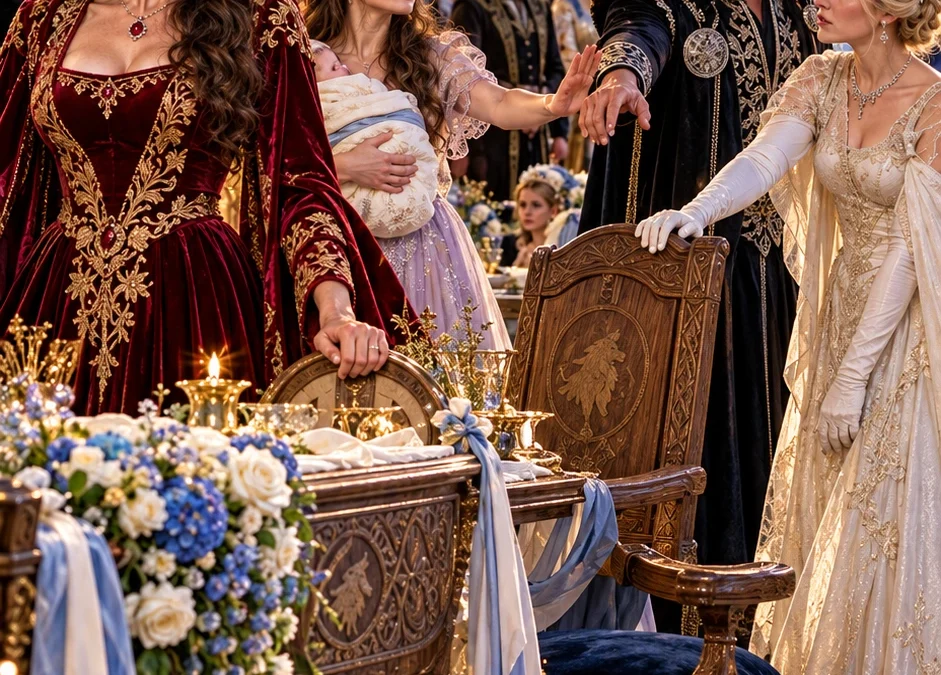
My Alpha Brought His Mistress to Our Granddaughter’s Naming and Told Me to Give Her My Chair… Then Our Daughter Whispered Three Words That Silenced the Entire Pack 😱🔔
Part 1
My husband brought his mistress to our granddaughter’s naming ceremony and asked me to give her my chair.
“Marin, Celia will stand as Luna today,” Ronan said. “It would be better if you sat with the other guests.”
I looked at the chair beside the cradle.
It was made of dark ashwood and wrapped in pale ribbons. My mother had sat in that same chair when Hazel was named. My grandmother had sat there before her. We called it the mother’s witness chair, though fathers and grandfathers had occupied it too. Its purpose was simple: a child should have someone close enough to hear her name and promise to answer when she called.
Celia Ardan rested one white-gloved hand on its back.
She was thirty-four, with shining blonde hair and a pearl brooch shaped like the moon. Last winter, she had been my husband’s diplomatic assistant. This spring, she had begun attending dinners in my place. Three weeks ago, he had announced that their mating would give Seabrier “a more modern future.”
I was forty-seven. Ronan had been my mate for twenty-five years.
Today was the first time he had brought Celia into a room where our daughter expected both her parents.
“That is not a Luna’s chair,” I said.
Ronan’s smile thinned. “We do not need a lesson in tradition.”
“Apparently, we do. It belongs to the person Hazel chooses.”
“Hazel understands the importance of appearances.”
Beyond the courtyard, the sea struck the harbor wall. The morning breeze shook the white lanterns and carried the smell of salt and baking bread. I could hear our granddaughter making small, impatient noises in her cradle. She was eight weeks old, warm and alive, and blissfully unaware that her grandfather intended to turn her naming into a political announcement.
Celia gave me an apologetic smile. “I would never dream of taking your place as grandmother. Ronan only means the pack should see us united.”
“Then why did neither of you ask Hazel?”
“Because I am asking now,” Ronan said.
The old pressure crept behind his words, the Alpha’s command I had heard in private for months. He had grown accustomed to people stepping aside before he reached the end of a sentence.
“Marin, please. Do not embarrass the family.”
A movement near the garden gate drew my eyes.
Hazel stood there with her husband Theo, her infant daughter asleep against her shoulder. She had heard enough. I could tell by the set of her jaw, that small square of determination she had inherited from me, which Ronan had always called stubbornness.
“Dad,” she said. “Take your hand off that chair.”
The nearest guests went quiet.
Ronan turned, relief spreading across his face. “Hazel, thank goodness. Tell your mother there is no need for a scene.”
Hazel came toward us. She was twenty-seven and still pale with the exhaustion of new motherhood. Theo walked beside her, carrying a folded blanket and the little silver rattle his own father had made.
“I said, take your hand off the chair.”
Celia lifted her hand at once. Ronan did not move.
“You invited me here,” he reminded her.
“I invited my father. I did not invite his mistress to take Mom’s place.”
A murmur rippled through the guests. Celia looked wounded. Ronan went rigid.
“Celia is my chosen Luna. You will show her the courtesy her position deserves.”
Hazel drew her baby closer. “I can be courteous without handing her my daughter’s family.”
“The child will be recorded under the Calder line,” Ronan said. “That carries responsibilities.”
Hazel stared at him. Then she looked at me, and seemed to make a decision that had frightened her for weeks.
“No,” she said. “That is what I came to tell you.”
Ronan’s face changed. “Our granddaughter will carry the Calder name.”
In the hush that followed, the baby’s eyes opened. She made a small, offended sound, as if even she had a complaint to lodge.
Hazel kissed her forehead.
“Her name is Ren Abby Bell,” she said. “And Mom is going to sit beside her.”
Ronan looked at me as though I had stolen something from him. I had not said a single word. But for the first time in months, I understood that my daughter had seen everything.
And then Ronan did something I never expected.
He lowered his voice, leaned toward Hazel, and whispered a threat so quiet that only the three of us could hear it, a threat about Theo’s job, Theo’s house, and everything her new little family depended on.
I watched my daughter’s face go white.
And then, to my astonishment, I watched her smile.
👉 Part 2 is waiting in the comments! Can’t find it? Leave any word below and I’ll send it to you privately. 🔥
Part 2
Hazel’s smile was not the smile of a frightened woman.
“Dad,” she said softly, “I know about the offer.”
Ronan blinked.
“The harbor position. The house. The seat on the trade committee.” She shifted Ren on her shoulder. “You called Theo to buy my daughter’s naming. He told you her cradle was not a bargaining table.”
Ronan said nothing. Beside her, Theo stood very straight, a quiet man who once apologized to a door after walking into it.
“I did not come here to fight you,” Hazel went on. “I waited weeks to be sure. I needed to know I would still choose this name on a day I was not angry.”
She had.
I could hardly breathe.
The bell name came from a lighthouse that no longer stood. My grandmother told me that her grandmother had kept a lantern burning on the cliffs when storms swallowed the coastal paths. She held no rank, but fishermen followed her light home. When the lighthouse collapsed, our family hung its brass bell outside the cottage, and travelers began calling us the bell women.
When Ronan met me, none of that mattered. I was twenty-two, an apprentice healer who taught young wolves to cross tidal flats when the moon vanished behind clouds. He was twenty-five, the newly appointed captain of the harbor guard, with a crooked smile and a habit of arguing with me while I bandaged his hands.
At our mating, my mother rang the old bell. The sound floated across the water and brought a dozen curious seals to the rocks below the chapel. Ronan laughed and kissed my forehead. He promised that our children would hear stories from both families.
When Hazel was born, he cried. She can be anything, he whispered.
For years, he meant it.
But somewhere along the road to becoming Alpha, he began calling my family kind but sentimental. He began treating my questions as disloyalty. When Celia arrived, she praised his speeches and called my doubts divisive, and Ronan decided I was no longer necessary.
“I want someone who believes in me,” he told me one night.
“I have believed in you for twenty-five years,” I said. “But believing in you is not the same as pretending you are always right.”
He left our bedroom that night and did not return.
Now he stood in a courtyard full of white lanterns, looking at the daughter he had taught never to choose between her families, who had finally chosen.
“If you enter her under Bell,” he said stiffly, “you put her outside the ruling line.”
“I am not taking anything from Ren,” Hazel answered. “She can know you. She can love you. But I will not teach her that she must carry your name to deserve your affection.”
Celia stepped forward with a careful, sympathetic smile. “Perhaps we should postpone and discuss this privately.”
“We discussed it privately,” Hazel said. “Dad refused to listen.”
Iris Boon, the naming keeper, rose from the front row with the register held against her chest. She had served for nearly forty years and knew the old customs better than any living soul in Seabrier.
“Ronan can say the moon is made of butter if he likes,” she said mildly. “That does not make it law. The parents choose the child’s name. The witness confirms she is welcomed, not owned.”
A ripple of astonished whispers crossed the courtyard.
Ronan’s jaw clenched. “Iris. Surely this cannot stand.”
“The keeper records the parents’ chosen name,” Iris said. “That is our custom. If you have forgotten it, you may read the register when we are finished.”
I sat down beside the cradle. Ren’s tiny fist curled around my finger, her eyes dark and serious.
Iris lifted the register and turned to me.
“Marin Bell,” she said. “As first witness, what do you promise this child?”
My legs trembled. I wondered whether the words would come.
And then, from the back of the crowd, a sound broke the silence.
Not a murmur. Not applause.
A bell.
Soft, clear, unmistakable. The old brass bell from my mother’s porch, ringing from somewhere beyond the courtyard wall.
Every head turned. Ronan went white.
Because the bell had not been moved from my cottage in twenty years.
And someone had just carried it to Ren’s naming.
👉 Want to see what happens next? LIKE or comment “REVEAL” and Part 3 will be posted once we have enough comments! 🔥
Part 3
It was Jonas Reed.
He stood in the archway with the old brass bell in his weathered hands, looking sheepish, as though he had been caught carrying a stolen cake.
“Hazel asked me to bring it,” he said quietly. “I may have been dramatic about the timing.”
A ripple of laughter swept the courtyard, soft and surprised.
Hazel pressed her lips together to hide her own smile. Jonas was the man who repaired the storm doors at the youth shelter, a fifty-year-old carpenter covered in paint, with a slow laugh that filled a room. He had known my mother. He had heard her say that anyone who could not read the tide ought to learn the bus schedule.
He carried the bell to Iris, bowed slightly, and stepped back.
“Marin,” Iris said again. “What do you promise this child?”
I looked at Ren. Sunlight had caught the tiny gold threads in the red ribbon tied to her cradle, the one my mother had embroidered with three little bells, with tired eyes and a needle too small for her fingers.
“I promise to answer when she calls,” I said. My voice shook, then steadied. “I promise to tell her the truth about where she came from. And I promise that she will never have to earn a place beside me by being clever, strong, beautiful, or useful. She will have it because she is ours.”
Iris turned to Theo and Hazel for their promises. They spoke of patience, of shelter, of questions they would answer and mistakes they would admit.
Then Iris wrote the name into the register.
Ren Abby Bell.
Theo lifted the cloth from the carved wooden stand he had built with his own hands. Beneath it, the same name had been burned carefully into the wood. Iris rang the little brass bell once.
It was not loud. The sound rose above the courtyard and fell away toward the water.
Ren startled, then settled against Hazel’s chest.
A few guests began to clap. More followed. It was not thunderous. The moment did not require thunder.
Ronan stood at the edge of the stones, looking at the family he had expected to direct and did not know how to join.
I wished, even then, that he could simply have said her name.
The weeks after the naming were not easy.
Hazel hated the gossip. She loved her father and feared she might have hurt him beyond repair. More than once, she arrived at my cottage with Ren in her arms and asked whether she should have chosen a quieter path.
“Would you choose the same name today?” I asked.
“Yes.”
“Then perhaps you regret the hurt, not the decision.”
She considered that. “Can those be different things?”
“Usually they are.”
Theo’s work grew harder. A promised harbor contract never appeared. A supplier who had always offered fair credit suddenly demanded payment in advance. We could not prove Ronan had ordered either change, and I refused to invent motives where there was no evidence. But we could see how quickly people turned cautious when an Alpha was displeased.
Theo took smaller carpentry jobs. Hazel returned to teaching while I cared for Ren. Iris connected Theo with a coastal cooperative that needed storm shutters and boat repairs. The money was modest at first, but the cooperative ordered more after the first winter gale.
One morning, I found Hazel calculating monthly expenses beside a sleepy Ren.
“Are you frightened?” I asked.
“Sometimes. But Theo is proud of the new work, and I like teaching again. We are making something that belongs to us.”
“That sounds good.”
“It is. I just did not expect good to be so tiring.”
I laughed. “That is a fair description of most worthwhile things.”
Meanwhile, Celia tried to approach me through the healing rooms. She arrived one afternoon with a donation of expensive blankets for the youth shelter. I thanked her and asked whether the council had approved the gift without conditions.
“I am trying to help,” she said, offended.
“Then the shelter will be grateful.”
“You could make this easier for Ronan. He says you once understood what leadership costs.”
I folded one blanket and set it beside the others. “I understand that it should never cost a baby her parents’ choices.”
Her composure slipped. “I did not know he would offer Theo that position. He told me it was only a kindness. When Hazel would not accept the seating plan, he was furious. He kept saying she had embarrassed him.”
“Did you tell him you were embarrassed too?”
Celia lowered her eyes. “I suppose I did.”
“Then perhaps you should tell him how you actually feel, instead of letting him punish people on your behalf.”
She gave a brittle laugh. “He does not like being questioned.”
“I know.”
At the shelter, Jonas stayed after work to mend shelves and teach the children bicycle repair. He never demanded an explanation for my failed marriage. I began looking forward to afternoons when he arrived with a toolbox and an absurd story about something he had broken while trying to fix it.
For the first time since Ronan left, I caught myself imagining a future that did not begin with what had been taken from me.
Ronan came to Hazel’s cottage in late winter.
Hazel called me that morning. “He asked politely to see Ren. I told him he can come for half an hour if Theo is home. Do you think that is a mistake?”
“Do you feel safe having him there?”
“Yes. I just do not want another fight.”
“Then tell him the rules clearly. If he does not respect them, you can end the visit.”
A pause. “Can you come too?”
I understood what she was asking. She did not want me to argue for her. She wanted a familiar hand nearby if the conversation turned painful.
“Of course.”
Ronan arrived carrying an enormous stuffed gray wolf, nearly as large as Ren. Theo opened the door, took one look at the toy, and said, “She may have to grow into it.”
Ronan laughed awkwardly.
Ren regarded him solemnly from Theo’s lap. Ronan lowered himself into the chair opposite her and offered the wolf. She grabbed its ear.
His face softened in a way I had not seen in years.
“Hello, Ren,” he whispered.
Hazel noticed. Her shoulders eased.
For a while, the visit was ordinary. Then Ronan glanced at the wooden name plaque hanging beside the kitchen door.
Ren Abby Bell.
“That name is going to follow her all her life,” he said.
“That is usually what names do,” Hazel replied.
“Perhaps when she is older, she will want the opportunities that come with Calder.”
Theo set down his cup. I remained still.
“Are you saying you will only help Ren if we change it?” Hazel asked.
“I am saying family names have consequences. And I am saying she is my granddaughter whether she is Bell, Mercer, or Calder.”
He looked at me. “You must understand the importance of inheritance.”
“I understand that names carry history,” I said. “They do not determine who deserves love.”
Ronan pressed his lips together. Then he looked down at Ren, who was chewing the stuffed wolf’s ear with absolute concentration.
“I want to be part of her life,” he said at last.
Hazel’s voice softened. “Then be part of it. Read to her. Visit when we invite you. Learn what makes her laugh. Do not begin every conversation by telling us what we should have done.”
He looked lost. “I do not know how to be ordinary with you anymore.”
It was the most truthful thing I had heard him say in months.
Hazel’s eyes filled. “Then start small.”
He stayed another twenty minutes. He held Ren after asking permission, and when she began to cry, he handed her back without pretending he knew better than her parents. At the door, he thanked Theo for the tea.
There was no grand apology, no instant repair. But he had spoken his granddaughter’s chosen name. That was a beginning, if he wished to make something of it.
Spring returned to Seabrier. Ren learned to pull herself upright against the furniture. Theo’s work with the cooperative expanded. Hazel taught three days a week, sharing the old coastal stories with her students. At the shelter, the children named our repair room the Bell Workshop.
Ronan visited Ren occasionally, with Hazel’s permission. Sometimes he listened. Sometimes he began offering advice before anyone asked and had to be reminded that being a grandfather was not the same as being Alpha. His mistakes did not vanish, but he no longer made them my responsibility.
Our formal separation became final in early summer. I kept my cottage and my work. Ronan kept the hall. We signed the documents in a quiet room without witnesses eager for spectacle.
He asked once whether I remembered how happy we had been when Hazel was small.
“Every day,” I said.
He looked at me with sudden hope. “Then maybe…”
“No, Ronan. Remembering joy does not erase the choices that ended it.”
He lowered his head. “I wish I had listened sooner.”
“So do I.”
I meant it. I did not need to hate him to know we were finished.
On Ren’s first birthday, Hazel invited both families for cake. Ronan came without Celia, respecting Hazel’s request. There were no official seats. Ren pulled off her socks and pressed one finger into the frosting. Hazel laughed. Ronan laughed too, and I could hear that sound without mistaking it for an invitation to return.
After the candles, Hazel handed me a small parcel wrapped in brown paper. Inside was a new brass bell, cast from a fragment of the old one that had cracked during the winter. Three names were engraved around its rim.
Abby. Marin. Ren.
I touched the letters. My eyes filled.
“The old bell will stay with us,” Hazel said. “This one is for the workshop, so children know someone is waiting when they need help.”
I could not speak. I hugged her, carefully avoiding the cake she had somehow acquired on one sleeve.
Later, Jonas helped me hang the bell at the shelter door. He studied the hook and declared that even a perfect bell could not make him a better carpenter.
“It is not crooked,” I said.
He tilted his head. “We are looking at different bells.”
I laughed, and he took my hand. He did it gently, giving me time to pull away if I wished.
I did not.
“Would you like to have dinner with me tomorrow?” Jonas asked. “As friends, or whatever we are comfortable becoming. We can decide after the soup.”
“Your soup needs salt.”
“Then I shall need supervision.”
I said yes.
Before leaving the workshop, I rang the bell once. Its clear sound crossed the little courtyard, slipped between the harbor houses, and carried toward the water.
I walked home through the fading light. At Hazel’s window, Ren stood holding the sill while her father steadied her small waist. She spotted me outside and slapped both palms against the glass, her face opening into a delighted grin.
I waved back.
My husband had once believed a name was something you wore like a crown, something other people should bow before. My daughter had looked at her own child and chosen a different inheritance. Not revenge. Not a crown. A name that reminded her what love was supposed to do.
It was supposed to answer.
The best way to honor a name, I thought, was not to make other people bow to it.
It was to become someone worth calling. 🔔💙
This story is entirely fictional and created for entertainment purposes only. It does not represent any organization or individual, nor does it encourage inappropriate behavior. The content was generated with AI assistance.








