My Brother Stabbed Me at 4 A.M. While My Parents Laughed and Said, “You’re So Dramatic.” One Text Message Saved My Life.
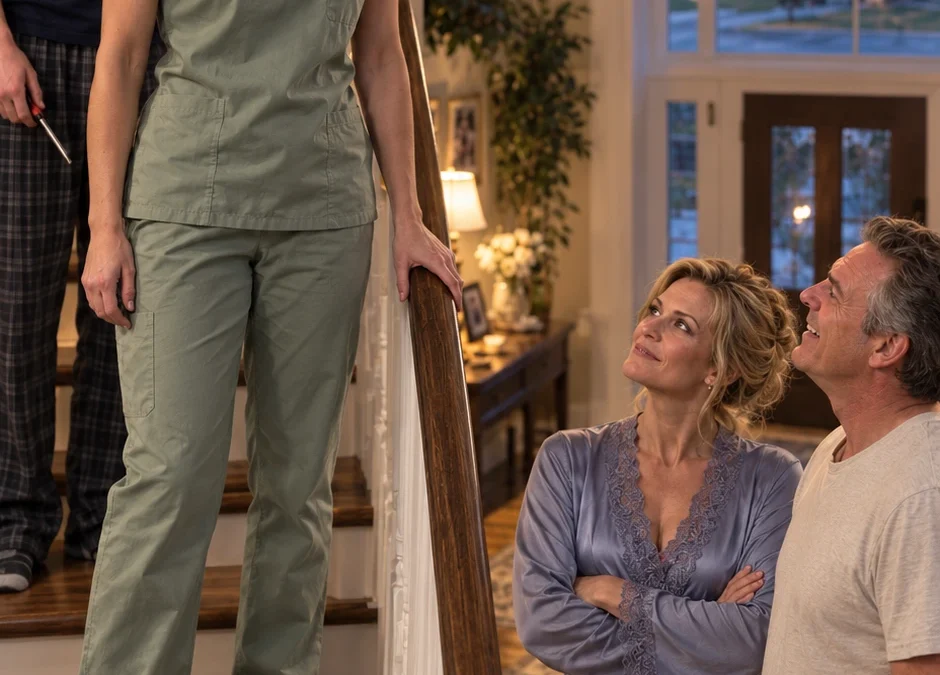
My Brother Stabbed Me at 4 A.M. While My Parents Laughed and Said, “You’re So Dramatic.” One Text Message Saved My Life.
Part 1
I asked them politely to move the party somewhere else.
That’s all I did. I had a shift at 6:00 the next morning, and there were six strangers on my couch drinking beer in the house I had bought with my own money.
My half-brother Renick leaned back against my cushions and smirked at me. He was almost a foot taller than I was.
“Relax, Marlo,” he said. “This is our house now. Mom said.”
I felt my stomach drop. “What do you mean, our house?”
He shrugged like the answer was obvious. “Family shares. You’ve always been selfish, keeping this place all to yourself.”
His friends laughed. One of them, a kid with a chipped front tooth, raised his beer at me like a toast.
My neck went hot. “You have ten minutes. After that, I’m calling the police.”
That was when Renick stood up.
He wasn’t drunk. Not really. I have thought about that a thousand times since. He knew exactly what he was doing.
He walked past me into my kitchen and opened the drawer where I keep my little household tools. The tape measure. The batteries. The small red screwdriver I used to tighten my cabinet handle.
He took it out and held it up like a curious thing he’d found.
“Go to bed, Marlo,” he said, still smiling. “Go to bed before something happens.”
I didn’t call the police.
That’s the part I hate admitting, because everyone asks why. The truth is that when your mother has spent 34 years telling you that you overreact, a small part of your brain starts to agree with her. It sits down in a chair, folds its hands, and whispers, Maybe he’s joking. Maybe you’re being dramatic.
So I went upstairs. I locked my bedroom door. I lay down on top of the covers in my scrubs, too tired to change, and listened to them laughing below me until I fell asleep.
Renick had been staying with me for 19 days.
Just two weeks, my mother had promised on the phone in March. Just until he gets back on his feet, honey. Please. He’s your brother.
In those 19 days he had eaten everything in my fridge, hosted parties until midnight, and never once locked the front door.
I woke at 4:00 in the morning to a low, humming quiet.
Then I heard my bedroom door click open.
I had locked it. I knew I had locked it. But it was one of those cheap locks you can pop open from the outside with a coin, and Renick had clearly figured that out.
He stood over my bed. The screwdriver was in his hand. His eyes were glassy, and he was breathing through his nose like a bull.
“You embarrassed me,” he whispered. “In front of my friends. You made me look small in my own house.”
I tried to sit up. I got as far as my elbows.
He brought his hand down.
What I felt wasn’t pain. Not at first. It was pressure, a hard blunt force into the top of my left shoulder, then a strange popping, then a heat that ran down my arm so fast I thought I’d knocked over a glass of water.
I looked down. My white scrub top was turning red in a circle that grew while I watched.
I screamed so loudly my throat hurt for three days.
Renick stepped back and stared at the screwdriver like he’d never seen it before.
Then he laughed.
A short, nervous, surprised laugh, like a kid who has just broken a lamp.
Downstairs, I heard footsteps and my mother’s sleepy, annoyed voice. I had forgotten she was even in the house. She’d driven over the night before to drop off Renick’s mail and stayed because it was late. My stepfather Bram was with her.
I stumbled to the top of the stairs.
My mother stood at the bottom in her nightgown, hair flat on one side. Bram was behind her in a stained white T-shirt, scratching his stomach.
“Mom,” I begged. “He stabbed me. Renick stabbed me with a screwdriver. Please call an ambulance. Please.”
She looked at my shoulder. She looked at Renick behind me, still holding the screwdriver at his side.
Then she looked at me, and she smiled.
The same tight little smile she gave me when I was seven and came to her crying because Renick had broken my toy.
“Marlo,” she sighed. “For God’s sake, you’re so dramatic. It’s a screwdriver, not a knife. Go clean yourself up and stop scaring the neighbors.”
Bram started laughing. A deep, wet laugh from the belly. A second later Renick joined in, nervous, taking his cue from them the way he always had.
My whole family stood in my house at 4:00 in the morning and laughed while blood ran down my arm and dripped off my fingertips onto the hardwood floor I had refinished myself.
Something inside me broke.
And for the first time in 34 years, it decided to stay broken.
My phone was on my nightstand. It might as well have been on the moon. My left arm wasn’t working, and my knees had begun to shake.
Shock, a calm voice in my head informed me. You are going into shock. Move.
I backed into my bedroom and dragged my dresser against the door with one arm, one screaming inch at a time.
My thumb was on the nine of my phone when that cold, clear voice spoke again.
If you call 911 right now, she’ll tell them you fell. She’ll tell them you’re on drugs. She has been rehearsing that story about you your entire life. You need proof first.
I put the phone down on my dresser, propped it against a candle, and hit record.
What I said into that lens, and the one text I sent right after, is what saved my life.
What happened next still gives me chills. Part 2 is in the comments—or leave any word below and I’ll send it to you privately.
Part 2
What happened next still gives me chills. Part 2 is in the comments—or leave any word below and I’ll send it to you privately.
“My name is Marlo Kestrel,” I whispered.
My voice sounded like someone speaking underwater.
“It’s April 15th, 2025. It’s 4:17 in the morning. My half-brother Renick Vale just stabbed me in the left shoulder with a screwdriver in my own home. My mother and my stepfather are in the house. They’re refusing to call an ambulance. They’re laughing at me. I’m bleeding. If something happens to me tonight, this video is my statement.”
I pulled my collar down. The wound was small, about the size of a pencil eraser, but the skin around it was already a color I had only ever seen on patients in the ER.
Then I opened my messages and found one name.
Yolanda. My best friend since nursing school. A labor and delivery nurse who lived four streets away, held a spare key to my house, and always, always answered her phone. Her father was a retired police lieutenant.
My fingers were slippery. I typed with one thumb.
Renick stabbed me. Screwdriver, left shoulder. Mom and Bram here laughing. Please come. Call 911. Don’t let my mom talk to them first. Front door unlocked.
Three dots appeared instantly.
On my way. Calling now. Don’t open the door for anyone but me.
She called two seconds later. I didn’t speak. I just held the phone against my good ear and listened to her car door slam and her voice, low and steady.
“Marlo, you are okay. I’m four minutes away. Stay with me. Keep your eyes open.”
Downstairs, my mother was whispering to Renick in a hard, fast rhythm. I knew that voice. Her damage control voice. She had used it when Renick stole in high school and when Bram put a hole in the wall the Christmas I was sixteen.
She was cleaning it up. She was writing the story.
Then I heard her on the stairs, slow and deliberate. She knocked softly on my door, the way she used to when she wanted me to come out and apologize for something I hadn’t done.
“Marlo, honey. Sweetheart, open the door. I’m sure it isn’t as bad as you think. You know how you get.”
I said nothing.
“Renick feels terrible. He was startled. You snuck up on him. He thought you were an intruder. That’s what happened. That’s what we’re going to tell people. Do you understand me?”
I whispered into the phone, “Yolanda, did you hear that?”
“I heard every word,” she said, tight as wire. “I’m recording. Keep her talking. Two minutes.”
My mother rattled the handle. Then she pushed. The dresser scraped an inch across the floor.
“Don’t make me get your father up here.”
Bram. She meant Bram. The man who had never once remembered my birthday in 22 years of marriage to my mother, who made me sleep in the basement the winter I was thirteen because Renick wanted my bedroom for his toys.
Something in me went very still.
“He is not my father,” I said through the door. My voice was clearer now. “I’m not opening this. The police are on their way, Delphine.”
A long silence.
Then her voice dropped twenty degrees. All the sweetness drained out like water from a cracked glass, and what was left was something I had heard maybe three times in my life. Always right before she did something cruel.
“You ungrateful little witch. After everything I’ve done for you. You’re going to send my son to jail over a scratch?”
I slid down the dresser to the floor. The edges of the room had begun to spin.
“Yolanda,” I whispered. “I don’t feel good.”
“I’m turning onto Larkwood. I see your house. I see your mother’s car. Marlo, do not close your eyes.”
Downstairs, the front door banged open.
Yolanda’s voice cut through my house like a scalpel. “Step away from the stairs. Bram, sit down. Renick, hands where I can see them. The police are two blocks away.”
My mother started shouting. Bram started shouting. Renick started crying, the same fake tears he cried at twelve when he broke my violin and blamed the cat.
Feet pounded up the stairs, two at a time.
“Marlo, it’s me. Open the door, honey.”
I pushed at the dresser with fingers I could no longer feel. Yolanda pushed from the other side. Together we got it open a few inches, and she slipped through.
She dropped to her knees and pressed a towel against my shoulder, and I saw her face when she looked at the floor. Yolanda had seen everything in her career. In that moment she looked like she wanted to kill someone.
Red and blue light began to pulse across my bedroom wall.
I heard my mother’s voice rising downstairs, saying something to the officers. Something about me. Something she’d rehearsed for years.
“Yolanda,” I whispered. “She’s telling them I’m on drugs.”
“I know, baby. I know.”
I wanted to tell her about the video. I wanted to tell her it was all there, that she could show them.
But somewhere between one heartbeat and the next, the room tilted sideways, and everything went dark.
If you want to know what I woke up to in that hospital room, and what my mother did next, LIKE this post and comment “DRAMATIC.” When enough people comment, I’ll post Part 3. 💔
Part 3
I woke to the sound of a heart monitor and that particular hospital soap smell you find in every ER in America. For one confused second I thought I’d fallen asleep at work.
Then I tried to move my left arm, and a white-hot pain lit up my whole body.
A nurse with kind eyes leaned over me. “Welcome back, sleepy. You’re safe.”
“Where’s Yolanda?”
“In the hallway with the detectives. She hasn’t left this hospital in eleven hours. She’s been chewing everyone out, including me.”
Yolanda came in like a small hurricane, still in the sweatpants she’d thrown on to run to my house. She grabbed my good hand and squeezed so hard I thought my fingers might come off.
“Don’t you ever go quiet on me on the phone like that again. I aged forty years, Marlo.”
“I’m sorry.”
“Don’t you dare apologize.”
She told me slowly. The screwdriver had gone in almost two inches and missed my artery by about half a centimeter. Ten minutes later, and I would have bled out on my bedroom floor.
Renick had been arrested at the scene. My mother had been detained too, for interfering with the police response. When the officers arrived, she had been in my bedroom trying to wipe the screwdriver clean with the hem of her nightgown.
“She told them you set it all up,” Yolanda said quietly. “She told them you’re mentally ill. That you take medication for delusions.”
“I’ve never taken a pill stronger than ibuprofen in my life.”
“I know. I told them that. But you need to know she said it. That’s the story she’ll keep telling.”
“Do you have the video?”
Yolanda turned her phone around. She had saved it while I was in surgery and handed a copy to the lead detective, a woman named Morraine, making sure the detective watched her do it so there would be no question about the chain of custody.
“You saved yourself,” she said. “Before I got there. Before anyone did. I want you to understand that.”
I closed my eyes. I didn’t want to cry in front of her.
Then I cried anyway.
Detective Morraine came in an hour later. She was in her fifties, gray at the temples, with the face of someone who had heard every lie a human being can tell. I told her everything from the beginning. When I reached the part where my mother told me I was being dramatic while I bled, her pen stopped moving.
“Miss Kestrel,” she said, “I’ve done this for twenty-six years. What happened in that house is not your fault. What your mother chose to do when she saw you bleeding is not your fault. And you don’t owe anyone in that family anything. Not forgiveness. Not silence. Not a phone call.”
I nodded. I didn’t trust my voice.
The next morning a short woman with silver hair and a battered leather folder walked into my room without being invited. Her name was Simone Alcarez. She was a victim advocate, and she had been doing this work for 31 years.
“I’m going to walk you through the next six months step by step,” she said. “And on the other side you will still have a life. A better one. Are you ready to work?”
It wasn’t a question. I nodded anyway.
She had a checklist for everything. A protection order against all three of them. My legal name restored to the one I’d kept on my paperwork, Kestrel. A lien on my house so no one could claim it. New locks, a security system, a lawyer named Everett Bishop who owed her a favor.
Then she slid one last rule across the tray table.
“You will not answer one call, text, or message from your mother, your stepfather, or your brother. Every word you say to that woman, she will twist into a weapon. The only way to win is silence. Total, boring, strategic silence.”
Thirty-four years of training fought back in my chest. If you go silent, she’ll punish you.
“Say it back to me,” Simone said.
“I will not respond. I will screenshot everything and send it to you.”
“Good.”
That night I finally opened my phone.
Forty-seven missed calls from my mother. Sixteen from Bram. Dozens of voicemails.
The first: “Marlo, honey, I know things got out of hand. We need to figure out what to tell them so we can bring Renick home. Families protect each other.”
The second: “Renick is in jail because of your video. Do you understand what you’ve done?”
The third: “If you don’t call me back within the hour, I’m going to come to that hospital and drag you home by your hair.”
The fourth, sweet again: “Please call mommy back. Do this for me.”
I put the phone face down on my chest and stared at the ceiling tile with the water stain shaped like Florida.
I thought about the little girl who would have crawled through broken glass for a call from her mother that started with honey.
I didn’t call back.
Over the next weeks, they sent people.
My aunt showed up on my porch with a casserole. Yolanda opened the door two inches and closed it in her face. My mother’s pastor left a nine-minute voicemail about Christian duty. My cousin posted on Facebook that I was tearing the family apart and letting my baby brother rot in jail.
Not one person in my extended family asked how my shoulder was. Not one asked if I could still work with both arms. Not one asked if I was scared.
That was when the last little girl inside me, the one who’d been hoping someone would surprise her, packed her bag and walked out for good.
Renick was denied bail. My mother got out on bond within two days and began driving past my house five times a day. My cameras caught every pass.
I went back to work in June. On my desk was a card the size of a poster board, with 56 signatures. One was from a janitor named Miguel, whom I’d eaten lunch with maybe three times in six years.
We are your family here, he wrote.
It’s still framed on my wall.
Renick’s trial began on July 22nd.
My mother sat in the second row in a lavender cardigan and pearls, a rosary wrapped around her hand. She had never owned a rosary in her life. She wasn’t even Catholic.
I sat on the witness stand and told the truth. Then the prosecutor played my video.
The courtroom was silent as my own pale face filled the screen. I watched two jurors cry.
I looked at my mother. She wasn’t crying.
She was smiling. The same tight little smile from the bottom of my stairs.
Judge Aeronson, a woman in her sixties with silver locks and reading glasses on a beaded chain, saw it too. She wrote something down.
The defense put Bram on the stand. He swore he hadn’t laughed. The prosecutor, Anise Cardoza, let him finish. Then she pressed play.
Faint but unmistakable under my own voice came a low, wet belly laugh. Then my mother’s voice: “Marlo, for God’s sake, you’re so dramatic.”
Bram’s face went a color I didn’t know a face could go.
“I don’t remember,” he said.
“You will answer the question, Mr. Vale,” Judge Aeronson said, leaning forward. She wasn’t angry. She was something more dangerous. She was interested.
Then they called my mother.
She took the oath in her hurt little bird voice, the one she used at family dinners when Bram said something cruel and she wanted the table to pity her. She claimed I’d been diagnosed with an anxiety disorder as a teenager. A lie. She said she loved both her children equally.
Anise stood up slowly.
“Mrs. Vale. Between the assault and the protection order, you had two days to visit your daughter in the hospital. Did you go?”
“I was dealing with my son.”
“Your son who stabbed your daughter.”
“He needed me.”
Anise read the voicemails aloud. Drag you home by your hair. Then she played the recording one more time and isolated my mother’s voice.
“It’s a screwdriver, not a knife. Go clean yourself up and stop scaring the neighbors.”
“Is that your voice, Mrs. Vale?”
“Yes.”
“You were more concerned about the neighbors than your daughter’s wound.”
“That is not what I said.”
“It is exactly what you said. The jury just heard it.”
I watched my mother stand and walk back to her seat. She never cried. She stared at the back of her own lawyer’s head, and I realized something that made the whole room go quiet inside me.
I had never known this woman. The mother I’d loved was a story I told myself.
When she finally looked at me across the courtroom, her eyes were flat. No love. No regret. Just cold anger, as if I were the one who had walked into her bedroom with a screwdriver.
I met her gaze and didn’t look away.
For the first time in 34 years, I did not feel small.
The jury deliberated six hours. Guilty on all three counts.
At the sentencing, I stood at a lectern and told Renick that what he did wasn’t a mistake. It was a choice. I told him I forgave him, and that forgiveness didn’t mean reconciliation. It meant setting down the weight of him so I could carry my own life.
“You are not my brother,” I said. “You are a man who did something to me.”
Judge Aeronson gave him twelve years. And she looked at my mother when she said the rest.
“Violence like this doesn’t come from nowhere. It is grown. It is fed. It is taught.”
My mother’s trial came in October.
It was about a lifetime. Obstruction of justice. Tampering with evidence. The nightgown, with my blood smeared on the hem. Forty-seven voicemails. The pastor, the aunt, the drive-bys. All documented in a binder so thick it took two hands to lift.
This time she didn’t take the stand. She had learned that lesson in July.
Guilty on all counts.
On November 3rd, I stood at the lectern a final time. My statement was short.
I told her that when I was seven, she gave my birthday cake to Renick. When I was thirteen, she made me sleep in the basement. When I was twenty-two, she wrote Renick a $4,000 check after refusing me $2,000 for nursing school. When I called her at nineteen from a dorm with a 104-degree fever, she hung up.
“And when Renick stabbed me, and you smiled,” I said, “that didn’t hurt. Because by then I was already gone.”
I told her I forgave her too, in the same way. Forgiveness that meant walking away, not walking back.
“You are not my mother. You are a woman who gave birth to me. That’s all.”
She looked at me then. And what cracked open on her face wasn’t love or shame.
It was fear.
She finally understood that the trapdoor she’d used my whole life, push me away, pull me back with a phone call, had been welded shut. She was on the other side of it forever.
Judge Aeronson sentenced her to four years in state prison.
“Motherhood is not a title,” she told her. “It is a set of choices.”
The winter after everything ended was the quietest of my life. Not sad quiet. Still quiet, like the morning after a storm when branches are down and the sky is washed clean.
I sold the house on Larkwood. I couldn’t sleep in that pale green room, not with my heart jumping every time the roof creaked at 4:00 a.m. I bought a small blue house with a porch that faces west. I planted lavender in the yard on purpose, to reclaim that color from my mother’s cardigan.
I adopted a rescue dog named Biscuit who sleeps at the foot of my bed.
Yolanda got engaged to a paramedic who cried the first time I told him my story, and who has never once made me feel too much or too dramatic. I’m her maid of honor. My dress is emerald green.
My mother has written me two letters from prison. I haven’t opened them. I hand them to Simone, unopened, every time.
That’s what a boundary looks like for me now.
A few weeks ago, I woke at 4:00 in the morning. Not from a nightmare. I just needed the bathroom.
The house was quiet. That same low humming quiet.
For one long second my heart raced, because my body always remembers.
Then I looked around. Blue walls. A dog lifting his head. A pale slice of streetlight through the curtain. The furnace kicking on.
And I understood something I hadn’t fully understood before.
The 4 a.m. I had feared for so long was never a time. It was a place. A specific house on Larkwood Avenue where a specific family had decided together that I didn’t matter.
I don’t live there anymore. Somebody else does now, a nice young couple who have no idea what happened upstairs.
Houses forget. Houses move on.
So do people.
I lay back down. Biscuit rested his head on my leg.
And I slept the rest of the night.
If any part of this sounded familiar, if you’ve ever been told you were too dramatic or too sensitive, please hear me: that small voice telling you it was your fault is a borrowed voice. You can give it back.
Family isn’t the people you were born to. It’s the people who show up when you’re bleeding. A best friend who breaks four traffic laws at 4:00 in the morning. A stranger with a leather folder and a checklist. A janitor who writes we are your family here on a card.
Walking away isn’t giving up. Silence isn’t weakness. Some rooms you leave and never return to, not because you’re unforgiving, but because you’ve finally forgiven yourself for the years you spent trying to make a home in a house that was never safe.
My name is Marlo Kestrel. I was stabbed in my own bedroom by my half-brother, and my mother laughed.
I sent one text message to one friend, and it saved my life. 💛
Disclaimer: This story is entirely fictional and created for entertainment purposes only. It does not represent any organization or individual, nor does it encourage inappropriate behavior. The content was generated with AI assistance.








