My Daughter-in-Law Told Security to Throw Me Out of My Own Son’s Birthday Dinner. She Had No Idea Who Signed Her Paychecks.
My Daughter-in-Law Told Security to Throw Me Out of My Own Son’s Birthday Dinner. She Had No Idea Who Signed Her Paychecks.
Part 1
“Someone get that man out of here before he ruins the dinner.”
Clara’s voice cut through the private dining room like a glass shattering on marble.
Conversations died. Forks froze in midair. Even the string quartet by the tall windows seemed to play more quietly.
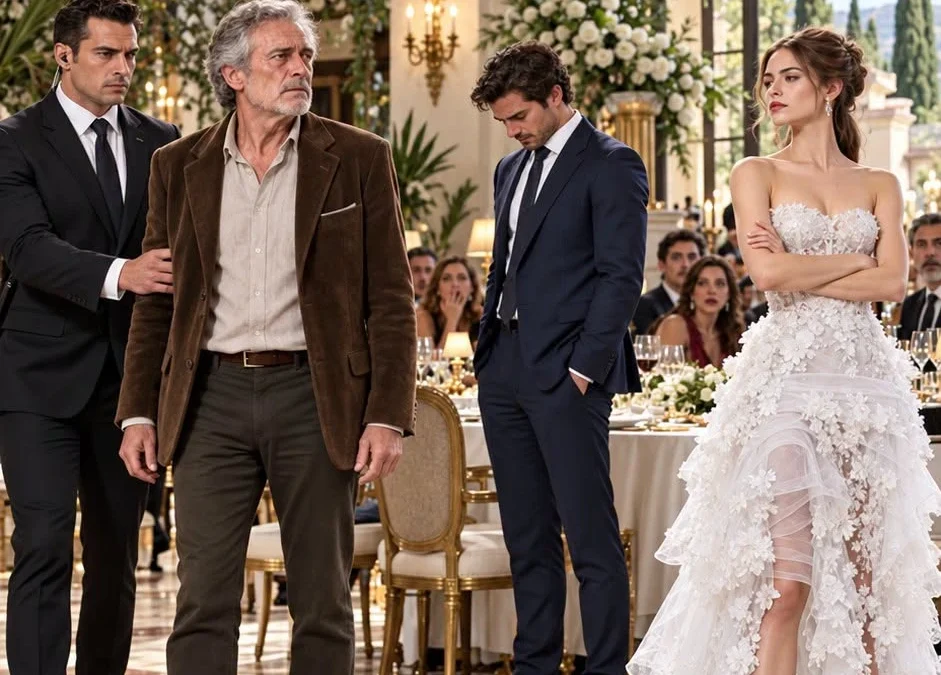
She stood at the head of the table in an ivory dress, pointing two perfectly manicured fingers at me.
At me. The man in the corduroy jacket, sitting in the last chair.
My name is Aurelio Martín. I’m 67 years old. And that night, in the Hotel Palacio de la Vega in Seville, I was being thrown out of my own son’s 42nd birthday dinner.
I didn’t look at the waiters. I didn’t look at the security guard who had already started walking toward me.
I looked at my son.
Álvaro was wearing a new Swiss watch, a gift from his father-in-law, the president of a big Madrid property company. Around the table sat Clara’s parents, two executives from Álvaro’s bank, a few friends from the golf club. And Nico, my fourteen-year-old grandson, staring at his plate.
I waited for one thing. Only one.
I waited for my boy to say, “He’s my father.”
Three words. That was all.
Álvaro looked down at his watch. He took a long breath, and in a low voice he said, “Dad, please. Don’t make this harder. Just go home.”
I have buried a wife. I have survived droughts in Jaén that took the skin off our hands and nearly took the land our family had farmed for generations. I thought I knew every kind of pain.
I didn’t know this one.
It was cold, quiet, and very clean. It was the pain of realizing my own son would rather pretend I didn’t exist than be seen with me.
Nico jumped to his feet. “But that’s Grandpa!”
Clara pushed him back into his seat with one sharp look.
I stood up slowly. My knees ached, but my back stayed straight. I took out my old leather wallet, laid 100 euros under my glass, and placed a small box wrapped in blue paper beside Álvaro’s plate.
Then I walked toward the door.
The guard reached for my arm. I raised one hand.
“No need,” I said. “I know the way out.”
And I did.
I washed dishes in that building when I was seventeen. I know its kitchens, its freezers, its service corridors. I know the manager’s office on the second floor, where the carpet still smells like cigars from 1976.
But here is the part nobody at that table knew.
Nine months earlier, the Hotel Palacio de la Vega had been bought, every brick of it, by a company called Olivar del Sur.
And Olivar del Sur belonged to me.
I hadn’t told my son. I hadn’t told anyone. I had my reasons, and they were buried next to my wife.
There was one more thing. Clara Ferrer, the woman who had just thrown me out like trash, was the hotel’s events director.
She worked for me.
I walked out into the Seville rain, climbed into my old van, and sat in the dark with the engine off. My hands wouldn’t stop shaking. I didn’t call a lawyer. I didn’t call Elena, the general manager. I didn’t want revenge. What I wanted was to know how far my son would go to keep the approval of people who measure a man by his surname, his suit, and his bank balance.
At 11:18 p.m., my phone buzzed.
A message from Álvaro.
“Clara is devastated. You should apologize to her tomorrow.”
I read it three times.
Apologize.
Then the phone rang again. It was Manuel, the head waiter, who has worked in that hotel for 26 years. His voice was barely a whisper.
“Don Aurelio… you need to hear what she did after you left.”
What happened next still gives me chills. Part 2 is in the comments—or leave any word below and I’ll send it to you privately.
Part 2
What happened next still gives me chills. Part 2 is in the comments—or leave any word below and I’ll send it to you privately.
“Tell me,” I said.
Manuel swallowed. “Clara threw your gift into the trash, Don Aurelio. The blue box. In front of the staff.”
I closed my eyes.
“There’s more. She made Iván, the security guard, write a report saying you came in uninvited and caused a disturbance. Iván refused to lie. Now she wants him fired in the morning.”
“Anything else?”
“Lucía, the waitress at your table, told her you were Álvaro’s father. Clara called her indiscreet and sent her to the storeroom for the rest of her shift.” His voice cracked. “The girl left crying.”
I hung up and sat there while the rain hammered the roof of the van.
I thought of my wife, Mercedes. For 38 years, she was the only person who could stop me when I was angry. She’d just say, quietly, “Don’t punish people when you’re hurt, Aurelio.”
She’s gone now. But I could hear her in that dark van as clearly as if she were sitting beside me.
At 11:46, my phone lit up again. This time it was Nico.
“Grandpa, I’m sorry. I wanted you to stay.”
My throat closed. I typed only: “You have nothing to be sorry for.”
I didn’t sleep. At dawn I drove to the hotel and called Elena Rivas, the general manager, the only person who knew the truth.
“I want a meeting at ten,” I told her. “HR, security, accounting, and Clara. Nobody tells her why.”
I put on the same corduroy jacket and the same worn boots. And before I left home, I went to the trash room of the hotel, where Manuel had quietly kept something for me.
The blue box. Crumpled, but unopened.
At 9:57, Clara strode into the meeting room with a leather folder under her arm and the look of a woman who expected to win.
She didn’t even knock.
“Elena, I want that guard from last night gone today,” she began. “And we need to review Lucía’s contract. Staff cannot be allowed to question a director in front of guests.”
Then she saw me at the head of the table.
The same corduroy jacket. The same boots. And in front of me, the blue box she had thrown away.
“You again?” she said, half laughing. “Elena, what is this man doing here?”
Elena didn’t smile.
“Clara, sit down. This is Aurelio Martín, owner of the Hotel Palacio de la Vega and president of Olivar del Sur.”
Clara let out a short, disbelieving laugh. “That’s ridiculous.”
The company lawyer slid papers across the table: the deed of sale, the company registry, the bank certification.
Her laughter stopped.
I watched her read the name once. Then again. The color left her face the way water leaves a basin.
“Aurelio… I didn’t know…”
“That,” I said quietly, “was exactly the problem.”
Elena opened another folder.
“And there’s more, Clara. You ordered a false report. You threatened two employees. And you charged last night’s dinner for twelve people to an internal account as a ‘commercial presentation for prospective clients.'”
She turned the last page toward her.
€8,460.
Clara went completely still.
I placed my hand on the blue box.
“Before we talk about your job,” I said, “you’re going to hear why I bought this hotel.”
And I opened the box.
If you want to know what was inside, LIKE this post and comment “PHOTO.” When enough people comment, I’ll post Part 3.
Part 3
Inside the box was a photograph, old, faded, torn cleanly in half and carefully taped back together.
A skinny seventeen-year-old boy in a kitchen apron. Next to him, a young waitress with a grin so bright it still hits me in the chest after all these years.
Clara stared at it.
“That’s…” She stopped.
“My wife,” I said. “Mercedes.”
I set the photo on the table beside the frame that had cracked when she threw it away.
“In 1976, this hotel was an old place on the edge of Seville that smelled of floor wax and soup. I was seventeen. My father told me if I wanted a motorbike, I’d have to earn it. They put me in the dishwashing area. I scrubbed pots. I carried crates. And I learned something I never forgot: you can tell everything about a person by how they treat the one who clears their plate.”
Nobody in that room moved.
“Mercedes arrived a year later, serving breakfasts. She was eighteen. She used to hide two sweet rolls for me at the end of her shift. We fell in love without any big promises.”
I told them about Jaén. About my father’s illness, the olive grove, the wedding with 43 guests and food cooked by our own families. About the bad harvests, the low prices, the phone calls from the bank. About Mercedes keeping our accounts at the kitchen table and working afternoons in a care home so we could keep going.
“When Álvaro was born in 1984, we counted every coin. I got up before sunrise and bought small plots next to ours, one by one.”
I looked at Clara.
“Your husband saw that effort and mistook it for poverty. He was ashamed of my boots. Of my van. He studied finance in Madrid and found a new world there, and when he met you, that world became his identity.”
Clara’s jaw tightened. “I never—”
“Mercedes told me once,” I continued, “‘Watch how she treats people who can’t give her anything.’ I chose not to judge you. That was my mistake.”
Then I told them the rest.
In 2023, when we both knew Mercedes had little time left, she took my hand and said something I’ve carried every day since:
“When I’m gone, sell part of the land. You’ve worked enough. And don’t tell Álvaro how much you have until you’re sure he remembers who he is. Money doesn’t make people worse. It only makes visible what was already inside.”
She died four months later.
Afterward, an energy company bought much of our land for a solar project. I kept the house and a few groves, and received more money than I had ever imagined. When I heard the Palacio de la Vega was for sale, I bought it in her memory. I asked Elena for one condition: nobody could reveal I was the owner. I wanted to keep entering through the service door, to talk with cooks and waiters, to see how the hotel really worked when nobody was trying to impress me.
“And that’s how I learned,” I said, “that you weren’t just demanding, Clara. Many people here were afraid of you.”
HR laid seven written testimonies on the table. Insults. Threats of worse shifts. Humiliations. The false report against Iván. The punishment of Lucía. The €8,460.
Clara pressed her lips together. “Are you going to fire me?”
“I could.”
“Then do it.”
I shook my head.
“I’m not here for revenge. I want to know whether you’re capable of learning.”
Elena slid two documents in front of her. The first was a termination letter. The second would let her resign as director and spend six months in operational roles: dishwashing, storeroom, housekeeping, dining room, reception. She’d earn the salary for each position. If she finished without incident, she could apply for a position of responsibility again. And she would repay the €8,460 within 30 days.
Clara laughed bitterly. “You want to see me washing dishes?”
“I want you to know what it costs for a table to look perfect by the time you arrive,” I said. “And I want you to learn the names of the people you used to call ‘staff.'”
She asked for until 5:00 p.m. to decide.
At 3:20, my son walked in.
He came furious, convinced I was destroying his marriage over a family quarrel. “What are you doing, Dad?”
I pointed at the photograph.
Álvaro recognized his mother instantly. I turned the frame over. On the back, in her handwriting:
“Where the best of our life began.”
His anger drained out of his face. I told him everything: the land, the hotel, the promise to his mother.
He sat down heavily. “Mom knew all this?”
“Enough.”
“And you didn’t trust me?”
“Your mother trusted that you’d remember where you came from. So did I. Last night, I got my answer.”
He was silent for a long time. Then, in a voice I hadn’t heard since he was a boy, he admitted it. He had been ashamed for years. Every joke his father-in-law made about my van made him feel like the village kid he was desperate to hide.
“And to stop feeling small,” I said, “you made your father small.”
Álvaro lowered his head.
At 4:48, he paid half of the €8,460 with his own card. Clara paid the other half.
At 4:56, she signed the second document.
Monday morning, 6:00 a.m. Clara walked into the dish room wearing non-slip boots and a kitchen uniform. Rosa Benítez, the head of dishwashing, 59 years old and 31 years at the hotel, was waiting. Clara had humiliated Rosa more than once.
Rosa didn’t take revenge.
“Big trays go on the left. Stack glasses badly, you lose time. Leave the floor wet, somebody gets hurt.”
Clara had braced for mockery. She got instructions.
By the end of the first week, she was exhausted. By the third, she nearly quit. Rosa found her crying in the locker room.
“If you want to go, go,” she said. “But don’t go because you’re ashamed to start at the bottom. Everybody starts at the bottom.”
Clara went back to her shift.
She moved to the storeroom, then housekeeping, where she watched one maid prepare eighteen rooms in a single day while almost nobody knew her name. In the dining room, she worked alongside Lucía again, the girl she had made cry.
Clara apologized.
Lucía answered, “I don’t need you to be kind because you know who Aurelio is now. I need to know you’d be kind even if you knew nobody important.”
I wasn’t there for any of this. I only heard it later. Elena told me, and Rosa, and eventually Clara herself.
But in the fourth month, something happened that I’m told changed her for good. At a wedding, an irritated guest blamed Lucía for a glass another waiter had spilled and began speaking to her with contempt in front of everyone.
Clara was walking past with an empty tray. Months earlier, she would have protected the guest to avoid a complaint.
This time, she stepped in. She asked Lucía to continue her work, then told the guest, calmly but without giving ground, that no employee would be spoken to that way. Afterward, she helped pick up the broken glass and asked Lucía if she was all right.
Lucía looked at her, stunned. “This time Aurelio wasn’t watching.”
Clara understood. For the first time, she had done the right thing without knowing whether anyone with power was looking.
Meanwhile, Álvaro began visiting me in Carmona on Saturdays. No grand reconciliation. We ate together, fixed things around the house, sometimes sat for long stretches without speaking.
One Saturday he showed up without the Swiss watch.
“I sold it.”
“You didn’t have to.”
“I know. I’m tired of proving things to people I don’t even like.”
I smiled. That’s how it began to heal. Not with speeches. With small acts.
One Sunday he brought Nico to the old olive grove I’d kept. We walked among trees that had survived decades of drought. I pointed to a twisted one, nearly hollow inside.
“Your grandmother said this was the ugliest tree of all. That’s why it was her favorite.”
Nico asked why we never pulled it out.
“Because it kept giving olives.”
Álvaro understood the comparison before his son did. He said nothing. He just rested his hand on the trunk. I didn’t need to explain.
Some apologies take months to become trust, the way a tree takes years to bear a good harvest again.
Six months passed. The hotel celebrated its 110th anniversary with a charity gala. In the lobby, I hung the 1977 photograph in a new frame made of olive wood.
Álvaro asked to speak in front of the staff, the guests, and both families.
“Six months ago, in this hotel, my wife called a man an intruder because of his clothes. I knew who he was. He was my father. And instead of defending him, I asked him to leave, because I was afraid of looking less important in front of other people.”
The room went silent.
“I spent half my life trying to make sure nobody noticed where I came from. Today I understand the only shameful thing was pretending I didn’t come from him.”
Nico was crying. I felt my own eyes burn.
Clara stood at the back, working as dining room manager on a trial basis. She had completed her six months but hadn’t asked for her old title. She asked to become operations coordinator instead.
“I want to keep learning how this hotel works when nobody is watching,” she explained.
Elena hired her. Nine employees had signed positive evaluations of her work.
When the gala ended, Clara found me in the corridor.
“For weeks, I hated you.”
“That sounds honest.”
“But I figured something out. I used to be kind to whoever could open doors for me. I thought that was knowing how to move through the world.”
“And now?”
“Now I try not to need to know who someone is before I respect them.”
I nodded. I didn’t hug her. It wasn’t necessary.
Nico appeared soon after. “Grandpa, when I turn sixteen, I want to start where you started.”
“In the dish room?”
“In the dish room.”
“Then get ready. Rosa doesn’t forgive a badly placed tray.”
He laughed.
I stepped out into the courtyard. Álvaro was waiting by my old van.
“Want a ride to Carmona, Dad?”
On the drive home, I watched the hotel lights shrink in the window. It took me decades to understand what Mercedes knew when she was young. Money can buy walls, chandeliers, deeds, and elegant tables. It can’t buy character.
Character shows up at other moments.
At a table, when a son decides whether to defend his father.
In a kitchen, when a woman agrees to begin again.
And in a fourteen-year-old boy who stands up, surrounded by silent adults, to say:
“That’s my grandfather.”
I never again remembered that dinner as the night I was humiliated.
I remember it as the night every person in my family showed who they were when they thought nobody important was watching.
And as the night some of them finally decided to become better.
Disclaimer: This story is entirely fictional and created for entertainment purposes only. It does not represent any organization or individual, nor does it encourage inappropriate behavior. The content was generated with AI assistance.








