My Father Slapped Me at My Own Wedding Reception Over a Box of Checks. Then My Grandmother, Who I Hadn’t Seen in 6 Years, Stood Up.
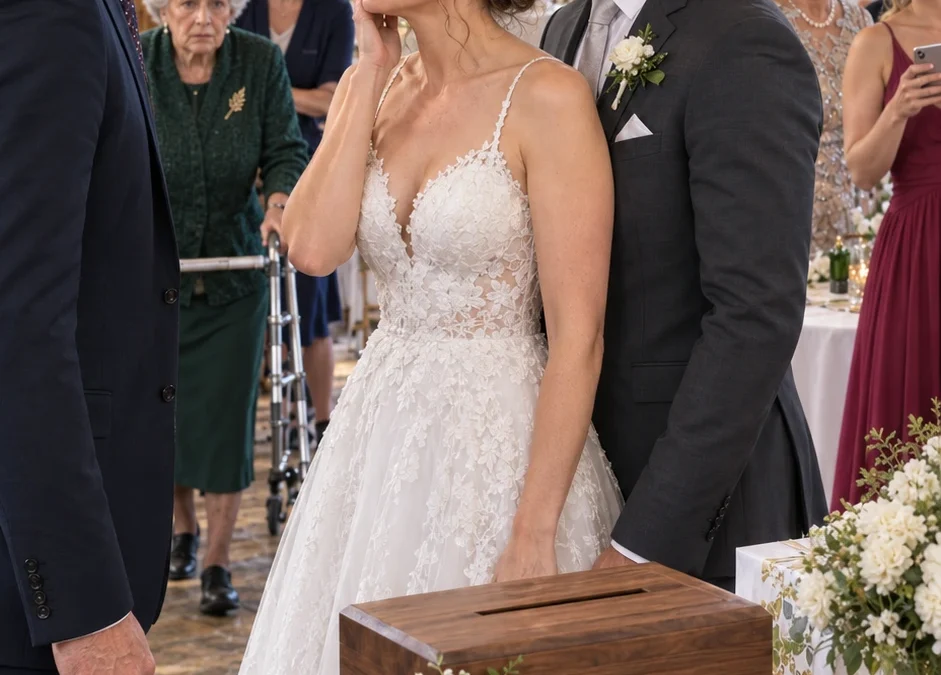
My Father Slapped Me at My Own Wedding Reception Over a Box of Checks. Then My Grandmother, Who I Hadn’t Seen in 6 Years, Stood Up.
Part 1
“Give me the box.”
“No.”
He said it again. I said no again. The third time, my father slapped me across the face at my own wedding reception.
Ninety minutes in. In front of 118 people. Because the checks on that gift table were not going to my sister.
My mother didn’t stop him. She looked at me the way you look at a child reaching across somebody’s plate.
“She needs them more. Stop being greedy.”
My sister smiled. She had known since Thursday.
I’m Esther Stark. I’m 31, and I manage a four-chair dental office in Grand Rapids. I’m good at other people’s messes. Give me a stack of paper held together with rubber bands and I won’t get up until the numbers agree.
In my family, that was never a skill. It was just weather. I filed my parents’ taxes free every March for nine years. I won my mother’s physical therapy appeal on the second try. Nobody thanked me, because it wasn’t help. It was just what I did.
My mother had a phrase for anything hard I mentioned: “You’ll figure it out. You always do.”
Then, without a pause: “Your sister’s the one I worry about.”
I heard that sentence for twenty years before I understood it wasn’t a compliment.
My husband, Ellis, teaches high school English and builds furniture on weekends. We paid for our own wedding, $21,800 over fourteen months, out of two normal paychecks. We booked Harrow Lake Lodge in Rockford in March because a lakeside lodge in Michigan costs half as much before the weather turns.
There was one name missing from the guest list. My grandmother’s.
Marin Stark. My father’s mother. She did two crosswords every morning in pen, and she was the only adult in my childhood who ever asked what I wanted. She called me Essie. Nobody else did.
In 2020 she broke her hip and couldn’t go home. Her house sold for $184,000, and $171,000 went into an account for her care. She moved into Bellweather Grove, a facility 40 minutes away, in the exact months no one in the country was allowed through the doors.
My father handled everything. Her mail. Her bank. Her Social Security. He’s an only child.
“I’ve got it handled,” he said. “You two just keep your lives running.”
When the doors reopened, the wall didn’t. My mother told me the staff recommended limiting visitors. Grandma got agitated. Confused. Her “regular people” would be my mother and my sister.
I didn’t fight it. I’d been told my whole life I was the one who didn’t need things.
So I did what I knew how to do. I sent things. Starting March 2021, I sent my mother $200 every month, with the same note: for grandma. A blanket one Christmas. A leaf-shaped brooch in 2023 that looked exactly like her. Hearing aids in 2024.
I never asked for a receipt. Not once in five years. It didn’t occur to me to audit my mother. There’s a category of person you don’t think to check.
Not one of those gifts was ever mentioned back to me.
The last time I saw Grandma before the wedding was Christmas, eleven weeks earlier. Twenty minutes in a common room, my mother perched on the arm of the couch the whole time.
“You must be so busy, dear,” my grandmother said. “Your mother says you’re always busy.”
Dear. Not Essie.
Then she looked out the window and said, warmly, “Bridget’s been so good to me.”
I sat in the parking lot for ten minutes. I decided she had chosen, and I had lost, and some things you just carry.
The wedding was beautiful. Lake ice still rimmed the shore. The fireplace roared all night. Ellis built our card box from leftover walnut, with a sliding lid that made a soft wooden knock when it closed.
In the receiving line, I looked up and saw a wheelchair.
My grandmother. In a green sweater. A woman in a navy cardigan standing behind her.
My brain refused the information for two full seconds.
I looked at my father. His face went flat and pale. Then he smiled and clapped somebody on the shoulder.
Grandma took my hand. “Don’t you look nice, dear? Your young man came all the way out to see me. Nobody’s done that in a while.”
Then I saw what was pinned to her sweater.
The leaf brooch. The one I sent in 2023. The one I’d assumed was lost in the mail because she never mentioned it.
My mother appeared and wheeled her away, talking the whole way.
Before dinner, our coordinator handed me an unsealed envelope that had slipped off the table. Inside was a $250 check from my great-aunt Loretta.
The pay line read Vaughn Stark. My father.
The memo, in careful cursive: For Esther and Ellis.
Two right names, under one wrong one.
I asked Loretta about it quietly.
“Your dad said it was easier that way,” she said. “Said he’d handle getting it to you kids. Was that not right?”
I told her it was fine. Then I went back to the table and found three more envelopes in the same slanted handwriting.
When I asked my mother, she answered too fast and too long. Nine years of insurance calls taught me this: when someone gives you four sentences to a yes-or-no question, the answer is in the extra three.
“That’s just your father being your father. Don’t make it into something.”
Across the room, my sister Bridget’s face glowed blue from her phone. She was reading something and smiling that small private smile, the one you make when something you’ve waited for finally lands.
She looked up. She looked straight at me. She kept smiling.
Then my father walked up to the gift table and laid his hand flat on the walnut lid before he said hello.
“Give me the box, sweetheart. You’ve got a hotel to get to. I’ll sort it Monday.”
He wasn’t demanding. That’s what made it hard. He was helping. He’d been helping in that exact tone my entire life.
“No,” I said.
And I thought, in the middle of my own wedding: I have never said that word to him.
“It’s family money, Esther. It always has been.”
I said no again. He said Bridget was drowning. He said something that meant nothing to me that night and everything nineteen days later.
“This has to be handled by the end of the month.”
Nobody had asked him about the end of the month.
My mother stepped in, not to stop him. To close it. “She needs them more. Stop being greedy.”
I pulled the box back. It hit the table edge, and the lid jumped open an inch.
And he slapped me.
A hundred and eighteen people stopped talking at the same time. Nobody screamed. All I remember is a glass being set down very carefully, my ear ringing on one side, and being more irritated by the ringing than anything else.
Ellis put down his drink. He stepped between us, hands in his pockets, voice level.
“You just made this very simple.”
My father scoffed. “Big words from a guy who teaches sophomores.”
Nobody moved for eleven seconds.
Then, at the far end of the room, a chair pushed back.
What happened next still gives me chills. Part 2 is in the comments—or leave any word below and I’ll send it to you privately.
Part 2
What happened next still gives me chills. Part 2 is in the comments—or leave any word below and I’ll send it to you privately.
My grandmother stood up.
It took her a long time. Her aide, a woman named Ivy Kesler, brought the walker around, set the brake, then let go and simply walked beside her.
It’s less than 25 feet from table 12 to where my father stood. It took nearly two minutes. Nobody in the room said a word. The only sound was four rubber feet on a wood floor, unhurried.
My father moved to help.
She lifted one hand. He stopped.
And then he gave himself away. He wasn’t surprised she could stand. He wasn’t surprised she’d survived forty minutes in a van. He wasn’t confused about anything he’d been telling me for six years.
He panicked because she was there.
“Ma, you’re tired,” he said, loud, for the room. “Let’s get you to the van. You have your medication.”
“She isn’t on anything that makes her tired, sir,” Ivy said, flat and professional.
He put his hand on his mother’s elbow. She took her arm back.
“I didn’t come here to ruin my granddaughter’s night,” she told the room. “I came because I just heard my son say three words to her that he’s been saying to me for six years. Family money. I sold my house, Vaughn.”
Her voice didn’t shake. She held no paperwork. Just a small clutch purse and a leaf brooch.
“I get $2,240 a month from Social Security and $610 from your father’s pension. I haven’t seen a bank statement since 2020. I’d like to know what a person has to do to see her own bank statement.”
At table six, Aunt Loretta stood, pointing her reading glasses at him. “You called me three weeks ago and told me to leave the name blank or write yours.”
“Easier for who?” she asked.
A man at another table said he’d been told the same thing. Then a third. Eleven envelopes. $2,900. I wouldn’t have that number until Tuesday.
Our coordinator, Trish, walked to the gift table and stood beside the walnut box. She didn’t touch it. She’d decided, I think, to be a wall if anyone needed one.
And I realized this was about to get away from me. It would become a roomful of people arguing about eleven checks, and none of it would answer the thing I’d felt behind my ribs since the receiving line.
So I did the opposite of everything I’d been taught. I picked up the box, carried it eight feet, and put it in Trish’s hands.
“Nobody opens this tonight. Not him. Not me.”
She slid the lid shut. The second wooden knock of the night.
Then I walked to my grandmother and asked a question that confused the whole room.
“Grandma, when was the last time you got money from me?”
She tipped her head, genuinely puzzled. No defensiveness at all.
“From you, dear? You haven’t sent me anything.”
“For how long?”
She thought about it, honestly, the way you think about a real question.
“I don’t believe you ever have.”
I didn’t argue. It’s the only thing I did right that night. I took out my phone, opened my transfers, and scrolled. The same note, over and over, past the edge of the screen.
For grandma. For grandma. For grandma.
I held it up to my mother. “Two hundred dollars. Every month. Sixty times. Mom, say the number out loud.”
She didn’t. She looked at Bridget.
My grandmother touched the brooch on her sweater. “Bridget gave me this.”
Nobody spoke.
“Bridget brought me the blanket. Bridget brought me the hearing aids in a little box.”
Then she asked it herself, which I’ll hear for the rest of my life, because I didn’t ask it and nobody made her.
“Bridget, did you buy me anything?”
My sister looked at the tablecloth like something was written on it.
It was my mother who answered. Fast, like explaining something obvious to someone slow.
“She had nothing, Esther. You had everything. The job, the degree. I just wanted her to be somebody’s favorite for once.”
The whole machine, and the reason she built it, in one sentence.
I thought of that common room at Christmas. An old woman thanking me to my face under my sister’s name.
My grandmother turned to her son. “Where did my money go?”
And my father, who had controlled every room he’d ever walked into, did the worst possible thing. He started giving numbers. Assisted living costs. Co-pays. Haircuts. The podiatrist. Out loud, at a wedding, in front of a professional caregiver from the actual facility.
“Six years I’ve carried that woman.”
“Carried?” my grandmother said.
“What am I in your books? What line am I on?”
“You’re an expense, Ma. That’s what you’ve been since 2020.”
Then he turned to me. “I fed you for eighteen years. Eighteen. And you’re going to stand here and count envelopes at me?”
He had just told a room full of relatives that his daughter was an investment that had come due.
My mother-in-law, Colleen, stood and put her napkin on the table. She said nothing. She just stayed standing and looked at him. It was the loudest thing that happened all night.
Loretta went for her coat. My mother’s cousin Deb squeezed my arm. “I wrote mine to you. I want you to know I wrote mine to you.” Then she got her coat too.
About twenty people left in twenty minutes. No speeches. They shook our hands, said congratulations to me and nothing at all to my parents.
That was the whole punishment. And it was enormous.
I kept my last words short.
“I’m not giving you the box. Starting next week, I’ll be talking to Bellweather Grove myself, and I’m not sending anything through you again. I’m not asking you to leave. You can stay. You just can’t have anything.”
Then I sat down and drank an entire glass of water, the most ordinary thing anyone did that night.
My grandmother put her hand over mine and said she’d like to go home.
And she wanted me to be the one to take her.
If you want to know what I found in her shoe box, and what a sealed envelope dated eight days before my wedding revealed, LIKE this post and comment “ENVELOPE.” When enough people comment, I’ll post Part 3. 💌
Part 3
I drove to Hastings in my wedding dress, skirt shoved down between the seats, my grandmother in the passenger seat and Ivy in the back. Ellis followed in my car. Nobody turned on the radio.
“Tell me about the last five years,” she said. “Start anywhere.”
Within ninety seconds I understood what I was dealing with. She didn’t know I’d become practice manager. She didn’t know I’d finished my degree, or that I’d been engaged since 2024. She’d learned my husband’s name three weeks earlier, from him, in a chair by a window.
For six years, everything she’d been told about me came out of one sentence. Esther’s busy.
I talked for forty minutes. She kept stopping me.
“Slow down. Start again at the part where you fixed the insurance. I want to hear that part properly.”
She held my hand through a curve on the county road and didn’t let go until the parking lot.
At 2:00 a.m., Ellis and I sat on our kitchen floor with our backs against the cabinets, too tired for chairs. He told me what he’d hidden. On February 21st, he’d driven to Hastings alone, after noticing my grandmother’s name wasn’t on the guest list or the regrets list. Her left hearing aid wasn’t working. She’d asked him, “Is Esther angry with me? I’d like to know what I did, if somebody would just tell me.”
“I broke the promise,” he said. I’d made him swear in January to let me handle my family.
“You broke the wrong promise on the right night,” I said.
The listing sheet for the house six minutes from my parents sat on the counter, soft from being folded in quarters. We looked at it for maybe two minutes. Then Ellis dropped it in the trash.
You can’t just call a nursing home about your grandmother’s money. They won’t tell you the weather.
So my grandmother called the business office herself, from the edge of her bed, on speaker. “This is Marin Stark, Room 14. I’d like my granddaughter added to this account, and I’d like to know why nobody’s been talking to me.”
They emailed a release form. She read every line and signed it.
Then we opened the shoe box from her bottom drawer. Two rubber bands crossed over the lid. Old statements. Medicare summaries. A birthday card from 2019.
And one white envelope, still sealed, addressed to my father, care of her room.
A 30-day notice of discharge for non-payment. Dated March 6th. Eight days before my wedding.
I turned it over and the entire month reassembled itself. The calls about the gift table. The envelope on the passenger seat. Handled by the end of the month. His hand on the walnut lid before he said hello.
The business office confirmed: three months behind. Discharge date April 5th. My grandmother had seventeen days.
Then I did what I do. I sat down with the paper until the numbers agreed.
$171,000 went into her account in 2020. Her income was $2,850 a month. Bellweather cost $3,650. The honest gap was $800 a month over 70 months, about $56,000. The account should have held around $115,000.
The March balance was $2,300. That’s $112,700 gone. Not fees. Not inflation.
And here is the part I’m still not over. I had seen almost all of it.
- $14,600: the used SUV my sister honked into my parents’ driveway. I told her it was a nice color.
- $19,300: my parents’ new kitchen. I ate Thanksgiving there and complimented the backsplash.
- $16,800: private preschool for my niece Nell.
- $30,400: a quiet $950 monthly subsidy on my sister’s rent.
- $31,600 in credit card payments labeled “household.”
I had eaten dinner in a kitchen paid for with my grandmother’s nursing home money.
I called all eleven people whose checks carried the wrong name. I didn’t ask them to rewrite anything to me. “If you still want to give,” I said, “write it to the care home with her name on the memo line.”
Nine of them did.
Three hours after one of those calls, Bridget texted. She chose a diner with a playground and brought Nell. I clocked that decision the moment I pulled in.
She gripped her coffee with both hands and came out swinging. “I drove down there twice a month for six years. I cut her toenails. I changed her watch battery. Where were you?”
I let her finish. Then I asked, “Who told you I wasn’t allowed to come?”
She opened her mouth and closed it.
The driving was real. Two Saturdays a month, six years, sometimes with a four-year-old in the car. Nobody made her.
“I’m not taking the driving away from you,” I said. “I’m taking the blanket.”
Her phone sat face down on the table the entire time. A person who’s been lying checks her phone. A person who’s been lied to has nothing to check.
I asked about Thursday. She turned it over and read aloud a text from our father, sent March 12th: “I’m handling the gift table Saturday. Most of it’s coming to you. Don’t say anything to your sister. She’ll make it a thing.”
“Most of it,” she said quietly. “Not all of it. Not to me.”
I told her about the notice. That $7,300 in that box had been spoken for eight days before he sent her that message. Then I told her the other half: her rent subsidy hadn’t stopped in January because things were “tight.” It had never been theirs to give.
She put her hand over her mouth and sat like that for a long time.
When she could talk, she told me about Christmas 2021. My mother handed Grandma the blanket I’d shipped and said, “That’s from Bridget.” And Grandma pulled her into a hug.
“Nobody in this family had hugged me in two years,” Bridget said. “I just let her.”
Two seconds. Then ten. Then the rest of the evening. Then four years of not making a decision.
Two walls. One builder.
Nell ran back and asked, dead serious, “Are you still my aunt? Mom said, ‘Maybe not.'”
“I’m still your aunt,” I said. “That part isn’t up to your mom. It’s just true.”
My grandmother was the one who asked to move. She said Hastings had been fine, but she’d like to be closer to Grand Rapids before she died. She said it matter-of-factly, the way she says everything.
I found a place called Alder Court. Twenty-two residents. Twelve minutes from where Ellis and I were about to make an offer. $3,200 a month. Her income covers nearly all of it, and I told her in front of the admissions director I’d cover the difference.
“And you’ll see every statement, mailed to you, with your name on it. If I ever stop, you’ll know before anybody.”
She called Social Security herself the next week and had her payee changed back to her own name. A form. That’s all it was. Six years of wall, and undoing the money part took one phone call and two pieces of paper.
The day we moved her, my father showed up with a borrowed truck.
He didn’t come to yell. I almost wish he had. He came to help.
That’s the whole playbook in my family. Usefulness is how you get back in the room. Useful becomes necessary. Necessary becomes owed. Owed becomes control.
“Then load it,” I said. “That’s all this is.”
He did, and he was genuinely good at it. But he got no key. He wasn’t added to a single form. When the admissions director asked for contacts, I said my name and Ellis’s, and stopped.
In four hours, he never apologized to his mother. He talked about the clutch and the traffic on M-37. Not one word to the woman he’d called an expense in front of 118 people.
She moved in on April 4th, one day before the discharge date. The new room is smaller. It faces east.
“It’s smaller,” she said, purse still on her arm. Then, after a moment: “It’s closer.”
Nobody did anything to my parents. No courtroom. No police. People just stopped calling. Aunt Loretta hasn’t spoken to my father since March. Three households skipped my grandfather’s memorial lunch. My mother, at 61, took a part-time scheduling job. Bridget picked up full-time hours at a grocery store.
“Nobody’s punishing them, honey,” Deb told me. “People just stopped calling. That happens on its own.”
Then one Thursday in April, my mother appeared at my door with a real moving box. She set things on my kitchen table one at a time. Report cards. A fourth-grade class photo. A lopsided Girl Scout ceramic. A yellow cotton dress she’d sewn for me the summer I was nine.
“I sewed that in one weekend. You wore it until the hem came out twice.”
I knew exactly what she was doing. It worked anyway. That’s the strongest thing she has, and she brought all of it.
Then she apologized. A real one, the first of my life. She said it started with the blanket, Christmas 2021. It came out of her mouth, and then it was easier the second time. She said she’d looked at Bridget after the divorce and seen someone with nothing, and she’d wanted her to be somebody’s favorite.
She cried. It wasn’t performance. I know the difference.
But in thirty minutes, she never once said my grandmother’s name. She was sorry for what she’d done to me.
“To me,” I said.
She didn’t hear it.
Forty minutes in, she told me why she’d come. “There’s $11,400 owed to Bellweather Grove. It’s in your grandmother’s name, Esther. They’re sending it to collections. At 84.”
Then the best-built sentence anyone used on me all year:
“You’d be doing it for her, not for us. You can hate me and still do it for her.”
I got up and filled a glass of water at the sink. I didn’t sit back down. That’s all that physically happened. A woman at her own counter, deciding not to sit, because she wasn’t wrong about the bill.
Thirty-one years of training came up my throat. It’s only money, and you’ve got it, and she’s 84, and what kind of person are you?
I put the glass down. “I already send it, Mom. Three hundred fifty a month to Alder Court. It’s got my name on it. They mail her a statement, and she reads it. I’ve been doing exactly what you’re asking this whole time. The only thing that’s changed is she knows it’s me.”
I wrote Wendy Proser’s name and the business office number on a sticky note. Under it: hardship plan. “Ask for it by name. Almost nobody does. But someone there has to make the call, and it isn’t going to be me.”
She picked up her purse and left the box. At the door, she asked one more question, and it’s how I know nothing I said had landed.
“So what am I supposed to tell your father?”
I didn’t answer.
We closed on a 1958 ranch on May 22nd, with a bad driveway, good bones, and a maple in the front yard. It’s twelve minutes from Alder Court.
“Twelve minutes,” Ellis said, measuring a door frame. “Close enough that it’s Thursday.”
Thursdays, I pick her up at nine and we drive two blocks to a diner with vinyl booths. She orders the same thing every week and buys her own coffee. We don’t talk about my parents. That was never a rule. Neither of us wanted to spend the good hour on them.
Around the third week, she stopped calling me dear.
“Seven letters,” she said over the crossword. “To take without asking.”
“You’re not funny, Grandma.”
“I’m a little funny.”
In the sixth week, she pushed an envelope across the table. Alder Court gives residents $60 a month for personal spending. In it was $18, everything she’d saved. I pushed it back.
She put her hand flat on top of it.
“I have spent six years being somebody’s expense. Take the $18, Essie.”
A note was folded inside, in her shaking handwriting: For gas. Thursdays. Grandma.
I took it.
I never finished our thank-you cards. After March, I couldn’t sit down with that stack. Two weeks ago I brought the whole box to the diner, and she addressed the envelopes. Her handwriting is bad now, and she doesn’t care. We finished eleven before the coffee went cold.
“Who’s next?” she asked, pen ready.
“Aunt Loretta.”
“Good. She’ll like that.”
The $18 envelope isn’t tucked away somewhere safe. It’s propped against the sugar caddy where I can see it.
I spent most of my life believing an envelope was something you handed over. My father put his hand on a box before he said hello to me. My mother told a ballroom I was greedy for not opening it. For about eleven seconds, I wondered if she was right.
Now an envelope is something I fill out at a window on a Thursday, with a woman who spent six years being told I’d forgotten her.
So here’s what I’m still working on. When your family tells you that you don’t need anything, who taught them that? 💛
Disclaimer: This story is entirely fictional and created for entertainment purposes only. It does not represent any organization or individual, nor does it encourage inappropriate behavior. The content was generated with AI assistance.








