MY HUSBAND ABANDONED ME IN THAILAND WITHOUT MY PASSPORT—THEN I DISCOVERED €82,000 WAS MISSING
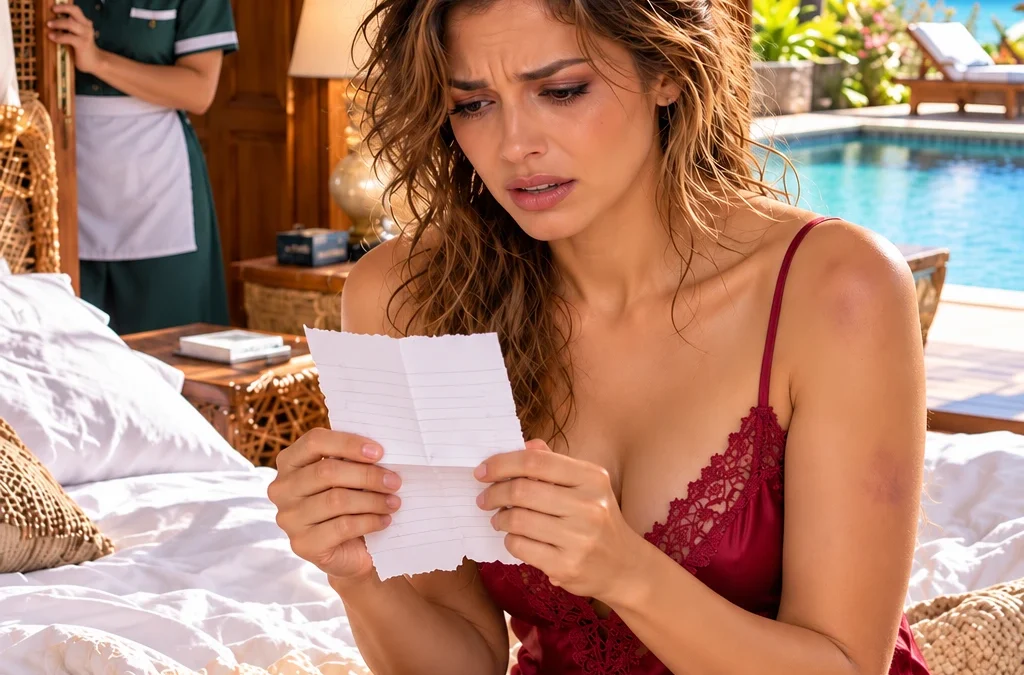
MY HUSBAND ABANDONED ME IN THAILAND WITHOUT MY PASSPORT—THEN I DISCOVERED €82,000 WAS MISSING
Part 1
When I opened my eyes in a luxury hotel in Phuket, Thailand, the first thing I noticed was how beautiful the morning looked.
Sunlight poured through the curtains.
Palm trees leaned toward a turquoise sea.
Down below, hotel staff were setting breakfast tables beside a brilliant blue pool.
For perhaps ten seconds, everything looked perfect.
Then I reached across the bed.
Empty.
“Álvaro?”
No answer.
I sat up.
That was when I saw the note.
A folded piece of hotel stationery rested on my husband’s pillow.
I recognized Álvaro’s handwriting immediately.
There were only four words:
“Figure it out yourself.”
I read them twice.
Then reached for my phone.
Gone.
I checked beneath the pillow.
The nightstand.
The bathroom.
Nothing.
My heartbeat accelerated.
I opened my handbag.
My wallet was there.
Two bank cards.
Some cash.
But the blue passport holder I always carried while traveling was missing.
I ran to the wardrobe.
Álvaro’s suitcase was gone.
So was his mother Carmen’s luggage from the adjoining room.
And so was Lucía’s.
Lucía was Álvaro’s twenty-five-year-old daughter.
I had never tried to replace her mother. I had simply spent years trying to build a respectful relationship with her.
Now all three of them had vanished.
I ran barefoot into the hallway.
First Carmen’s door.
I knocked.
“Carmen?”
Nothing.
Then Lucía’s.
“Lucía?”
Silence.
I hurried downstairs.
A receptionist named Mali checked the records.
Her expression became uncomfortable.
“Mrs. Valdés…”
“Yes?”
“Your husband and his family checked out at 4:35 this morning.”
I stared at her.
“All three?”
“Yes.”
“They left together?”
“Yes.”
“They took a car?”
“To the airport.”
My hands went cold.
“Did my husband leave me a message?”
Mali hesitated.
“Only an instruction.”
“What instruction?”
“He asked us not to wake you.”
That hurt more than I expected.
This wasn’t a misunderstanding.
They wanted me asleep.
I returned upstairs.
Then noticed another piece of paper beside the desk.
Different handwriting.
Elegant.
Controlled.
Carmen’s.
“Now we’ll see who comes to get you.”
I sat down.
For years, Carmen had known exactly where to hurt me.
I had no siblings.
Both my parents had died when I was relatively young.
Carmen often talked about my lack of a “real family.”
She loved saying things like:
“You wouldn’t understand. Family sacrifices for family.”
The argument that led to Thailand had started with Lucía.
She wanted to buy a €395,000 penthouse in Valencia.
Álvaro wanted us to help with the down payment.
I wasn’t against helping her.
But I wanted us to speak to the bank first.
Set a limit.
Review the financing.
Make sure we weren’t sacrificing our own financial security.
Carmen treated that as betrayal.
“When you married Álvaro, you accepted his daughter.”
“I accepted his daughter,” I replied. “I didn’t sign a blank check.”
After that, everything deteriorated.
The night before they disappeared, we argued again.
I went to sleep believing we would wake up uncomfortable, eat breakfast in silence, and eventually work through it.
Instead, my husband had taken my passport and phone and left me thousands of kilometers from Spain.
The hotel phone rang.
It was Mali.
“Mrs. Valdés, we checked your flight reservation.”
I gripped the receiver.
“And?”
“Your return ticket to Madrid was canceled yesterday.”
My stomach dropped.
“What time?”
“6:12 p.m.”
I closed my eyes.
We had eaten dinner together afterward.
Álvaro had smiled at me.
Carmen had ordered wine.
Lucía had barely spoken.
Meanwhile, they already knew I wasn’t flying home with them.
This had been planned.
That realization changed everything.
Then I remembered something Álvaro didn’t know.
Seven digits.
A number I had memorized nine years earlier.
Before my marriage, I spent twelve years working in corporate risk consulting.
Our work sometimes involved executives traveling internationally, emergency evacuations, missing documents, fraud, kidnapping threats, and crisis response.
We had a private emergency protocol.
I had never used it for myself.
Until now.
I went downstairs.
“Mali, may I use a landline?”
“Of course.”
I dialed from memory.
A sleepy male voice answered.
“Yes?”
“Javier.”
Silence.
“It’s Elena.”
“Elena?”
I took one breath.
Then said two words.
“Code Faro.”
Two seconds of silence.
When Javier spoke again, the sleep had vanished from his voice.
“Location.”
“Phuket.”
“Are you physically safe?”
“Yes.”
“Are you alone?”
“Yes.”
“Documents?”
“Passport missing.”
“Phone?”
“Missing.”
“Money?”
“I have cards and some cash.”
“Who took the passport?”
“My husband.”
Another silence.
Then:
“Start from the beginning.”
I told him everything.
The canceled flight.
The notes.
Álvaro.
Carmen.
Lucía.
Javier did not waste time telling me how terrible it sounded.
He began working.
Consular contacts.
A lawyer in Madrid.
Evidence-preservation procedures for the hotel.
Temporary access to my professional email.
That was when I saw the unread banking alert.
I opened it.
And stopped breathing.
TRANSFER COMPLETED: €82,000.
Date:
Three days before our trip.
Destination:
An account connected to a real-estate transaction.
I called Javier again.
“Something else happened.”
“What?”
“€82,000 is gone.”
Within an hour, my lawyer, Nuria Salcedo, had begun tracing the transfer.
The money hadn’t gone into Álvaro’s personal account.
It had gone toward the reservation for a property.
A penthouse.
In Valencia.
The one Lucía wanted.
But Nuria discovered something worse.
Before our trip, Álvaro had sent me digital documents.
“Routine bank paperwork,” he called them.
I had never signed them.
Now I learned what they really were.
An authorization connected to financing that would use an apartment in Madrid as collateral.
My apartment.
One I had purchased years before I even met Álvaro.
I stared at the screen.
This was no longer a family argument that had gone too far.
My husband needed me out of the way long enough to complete a financial transaction I would never have approved.
Then another email appeared.
This one was from a relative.
Apparently Álvaro had already been telling friends and family that I had chosen to remain in Thailand because I was…
“emotionally unstable.”
I felt strangely calm.
Because suddenly the entire plan became visible.
Cancel my flight.
Take my passport.
Take my phone.
Leave before dawn.
Tell everyone I chose to stay.
Move €82,000.
Then, presumably, finish the property transaction while I struggled to get home.
But Álvaro had made one mistake.
He thought leaving me alone meant leaving me helpless.
And while he was flying back to Spain believing I was trapped in Phuket…
the hotel was preserving its security footage.
My lawyer was tracing the money.
Consular assistance was being activated.
And Javier had just asked me one very important question:
“Elena, do you want us to treat this as a marital dispute…”
He paused.
“…or preserve everything as evidence?”
I looked at the two notes on the table.
Figure it out yourself.
Now we’ll see who comes to get you.
Then I answered.
“Preserve everything.”
Find Part 2 in the comments—or leave ANY WORD below and I’ll send it to you privately. 👇
Part 2
Find Part 2 in the comments—or leave ANY WORD below and I’ll send it to you privately. 👇
The hotel preserved the security footage.
And it contained something Álvaro had not anticipated.
At 4:31 a.m., he appeared in the lobby carrying our luggage.
In his hand was a blue passport holder.
Mine.
Suddenly, this wasn’t simply my word against his.
There was a record of him leaving the hotel with my identification.
My lawyer gave me one instruction.
“Don’t move money. Don’t empty accounts. Don’t retaliate. Document.”
“I don’t want revenge.”
I looked toward the ocean.
“I want to go home.”
For the next forty-eight hours, my life became forms, consular calls, identity checks, and repeated explanations.
Then Álvaro started calling the hotel.
Once.
Twice.
Three times.
On the fourth call, Mali approached me.
“He sounds nervous.”
I almost laughed.
“Good.”
The following morning, I finally answered.
“What the hell are you doing?” Álvaro demanded.
Not hello.
Not are you safe?
Not I’m sorry.
I watched tropical rain strike the windows.
“I’m trying to return to the country you deliberately prevented me from leaving normally.”
“Don’t be dramatic.”
Those words killed whatever remained of my marriage.
“You took my passport.”
“I wasn’t keeping it forever.”
“You canceled my flight.”
“We needed space.”
“You transferred €82,000 without my consent.”
Silence.
Finally:
“Lucía needed this opportunity.”
“They were our savings.”
“They were mine too!”
“Which gave you authority over your share. Not mine.”
He became angry.
Then I asked:
“Whose idea was it to take my passport?”
Silence.
“Álvaro.”
“My mother thought you needed to learn something.”
“What?”
“That you can’t go through life thinking you don’t need anyone.”
I actually felt contempt replace pain.
“So your plan for teaching me the importance of family was abandoning me without identification on another continent?”
“You were in a luxury hotel!”
“That doesn’t answer the question.”
“You had bank cards!”
“Still not an answer.”
Then Álvaro revealed what he actually cared about.
“Do you know what this is doing to my company?”
I frowned.
“Your company?”
“Javier filed an incident report.”
Then I understood.
Álvaro was a commercial director at a healthcare technology company.
His employer worked with Javier’s consultancy on risk and compliance.
Certain incidents involving senior executives had to be reported.
And Álvaro had spent two years pursuing a promotion.
“My candidacy is frozen,” he said. “HR wants to interview me.”
I remained silent.
“I need you to explain this was a marital argument.”
“You want me to lie?”
“I’m asking you to save our marriage.”
And suddenly I understood.
Whenever Álvaro said our marriage, he often meant his comfort.
Whenever he said family, he meant obey Carmen.
Whenever he said help Lucía, he meant use my resources without allowing me a decision.
“Where is my passport?”
“It’s safe.”
“That isn’t what I asked.”
Another pause.
“My mother has it.”
I closed my eyes.
“Perfect.”
“What?”
“Thank you.”
I hung up.
When I finally landed in Madrid using provisional documentation, Nuria was waiting at Barajas Airport.
No flowers.
No dramatic sign.
Just a folder full of evidence.
Exactly what I needed.
Then she nodded toward the other side of the arrivals hall.
Álvaro stood there.
Unshaven.
Exhausted.
“Elena.”
I raised one hand.
He stopped.
“We can fix this.”
I didn’t ask about our marriage.
I didn’t ask about €82,000.
I asked one question.
“Where is my passport?”
He lowered his eyes.
“My mother still has it.”
“Then we have nothing to discuss.”
Three days later, Álvaro requested a formal meeting to “resolve everything civilly.”
He arrived with Carmen and Lucía.
I arrived with Nuria, Javier, and Teresa Molina—the compliance officer from Álvaro’s company.
Teresa opened her file.
“Mr. Rivas, you told your employer that your wife voluntarily extended her stay in Thailand.”
“Yes.”
“But her return flight was canceled before she knew you intended to leave.”
Álvaro shifted.
“That was impulsive.”
“Ten hours before you left?” Nuria asked.
Carmen scoffed.
“You’re all acting as though we abandoned a helpless woman in a jungle.”
Teresa looked at her.
“Mrs. Carmen, did you know Elena was being left behind?”
Álvaro closed his eyes.
“Mom…”
“Of course I knew.”
Every person at the table froze.
Carmen continued.
“That was the entire point.”
And before anyone could stop her, she started explaining exactly why they had done it.
🔥 LIKE this post or COMMENT “FARO” if you want Part 3. Once there are enough comments, I’ll post the complete ending.
Part 3
Carmen crossed her arms.
“This whole ridiculous situation began because Elena refused to help Lucía.”
Nuria slowly placed her pen on the table.
“Help her how?”
“With the apartment.”
Lucía looked up.
“Grandma…”
But Carmen was already committed.
“Elena has far more money than she needs. What was wrong with helping the girl buy a home?”
Nuria opened her folder.
“€82,000.”
Lucía’s face changed.
“What?”
Álvaro went pale.
“That has nothing to do with this.”
“It has everything to do with this,” Nuria replied.
She turned toward Lucía.
“€82,000 was transferred from a joint account three days before the Thailand trip. The money went toward the property reservation in Valencia.”
Lucía stared at me.
Then her father.
“Dad told me Elena agreed.”
Nobody spoke.
Lucía’s breathing became shallow.
“You told me you two had discussed it.”
Álvaro raised his hands.
“I knew she would eventually agree.”
“That isn’t what you told me.”
“Lucía—”
“You told me Elena wanted to stay in Phuket too.”
Carmen made an irritated sound.
“Don’t be naive. Of course we knew she was staying.”
Lucía turned toward her grandmother.
“You told me she had her documents.”
The room went completely still.
Teresa looked up.
“Please repeat that.”
Lucía’s eyes filled with tears.
“When Dad woke me to go to the airport, I asked about Elena.”
She wiped her cheek.
“Grandma said Elena needed time alone to think. I specifically asked whether she had everything she needed.”
She looked at Carmen.
“You said yes.”
I finally spoke directly to Lucía.
“When did you discover that wasn’t true?”
She looked at me.
“During our layover in Doha.”
My chest tightened.
“How?”
“I saw your blue passport holder inside Grandma’s bag.”
Carmen immediately defended herself.
“We were already traveling! What were we supposed to do? Miss all our flights?”
Lucía stared at her.
“We could have returned it.”
“Don’t be ridiculous.”
“We could have called the hotel!”
“Lucía—”
“We could have done anything!”
Her voice broke.
Álvaro pressed one hand against the table.
“It was a mistake.”
I looked at him.
“No.”
He met my eyes.
“A mistake happens in a minute.”
Silence.
“You had hours to call me.”
Nothing.
“Hours to return my passport.”
He looked down.
“Hours to restore my flight.”
Still nothing.
“Then you crossed half the world and emailed people telling them I had chosen to remain in Thailand.”
Álvaro could no longer look at me.
Carmen, however, remained defiant.
“And here you are.”
She spread her hands.
“Safe.”
Then she said the sentence that finally revealed everything.
“This spectacle proves the problem I’ve always had with you. Every disagreement becomes an investigation.”
I opened my bag.
Removed a photograph.
Placed it in front of her.
Her own handwritten note.
Now we’ll see who comes to get you.
Some of the color disappeared from Carmen’s face.
“You wrote that.”
She said nothing.
“You wanted to prove I was alone.”
“I wanted you to learn humility.”
“No.”
I shook my head.
“You wanted me frightened.”
Her jaw tightened.
“You’ve always been too independent.”
I looked around the table.
At Javier.
At Nuria.
At Teresa.
Then I thought about Mali in Thailand.
The hotel employee who had protected the footage.
The consular worker who delayed her own lunch to complete my identity verification.
A former colleague who restored my professional access.
Even Lucía, now staring at her father with devastation.
Then I finally understood Carmen’s greatest mistake.
“You confused not having a large family with having nobody.”
She opened her mouth.
I continued.
“People came for me.”
Silence.
“People who don’t share my surname.”
I looked at Carmen.
“People who didn’t want my money.”
Then at Álvaro.
“And people who didn’t need to frighten or control me in order to prove they loved me.”
Nobody answered.
Teresa closed her file.
“Mr. Rivas, there are serious discrepancies between your initial declaration and the available documentation.”
Álvaro’s face tightened.
“Your promotion process will remain suspended pending completion of the internal investigation.”
He looked at me.
And something about his expression astonished me.
Expectation.
After everything, Álvaro still expected me to save him.
“Elena.”
I waited.
“Say something.”
I looked at him for several seconds.
“That is exactly what I did.”
I stood.
Nuria stood beside me.
Then another chair moved.
Lucía.
Álvaro blinked.
“Where are you going?”
“To stay with a friend.”
“Lucía, don’t mix things up.”
She laughed bitterly.
“Don’t mix them up?”
She grabbed her handbag.
“You used money that wasn’t entirely yours to buy me an apartment. Then you used me as the excuse for what you did to Elena.”
“I did it for you.”
“No.”
Her voice was shaking.
“You did it because you like being the father who solves everything.”
Carmen slammed her palm on the table.
“Ungrateful girl!”
Lucía turned toward her.
“And you wanted to punish Elena because you couldn’t control her.”
For perhaps the first time in Carmen’s life, she had no answer.
The penthouse purchase was eventually canceled before completion.
Part of the money was recovered.
Lawyers dealt with the rest.
I began separation proceedings.
Álvaro tried everything.
First apologies.
Then promises.
Then memories.
He reminded me of dinners in Malasaña.
Weekends in Cádiz.
A wedding where we danced until three in the morning.
I never pretended those memories were false.
That was what made everything harder.
People sometimes believe a relationship must have been entirely fraudulent if it eventually collapses.
That isn’t always true.
There had been love.
Tenderness.
Good years.
Real laughter.
And still, Álvaro eventually crossed a line that made those good memories insufficient reason to remain.
I could love who he had once been to me without accepting who he had chosen to become.
Carmen never apologized.
Instead, she sent me a six-page message explaining why her actions had been “misinterpreted.”
I stopped reading before reaching the second page.
Lucía took longer.
Three months later, my doorbell rang.
When I opened the door, she stood there holding a small box.
“Hi.”
“Hi.”
She handed it to me.
Inside was my blue passport holder.
My original passport had already been invalidated.
But the holder remained.
“I found it among Grandma’s things.”
I picked it up.
And for one second, I was back in Phuket.
The empty bed.
The tropical sunlight.
My missing phone.
My hands searching desperately through my handbag.
Figure it out yourself.
Lucía looked down.
“I got into that van.”
I waited.
“I thought you had your passport and phone.”
“Yes.”
“But I still knew they were leaving you alone.”
I nodded.
“That’s also true.”
She swallowed.
“I’m sorry.”
I didn’t immediately forgive her.
She didn’t ask me to.
That mattered.
There was no dramatic embrace.
No instant reconciliation.
No imaginary music.
I simply opened the door a little wider.
“Do you want coffee?”
Lucía looked surprised.
Then nodded.
“Yes.”
She stepped inside.
Months later, I traveled abroad again.
Alone.
Not to prove anything.
I no longer needed to prove that I could survive without Álvaro.
In my luggage were physical copies of my documents.
Emergency numbers written on paper.
A backup phone.
I had learned practical lessons too.
But there was one number I still knew by heart.
Seven digits.
Code Faro.
Some people might say that code rescued me.
I never saw it that way.
What saved me wasn’t simply an emergency protocol.
It was the network of people I had built by living a life beyond the boundaries Carmen considered “family.”
A former colleague answered.
A lawyer acted.
Hotel employees helped.
Consular staff helped.
Professionals preserved evidence.
People showed up.
Carmen had left that note because she wanted me to wake up frightened.
Now we’ll see who comes to get you.
The irony was that her cruel little experiment answered a question I had never needed to ask.
Who would come?
People did.
Not because they shared my blood.
Not because marriage obligated them.
Not because they expected €82,000.
They came because loyalty is an action, not a surname.
Álvaro and Carmen believed being physically alone meant having nobody.
They believed fear would make me obedient.
They believed taking my passport would make me dependent.
They were wrong.
Being alone is not the same as being abandoned by the world.
Blood is not automatically family.
Marriage is not automatically loyalty.
And love that demands obedience is not love I am willing to call home.
I never forgot that morning in Phuket.
But eventually, when I remembered the empty bed, I stopped thinking about the people who had left it.
I remembered the woman who woke up in it.
No phone.
No passport.
Thousands of kilometers from home.
€82,000 missing.
And two cruel notes waiting for her.
They expected that woman to panic.
Instead, she picked up a telephone.
Dialed seven numbers from memory.
And began taking her life back. ❤️
Disclaimer: This story is entirely fictional and created for entertainment purposes only. It does not represent any organization or individual, nor does it encourage inappropriate behavior. The content was generated with AI assistance.








