My Parents Had Me Handcuffed at Grandma’s Funeral in Front of 80 Relatives. Then the Detective Opened a File and Whispered, “Your Family Doesn’t Know You Have This, Do They?” 😳
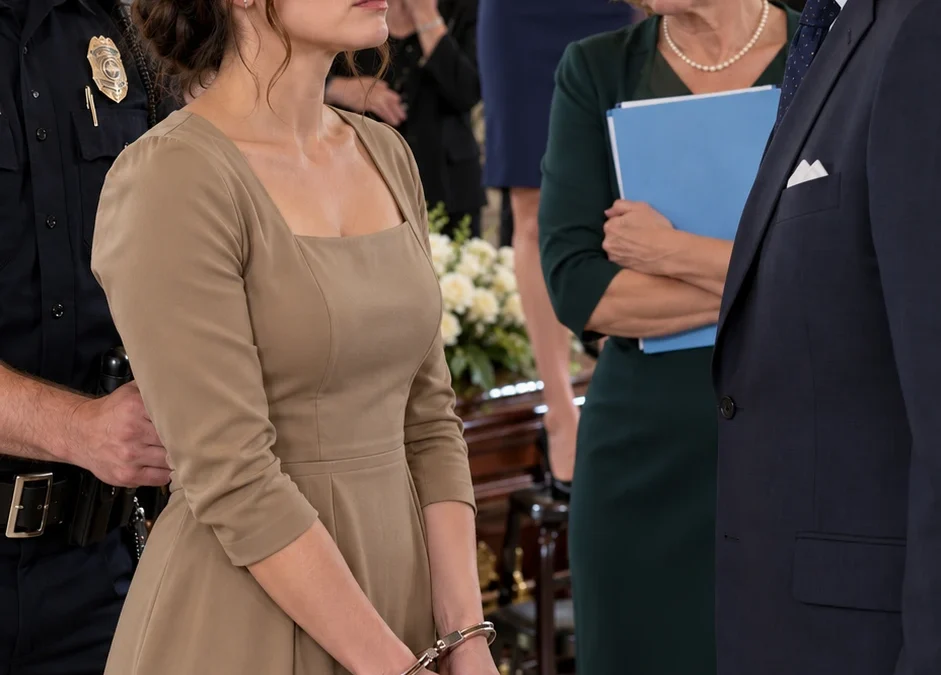
My Parents Had Me Handcuffed at Grandma’s Funeral in Front of 80 Relatives. Then the Detective Opened a File and Whispered, “Your Family Doesn’t Know You Have This, Do They?” 😳
Part 1
I washed my grandmother’s hair the morning she died.
Six days later, at her funeral, my mother pointed at me in front of 80 relatives.
“She stole from a dying woman. She’s a nurse. She knew exactly what she was doing. She took the wedding ring off her hand.”
I’m Joyce Peterson. I’m 38. I manage care for elderly patients, and people trust me with the parts of their lives they can no longer hold themselves. 💔
That Saturday, Grace Lutheran Church in Kettering was nearly full. The casket stayed in the sanctuary while the family gathered for the luncheon in the fellowship hall. I had brought a box of Grandma’s photo albums for the memory table.
My parents hadn’t spoken to me all morning. Not one word.
Two police cruisers were parked at the far end of the lot. I assumed they were for the procession.
Around one o’clock, I picked up the box of albums and started for the side door.
My father walked past me and came back with two officers.
He pointed at me.
“That’s her. There’s a sworn complaint on file since yesterday, and she’s carrying my mother’s property out right now.”
Eighty people stopped talking.
My mother stood up from the family table holding a light blue folder. The tab said JOYCE in her handwriting. She handed it to the older officer, whose name tag read Kesler, and then she turned to the room, because the room was the point.
I set the box down.
“I hold her power of attorney,” I said. It was the only true sentence I could fit into one breath.
My father didn’t let it land.
“Forged. She’s a nurse. She knows how to handle a confused old woman. She was alone with my mother every single day.”
Officer Kesler opened the folder. I could see bank statements striped with yellow highlighter. He looked at me, then at the 80 faces watching him decide.
“Ma’am, I’m going to need you to come with us.”
“Handcuff her,” my father said. “Walk her past the casket. I want everyone to see.”
Kesler didn’t answer him. But he took out the cuffs, because that’s procedure.
The metal was cold on wrists that still smelled like the shampoo I’d used on her a week earlier.
That’s when my sister, Brittany, climbed onto a folding chair.
She held her phone high, the way she does at open houses, and her voice went bright and public.
“For everyone asking, yes, this is my sister. Yes, she’s a nurse. Not for long.”
She pointed the screen straight at my face. Twelve thousand people were watching.
“Say goodbye to your career, Joyce. Grandma died ashamed of you.”
Around the room, people did what people do. Two of Grandma’s brothers turned toward the wall. A cousin covered her mouth. Most stared at the floor, because the floor doesn’t ask you to choose.
I didn’t argue.
Silence was the only thing in that room they couldn’t edit.
The walk to the cruiser went through the sanctuary, because my father had told them where to park. It was cool and dim in there, and my grandmother lay in the open casket with her hands folded.
No ring.
I’d known about that bare hand for a year. It still hit me in the ribs, because now 80 people had seen it, and they all had one story to explain it.
Her sister Lorraine, 84, followed us onto the front steps in her good navy coat.
“Joyce,” she said, low. “Don’t say anything until you’ve slept.”
The cruiser door shut.
Through the window I saw Brittany still filming. I saw my mother being held by a cousin. And I saw my father walk back inside and shake the pastor’s hand like a man who had just finished a job.
At the Kettering Police Station, they photographed me against a height chart and took my fingerprints on a glass scanner. A young officer asked if I had any medical conditions.
“I’m a nurse,” I said.
She wrote it down like an allergy.
Nobody said the word charged. Nobody said the word released.
Hours later, a detective from the Elder Crimes Unit came in. Her name was Carol Hensley. Mid-50s, reading glasses shoved into gray hair, the kind of tired that comes from years of listening to families lie about money.
She carried a laptop in one arm and a thin folder in the other.
The folder wasn’t my mother’s. The tab was yellow, and the paper looked old.
She typed something. Then she stopped.
She opened the folder, turned to the second page, and her whole posture changed. Not dramatic. Just a woman settling into a chair she hadn’t expected to be comfortable.
“You’re the agent on Eleanor Peterson’s power of attorney.”
“Yes.”
“Notarized February of last year.”
“Yes.”
She closed the folder halfway, the way you close a door when you don’t want anyone in the hall to see through it.
“Your family doesn’t know you have this, do they?”
“Have what?”
“A power of attorney that’s already on file with this department,” she said. “Attached to something your grandmother filed herself fourteen months ago.”
What happened next still gives me chills. Part 2 is in the comments—or leave any word below and I’ll send it to you privately.
Part 2
What happened next still gives me chills. Part 2 is in the comments—or leave any word below and I’ll send it to you privately.
“What did my grandmother file?”
Hensley shook her head before I finished asking.
“I can’t show you what’s in here. I can tell you the transfers your mother reported were made by someone your grandmother authorized in writing, in front of a notary, with a physician’s evaluation attached. That’s not theft. That’s paperwork.”
I don’t remember what my face did. I remember the paper cup of water, and that my hands were finally steady enough to want it.
They released me a little after seven, pending investigation. No charges. Don’t leave the county.
“And if I were you,” Hensley said, “I’d start with whoever drove your grandmother to her appointments last February.”
She was gone before I could ask how she knew there was a whoever.
In the parking lot, I turned my phone back on.
Sixty-three messages. Nothing from my parents.
I watched Brittany’s livestream replay, all 22 minutes. At minute 19, I heard something I hadn’t caught in the room. My father leaned toward Officer Kesler and murmured, quiet for him:
“Cuff her before she gets to that lawyer of hers.”
Lawyer.
Grandma’s lawyer was Norah Whitfield. My mother had copied that name onto the back of a Christmas card months ago.
By Sunday, a 40-second clip had spread through a Facebook group with 9,000 members. Local nurse arrested at funeral for stealing from grandmother.
On Monday, my director, Denise, put me on paid administrative leave. Five families had called. She reassigned my 14 patients herself, one by one, and phoned afterward to tell me who had each.
On Tuesday, I drove to Grandma’s house on Ridgeway Road.
My key didn’t turn.
The deadbolt was brand new. Taped inside the storm door was an index card in my father’s block capitals: PROPERTY OF THE ESTATE. NO ENTRY WITHOUT AUTHORIZATION.
Ten days later, a letter came from the Ohio Board of Nursing. A complaint. The complainant’s name was withheld. The wording was my mother’s.
Then Norah’s office sent an envelope. Grandma’s will, filed with probate court, dated the same day as my power of attorney. I was named executor.
And suddenly I understood the funeral.
They hadn’t needed me arrested over a ring. They’d needed me under investigation before anyone read that will. An executor with an open criminal complaint is an executor you can fight.
That night I finally opened the green cloth notebook Grandma had pressed into my hands two weeks before she died. She’d kept it since 1960. Every dollar in and out of her house, in a retired math teacher’s handwriting.
“Keep this,” she’d said. “It’s just my numbers.”
I turned pages for an hour. Rent, $22. Milk. A furnace filter.
Then I found May 2009.
J — tuition, $6,200. Don’t tell Dale.
I cried at that. Not at the amount. At the margin note.
Then I reached January 2022, and the entries changed.
D card — $2,000.
D card — $2,500.
D card — $2,900.
Every month. Thirty-six lines in three years, in the same neat column where she’d once recorded a postage stamp.
My father had a card on her account.
At the bottom, in a heavier hand, she had added the whole column. $61,000. And one word, underlined.
Enough.
My stomach dropped. I flipped ahead to February 2025 and found three strange lines.
Feb. 4 — NW — $350.
Feb. 11 — Dr. H — $40 copay.
Feb. 12 — L drove — $0.
Nothing bought. Nothing paid. Yet she’d thought it worth writing down.
I closed the book to think, and that’s when I felt it. The back cover was thicker than the front.
I slid a butter knife under the cloth lining.
Taped to the board was a small flat key stamped with the number 218, and a folded scrap in her handwriting.
Heartland. You’re on the box. E for later.
If you want to know what was inside that box, LIKE this post and comment “ENOUGH.” When enough people comment, I’ll post Part 3.
Part 3
I didn’t go to the bank right away.
First, Detective Hensley called me back in and asked to see the notebook. I brought Norah Whitfield with me. She’s 60, wears a gray braid, and speaks the way Grandma did, in complete sentences with the verbs in the right places.
“She never told me what was in that box,” Norah said in the parking lot. “She told me there was one, and that you were on it. I’ve had clients hide things from their children. I’ve never had one hide something from the child she was protecting.”
“Why would she?”
“Because you’d have opened it while she was alive. And then you’d have had to look at her, knowing.”
Hensley stopped on the page that said Enough and stayed there.
“People who are confused don’t add columns,” she said quietly. Then she asked again: “Who drove your grandmother to her appointments last February?”
“My great-aunt Lorraine.”
She nodded, like she’d waited days to hear it. “Then she’s the one you should talk to. Not me.”
So on Saturday, I drove 18 miles to Lorraine’s farm in Xenia with the notebook on the passenger seat.
She was on the porch in the same navy coat. “You took your time.”
“You told me to sleep first.”
“Coffee’s on.”
In her kitchen, she laid last year’s wall calendar open to February 2025. Three dates were circled in red pen. The 4th, the 11th, the 12th.
“Your grandmother made me promise to wait until you asked.”
February 4th, Lorraine said, was the lawyer. Grandma had walked out of Norah’s office and said only, “She says I’m not crazy, and I should get that in writing from someone with a medical degree.”
February 11th was Dr. Susan Halverson, a full cognitive evaluation. “If she was going to be called senile,” Lorraine said, “she wanted it on paper that she wasn’t, before anyone got the chance.”
“And the 12th?”
Lorraine turned her mug a quarter turn.
“Adult Protective Services. She sat in a plastic chair for two hours. And when they called her number, she filed a report on Dale.”
I couldn’t speak.
“The woman asked if she wanted an investigation opened. And Ellie said, ‘I don’t want him arrested. He’s my son. I want it written down that I knew, so nobody can ever say my granddaughter did it.'”
Lorraine’s voice cracked for the first time.
“She wore her blue church suit. She said if she was going to accuse her own son, she’d do it dressed.”
“Why didn’t she tell me?”
“Because she knew you’d go ask your father why. And he’d tell everyone you were turning his mother against him. She didn’t want you to carry it while she was alive. She wanted it to carry you after.”
She looked out the window.
“She planned for a lie, Joyce. She didn’t plan for a show.”
That undid me. Grandma had built a wall exactly one lie high, and my parents had brought a crowd.
Days later, I went to Heartland Savings Bank. The woman at the desk, Gail, remembered me. She printed the access log because I’d learned to ask for paper. One line. Eleanor Peterson — February 18th, 2025. Nobody since.
Box 218. I turned my key.
Inside was a blue velvet box, a folder of documents, and an envelope with my name on it.
The ring was in the velvet box. Thin gold, worn flat on one side. It had been locked in steel for over a year, while my mother swore to the police it was stolen from Grandma’s hand in March.
The letter was two pages, in the teacher’s hand.
She wrote that she knew her son had taken from her for three years. That she couldn’t bring herself to have him charged. That she’d filed a report with the county so the fact existed somewhere she didn’t control.
They will say you took it, she wrote. I have made sure a stranger with a badge can say you didn’t.
And at the end:
You can burn the notebook. You can give the ring to your sister if that buys you peace. You can do nothing at all. I trust the girl who showed her work. Being loved by me never required you to be quiet. Don’t let it require that from anyone else.
I put the ring on. It fit. Then I slipped it into my pocket, because I wasn’t going to let anyone film it on my hand until they’d heard the rest.
At the will reading, my father’s lawyer had already filed an objection to me as executor, with the Facebook clip attached as an exhibit. Norah read the will plainly. The house would be sold. Half to me. A quarter to Brittany. A quarter to a scholarship at Fairmont High School for a student going into teaching, called the Show Your Work Scholarship.
Then she read one more sentence.
“I acknowledge that my son, Dale Peterson, has received from me during my lifetime the sum of $61,000, which I intend as his full share of my estate.”
Nobody moved.
My mother said, “She was confused.” Norah slid across Dr. Halverson’s evaluation. Every score normal, dated a week before the will.
Then came the pieces, one by one. Renee, the hospice aide, signed a statement. When my mother had asked about the ring, Grandma opened her eyes and said four words. It’s where it belongs. Not Joyce took it. Renee had been four feet away.
Detective Hensley’s subpoena came back. Every transfer had been made under the valid power of attorney. Thirty-six card transactions on a supplemental card issued to Dale Peterson. The report read:
UNFOUNDED. NO CHARGES.
Denise slid my badge back across her desk. “You’re reinstated. Monday.”
Then my father posted in the family chat: Family meeting at Lorraine’s Saturday. We’re settling this.
He didn’t know Lorraine had already saved me a chair.
The Voss reunion was held that Saturday, under the walnut trees behind her farmhouse. Eighty-two people. The same faces as the church.
My mother brought 20 light blue folders. My father took the microphone and asked everyone to stand with them, saying there was an open police investigation.
I stood and set one sheet of paper in front of my 87-year-old great-uncle Ray.
“Disposition: unfounded. Transfers executed under valid durable POA on file. No charges.”
He read it aloud, slowly, so the far tables could hear.
My father turned his head. Not toward me. Toward my mother.
“You said they were still investigating.”
She said nothing. For the first time in my life, I saw the two of them not on the same page.
I laid out the ring, the bank’s access log, and Renee’s statement, which Lorraine read word for word. Then I opened the notebook and read, in a flat charting voice, six of Grandma’s entries and the total.
“Sixty-one thousand dollars.”
Lorraine lifted the book so the near tables could see. “She sat two hours at Adult Protective Services, Dale. Not to have you arrested. To make sure they could never arrest her.”
My father’s voice came out like the kitchen of my childhood. “She was confused. Joyce was in that house every day—”
My cousin Meredith opened her laptop. She had screen-recorded all 22 minutes before Brittany deleted it. She turned the volume up and pressed play.
My mother’s voice. “She stole from a dying woman.”
Brittany’s. “Say goodbye to your career, Joyce.”
And at 19 minutes, four seconds, my father, meant for one officer only.
“Cuff her before she gets to that lawyer of hers.”
Meredith froze the frame.
I asked him one question, the way I’d ask a patient’s son when the last dose was given.
“How did you know I had a lawyer, Dad?”
My mother answered for him, because she never let a silence stand.
“Because your grandmother threatened us with her. She said if we touched one more dollar, she’d—”
She stopped. Everyone heard it.
If we touched one more dollar.
Brittany turned her phone face down on the table. I’d never seen her do that.
And my father, who had known there was a lawyer and a file and a line, did what he always does when the ground moves. He explained why he was right.
“That money was mine. I’m her son. I was owed.”
Eighty people had heard him say handcuff her in a church. Now they heard I was owed in a field.
Uncle Ray held out his palm. My father put the microphone in it.
“Dale, sit down.”
He sat.
Some cousins crossed the field and sat across from me without a word. Six, maybe seven. Others stayed where they were, looking at their hands. My aunt Bev walked behind my mother and put a hand on her shoulder.
Some people choose the person, not the truth. That’s allowed.
I put the ring on in front of everyone, because the last time they all watched me, they watched my hands go behind my back.
“I’m not asking anyone to pick a side,” I said. “Grandma already wrote hers down.”
Eighteen words. She’d have given me full credit.
Lorraine took the microphone. “Ellie showed her work. Now you’ve seen it. Eat something.”
The aftermath was quiet and happened on paper. The lawyer withdrew his objection. The court issued my letters of authority. The Board of Nursing closed its complaint. Brittany sent me eleven words: I didn’t know about the card. I’m sorry about the video. I believed the first sentence. I didn’t answer. I didn’t block her either.
My mother emailed, subject line capitalized like a church bulletin: MOVING FORWARD AS A FAMILY. I wrote back three lines. Say to them what you said to the officers, and say which parts were untrue. Then we can talk about family.
She hasn’t.
My father hasn’t written. Men who are owed don’t apologize. It would upset the ledger.
Back at work, 91-year-old Ida Brennan looked at my chain while I counted out her pills.
“That’s new.”
“It was my grandmother’s.”
“Nice that you’ve got it.”
“It’s where it belongs,” I said, and heard whose voice it was.
The green notebook sits on my kitchen shelf now. For a while I thought Grandma had left me an answer. She hadn’t. She left me a method. Write it down. Date it. Keep the receipts. Show the work. So that when someone stands up in a room and tells 80 people who you are, there’s already a book that says otherwise.
On the last Friday in May, I opened it to the page after Enough. She’d left room.
I wrote in my own hand under hers.
May 2026. J. Ring. $0. Show your work.
My parents told 80 people who I was.
My grandmother wrote it down first. ❤️
Disclaimer: This story is entirely fictional and created for entertainment purposes only. It does not represent any organization or individual, nor does it encourage inappropriate behavior. The content was generated with AI assistance.








