My Sister Threw My Work Bag Off a Navy Pier in Front of Sailors and Federal Agents. She Had No Idea I Was the Commander in Charge. 😳
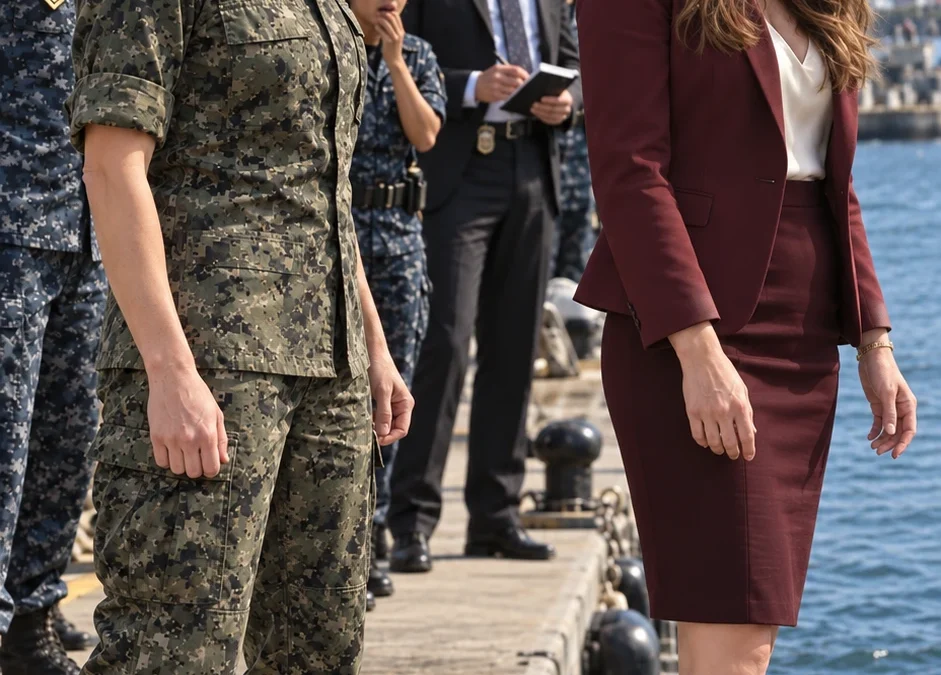
My Sister Threw My Work Bag Off a Navy Pier in Front of Sailors and Federal Agents. She Had No Idea I Was the Commander in Charge. 😳
Part 1
For 37 years, my sister told everyone I thought I was better than them.
I never corrected her.
Correcting her would have meant explaining why I left Rowan Oak at 18 and never came home. I wasn’t willing to explain that to people who had already decided who I was.
So Delphine attacked, and I retreated. Delphine performed, and I stayed quiet.
That was our pattern, and it held for almost four decades.
On June 3rd, 2025, at 0947, it broke. 💔
I was standing near the brow of a destroyer at Pier 12, Naval Station Norfolk. The Elizabeth River was flat and gray under a heavy, humid sky. The air smelled like diesel, salt, and hot concrete.
I had a clipboard in my hand and a leather work bag at my feet. Next to me stood Master Chief Ivo Kettleman and a civilian project manager named Rosalind Vega. We were arguing quietly about corrosion on a mooring cleat.
Then I heard heels on the concrete behind me.
Heels don’t belong on a working pier. Heels moving fast are a warning.
I turned because Master Chief Kettleman’s eyes had gone wide. His hand was drifting toward his radio.
Delphine was walking straight at me.
I knew that expression. She wore it when we were kids and she had decided I’d taken something that belonged to her. Her hair was frizzing in the humidity, and her mouth was already open before she reached me.
“You have got to be kidding me,” she said, loud enough that two contractors turned to stare. “You actually showed up here. You actually did it.”
I set my clipboard on an equipment crate, slowly and carefully. After 19 years of service, I’d learned that when something unexpected happens, you take anything breakable out of your hands.
“Delphine,” I said, keeping my voice level. “This is a secured work area. You need to step back.”
“Don’t you Delphine me.”
She was close enough now that I could smell her perfume, the same jasmine she’d worn since high school. It hit me like a memory I didn’t ask for.
“Bram told me you’d pull something like this. He said you couldn’t stand that I was working the Kellerman retirement event today. He said you’d find a way to ruin it.”
I had never heard the name Kellerman in my life.
But I could see it clearly. She had built an entire story in her head on the drive over, and she’d arrived fully prepared to perform it.
“I’m working,” I told her quietly. “I need you to leave the pier.”
“Working?”
She laughed. It was the bright, brittle laugh she used at family dinners right before she said something cruel.
“In your little costume, with your little clipboard, in front of my clients? You couldn’t let me have one day, could you, Marlo? You couldn’t just stay in your lane.”
Master Chief Kettleman stepped forward. I gave him the smallest shake of my head.
Not yet.
She was my sister. I would handle it.
“Delphine, I’m giving you one more chance to walk back to your car.”
That was when she lunged.
She snatched the strap of my bag off the crate with the practiced speed of an older sister who had spent our whole childhood taking my things. She held it up like a trophy and spun on her heel.
Then she marched toward the edge of the pier.
“Delphine, do not—”
“Do not what? Embarrass you? Isn’t that what you came here to do to me?”
“That bag contains federal property. Put it down.”
She looked back at me over her shoulder. And I watched a smile spread across her face.
I knew what she was going to do before her arm moved.
The bag sailed through the air and hit the river flat, with a sound like a slap. Then it sank almost at once, dragged down by the tablet inside.
Somewhere behind me, a young sailor whispered, “Oh my God.”
Out of the corner of my eye, I saw a man in a plain jacket quietly pull a small notebook from his pocket. I would learn later that he was Special Agent Corbin Ashford of NCIS.
Delphine turned back to me with her chin lifted, waiting.
She wanted tears. She wanted shouting. She wanted the little sister she had spent 37 years constructing in her head, the one who could always be made to feel small.
My heart was pounding.
But my voice came out steady.
“Master Chief,” I said, never taking my eyes off her. “Contact harbor patrol and request dive recovery for a lost item containing sensitive material. Then call base security and request an escort.”
“Aye, Commander.”
And there it was.
Delphine’s face changed. It was only a flicker, a tiny crack in the performance.
Her eyes dropped to the silver oak leaf on my collar. Then to the name tape over my pocket. Then back up to my face.
In 19 years, she had never looked at my uniform. Not at a single promotion. Not at a single ceremony. Not even at Mom’s funeral.
Looking would have meant admitting something.
“What did he just call you?” she whispered.
“He called me by my rank.”
“Your… rank?”
“Commander, United States Navy. I’m the officer in charge of this inspection. Every person on this pier is here because I authorized it. And you just committed a federal offense in front of all of them.”
The color drained from her face in stages. First her lips. Then her cheeks. Then her forehead.
Behind me, Agent Ashford cleared his throat.
What happened next still gives me chills. Part 2 is in the comments—or leave any word below and I’ll send it to you privately.
Part 2
Part 2 is in the comments—or leave any word below and I’ll send it to you privately.
“Commander Prescott,” Agent Ashford said gently. “With your permission, I’d like a conversation with this individual.”
I looked at my sister. She was staring at me as if she’d never seen me before.
In a way, she hadn’t.
“She’s my sister,” I said.
“Understood. My request stands.”
Every instinct I’d carried since childhood screamed at me to fix this, to smooth it over, to make it go away like I always had.
I let it pass.
“Permission granted.”
Two masters-at-arms appeared behind him. Delphine’s threats about suing the entire United States government dropped in volume by about half.
I didn’t watch her go. I picked up my clipboard and went back to work, because letting her take one more minute of my attention would have been a professional failure.
The dive team pulled my bag out of 18 feet of water by 10:30. The leather was ruined, and the tablet was almost certainly dead. The paperwork was pulp.
At 11:15, my phone rang. It was Captain Bramwell, my commanding officer.
When I finally told her the woman was my sister, the silence on the line lasted four full seconds.
“Marlo. I’m sorry. I know this is complicated.”
By afternoon, a JAG officer named Lieutenant Commander Per was explaining exactly how much trouble Delphine was in. Destruction of federal property carried up to 10 years.
And Delphine was already telling NCIS that I had been harassing her.
That I’d scheduled the inspection on purpose to wreck her catering gig.
That I used my rank to intimidate her.
I answered every question for two hours in a windowless room, in the same flat voice I used for after-action reports.
I said I hadn’t spoken to her in 20 months. I said I could prove every word with phone records.
For the first time in my life, I was saying it all out loud to someone with the power to do something about it.
That night, my phone started buzzing.
Aunt Maragold, in all caps: YOU’VE DESTROYED THIS FAMILY.
Cousin Pru, who hadn’t spoken to me in eight years: You’ve always been jealous of her.
Uncle Tavish: Call me now.
I ate buttered pasta standing at my kitchen counter and called none of them.
At 8:47 p.m., Delphine called. Then again at 8:49. Then 8:52. Then 8:56.
On the fifth call, she left a voicemail.
I played it once, on speaker, while recording it with a second phone. Some instinct told me I’d need a copy.
Her voice was shaking with rage.
“I lost my job because of you. I was fingerprinted like a criminal. You are going to call whoever you called and undo this. Or I swear to God, Marlo, I will tell every person we know what kind of person you really are. I’ll call the newspapers. I’ll call your commanders. I’ll tell everyone what you did to Mom.”
The message ended.
I sat very still.
What you did to Mom.
She’d never said that out loud before. Not once.
I transcribed it word for word, saved it in two places, and sent it to Lieutenant Commander Per.
I did not call her back.
The next morning at 0600, I watched the pier footage from four angles. It showed everything.
Her heels. My raised hands. The bag. That smile.
Then Captain Bramwell slid a printout across the conference table.
A local news site had run a story overnight. Delphine was quoted calling herself “traumatized.” She said she’d gone to the pier to reconcile, and that her sister, a base leader, had used rank to have her detained.
There was no mention of the bag.
No mention of the federal inspection.
Then Per leaned forward.
“Commander, her attorney called this morning. He says his client has significant information about you that could complicate things.”
Captain Bramwell’s eyes locked on mine.
“Marlo. Is there anything in your past that could be used against you? I need to know right now.”
I thought of my sealed-off childhood. My mother’s final year. Everything I’d never told anyone.
If you want to know what I said, LIKE this post and comment “RECORD.” When enough people comment, I’ll post Part 3.
Part 3
I looked at Captain Bramwell and told her the truth.
“No, ma’am. My record is clean. The worst thing anyone could say about me is that I keep to myself and I don’t call my family enough.”
She studied me for a long moment, then nodded.
“Then we treat the threat as noise,” Per said. “If he produces something, we respond. We don’t chase phantoms.”
I wish I could say I felt calm. I didn’t.
Because the secret Delphine was hinting at wasn’t a crime. It was something worse for someone like me: it was a story.
She had been telling it for years. In her version, I left because I thought I was too good for them. I abandoned our mother. I disappeared when the family needed me.
The truth was messier, and it was mine.
That Saturday, Aunt Maragold held what she called a “family meeting” in Rowan Oak. She told my brother Corwin to instruct me to attend, or the family would make decisions about me in my absence.
She wanted a formal cutoff.
I didn’t go. I drove to Richmond instead, to Corwin and his husband Teodoro’s brick house, and spent the weekend with a stack of books and a cat named Perl who decided I was acceptable.
Teodoro made shrimp and grits. We talked about everything except Delphine.
It was the most peaceful night I’d had in weeks.
Around 10:00, Corwin’s phone started buzzing. He read the messages, then set it face down.
“The meeting’s over.”
Aunt Maragold had opened by asking everyone to sign a letter cutting me off.
Uncle Tavish refused. So did two cousins. So did Pru.
Delphine fell apart when she realized the room wasn’t automatically hers. She screamed that nobody loved her, and Aunt Maragold told her to sit down and stop making a scene.
For the first time in my life, the story wasn’t holding.
On Monday, a new article ran. This one included the truth: that Delphine was under federal investigation for destroying federal property on a secured pier.
The comments turned. People asked why a woman would throw a naval officer’s bag into a river and then play the victim. Some demanded the surveillance footage.
I asked Per to make sure it was never released unless the law required it.
It would have been Delphine’s ultimate humiliation. And as much as she’d earned it, I couldn’t take pleasure in that.
On June 11th, she was formally charged: destruction of federal property and trespassing on a military installation. The tablet alone was worth about $14,000.
Delphine didn’t have $14,000.
I sat in my office thinking about her kids, my nephew and my niece, and a mortgage that would suddenly be at risk.
“Per,” I said. “Is there any way to reduce the restitution?”
“Ma’am, are you asking as her sister, or as the victim?”
“As someone who doesn’t want those kids to lose their house.”
He was quiet. Then he said something I’ve never forgotten.
“Your sister needs consequences. Not because you want to punish her, but because she’s never had to face any. If you soften this too much, she’ll read it as another rescue. If you let it run its course, this might be the first time anyone has held her accountable. It might be the best thing that ever happens to her.”
I had three older sisters, ma’am, he added with a small smile.
I let it run.
A week later, I came home from the Outer Banks to find a note taped to my apartment door, in handwriting I hadn’t seen in seven years.
It was from Bram, my brother-in-law.
I’ve spent 17 years listening to Delphine describe you in ways I now realize weren’t accurate. Two years ago she started therapy. She quit after four sessions and was angry for weeks. I think the therapist told her something she didn’t want to hear. I’m not asking you to withdraw the charges. I’m not asking you for anything. I’m only telling you I’m sorry it took this for me to see clearly.
I read it three times. Then I filed it away without deciding what it meant.
Soon after, the prosecutor asked whether I’d agree to a mediated conversation with Delphine before the hearing. She had requested it.
I gave myself a week.
In that week, I did four things.
I called a therapist, Dr. Kalista Mendel, who specialized in family estrangement.
I reread every message Delphine had sent me since 2009, and I finally saw the pattern. She asked, demanded, attacked if I said no, and accused me of abandonment if I said nothing. In 16 years, she had asked how I was exactly once.
I wrote down everything I’d never said to her. It ran four pages. When I read it back, I realized most of it wasn’t anger.
It was grief.
And I said yes.
The mediation room was small and neutral, with a pitcher of water and a box of tissues nobody wanted to admit they’d need.
Delphine arrived thinner than I remembered. She tried to interrupt me in the first minute.
“If you can’t let me finish,” I told the mediator, “I’ll end this session.”
Delphine went quiet.
I spoke for 17 minutes.
I told her about the dress she cut to pieces. The $20 she took and blamed on me. The rumors she spread about my health. The lies she told our relatives about my Naval Academy acceptance. How she blamed me for Dad’s death, and the lies she told about my support for Mom at the end.
I told her I’d stayed away because staying meant surviving her.
“I won’t lie for you in court,” I said. My voice cracked and I let it. “But I won’t hate you either.”
Then I watched my sister break.
She cried, and she didn’t perform it. She admitted all of it. She said she’d been jealous of me for as long as she could remember.
And then she said something that took the air out of the room.
“Mom was proudest of you, Marlo. She told me. And I hated you for it.”
I sat there, stunned, and I didn’t forgive her.
But I heard her.
“I heard you,” I said. “I’m just not ready to say more.”
Afterward, I walked out into the parking lot and felt like I’d set down something I’d carried since I was fourteen.
Delphine took the plea deal: $14,600 in restitution, probation, and community service. Then she did something no one expected.
She asked the court to require her to attend therapy.
On July 20th, two days before sentencing, a three-page handwritten letter reached me through Per. It wasn’t a general apology. She listed every specific thing she remembered doing to me, and apologized for each one separately.
She didn’t ask me to forgive her. She wrote that forgiveness wasn’t owed.
The last paragraph read:
If you ever want a different kind of relationship, one built on truth instead of the story I made up about us, I will be here. I will do the work. I have already started. I’m sorry it took throwing your bag into the river to make me see it.
I folded the letter and put it beside Bram’s note.
At the sentencing on July 22nd, Judge Corona Vale read my written victim statement in silence. It ended with one sentence:
I don’t seek additional punishment beyond the agreed sentence. I ask only that the court require her to complete the therapy she requested, so this may be the last incident of its kind.
Then Delphine stood.
“Your Honor, I understand this wasn’t just an incident on a pier. It was the last in a long line of choices I made to hurt my sister. I’m sorry, Marlo.”
Judge Vale ordered two years of probation with weekly therapy and monthly reports to the court.
The gavel came down at 10:42.
As we filed out, Delphine turned in her seat. Our eyes met across the aisle.
I didn’t smile.
I nodded once.
She nodded back.
That was all. And somehow it was everything.
The months that followed were quiet in the best way. I kept working. I kept seeing Dr. Mendel. I flew to Guam for an exercise and came home sunburned with a strong report.
In October, I finally wrote Delphine back, three months after her letter.
I heard your apology and I believe you meant it. I’m not ready for a relationship, and I don’t know if I ever will be. But I’m leaving a door slightly open.
She never answered. That was the right answer.
Bram sent a Christmas card with a photo of the kids and two words: Thank you.
In January, I learned I’d been selected for captain. Rosalind Vega sent me bourbon with a note reading, From one hard-headed woman to another. Master Chief Kettleman reminded me the Chiefs’ mess still had a fund for a new bag.
In February, my phone buzzed with a text from Delphine. It was a photo of my nephew Nolan, 10 years old, with my father’s eyes, holding a second-place ribbon for a science project on ocean currents.
He picked it because he wanted to be like his aunt in the Navy.
I stared at it for a long time.
Tell him second place is a great result, I wrote. And that he can visit a real ship one day if his mom wants to bring him.
Really?
Really.
In April, I pinned on my fourth stripe. Delphine didn’t come, but a small arrangement of white roses was waiting in my office with a card: From your sister.
In May, Bram brought Nolan and six-year-old Piper to the base. Delphine had asked if the kids could come without her. I said yes.
Piper wore my hat for most of the tour. At the end of the day she hugged me around the waist and said she loved me.
“I love you too,” I told her.
And I meant it. I realized I hadn’t said those words to anyone in my family since my mother died.
Over the roof of his car, Bram told me Delphine was 14 months into therapy and hadn’t missed a session.
“Tell her I know,” I said.
I stood in that parking lot for a long time after they drove away.
Here’s what I learned.
For 37 years, I believed silence was strength. For a while, it was. It kept me safe and let me build a life.
But somewhere along the way, silence stopped protecting me and started protecting her. It let her stay exactly who she was without ever seeing the cost.
You don’t have to explode to be heard. You don’t have to be cruel to be honest. You don’t have to burn a relationship down to set a boundary.
But at some point, you have to speak. The people who hurt you are counting on your silence, and the moment you speak, even once, even calmly, the story they’ve been telling starts to fall apart.
My sister threw my bag off a pier because she expected me to react the way I always had: small, quiet, contained.
Instead, I let the truth stand on its own and let the consequences follow.
I don’t know what we’ll be in five years. We might never be close.
But we’re talking now, carefully, in small doses. And we’re both different people than we were on June 3rd.
That’s enough for me.
If someone in your life has spent years telling a false story about who you are, you don’t have to keep letting them tell it.
You don’t have to shout. You don’t have to fight.
You just have to be willing to speak when the moment comes.
And it will. ❤️
Disclaimer: This story is entirely fictional and created for entertainment purposes only. It does not represent any organization or individual, nor does it encourage inappropriate behavior. The content was generated with AI assistance.








