MY UNCLE TRIED TO PAY HIS DEBT WITH ME AT MY OWN WEDDING—THEN THE “TOWN DRUNK” WHISPERED SIX WORDS THAT CHANGED EVERYTHING
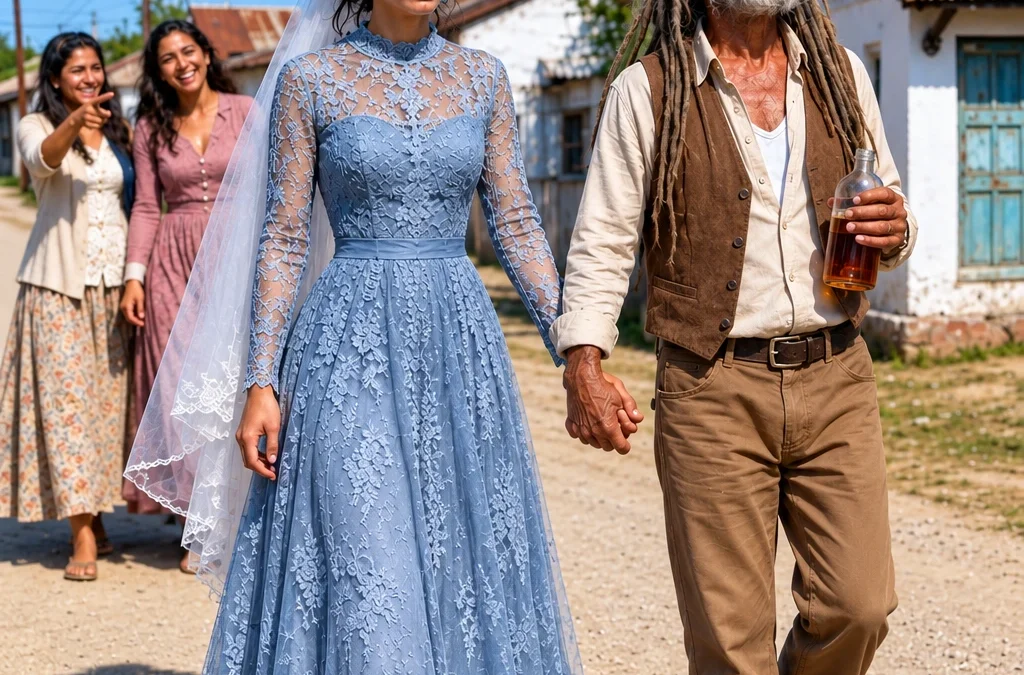
MY UNCLE TRIED TO PAY HIS DEBT WITH ME AT MY OWN WEDDING—THEN THE “TOWN DRUNK” WHISPERED SIX WORDS THAT CHANGED EVERYTHING 😳
Part 1
The moment my uncle raised his wineglass in front of seventy people and announced that his debt had finally been “settled” because I was marrying the most despised drunk in town, I understood something horrifying.
This was not my wedding.
It was my public humiliation.
My name is Lucía Ortega. I was twenty-two years old, standing inside the municipal hall of San Bartolomé de la Vega in Castilla-La Mancha, wearing a simple white dress my aunt Pilar had chosen because, according to her, “there was no reason to waste money.”
Around me were paper tablecloths, trays of tortilla, croquettes, ham, cheap wine, and almost every neighbor who had watched me grow up.
Some were smiling.
Some were whispering.
A few were laughing.
And near the open window stood the man I had supposedly agreed to marry.
Daniel Montalvo.
Thirty-five years old.
Unshaven.
Wrinkled shirt.
Bottle in one hand.
For almost a year, people had called him the Shipwreck.
They said he sometimes slept in an old van beside an abandoned warehouse. They said he repaired machinery for almost nothing. They said he had once been successful but had destroyed his life and now spent his days drinking whatever he could afford.
Nobody understood why Daniel wanted to marry me.
But my uncle Ramón and aunt Pilar looked relieved.
Too relieved.
My parents had died in an accident when I was sixteen. Ramón became guardian of me and my younger brother, Diego. He also took temporary control of everything our parents had left us: our family house, twelve hectares of olive and almond trees, agricultural equipment, and savings.
At least, there had once been savings.
For six years, whenever I asked where the money had gone, Ramón gave me the same explanation.
Taxes.
Bad harvests.
Repairs.
Debts.
“You should be grateful,” Pilar would tell me. “Without us, you and Diego would have nothing.”
I worked anyway.
I harvested olives.
I sold oil and almonds in markets around Toledo and Talavera.
I delivered orders.
I kept accounts whenever Ramón allowed me to see them.
And I raised Diego as best I could.
But I never saw the complete financial records.
Then Arturo Valcárcel entered our lives.
Valcárcel was a builder, an informal lender, and the kind of man who always seemed to know which farmland would suddenly become valuable before anyone else did.
Ramón owed him €92,000.
His machinery business was collapsing.
The bank refused to lend him more.
And Valcárcel wanted payment.
A week before the wedding, I overheard Ramón and Pilar arguing behind the kitchen.
“The parcel beside the road won’t cover everything,” Ramón said.
“Then give him what he wants,” Pilar replied.
“It’s in Lucía’s name.”
Silence.
Then my aunt said the sentence I would never forget.
“Then make her sign. And if Daniel wants a wife, even better. For once, let that girl get us out of a problem.”
My stomach turned cold.
The marriage itself wouldn’t legally erase Ramón’s debt.
Their real plan was worse.
They wanted me to sign documents transferring rights over part of my land while I was overwhelmed by the wedding.
Ramón knew exactly how to make me cooperate.
Diego.
“If you refuse,” he warned me, “I’ll send your brother to relatives in Murcia. And don’t assume this house will still be here when you come crawling back.”
I believed him.
So I agreed to the wedding.
Not because I loved Daniel.
Not because I wanted him.
Because I was terrified of losing the only family I had left.
And now seventy people were watching my uncle celebrate as if he had sold an old tractor.
Ramón lifted his glass higher.
“To Daniel!” he shouted.
Laughter erupted.
Someone yelled, “At least Lucía will keep him sober!”
More laughter.
Pilar pressed one hand against my back and pushed me gently toward my future husband.
“Smile,” she hissed.
I looked at Daniel.
His head was lowered. His shoulders sagged. The bottle hung loosely between his fingers.
I felt anger rising inside me.
Was this really what my life had become?
A payment?
A burden handed from one man to another?
Then something changed.
Daniel stopped swaying.
His shoulders straightened.
And when he raised his eyes to mine, I forgot how to breathe.
They were completely clear.
Not glassy.
Not unfocused.
Clear.
Alert.
Calculating.
He leaned close enough that nobody else could hear.
“From now on,” he whispered, “don’t sign anything.”
For one second, the entire room seemed to disappear.
“What did you say?”
Daniel immediately bent his shoulders again.
He raised the bottle.
Someone laughed.
Then, without looking at me, he murmured:
“This wedding isn’t your trap, Lucía.”
I stared at him.
“It’s theirs.”
My heart slammed against my ribs.
Before I could ask what he meant, Ramón appeared beside us carrying a folder.
“Perfect,” he said brightly. “Now that everyone’s together, there are only a few little papers left.”
He placed the folder on the table.
A pen rolled toward me.
I recognized the name of my family’s northern parcel on the first page.
Daniel’s hand suddenly covered mine beneath the table.
“Don’t.”
Ramón’s smile tightened.
“Lucía?”
“I want to read it.”
The room became strangely quiet.
Pilar stared at me as though I had slapped her.
“Don’t embarrass us.”
“I said I want to read it.”
Ramón leaned closer.
His voice dropped.
“Think about Diego.”
That was when Daniel staggered forward dramatically, knocking a glass onto the table.
Wine spilled everywhere.
People shouted.
Ramón cursed.
And in the confusion Daniel snatched the document, folded it once, and slipped it beneath his jacket.
Nobody noticed except me.
Twenty minutes later, I was legally married to a man everyone believed was drunk.
But I signed nothing else.
That night Daniel took me to the small house beside the warehouse where everyone assumed he lived in chaos.
The moment the door closed behind us, I realized the entire town had been fooled.
There were no piles of empty bottles.
No filthy clothes.
No stench of alcohol.
The house was spotless.
Folders were arranged by date.
Maps covered one wall.
A laptop sat beside a printer.
And inside a locked cabinet were files labeled with names I recognized.
RAMÓN ORTEGA.
ARTURO VALCÁRCEL.
Two local businessmen.
A councilman.
A notary office in Toledo.
Then I saw another folder.
My name was written across it.
LUCÍA ORTEGA.
My hands began shaking.
I opened it.
Inside was a copy of my father’s will.
The twelve hectares were still mine.
Ramón’s authority to manage them had ended when I turned eighteen.
Four years ago.
Beneath the will was a valuation report for the northern parcel.
I looked at the number twice.
€480,000.
Not the pathetic amount Ramón had claimed.
Not remotely.
I turned toward Daniel.
“Who are you?”
He put the bottle on the table.
For the first time, he spoke without slurring.
“Someone who’s been waiting for your uncle to make a mistake.”
My throat tightened.
“And me? What was I?”
Daniel hesitated.
That hesitation hurt more than an insult.
“At first?”
He looked directly at me.
“A way to get close to Ramón.”
I grabbed my handbag.
“You used me.”
“Yes.”
I reached the door.
Then headlights swept across the curtains.
One car stopped outside.
Then another.
Daniel’s entire expression changed.
He switched off the lamp.
“Don’t move.”
“What’s happening?”
He quietly opened the cabinet and looked inside.
His face went pale.
“One file is missing.”
“What file?”
“The one proving your uncle tried to sell land he never owned.”
Footsteps crossed the gravel outside.
Daniel looked toward the door.
Three hard knocks hit the door.
👉 Part 2 in the comments — leave ANY word and I’ll send it to you privately
Part 2
Three hard knocks hit the door.
Daniel raised one finger to his lips, then moved toward the window. “Valcárcel knows the file is missing.” My stomach tightened. “Then give it back.” Daniel turned. “Lucía, that file may be the only thing stopping them from taking everything your parents left you.”
Before I could answer, someone knocked again.
“Daniel!” Ramón shouted from outside. “Open the door.”
My uncle.
I felt something inside me break.
All evening I had feared Daniel. Now the familiar voice outside frightened me more.
Daniel gathered several documents and pushed them into a large envelope. “Go through the back door. Teresa lives opposite the church. Give her this.”
“And you?”
“I’ll keep them here.”
“No.”
His eyes narrowed. “Lucía—”
“I’m tired of everyone deciding what I’m allowed to know.”
For the first time that night, Daniel had no reply.
He opened the door.
Arturo Valcárcel stood outside in a dark coat, immaculate shoes and a calm smile. Ramón was beside him. Two large men waited near the cars.
“What a wedding,” Valcárcel said. “And what a wedding night.”
Then he looked directly at me.
“I hear the bride has been reading documents that don’t belong to her.”
Ramón stepped inside.
“Lucía. Come home.”
I almost laughed.
“Which home? The one you were going to use as collateral, or the land you tried to sell?”
His face hardened instantly.
“Everything I did was to save this family.”
“Or your business?”
Valcárcel placed a folder on the table.
“Enough drama. This is simple. Sign the ratification of sale for the northern parcel. Your uncle clears part of his debt. Tomorrow everyone wakes up happier.”
I read the document.
Four hectares.
Sale price: €165,000.
But the report in Daniel’s cabinet valued it at more than €480,000 because a new logistics connection near the motorway had dramatically increased surrounding land prices.
Ramón wasn’t saving my inheritance.
He was selling it cheaply to save himself.
“No.”
Ramón stepped toward me.
“Don’t act like a child. Diego depends on me.”
Daniel dropped his bottle.
It hit the floor with a dull thud but didn’t break.
Everyone turned.
Then Daniel slowly straightened.
The drunken posture vanished.
The sleepy eyes disappeared.
Even his voice changed.
“That’s enough.”
Valcárcel stared at him.
“Who the hell are you?”
Daniel reached into his jacket and removed a phone.
“Did you get all that?” he asked.
A voice came through the speaker.
“Every word.”
Valcárcel’s smile vanished.
Ramón staggered backward.
Daniel looked at me.
And suddenly I realized the bottle he had carried for months had never smelled like alcohol.
“What is going on?” I whispered.
Daniel opened his mouth.
But Valcárcel lunged toward the table.
Daniel moved faster.
He seized the envelope.
Ramón shouted.
The two men outside rushed toward the door.
And then blue lights flooded the entire room.
Sirens.
Car doors.
Boots on gravel.
Daniel looked through the window and said six words that made Ramón collapse into a chair:
“They’ve been waiting for this moment.”
👉 LIKE this post or comment “TRUTH” if you want Part 3. When we hit enough comments, I’ll post the ending.
Part 3
The blue lights flashed across the walls, turning every face in the room pale.
For several seconds, nobody moved.
Then two Guardia Civil vehicles stopped outside the house.
A dark unmarked car pulled in behind them.
Doors opened.
Officers stepped onto the gravel.
Valcárcel looked at Daniel as if seeing him for the first time.
Ramón’s lips trembled.
“What have you done?”
Daniel didn’t answer him.
Instead, he placed the envelope on the table and looked at me.
“Stay where you are.”
“No.”
He blinked.
“No?”
I was shaking, but I had spent six years being told where to stand, when to speak, what I could know, what I owed, what I had to sacrifice.
I wasn’t doing it again.
“I’m staying because I want to.”
Something changed in Daniel’s expression.
He nodded.
Not approval.
Acceptance.
The front door opened.
Several officers entered along with two investigators in plain clothes.
One of them looked at Daniel.
“Montalvo Sanz?”
Daniel nodded.
That name meant nothing to me.
But Valcárcel reacted.
“You…”
Daniel turned toward him.
“My full name is Daniel Montalvo Sanz.”
The investigator took possession of the documents.
Then Daniel told me the truth.
Two years earlier, the agricultural transport company he ran had noticed something strange.
Several farms along transport routes had been sold far below market value shortly before infrastructure announcements caused their value to explode.
The same names appeared again and again.
Companies connected to Arturo Valcárcel.
Families who claimed they hadn’t understood the documents they signed.
Suspicious valuations.
Questionable powers of attorney.
Loans structured so aggressively that landowners had almost no chance of escaping them.
Daniel had started cooperating quietly with investigators.
But they had a problem.
Everyone was careful around officials.
Everyone was careful around businessmen.
Everyone was careful around lawyers.
Nobody was careful around the town drunk.
So Daniel rented the warehouse.
Stopped shaving.
Drove an old van.
Started accepting cheap repair jobs.
And carried a bottle everywhere.
“What was in it?” I asked quietly.
“Cold tea.”
Despite everything, I almost laughed.
Almost.
He had fooled an entire village because people saw what they expected to see.
A failure.
A drunk.
A man beneath their notice.
And once they stopped respecting him, they stopped guarding their words around him.
Valcárcel pointed toward Daniel.
“You think playing dress-up makes you a detective?”
“No,” Daniel replied. “The recordings don’t matter nearly as much as the forged authorizations, altered valuations, cross-transfers and witness statements.”
“How many witnesses?”
“Nine.”
For the first time, Valcárcel looked afraid.
But I was staring at Daniel.
One question mattered more than all the others.
“And the wedding?”
Silence.
Valcárcel gave a short laugh.
“Yes, Daniel. Tell your bride the romantic part.”
Daniel looked at me.
He could have lied.
He could have said he married me to rescue me.
He could have transformed himself into the hero of the story.
He didn’t.
“Ramón suggested it.”
My stomach tightened.
“He thought I was desperate enough to accept almost anything. He wanted someone to ‘take responsibility for you’ while he pressured you to sign away the northern parcel.”
“And you agreed.”
“Yes.”
“Why?”
“Because marrying you got me closer to Ramón. It kept Valcárcel confident. And I believed I could stop the sale before you signed.”
The room seemed suddenly colder.
“So I was part of your investigation.”
“At first.”
Those two words cut deeply.
I looked away.
“You used me.”
“Yes.”
No excuse.
No beautiful speech.
No attempt to pretend otherwise.
“You could have told me.”
“If Ramón suspected you knew anything, I believed he might destroy the evidence.”
“You believed?”
Daniel’s jaw tightened.
“And I thought he might use Diego.”
I stared at him.
“So instead, you let me be terrified for real.”
“Yes.”
For some reason, that answer hurt more because it was honest.
Valcárcel slammed his hand onto the table.
“This conversation proves nothing.”
Daniel looked at him.
“You’re right.”
Valcárcel paused.
Daniel continued.
“But the financial records do.”
One of the investigators began placing documents inside evidence bags.
Ramón sank deeper into the chair.
And as I watched him, something extraordinary happened.
He suddenly looked small.
For years, Ramón had filled every room.
His anger controlled dinner.
His debts controlled our future.
His threats controlled my decisions.
But now he was simply a frightened man sitting beneath flashing blue lights.
He looked at me.
“Lucía…”
I stepped away.
“No.”
“Listen to me.”
“I’ve listened to you for six years.”
“I was trying to protect the family.”
“No.”
My voice surprised even me.
“You were trying to protect yourself.”
His eyes filled with something that may have been shame.
Or fear.
At that moment, I didn’t care which.
The following weeks uncovered more than I could have imagined.
The farm had never been the hopeless financial ruin Ramón described.
There had been difficult years, yes.
But there had also been profits.
Profits Ramón had diverted into his struggling used-tractor business.
When his losses grew, he borrowed from Valcárcel.
Then he began offering assets as security.
My assets.
Pilar knew much more than she later admitted.
She had helped pressure me whenever signatures were needed.
She had repeated that I should be grateful until gratitude began to feel like a debt I could never repay.
Even Diego had been threatened.
When investigators spoke with him, he admitted Ramón had told him more than once:
“If your sister creates trouble, you’ll be living in Murcia before the week ends.”
Diego packed two backpacks.
Then he came home with me.
Our real home.
The house our parents had left us.
The first night, we ate tomato bread, cheese, and an overcooked tortilla because I forgot the pan while trying to understand six years of bank statements.
There was no new furniture.
No television in the sitting room.
No certainty about what would happen next.
But halfway through dinner, Diego started laughing.
“What?”
He shook his head.
“Nothing.”
“Diego.”
He looked around the kitchen.
“It’s just the first time this house actually feels like ours.”
I turned toward the sink before he could see me cry.
I didn’t see Daniel for three weeks.
Part of me was grateful.
Another part hated that I wondered where he was.
Then one afternoon, while I was checking irrigation lines in the olive grove, I saw him walking toward me.
No bottle.
No slouch.
Clean shirt.
Trimmed beard.
He stopped several meters away.
“I spoke to your lawyer.”
I closed my notebook.
“Why?”
“There are grounds to seek an annulment or challenge the marriage based on the circumstances surrounding your consent.”
“And you’ll agree?”
“I’ll sign whatever is required.”
I watched him carefully.
“You want the marriage ended?”
Daniel looked across the trees.
“I want it to stop being a decision somebody else made for you.”
The answer unsettled me.
During our so-called wedding night, he had slept on the sofa.
He had handed over copies of everything he had collected.
He offered access to lawyers but never insisted I use them.
He never came to the house without permission.
He never pretended what he had done was harmless.
But one truth remained.
He had used me.
“When did I stop being a piece of your investigation?”
He looked at me.
“Before the wedding.”
“When?”
“The day you gave Teresa back forty euros.”
I frowned.
Teresa, my former teacher, once bought several containers of olive oil and deliberately overpaid by forty euros.
She knew money was tight.
I had gone to her house the following day and pushed the difference beneath her door.
“You knew about that?”
“I was outside repairing her generator.”
“So?”
“So Ramón controlled your accounts. He controlled nearly everything. But somehow he never taught you to take advantage of people.”
I folded my arms.
“That was enough?”
“No.”
Daniel glanced toward the farmhouse.
“I watched you protect Diego. I watched you work markets in the rain while Ramón told everyone he was supporting you. I started looking for a way to get you both out without destroying the investigation.”
“And you didn’t find one.”
“No.”
“So you chose the investigation.”
“Yes.”
The word landed between us.
I was angry.
But strangely, I also felt calm.
For six years, people had lied to me supposedly for my own good.
Daniel was finally giving me something ugly and complete.
The truth.
“Do you regret it?”
“Helping expose Valcárcel? No.”
He paused.
“Making you pay part of the price without knowing what was happening? Every day.”
He didn’t ask me to forgive him.
Maybe that mattered.
I decided not to begin annulment proceedings immediately.
Not because I had forgiven Daniel.
I hadn’t.
Not because I was in love with him.
I didn’t even know what love between us could mean yet.
I waited because I had spent too many years making decisions with a threat behind me.
For once, I wanted to learn what I chose when nobody was pushing.
A month later, Ramón asked to see me.
I agreed to meet at a café in Toledo.
My lawyer sat nearby.
Ramón looked older.
Smaller.
Tired.
“I never wanted to hurt you.”
I looked directly at him.
“You wanted to save what belonged to you by using what belonged to me.”
“I was desperate.”
“So was I.”
“You’re my niece.”
“That didn’t give you the right to sell my life.”
His eyes dropped to the table.
“Can you ever forgive me?”
I thought about everything.
The markets in winter rain.
The accounts I was forbidden to see.
Diego lying awake wondering if he would be sent away.
The wedding.
Seventy people laughing while Pilar pushed me toward a man everyone believed was worthless.
“Today?”
I stood.
“No.”
Then I walked out.
That “no” became one of the most important words I ever said.
Not because it was cruel.
Because for once, it wasn’t designed to make somebody else comfortable.
Three months later, Daniel told me he was returning to Madrid.
His role in the investigation had become minimal, and his transport business needed him back.
The afternoon before he left, I found him sitting on a hill overlooking San Bartolomé.
“You leave tomorrow?”
“Seven ten.”
I raised an eyebrow.
“Very punctual for an alcoholic.”
He smiled.
“I’ve made progress.”
I sat several feet away.
For a while, neither of us spoke.
The silence wasn’t romantic.
It wasn’t hostile.
It was simply honest.
Finally, I asked:
“What happens to us?”
Daniel thought for a moment.
“You decide.”
I groaned.
“I hate that sentence.”
“I know.”
“For six years, everyone made decisions for me. Now suddenly everyone keeps telling me I’m free, as if opening the cage automatically tells the bird where to fly.”
Daniel looked toward the town.
“Freedom can be frightening.”
I studied him.
“I don’t forgive everything.”
“I know.”
“I don’t want to become some poor village girl saved by a rich businessman.”
“Then don’t.”
“And I will never again be part of one of your plans without knowing.”
“Never.”
I believed he understood exactly what that meant.
Below us stood the municipal hall.
The place where seventy people once watched me being handed away as though I were property.
From the hill, it looked tiny.
So did the village.
So did everything that had once seemed powerful enough to determine my entire life.
“I’m not seeking an annulment yet,” I said.
Daniel’s face remained still.
“This isn’t a promise.”
“I know.”
“It isn’t forgiveness.”
“I know.”
“I want to find out what I choose when nobody pressures me.”
He nodded.
Then I held out my hand.
Not as his wife.
Not as a debt.
Not as Ramón Ortega’s niece.
Not as the frightened girl who had accepted a wedding to protect her brother.
As myself.
Daniel took my hand gently.
And he didn’t pull me closer.
That mattered.
In San Bartolomé, people told the story for months.
They said the town drunk had secretly been wealthy.
They said Daniel Montalvo had saved poor Lucía Ortega from her terrible relatives.
Teresa always corrected them.
“No,” she would say.
“He opened a door.”
Then she would smile.
“Lucía was the one who walked through it.”
Two years later, I had recovered control of the accounts and transformed our farm into a small olive-oil operation employing fourteen people permanently.
Diego began studying agricultural engineering.
Daniel continued traveling from Madrid.
There were no dramatic declarations.
No instant fairy-tale ending.
We learned each other slowly.
Outside fear.
Outside surveillance.
Outside lies.
Another year passed before I finally decided what I wanted regarding the marriage.
I kept it.
But this time there were clear marital agreements.
Separate property.
Independent accounts.
Full legal advice.
And when the documents were placed before me, I read every page.
Every paragraph.
Every number.
Nobody hurried me.
Nobody mentioned Diego.
Nobody threatened to take my home.
Nobody told me what a grateful woman should do.
When I finally signed, Daniel looked at me.
“Certain?”
I smiled.
“Yes.”
Then I pointed my pen at him.
“And if you ever pretend to be drunk again, you’re sleeping in the warehouse.”
Daniel nodded solemnly.
“Fair.”
But the truth is, my life didn’t begin again on that day.
It didn’t begin when Valcárcel lost control of his companies.
It didn’t begin when Ramón finally had to answer for what he had done.
It didn’t begin when our neighbors stopped looking at me with pity.
My new life began much earlier.
At the most humiliating moment of my life.
Inside a crowded municipal hall.
When seventy people thought they were watching a young woman being handed over to settle someone else’s debt.
Because two lies died that afternoon.
The first was the lie that Daniel Montalvo was a broken man.
That lie fooled an entire village.
But the second lie was far more dangerous.
It was the lie that my uncle had repeated for six years.
That gratitude meant obedience.
That family gave him ownership over my choices.
That protecting my brother required sacrificing myself.
That because other people had paid bills, made decisions and spoken loudly, I had somehow lost the right to control my own life.
That lie almost stole everything from me.
My home.
My inheritance.
My future.
My voice.
But in the end, the most valuable thing I recovered was not the land worth €480,000.
It was the ability to say one simple sentence and mean it:
I choose.
And once I learned how to say those words, nobody could ever turn me into a debt again. ❤️
Disclaimer: This story is entirely fictional and created for entertainment purposes only. It does not represent any organization or individual, nor does it encourage inappropriate behavior. The content was generated with AI assistance.








