NEIGHBORS LAUGHED AT THE FAT WIDOW’S STONE HUT — THEN THE BLIZZARD CAME, AND WHAT HAPPENED NEXT LEFT THEM ALL SPEECHLESS
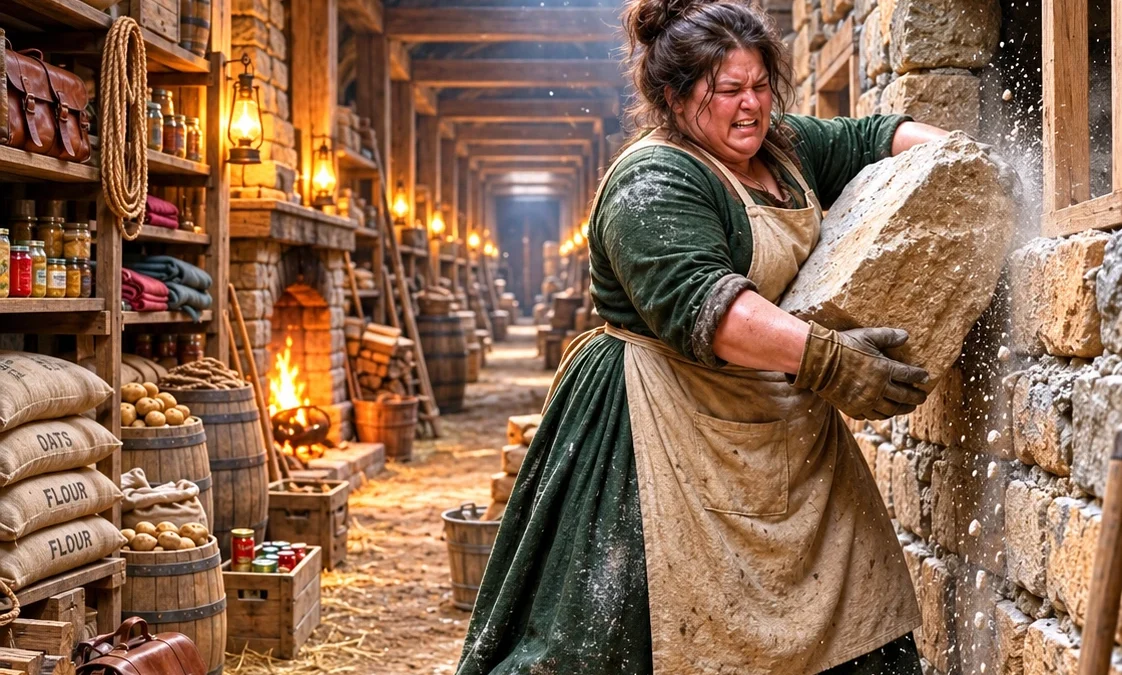
NEIGHBORS LAUGHED AT THE FAT WIDOW’S STONE HUT — THEN THE BLIZZARD CAME, AND WHAT HAPPENED NEXT LEFT THEM ALL SPEECHLESS 😢❄️
Part 1
October 1884, Sage Hollow, Wyoming Territory.
The kind of morning where the wind held its breath and frost did all the talking.
Eight-year-old Silas Wickham reached for the tin cup beside his bed.
Where water should have been, his fingers found solid ice.
It cracked like a tiny window when he pressed it.
“Mama… it’s frozen solid.
And it’s not even November.
”
Hattie Wickham didn’t turn from the stove.
At 34, she stood 5’7” and weighed nearly 370 pounds.
When she walked across the cabin floor, the pine boards groaned — boards her husband Jonas had laid with his own hands.
Jonas had built every wall, every beam, this whole cabin, promising the land wouldn’t break them.
Then a freight wagon broke him instead.
Silas held up the shard of ice.
“Papa said the hardest winters come when the geese leave early.
”
Hattie’s hand rested on the iron stove.
Every log she fed it was money she’d never earn back.
Last winter, she’d burned a kitchen chair, half a wagon bed, fence rails — anything to keep her children breathing.
Five-year-old Addie slept curled under quilts in the corner.
Old Barrow, Jonas’s sheepdog, lay at the door, half-blind but still watching like his master might walk through at any moment.
She looked at her shrinking wood pile… then at the ridge behind the cabin, where gray stone pushed through the dead grass… then at her own hands — large, scarred, hands the whole town whispered about.
At Jonas’s funeral, Prudence Halloway — the banker’s wife, perfect in black lace — had leaned close and whispered loud enough for Silas to hear: “Poor Jonas.
Married a woman twice his size.
No wonder his heart gave out.
”
After that, they stopped calling her Hattie.
They called her “the big widow.
” “The ridge cow.
” Worse.
Children crossed the street.
Shopkeepers looked away.
That July, a letter arrived from Colorado.
Her father had died.
Inside the package was his old leather book — sketches, plans, thick stone walls, shelters dug into hillsides, built to withstand mountain storms.
He’d spent his life building places where men survived when the world froze.
But one page was torn clean out.
The only line left read: “My daughter, if you ever read this, never…”
Silas leaned in.
“Grandpa built houses out of rock? Can we?”
Hattie stared at the ridge.
By noon, she’d made her choice.
She started hauling stone.
Lifting blocks grown men strained to move.
Setting them one by one.
Word spread like wildfire.
Bo Coulter, the richest rancher, rode out to mock her: “Timber is what sensible folks build with, Hattie! Stone’s madness!” When she asked him why he’d never offered Jonas help when he was alive, he rode away red-faced.
Prudence Halloway took charge next.
At her weekly tea, she told the town wives: “No more help for her.
No eggs, no tools, no playdates.
We must teach our daughters better than to follow such an example.
”
Overnight, Silas sat alone at school.
His best friend moved her desk away.
No one spoke to him.
When Hattie went to the mercantile for lime, the shopkeeper wouldn’t meet her eye.
“Sold out,” he lied — and she knew Bo had gotten there first.
That night, she counted every cent she had left: $6.
40.
Enough for lime, not enough to hire a wagon.
Before dawn, she kissed her sleeping children, left a note saying Gone for supplies — back tomorrow, and walked out into the freezing dark.
Sage Hollow to Rock River was 20 miles.
Another 20 back.
Forty miles there and back, alone, carrying 50 pounds of lime.
No one stopped to give her a ride.
The Coulter hand who passed her looked straight ahead and whipped his horse faster.
She ate half her bread at midday, rested in the lee of a rock, and kept walking.
Her legs burned.
Her feet went numb.
When she reached Rock River, the storekeeper — a man named Belle who didn’t know Bo Coulter — weighed out the lime and took her money.
When she said she was walking back, he pushed her nickel change across the counter.
“You didn’t buy lime here today.
You bought strength.
”
The return journey was worse.
The wind turned.
Rain turned to sleet.
She wrapped Jonas’s coat around the sacks of lime and walked on in her thin wool shirt, shivering so hard her teeth chattered.
Ten miles from home, she sat down on a stone and cried — quiet tears, the kind she hadn’t let fall since Jonas died.
She thought of Silas carrying buckets alone.
Addie watching the other children play.
Prudence’s voice.
Bo’s laughter.
She stood up.
Hoisted the weight.
Kept going.
She stumbled into the yard after dark, knees buckling, covered in mud and frost.
Silas ran out barefoot and sat beside her in the dirt, placing his small hand over hers.
“You got it.
”
“I got it.
”
For weeks they built.
Then a stranger rode in — Wendell Ashcraft, a carpenter from Denver.
He didn’t laugh.
He walked the walls, touched the stone, checked the mortar, and turned pale.
“Who taught you this?”
“My father.
He built mining shelters in Colorado.
”
Wendell went quiet.
“I heard of a man who built a bunkhouse that saved 12 men when the pass closed.
That was him.
He built well.
”
“But you’re in danger.
When snow melts on your roof, it will seep into these seams, freeze, and split your walls apart from the inside.
You have to tear down the top course and rebuild it with drainage — or everything you’ve sacrificed for will collapse when the worst winter hits.
”
Part 2
Hattie stared at the walls she’d laid stone by stone, every block lifted with strength the town mocked.
“Tear it down… after all this?”
Wendell nodded gently.
“Better to lose a week than lose everything when the storm comes.
And it’s coming — harder than anyone here remembers.
”
So they began again.
Silas hauled stones down.
Addie sorted them by size.
Wendell showed her how to angle flat stones so water ran away instead of settling.
Word raced back to town.
Bo Coulter rode out, watching them dismantle their own work, and laughed loud enough to carry across the ridge.
“Knew it! Foolishness from the start!”
Hattie didn’t look up.
“Go back home, Bo.
Before the wind changes.
”
He rode off shaking his head.
But the damage was done — now even those who’d wondered began to say she was crazy.
That night, Hattie found the first cut.
A thin, deliberate scratch scored into the fresh mortar on the north wall.
Then another on the east.
A third on the south.
Small, shallow — but exactly where water would pool and ice would pry the stones apart.
Someone had crept under cover of darkness to sabotage her work.
Silas kept watch from the loft window all night.
Nearly dawn, he saw it: a small figure creeping up the slope, hunched against the cold, a tiny knife in hand.
He pressed his forehead to the glass, breath fogging the pane… and his heart stopped.
He knew that braid.
That coat.
That face.
It was Delphine Halloway — Prudence’s daughter.
The same girl who’d been his desk partner, his friend, until her mother forbade it.
She knelt and scraped at the mortar, crying so hard her shoulders shook.
When she finished, she stood there a long moment, staring at the walls as if she didn’t want to leave.
Then she turned and ran back down the trail.
Silas climbed down shaking and woke his mother.
Hattie waited the next night hidden in the shadows.
When Delphine arrived, she stepped forward softly.
“Delphine.
”
The girl froze.
The knife dropped into the snow.
“I didn’t want to!” she sobbed.
“But Mama said… she said if your walls stood, everyone would see she was wrong.
And she couldn’t bear it.
She made me promise…”
Hattie sat in the snow beside her, not touching her, letting her cry.
“You don’t have to be your mother’s voice, Delphine.
You have your own.
” She fed the girl warm bread, walked her to the trail, and told her to sleep without guilt.
She told no one what had happened.
The stone house was finished by mid-November.
They moved in that day.
The first night, Hattie lit a fire with just four sticks of pine.
Silas woke twice expecting to see his breath — and found the air warm.
By dawn, the outside temperature had dropped to 19 degrees below zero.
Inside, it was 61.
Word spread.
Slowly.
Silas walked to school with his coat unbuttoned.
Addie played outside in December without shivering.
Bo rode out to see for himself.
He stared at the thin steady smoke, felt the warmth spilling from the doorway, and rode away silent and confused.
Then came the letter Jonas had hidden — found tucked away in an old box.
He’d written it just days before he died: “Build the house, Hattie.
Not for me.
For our children.
So they grow up knowing what courage looks like.
You are stronger than this valley will ever understand.
”
Hattie wept as she read it.
Wendell stayed.
He told her his own story — how he’d lost his wife Clara in a cabin fire he’d built with his own hands, how he’d wandered grieving ever since.
“Your walls… they’re the kind she always wanted.
If they stand this winter, maybe I can finally forgive myself.
”
By late December, the sky turned the color of iron.
The wind died completely — the dead silence that comes before destruction.
Wendell rode back from town at a gallop, his face grave.
“The barometer’s dropped further than I’ve ever seen.
The blizzard of the century is coming — tonight.
”
“And Hattie… Bo Coulter’s 12-year-old son Ellis is dying.
His cabin’s freezing.
The walls can’t hold the cold.
He won’t survive what’s coming — unless we get him here.
”
Hattie looked at her children sleeping safe and warm.
She thought of Bo’s laughter.
Prudence’s cruelty.
Delphine’s frightened face in the moonlight.
Then she pulled on Jonas’s coat.
“Get the horses,” she said.
“We’re going.
”
Part 3
The storm struck before they reached the Coulter ranch.
Snow didn’t fall — it drove, horizontal, stinging, blinding.
Hattie leaned low over the borrowed mare, trusting the horse to find the road through the white chaos.
Beside her, Wendell guided Bo’s horse, Ellis wrapped in layers of fur and blankets slung between them.
The wind howled like a living thing, tearing at coats, snatching breath away.
When they finally burst through the gate, Bo was waiting on the porch — not proud, not loud, just a broken father with red-rimmed eyes.
He didn’t mock.
He didn’t hesitate.
He helped lift his son as if Hattie were an angel sent instead of a woman he’d scorned.
The ride back was longer, harder.
Twice the horses stumbled in drifts that swallowed their bellies.
Hattie could no longer feel her hands.
She thought of Silas standing guard at the door.
Addie waiting.
Delphine’s confession.
Jonas’s letter.
You are stronger than this valley will ever understand.
They fell through the door of the stone house nearly two hours later, half-frozen, gasping — and stepped into warmth so sudden it felt like a hug.
Ellis was laid gently near the deep stone firebox.
“Warm him slowly,” Hattie instructed, taking the boy’s cold hands in her own larger, warmer ones.
“Too fast and it will hurt him.
”
Bo stood in the middle of the small room, dripping snow, staring.
Four sticks of pine smoldered in the hearth.
The thermometer read 63 degrees — outside it was nearing 30 below.
He touched the wall.
Solid stone.
Radiating heat.
“How?” he whispered.
“My house is twice this size, burning twice the wood, and my bedroom’s freezing.
”
“Stone holds heat,” Hattie said quietly.
“Once it’s warm, it remembers.
”
He sank onto a bench, face in his hands.
“I told the whole town you were foolish.
I told them you’d kill your own children.
I told them…” He looked up, shame raw in his eyes.
“I was wrong.
And my son is alive tonight because of you.
”
Before dawn, the knocking began.
Weak, desperate.
Hattie opened the door to find Adah Mercer shivering — her chimney had collapsed, her cabin filling with smoke.
Hattie pulled her inside.
Then came the Beaman brothers — their roof had blown half away.
Then the Nilin family, five of them, their sod ceiling caving in.
One by one, the storm drove them to the only door that didn’t slam shut.
By sunrise, 13 people huddled inside the house built for three.
Then came the softest knock yet.
Hattie opened it to find Delphine, soaked, shivering, her cap gone.
Behind her, half-buried in a drift, lay Prudence Halloway.
They carried her in and laid her by the fire.
Delphine sobbed as she spoke: “The roof… it fell.
Papa didn’t make it.
”
Prudence stirred.
Her eyes fluttered open.
She saw the crowded room, the warm light, her daughter clinging to a stranger’s hand.
She saw Hattie — not “the big widow,” not a joke, but the woman who held her child safe.
Her face crumpled.
“I’m sorry,” she whispered, reaching out a trembling hand.
“I was wrong about everything.
About you.
About how to be strong.
I’m so, so sorry.
”
Hattie knelt beside her.
“You’re here now.
That’s what matters.
”
Outside, the old wooden cabins groaned and gave way.
The storm raged for two days and nights.
The stone house never trembled.
Its walls held.
Its warmth didn’t fade.
It fed them, sheltered them, held them together — built by hands that had been laughed at, mocked, underestimated, and proven right.
When the sun finally broke through, the valley was unrecognizable.
Roofs were gone.
Walls lay flat.
Trees snapped like twigs.
But at the base of the ridge, one house stood whole — solid, quiet, warm.
Slowly, the healing began.
Bo helped rebuild every cabin.
Prudence never spoke ill of anyone again; she and Hattie became friends, quiet and steady, bound by what they’d survived.
Delphine and Silas walked to school together side by side.
Wendell stayed.
In June, he and Hattie were married on the stone step, with the whole valley gathered round — including Prudence, who sat in the front row and smiled through her tears.
Years passed.
Stone houses dotted Sage Hollow.
The lessons stayed.
Hattie lived to 69, loved by all who once laughed at her.
Prudence, in her final years, had a line chiseled into the stone wall by the fireplace:
A heart is not measured by a scale, and a woman is not made by what our eyes see.
Hattie Wickham taught me both.
Fifty years later, Silas brought his granddaughter to the old stone house.
He placed her small hand against the wall.
“It’s warm,” she said, confused.
“But there’s no fire.
”
“Stone remembers,” he told her.
“Once it’s been loved and warmed, it never truly forgets.
”
The little girl looked up.
“And what do I do if someone laughs at me for being different, Papa?”
Silas smiled and pressed his hand over hers.
“You do what your great-great-grandmother did.
You build something warm.
And you open the door.
”
This story is entirely fictional and created for entertainment purposes only.
It does not represent any organization or individual, nor does it encourage inappropriate behavior.
The content was generated with AI assistance.








