“NO HUSBAND YET?” HER EX MOCKED HER IN FRONT OF 40 GUESTS… THEN A LITTLE GIRL PUSHED A HAND INTO HERS, AND THE DUKE’S SECRET CHANGED EVERYTHING
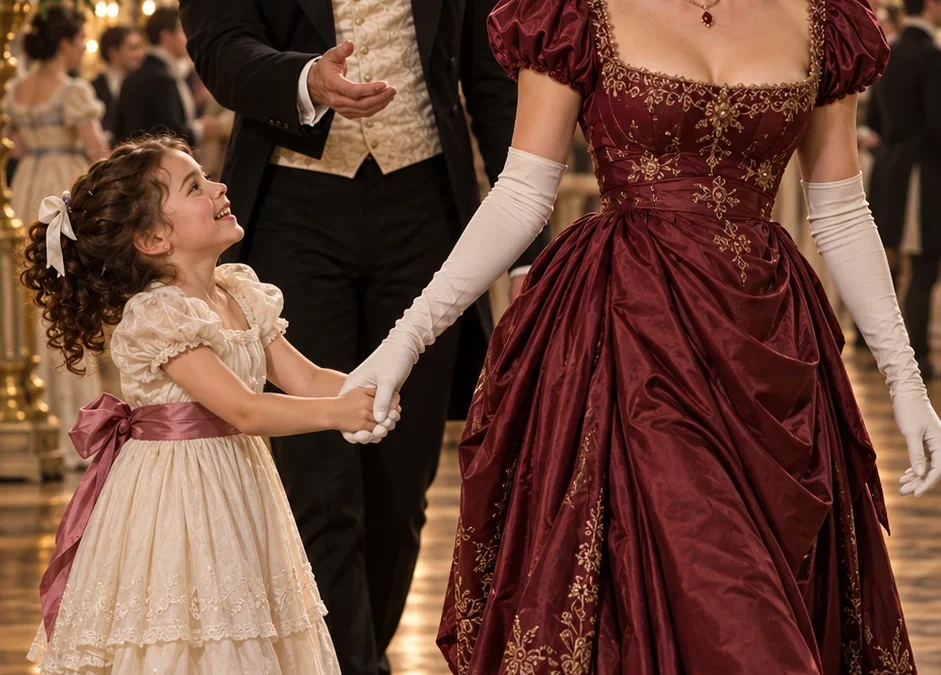
“NO HUSBAND YET?” HER EX MOCKED HER IN FRONT OF 40 GUESTS… THEN A LITTLE GIRL PUSHED A HAND INTO HERS, AND THE DUKE’S SECRET CHANGED EVERYTHING 😱💙
Part 1
“No husband yet, Miss Caro?”
Edmund Crane asked it loudly enough for the whole marquee to hear. Forty people with teacups in their hands turned to look at her.
Somebody laughed. Then several people did.
Three summers ago, this man had asked her father’s leave to court Isabelle Caro. Now he was asking the entire county whether anyone had wanted her since. 😳
One sharp word back, and old Mrs. Ormarrod would turn her off before supper with nowhere to go.
Across the tent, the unsmiling Duke of Marbury set down his glass.
Isabelle turned slowly, her employer’s shawl over one arm and her employer’s teacup in her hand. She did it the way her father used to turn from a frightened patient, so nobody could see how fast her heart was racing.
Edmund looked very well. He had always looked well. It was the first thing anyone noticed about him, and she had learned it was very nearly the last.
His coat was a fresh blue. His hair was the color of wheat in August. And on his arm, in a primrose muslin that cost more than Isabelle earned in two years, stood Miss Leticia Pel, whose father owned half the ships that put in at Weymouth. Their engagement had been printed in the county paper on Tuesday.
“Miss Pel,” Isabelle said evenly, “I hope you are enjoying the strawberries.”
“Oh, the strawberries are excellent,” said Edmund. “I was only asking after your prospects.”
He turned his smile on the little circle gathering around him, the Pels, the Hardings, and two young officers from the regiment at Dorchester.
“Miss Caro and I were very nearly something more than friends once, before her circumstances changed.”
“Edmund,” murmured Miss Pel, delighted.
“Her father was a physician,” Edmund explained to the officers. “A very good one, they say. He simply never got round to sending anyone a bill. A charming habit. Ruinous, of course.”
He looked back at Isabelle.
“So I wondered, that’s all. Three years. Is there no one yet? Not a curate? Not some widowed attorney with seven children and a cough?”
The laughter came again, louder, and with it that particular hush that settles around a woman when a room has decided she is the entertainment.
The cup began to rattle against its saucer. She steadied it with her thumb.
“No, Mr. Crane,” she said. “No husband. I find I am still recovering from the last gentleman who offered to be one.”
For a moment, nobody laughed at all.
One of the officers coughed into his glove. Miss Pel’s smile stayed exactly where it was, which is to say it stopped being a smile and became something she was holding up in front of her face.
Edmund’s color rose. He had never liked to be answered.
“Recovering,” he said. “Is that what you call it? I call it good sense on my part. Some men can read a ledger, Miss Caro. I’m only sorry your father made such poor reading.”
That one landed. 💔
She felt it go in under the ribs, exactly where he had aimed it. For a terrible second, she could not find a single word.
Her father had been dead two winters. He had died owing the coal merchant, the wine merchant, and the man who mended his gig. And he had died owed by half the cottages in the parish, in sums nobody had ever written down.
Edmund knew that.
Edmund had sat at their table.
Then something small and warm pushed its way into her free hand.
She looked down.
A little girl stood at her side, six years old at the very most, in a white muslin frock with a cornflower-blue sash that had come untied and was trailing on the grass. Dark curls were escaping from a ribbon. There was a smear of strawberry at the corner of her mouth, and the stern, considering expression of a bishop at a christening.
A quarter of an hour earlier, Isabelle had found her sitting cross-legged under the long refreshment table, feeding a macaroon to nobody in particular.
The child had refused to say whose she was. She had only asked, very politely, whether Isabelle would mind not telling anyone she was there. And Isabelle, who had spent most of the afternoon hiding from Mrs. Ormarrod’s footstool, had said she understood completely.
Now the little girl lifted her chin at Edmund Crane.
“That,” she said, in a clear voice that carried to the tent poles, “was a horrid thing to say.”
The circle broke into fresh laughter, relieved to have something new to laugh at.
“Good heavens,” said Edmund. “And who is this? Have you hired yourself a champion, Miss Caro, since no grown man will take the post?”
“I am not hired,” said the little girl. “I am six.”
“Margaret.”
The voice came from the entrance of the marquee like a door slamming in a cold house.
Every head turned. Every face changed.
Lady Honoria Lyall stood in the opening in gray silk and a bonnet with a single black plume. She was the Duke of Marbury’s widowed sister. She had kept his house for two years, and she had organized this very fête, its marquee, its band, and its strawberries. Everyone said its purpose was to show the county that her brother was alive again, and in want of a wife.
“Lady Margaret Lyall,” she said. “Come here this instant.”
The small hand tightened in Isabelle’s.
And Isabelle understood, all in one cold second, whose child she had been keeping under a tablecloth.
Lady Margaret Lyall. The Duke of Marbury’s only daughter.
Edmund understood it, too. She watched it reach him. His smile slipped. His eyes went to the grass-stained blue sash, and then very quickly to the far end of the tent.
The Duke was coming down it.
He did not hurry. He was a tall man, dark-haired, in a black coat that had been cut for mourning and never quite put away again. People stepped out of his path without seeming to know they had done it.
Isabelle had seen him only twice before, both times at church, both times at a distance. She had thought then that he had the stillest face she had ever seen on a living man.
It was no less still now.
He stopped a yard from her. He looked at his daughter’s hand in hers. Then he looked at Edmund Crane for what felt like a very long time, and said nothing at all.
“Your grace,” Edmund bowed, rather too low. “We were only… that is, the young lady was just…”
“Papa,” said Lady Margaret. “That man was horrid to her.”
The Duke bent and lifted his daughter onto his hip as easily as if she weighed nothing. Up close, Isabelle could see that his eyes were gray and very tired, and that he was angry.
She could not tell with whom.
“Thank you,” he said to her. “For minding her.”
That was all.
He turned and carried the child back up the length of the marquee. Lady Honoria swept out after him. The band on the lawn, which had faltered, found its place again in a country dance and played on as though nothing had happened.
Behind Isabelle, somebody let out a breath.
“Well,” said Mrs. Harding. “He did not look pleased.”
“Pleased?” Miss Pel had found her smile again. “My dear, did you see his face? A paid companion putting herself forward with his child in front of the whole county. I should think he was mortified.”
Edmund said nothing.
He was watching the bright opening where the Duke had gone, and there was a look on his face Isabelle had seen once before, three years ago, on the morning his letter came.
It was the look of a man doing sums. 🤔
Mrs. Agatha Ormarrod had watched the entire affair from her chair beside the tea urn, like a small and furious idol, seventy-four years old, a silver-topped cane across her knees and a purple bonnet nobody had dared tell her went out of fashion before Waterloo.
“Miss Caro,” she said, when Isabelle returned with the shawl. “My cup.”
Isabelle gave it to her. The old woman did not drink from it.
“You will take me home,” said Mrs. Ormarrod. “Now. Before anybody else feels obliged to tell me what my companion has been doing underneath the Duke of Marbury’s tables.”
And before the next sunrise, Isabelle would lose her position, her roof, and the last of her good name.
But she would also gain something she had never once asked for, from a six-year-old with a secret of her own. 🌙
👇 Want Part 2? Find it in the comments, or drop any word and I’ll send it to you privately. 👇
Part 2
The Ormarrod carriage was old, and it smelled of camphor and peppermints.
For the first mile out of the gates of Marbury Hall, nobody inside it said a word.
Mrs. Ormarrod sat with both hands folded on the head of her cane, looking out at the Duke’s elms going by. Isabelle sat opposite, with the shawl, the footstool, the parasol, and the little velvet bag of lozenges arranged around her like the walls of a fort.
“I have sat at Honoria Lyall’s whist table,” said Mrs. Ormarrod at last, “every Thursday evening for thirty-one years.”
Isabelle waited.
“I sat at it when her mother was alive. I sat at it the winter her husband died. I sat at it the night the duchess was buried and nobody could think of a thing to say. Thirty-one years, Miss Caro. And this afternoon I watched my own companion answer Edmund Crane back in front of the Pels, and then stand holding the Duke’s child by the hand as if she had a right to it.”
“The child came to me, ma’am. She was hiding under the table. I didn’t know whose she was.”
“You might have guessed.”
“I wasn’t looking at her sash. I was looking at her face. She was frightened of something.”
Mrs. Ormarrod made a small sound through her nose.
“You should have been invisible,” said the old woman. “That is what companions are for.”
She turned back to the window. 🪟
The note came at seven.
Isabelle was reading aloud in the drawing room, a chapter of a novel about a curate that Mrs. Ormarrod despised and would not let her stop. The footman brought it in on a salver. It was sealed in black wax with the Marbury arms.
Mrs. Ormarrod read it twice. Then she folded it, laid it on her knee, and pressed her hand flat on top of it as if it might get up and walk away.
“Lady Honoria regrets,” she said, without looking up, “that my companion saw fit to keep Lady Margaret from her nurse for the better part of an hour. She regrets that a familiarity was encouraged. And she is sure, quite sure, that I would not wish to keep in my house a young woman who is being talked of all over the county as setting her cap at dukes by way of their nurseries.”
The clock on the mantel ticked.
“That isn’t what happened,” said Isabelle.
“I know it is not what happened, you foolish girl. I was there.”
“Then why?”
“Because I am seventy-four years old.” Her voice had gone very flat. “Because my husband is dead, and my son is in Bengal and has not written since spring. Because there are four people left in this county who will sit down to cards with me, and Honoria Lyall is one of them, and the other three go where she goes. That is why.”
Isabelle set the novel down.
“You will have your quarter’s wages, and a character from me that says you are honest and sober and read aloud better than anybody I have ever paid to do it. All of which is true. You may stay tonight. In the morning, I think it best you go.”
“Yes, ma’am.”
“Don’t,” said the old woman sharply. “Don’t look at me like that.”
“I’m not looking at you like anything.”
“You are. You are looking at me exactly the way your father looked at Mrs. Kemble’s dropsy. As if you were sorry for it and did not intend to say so.”
She threw the note into the fire. 🔥
“Go to bed, Miss Caro.”
Isabelle did not go to bed. She packed.
There was not very much. Two gowns, both gray. Her father’s medical books, which she could not sell and could not read and would not leave behind. Her mother’s workbox. A miniature of her father at twenty with too much hair.
And four letters she had kept for three years, for no reason she could explain. She read them through once, standing by the washstand, before she fed them to the grate with the ashes of Lady Honoria’s note.
The last began: Circumstances having altered so materially…
It ended: I am sure you will see that it is kinder this way.
It was signed with a flourish she had once thought rather fine.
In the morning, a boy from the inn came with a handcart for her box. She walked down the village street behind it with her bonnet tied tight and her eyes on the cobbles, and did not look up once.
She did not need to. She could feel the windows.
At the bottom of the street the cobbles gave out and the lane began. It ran down between hedges heavy with dog roses toward the water meadows. Half a mile along stood the last cottage before the river, with a whitewashed wall, hollyhocks leaning against it, and thatch coming down low over two small windows like a bonnet over a pair of eyes.
Mrs. Hannah Dorish was at the gate before the handcart had stopped.
She was a broad, red-armed woman of sixty who had kept house for Dr. Caro for nineteen years, and she had heard everything already, because she always did.
“Turned off for minding a child,” she said.
“For minding the wrong child. Hannah, I only need a week. Two at the most. I’ll write to the registry office in Dorchester tonight.”
“You’ll stop as long as you like, and you’ll hold your tongue about weeks.” Mrs. Dorish took the box off the handcart herself and set it on her hip. “Your father set my Tom’s arm for nothing. He sat up three nights with my Annie when she had the fever, and never sent me so much as a word about it after. You’ll have the back bedroom. It’s got the roses at the window.”
So Isabelle had her tea at the scrubbed table in the low kitchen, with the door open to the garden and a bee bumping against the glass.
And for the first time since Edmund Crane had asked his question in the marquee, she put her face in her hands and cried quietly, the way you cry in somebody else’s house, while Hannah banged the kettle about and pretended very loudly not to notice. 😢
That same afternoon, a little after three, the garden gate squeaked.
Isabelle was on her knees in the bean rows. She looked up, expecting the carrier or the curate’s wife with a tract.
Instead she saw a small figure in white muslin, standing just inside the gate with both hands behind its back. Forty yards behind it, toiling down the lane, came a stout woman in a brown cloak, very red in the face.
“Lady Margaret! Lady Margaret, you will wait for Tibs this minute!”
Lady Margaret did not wait for Tibs.
She marched up the path between the marigolds, stopped at the edge of the bean rows, and brought her hands round from behind her back. In one of them was a gray cotton glove.
“You dropped this,” she said. “In the tent. Under the table. I kept it.”
“So I did. Thank you, Lady Margaret.”
“You can call me Daisy. Everybody does who likes me.” Daisy considered the beans. “Are you a gardener now?”
“Only for this afternoon.”
“Because that man made you lose your place. Tibs said so, to Mrs. Pruitt in the still room. They didn’t know I was behind the door.” Her lower lip came out a fraction and was firmly put back. “I am very sorry. I only meant him to stop.”
“He did stop,” said Isabelle. “For a moment. That was your doing.”
Tibs arrived at the gate, gripping it with both hands and heaving like a bellows. “Miss Caro, I do beg your pardon. She has talked of nothing else since yesterday, and when we came out for our walk, she simply turned left at the lodge instead of right, and I could not catch her, ma’am, not with my knees.”
“Come in and sit down, Mrs. Tibbs. Hannah has a kettle on. She always has a kettle on.”
That was how the Duke of Marbury’s daughter came to sit at Hannah Dorish’s kitchen table in her white frock with bread and honey in one hand and a glass of milk in the other, while her nurse sat by the range with her boots off and her eyes closed, murmuring thanks to heaven.
Daisy ate like a person who had been told for a long time to eat more slowly. And between bites, she talked.
She talked about Marbury Hall, which had a hundred and forty rooms, thirty of them with sheets over the furniture, so you could not sit on anything. She talked about Aunt Honoria, who was not unkind exactly, but who said Margaret in the voice you would use for a mud stain. She talked about Lady Caroline Ashdown, who smelled of oranges and patted her head as if she were a spaniel.
“Aunt Honoria wants Papa to marry her. Everybody does. Mrs. Pruitt says there’ll be a duchess in the house again by Christmas.” She put her glass down. “I don’t want one. Not her. She doesn’t laugh. And Papa doesn’t laugh. If they marry, nobody in the whole house will ever laugh at all.”
“Does your father never laugh?”
Daisy shook her head. “Not since Mama went to heaven. He used to. He used to laugh so loud the footman jumped.” She thought about this. “I don’t remember Mama’s face very well anymore. I remember her singing. Is that wicked? To remember the singing and not the face?”
“No,” said Isabelle gently. “I think that is how most of us remember the people we love. By the parts that were warmest.” 🕯️
Daisy looked at her over the rim of the milk glass for a long, measuring moment.
“I don’t sleep,” she said abruptly. “Tibs tells Papa I do, but I don’t. I wake up in the night and the house is too big and too quiet, and I can hear the clocks. There are nine clocks between my room and Papa’s. I’ve counted.”
By the range, Mrs. Tibbs had opened her eyes.
Isabelle pulled out the chair beside the child and sat. “May I tell you something my father taught me? He was a doctor. When I was small and couldn’t sleep, he would sit on the end of my bed and say, Isabelle, tell me your brave list. I had to tell him three brave things I’d done that day, out loud. Even little ones. Especially little ones. Because he said the dark is only frightening to people who have forgotten they are brave.”
“What sort of brave things?”
“Oh, any sort. Speaking to someone you were shy of. Eating your turnip. Telling the truth when a fib would have been easier.”
“I don’t eat turnip.”
“Then that one would be very brave indeed.”
Daisy frowned with the whole of her face. Then she held up one sticky finger.
“Yesterday I told that man he was horrid in front of everybody. That’s one.” A second finger. “I went out of the gate the wrong way on purpose. That’s two.” A third, slower. “And I told you about not remembering Mama’s face. I’ve never told anybody that. That’s three.”
Isabelle found, to her surprise, that her eyes had gone hot.
“Then that’s your list, and it’s a fine one. Tonight, when the clocks start, say it to yourself. Or to somebody, if you can.”
“I’ll say it to Papa,” said Daisy at once. Then her face changed and grew calculating in a way that reminded Isabelle, suddenly and alarmingly, of Lady Honoria. “That man in the tent. He said you hadn’t got a husband.”
“He did say that.”
“Do you want one?”
Mrs. Tibbs made a strangled sound by the range.
“I think,” said Isabelle, keeping her face perfectly grave, “that is a question a lady is allowed not to answer.”
“I shall find you one,” said Daisy with enormous confidence. “I know where there’s a very good one. He’s sad. But he’s very tall.”
At the gate, as Tibs took a firm grip of her wrist, Daisy turned around.
“I’ll come back tomorrow,” she said. “And I’ll tell you if it worked.”
She did not come back the next day.
Her father did. 🚪
He came at about five, on foot and alone, up the lane from the river with his hat in his hand and the dust of the water meadows on his boots. Hannah Dorish saw him first through the kitchen window and dropped a saucepan lid.
“Oh my good lord,” Hannah breathed. “Oh, Miss Isabelle. Oh, put your hair up.”
There was no time to put her hair up.
The Duke of Marbury stood on the wrong side of the gate, as if he weren’t sure he would be let in. In the low gold light, with no marquee and no crowd and no sister, he looked younger than he had in the tent, and far more uncertain.
“Miss Caro. Forgive me. I should have sent word. I didn’t know what word to send.”
She came down the path wiping her hands on her apron, horribly aware of the apron. “Is Lady Margaret…”
“She is very well. She is better than well. That is why I’ve come.”
Hannah Dorish’s parlor was nine feet square and had never in its life held a duke. It held one now, perched on the very edge of the horsehair sofa with his knees nearly up to his chin.
“She slept,” said the Duke. “Last night. The whole night through. She hasn’t done that in two years. I know she hasn’t, whatever her nurse tells me, because I don’t sleep either. And I hear her.”
He turned his hat round in his hands.
“At bedtime she made me sit on the end of her bed. She said I had to hear her brave list. She told me three things. And one of them was that she had told a lady she couldn’t remember her mother’s face.” He stopped. “I didn’t know that. I am her father, and I didn’t know it. She told a stranger in a kitchen, over bread and honey. And then she told me. And then she turned over and went to sleep.”
Isabelle could not speak.
“There is a second thing. I learned this morning that Mrs. Ormarrod has turned you out. I learned it from my daughter, who learned it from her nurse, who learned it from my sister’s maid. And I learned why. My sister wrote that note without my knowledge. That doesn’t excuse it. It was my house she wrote from and my name she wrote in.”
He set the hat down on the floor, as if he had decided to stop hiding behind it.
“And there is a third thing, which is worse, because it is mine. At the fête, I stood at the end of that tent and heard Crane say what he said to you. And I said nothing. I took my daughter and walked away. You will have thought I was angry with you.”
“Everyone thought so, your grace. Miss Pel was quite certain of it.”
“I was angry,” he said. “Not with you.”
He looked at her directly then, and his gray eyes were not still at all.
“If I had said one word to Edmund Crane in front of that marquee, your name would have been tied to mine at every dinner table in the county by nightfall. A duke defends a companion in public, and the county asks what she is to him. I told myself that silence was kinder.” His voice dropped. “It wasn’t. It was only easier for me. And you paid for it. I am sorry.”
It was so unexpected, so plainly said, that for a moment she could not answer.
“You owe me nothing,” she managed at last. “Truly. Mrs. Ormarrod would have found a reason before Christmas. She has turned off four companions before me.”
“Then let me at least…”
“Please don’t.”
Her own voice came out sharper than she meant. “Forgive me. But please don’t offer to find me a place, or speak to someone, or write me a character. I’d rather not be a favor you do. I have been a charity case in this county for two years, ever since my father died owing money to people who owed him more. I would like very much not to be one to you.”
He looked at her for a long moment.
Then, unexpectedly, the corner of his mouth moved.
“What you said to him in the tent,” said the Duke. “About still recovering from the last gentleman who offered.”
She felt her face go hot. “It was very rude of me.”
“It was the best thing I have heard anyone say out loud in two years.”
He stood, ducking his head under the beam.
“Then I won’t offer you anything. I’ll ask for something instead. My daughter wants to visit you. She has informed me of it in some detail. Will you let her come, with her nurse, and with my word that I’ll answer for it to anyone who has anything to say?”
“Of course she may come.”
“Thank you.”
At the parlor door, he turned back. “May I ask you something else, Miss Caro? Your father’s list. The three brave things. Did he make you say it every night?”
“Every night until I was twelve. After that he said I was old enough to keep it to myself.”
“And do you still?”
She thought of the walk down the village street behind the handcart. The windows. The letters in the grate.
“Most nights,” she said.
“Then I hope,” said the Duke quietly, “that today’s was easier than yesterday’s.”
He went out. Hannah Dorish, who had certainly been listening at the kitchen door, watched him from the window all the way down the lane. Then she turned and looked at Isabelle with such tremendous significance that Isabelle went upstairs and shut her door. 💛
But the Duke had not come to the cottage that day only to apologize.
He had come because he’d already made up his mind about something far bigger, something that would soon put his whole family, his name, and a certain golden-haired gentleman in the path of a scandal the county would never forget.
👇 Like or comment “REVEAL” to unlock Part 3. It will be posted once we hit enough comments! 👇
Part 3
Daisy came on the Thursday, with Tibs.
She came on the Saturday with Tibs and a basket of plums from the Marbury glasshouses that nobody had asked for.
And on the Monday after that, when the gate squeaked at three, it was not Tibs walking behind her down the lane, but the Duke of Marbury himself, his coat over his arm because of the heat and his daughter’s bonnet dangling from one hand by its ribbons.
“Tibs has a cold,” said Daisy, who had plainly arranged it.
That was the first of the walks home along the river. It became a custom without anyone deciding that it should.
Daisy came three afternoons a week and did her lessons at Hannah’s kitchen table, because she said she could not do sums in a room with sheets on the furniture. At six, her father came to fetch her. The way back to the Hall ran along the river path, through the water meadows, past the mill and the willows and the old stone footbridge. Because Daisy would not walk it unless Miss Caro came as far as the bridge, Isabelle walked it too, through the long gold evenings of that August, with the Duke a careful yard away and his daughter running ahead with a hoop. 🌾
At first they talked about Daisy, because Daisy was safe. Daisy’s sums, which were dreadful. Daisy’s French, which was worse. Daisy’s brave lists, which by the second week had grown so long and so ambitious that the Duke was obliged to sit on the end of her bed for twenty minutes every night while she worked through them.
“Item seven last night,” he said one evening, “was I was polite to Lady Caroline at luncheon, even though she called me ‘the child.’”
“Was it true?” asked Isabelle.
“Moderately. She only kicked the table leg twice.”
Then, little by little, they talked about other things.
He told her about his wife. Not all at once, and never at length, but in pieces, the way you hand someone a thing that is heavy and might break. Catherine had been the daughter of a Shropshire baronet. She had laughed at him the first time they met, because he had fallen off a gate. She had filled the Hall with music and dogs and people he did not like, and he had liked all of it, because she did.
The fever came in March, the year Daisy was four. It took nine days.
“After that I shut the house up,” he said. “Not the doors. The noise. I couldn’t bear it, so I stopped it. And I didn’t notice until a few weeks ago that I had stopped my daughter’s along with everyone else’s. That a child of six had learned to walk through a hundred and forty rooms without making a sound in any of them.”
The river murmured below them.
“And then a stranger in a tent told me she didn’t sleep.”
“Daisy told you that?”
“Daisy told you,” said the Duke. “Because you showed her how.”
In her turn, she told him about her father. About Dr. Ambrose Caro, who had driven his gig out in every kind of weather to every kind of house, who sat up with dying farm laborers as gently as with the squire’s mother, and who in thirty years had never once been able to look a poor man in the face and ask him for his fee. He had died of a chill caught driving home from a confinement at three in the morning. The funeral was the largest the parish had ever seen.
“And Crane,” said the Duke. “Forgive me. You needn’t answer.”
“There isn’t much to answer. He courted me for a summer. He asked my father’s leave in June. My father died in January. In February the lawyer read out what there was, which was a great deal of debt and a gig with a cracked axle. In March I had a letter.” She kept her eyes on the path. “It was a very well-written letter. He always wrote beautifully.”
They had reached the footbridge. Below them the river went over the weir in a long brown curve, and Daisy lay flat on her stomach on the warm stones at the far end, dropping sticks into the water to see which would win.
“He came to me last month,” said the Duke, “to ask for the borough.”
Isabelle looked up.
“The seat in Parliament for Marbury. It is in my gift, as it was my father’s. Thirty-two voters, and every one votes as the Hall asks, which is a disgrace, and which I have never yet found the courage to change. Old Mr. Fairley gives it up at Michaelmas. Crane wants it. He has been to dine three times since June. He is clever, and he talks very well about roads and the price of corn.” The Duke looked down at the water. “I had more or less made up my mind to give it to him. I find I am no longer sure what I think of Mr. Crane.”
Down on the stones, Daisy shrieked with triumph. “Mine won, Papa! Miss Caro, mine won by a mile!”
And the Duke of Marbury laughed.
It was not a large laugh. It was short and startled, as if it had got out of him before he could stop it, and he looked almost as surprised by it as Isabelle was.
But it carried over the water and the willows.
And on the far bank, a man sitting very still on a bay horse in the shade of the trees heard it, and turned his head, and saw them both quite clearly. The Duke on the bridge with his coat over his shoulder, laughing. And a yard from him, in a gray gown and no gloves, the companion Agatha Ormarrod had turned out of her house.
Edmund Crane watched them until they had gone up through the meadow toward the Hall.
Then he turned his horse and rode at an easy walk back toward the town. 😈
That night he dined with the Pels. Eighteen at table, with the Hardings and the Ashdown cousins. And somewhere between the soup and the saddle of mutton, when the talk turned, as it always turned that summer, to the Marbury ball, and whether the Duke would or would not make Lady Caroline an offer at it, Edmund put down his glass and smiled.
“I shouldn’t count on it. I’m told his grace has other interests.”
Mrs. Pel leaned in. “Interests?”
“Oh, nothing anyone could object to, I’m sure. A widower is entitled to his walks.” He lowered his voice exactly enough to make everyone lean closer. “Down by the river. Three evenings a week. With Miss Caro. You remember Miss Caro? Lety, the one who has no husband.”
Somebody gasped. Somebody laughed.
“Edmund, you are dreadful,” said Leticia Pel, in a voice that meant she would repeat it to everyone she knew before noon.
“I’m not dreadful in the least. I’m only sorry for the poor girl. She has set her cap at a duke by way of his nursery, and it seems to be working, at least as far as the river. Of course, it won’t go any further than that.” He picked up his glass again. “A man in his position doesn’t marry a woman like that. He doesn’t need to.”
By Wednesday, it was all over the county.
Lady Honoria came into her brother’s library on Thursday morning without knocking, which she had not done since they were children.
“A duke does not walk down a village lane three times a week to the door of a companion Agatha Ormarrod has turned off. I would have thought that went without saying, Gideon.”
“Apparently it does not.” He did not look up from his letters. “Good morning, Honoria.”
“Do you know what Edmund Crane told the Pels’ table on Monday night? Do you know what Mrs. Harding repeated in the assembly rooms yesterday?” She laid her gloves on his desk, one on top of the other, very precisely. “They are saying you have taken up with her. That she has made herself useful to you through the child. That it will end the way such things always end, with a cottage somewhere, and an allowance, and no name.”
Now he looked up.
“Then Edmund Crane is a liar,” said the Duke. “And you may tell him so from me.”
“I am not going to tell Edmund Crane anything. I am telling you.”
For a moment, the hardness in his sister’s face slipped, and he saw that she was frightened.
“The ball is on the twentieth. The Ashdowns come on the nineteenth. The whole county has been told, by me, at your table, with your leave, that you mean to dance the first with Caroline. If you make a fool of her in your own ballroom for the sake of a doctor’s daughter with two gray gowns, there is not a family between here and Bath that will forgive it. Not hers. Not ours. Not the child’s, when she is old enough to understand what was said about her father.”
He said nothing.
“I have kept this house for two years,” said Lady Honoria quietly. “I have kept it for you and for Margaret and for Catherine, because she would have wanted it kept. Don’t make me watch you throw away your standing in it for a walk by a river.”
She picked up her gloves and went out.
That same afternoon, her carriage stopped at the end of the lane, and she walked the last fifty yards to Hannah Dorish’s gate alone.
She would not sit. She stood in the middle of the nine-foot parlor in her gray silk, straight as a column that had been put there by mistake.
“My brother is a good man, Miss Caro. Good men do foolish things when they have been lonely a long time. I don’t say that you have encouraged it. I am willing to believe you have not. But you will know by now what is being said. And you will know, if you have any sense, that it can only end one way. He will not marry you. He cannot. And the longer this goes on, the less there will be left of you when it is over, and the more of it will stick to my niece.”
Isabelle had stood when she came in, and she stayed standing.
“What is it you want me to do, Lady Honoria?”
“Go away.” She drew a folded paper from her reticule. “My late husband’s cousin, Mrs. Ridley, lives near Alnwick in Northumberland. She is old and deaf and wants a companion who can read aloud and will not mind the cold. She will take you on my recommendation. The post is respectable. The house is comfortable. And it is three hundred miles from here. Nobody in Northumberland has ever heard of Edmund Crane.”
Isabelle looked at the paper and did not take it.
“And if I don’t go?”
“Then you will stay and be what they are already saying you are.” Her voice did not change. “And so will he.”
She laid the paper on the arm of the horsehair sofa and went to the door. On the threshold, she paused.
“The child is fond of you. I know that. I’m not blind. That is precisely why you must be the one to go.”
When she had gone, Isabelle read the paper three times. Then she went out and stood among the bean rows until Hannah came and put a shawl around her shoulders without asking why.
She wrote to Mrs. Ridley that night. She would come, she said, on the twenty-first, the day after the ball.
She told Daisy on the Saturday. She had thought for two days about how to do it, and in the end there was no good way. So she did it plainly, at the kitchen table, with the French grammar open between them.
Daisy listened with her hands folded. When it was finished, she did not cry. She closed the grammar very carefully and pushed it away.
“Then I shan’t do my brave list anymore.”
“Oh, Daisy, please don’t say that.”
“There isn’t any point. It only works if somebody’s listening.”
“Your father listens every night. He told me so.”
“He listens,” said Daisy. “But he doesn’t do one back.” She slid off her chair. “He’s got a list too. I know he has. He just never says it.” 💔
Her father came at six, as always. Daisy walked straight past Isabelle at the gate, took his hand, and would not look back.
And the Duke looked over his daughter’s head at Isabelle’s face and understood at once that something had happened.
“Northumberland,” said Isabelle, before he could ask. “Your sister found me a post. I go on the twenty-first.”
He went very still. “Miss Caro. Isabelle. I…”
“Please don’t.” She held on to the top bar of the gate. “Please don’t say anything you would have to take back at your sister’s ball. I couldn’t bear that. I would rather go with nothing said at all.”
For a moment, she thought he would say it anyway.
Then he bowed, quite formally, the way you bow to a stranger, and walked his daughter home along the river without a word. Isabelle stood at the gate in the dusk and watched the two of them go, a tall shape and a small one, until the willows hid them.
On the Tuesday before the ball, the Ormarrod carriage came down the lane at a pace it had not attempted in twenty years and stopped at Hannah Dorish’s gate with a jolt that nearly put the coachman in the hedge.
The first thing out of it was a silver-topped cane. The second was Mrs. Ormarrod.
“Don’t stand there gaping, Hannah Dorish. Help me down. Miss Caro, I have come to say something unpleasant, and I mean to say it sitting down.”
She said it in the parlor, on the horsehair sofa, with her purple bonnet very straight.
“My maid Phoebe is walking out with the Pels’ second footman. A thing I have pretended for six months not to know. On Sunday he told her that Edmund Crane rode home from the river last week in the best of spirits and said at dinner, in front of eighteen people, a thing about you which I will not repeat in this room. He said it on purpose, Miss Caro. Because he wants the borough, and he had got it into his head that the Duke was growing cool toward him, and that you were the reason, and that the quickest way to be rid of you was to make you impossible.”
She rapped the cane once on the floor.
“And I helped him. I turned you off because I was afraid of a card table.”
“You were kind to me for twenty months, ma’am.”
“I was tolerable to you for twenty months. It isn’t the same thing.” The old woman’s mouth worked. “I have been afraid of Honoria Lyall since she was nineteen and told me my hat was provincial. I find I am tired of it. I find I would rather have one companion who answers Edmund Crane back than four people to play whist with.”
She drew a breath.
“So you will come to the Marbury ball on Friday, as my companion, in my carriage, on my arm. And anybody who wishes to object may object to me, and I hope they try.”
“Mrs. Ormarrod, I am leaving for Northumberland on Saturday morning.”
“I know. Phoebe told me that too. Then you will leave for Northumberland on Saturday morning, having first gone to a ball in something that is not gray. Get your bonnet.”
The something that was not gray lay in a cedar press at Ormarrod House, folded in silver paper that crackled when she lifted it out. It was silk, a deep, clear cornflower blue, cut in a fashion fifty years gone, with a long train and sleeves like little clouds.
“I wore it to my engagement ball,” said Mrs. Ormarrod, holding it up against Isabelle by the window, so that the blue lit the whole dim room. “In 1768. My mother said it was too bright for a girl with my complexion, and she was quite right, and I danced every dance in it. Turn round.”
She narrowed her eyes.
“Hannah Dorish can take the train off, and Mrs. Penrose in the High Street can do the sleeves by Friday if I pay her enough, and I shall. Hold still, child. You are going to look like the sky.” 💙
On the Thursday night, the Duke of Marbury sat on the end of his daughter’s bed and listened to her brave list.
It was a short one. She had not wanted to say it at all. Item one: she had been civil to the Ashdowns when they arrived. Item two: she had not cried at her French. Item three she would not tell him.
“That’s not fair,” said the Duke.
“It’s private.” Daisy pulled the counterpane up to her chin. “Papa, what’s yours?”
“My what?”
“Your brave list. You never say it. You always listen to mine, and you never say yours back.”
He was quiet for a while. Down the long corridor, the nine clocks ticked one after another, not quite together.
“I haven’t done mine yet,” he said. “I mean to do it tomorrow night.”
Daisy sat up. “What is it?”
He looked down at his hands. Then, because it was dark, and she was six, and there was no one else in the world he could have said it to, he told her.
“I mean to ask Miss Caro to marry me.”
Daisy did not shriek. She went perfectly still, the way he did, and her eyes went enormous in the candlelight.
“I’ll ask her in the conservatory,” said her father, “away from everyone, so that if she says no, nobody will be there to laugh at her. She has been laughed at enough in this county.”
“She won’t say no.”
“She might. She is going to Northumberland on Saturday, Daisy. She asked me not to say anything at all.”
Daisy considered this with a deep frown. “When she says yes,” she said, “may I call her Mama?”
The Duke of Marbury found he had to look away for a moment, at the candle.
“Not yet,” he said, when he could. “Not until she has said yes. A lady must be asked properly, and she must be allowed to say no if she wants to. Do you promise me? Not a word until then.”
Daisy lay back down and pulled the counterpane up again.
“I promise,” she said. “Not until she’s said yes.” 🤞
That same afternoon, Edmund Crane had ridden up to the Hall and been shown into the library, where he talked for forty minutes, very well, about roads and the price of corn. At the end of it, as he drew on his gloves, he said as if it were nothing:
“Your grace will have reached a decision about the borough, I suppose. Mr. Fairley gives it up at Michaelmas.”
“I have,” said the Duke.
Edmund waited, smiling.
“You’ll have my answer tomorrow night, Mr. Crane. At the ball. In front of everyone.”
Edmund rode home whistling.
The ballroom at Marbury Hall had not been opened in two years, and that night it blazed.
Three great chandeliers hung down its length, every candle lit, so that the gilding on the ceiling seemed to move. The long windows stood open to the terrace and the warm dark. Two hundred people stood about under the light in silk and satin and regimentals, and the musicians in the gallery were tuning, and the whole room hummed like a hive around one question: whether the Duke would dance the first with Lady Caroline Ashdown, and what it would mean if he did.
Then the doors at the end opened, and Mrs. Agatha Ormarrod came in on her cane, in purple. And on her arm was a young woman in a gown the color of a summer sky.
The hum faltered.
Isabelle felt it happen. She felt heads turn one after another down the whole length of the room, and the whispering begin behind fans. And for one dreadful moment she was back in the marquee with a teacup rattling in her hand.
Then Mrs. Ormarrod’s fingers tightened on her arm like a little iron clamp.
“Chin up,” said the old woman out of the side of her mouth. “You look like the sky. Let them stare at it.”
At the top of the room, beside the musicians’ gallery, the Duke stood with Lady Caroline Ashdown and her father, and he had stopped in the middle of a sentence. Isabelle saw it. She saw him see her.
She looked away at once.
She had got perhaps a third of the way along the wall toward the chairs when Edmund Crane stepped into her path.
He had Leticia Pel on his arm, the Hardings behind him, and the two young officers from Dorchester, and he was in excellent spirits. Tonight was the night he would be given the borough. He had told everyone so.
“Miss Caro,” he said, and bowed, and the little crowd drew closer, scenting sport. “What a charming surprise. I’d heard you were off to Northumberland on Saturday. Still no husband, then.”
Somebody tittered.
“Perhaps the shepherds up there are less particular,” said Edmund, and the titter became a laugh.
“Mr. Crane,” said Mrs. Ormarrod, “I have known you since you were in petticoats, and you were a disagreeable child.”
“And you, ma’am, were a disagreeable lady. Some things don’t change.” Edmund kept his eyes on Isabelle. He had had a good deal of champagne, and he had been looking forward to this all week. “Or is it true what they’re saying, Miss Caro? That you’ve found a way into the best house in the county after all, by the nursery stairs?” He raised his voice so the next circle could hear. “I’m told you’re wonderfully good with children. Other people’s.”
That laugh was the loudest yet.
Away by the doors, Isabelle saw Lady Honoria lift one gloved hand toward a footman. She did not wait to be shown out. She had decided in the carriage that if it came to this, she would not be shown out.
“Good evening, Mr. Crane,” she said, and turned away.
That was when the white frock came across the floor. 🤍
Lady Margaret Lyall had been allowed down for the first hour on condition that she sat on the bottom stair with Tibs and did not speak to anybody. She had sat on the bottom stair for nineteen minutes.
Now she was running straight down the middle of the empty dancing floor in her white muslin and her cornflower-blue sash, and two hundred people watched her come.
She ran right through Edmund Crane’s circle as if it were not there. She took Isabelle’s hand in both of hers. And she turned around to face him with her chin up and her whole small body shaking.
“Don’t you laugh at my mama.”
There was a silence like the silence after a glass breaks.
Then Leticia Pel gave a little shriek of laughter, and Edmund threw back his head. “Your mama? Good lord, child. Is that what she’s been teaching you down in that cottage by the river?”
“Daisy?” Isabelle’s voice did not sound like her own. She knelt in the borrowed silk on the polished floor. “Daisy, darling, you mustn’t say that. You know you mustn’t. Go back to Tibs.”
“I promised Papa,” said Daisy fiercely, and her eyes were full. “I promised I wouldn’t say it till you’d said yes. So you have to come and say yes now, before he loses his nerve.”
And she pulled Isabelle up off the floor by the hand with all the strength of her six years, and towed her out into the middle of the ballroom toward her father.
He was already coming.
He had left Lady Caroline in the middle of her sentence and the Earl of Ashdown in the middle of his, and he was crossing his own ballroom with the whole county parting in front of him, exactly as it had parted in the marquee.
Only this time, he did not stop a yard away.
This time, he came all the way.
They met under the great chandelier, the three of them, and the music in the gallery died away in a long, uncertain squeak of strings. Everyone waited. Everyone knew what came next. The Duke would apologize for his daughter. He would send her up to bed. He would say something cool and kind to the companion, and the evening would close over the whole business like water over a stone.
The Duke looked down at his daughter. Then he looked at Isabelle.
“I meant to ask you in the conservatory,” he said.
He did not lower his voice.
“Where nobody could see. So that if you refused me, nobody would laugh. But you were asked a question in front of this county once, Miss Caro, and I stood at the end of a tent and let it go unanswered. I will not do that twice.”
And the Duke of Marbury went down on one knee on his own ballroom floor, in front of his sister, his guests, and every family in the county, and took her gloved hand in his. 😭
Somewhere behind them, Lady Honoria said, “Gideon,” in a voice like a dropped cup. Somebody near the windows murmured that a duke does not kneel to a companion, not in his own house, not with the Ashdowns standing there.
He heard it. Isabelle saw that he heard it, and that he knew exactly what it would cost him. His standing. His sister’s two years of planning. Every comfortable thing he had ever been told a man of his rank was owed.
He did not care.
“Isabelle Caro,” he said. “Will you marry me?”
“They’ll laugh at you,” she whispered.
“Let them. I have been silent in this house for two years. I would far rather be laughed at with you.”
There was a long, bright, ringing moment in which two hundred people did not breathe.
“Yes,” said Isabelle.
Daisy looked up at her father, trembling all over with the effort of having kept a promise for nearly a whole minute.
“Now?” she whispered.
“Now,” said the Duke.
And the Duke’s little daughter threw her arms around Isabelle’s waist in front of everyone, buried her face in the cornflower silk, and said it out loud.
“Mama.” 💙
The Duke rose, with his daughter’s hand in one of his and Isabelle’s in the other, and turned around.
“Mr. Crane. I promised you my answer about the borough tonight, in front of everyone. Here it is. You once asked this lady, in front of forty people, whether anyone had wanted her. Somebody did. Somebody does. And I will not put the name of Marbury behind a man who asks a woman that question in public. Not for any seat in England.”
Edmund opened his mouth. Nothing came out of it.
Leticia Pel slid her hand off his arm, quite slowly, as if it had only just occurred to her that it was there. Her father appeared at her shoulder and said in a flat voice, “We are going home, Lety.” The Hardings found they were wanted at the far end of the room. The two officers discovered the supper table.
And in less than a minute, Edmund Crane was standing alone on the bare floor under the chandeliers in his beautiful coat, with nobody looking at him at all.
For a man like Edmund Crane, it was the very worst thing that could have happened.
The Duke looked up at the gallery.
“Play something,” he said.
And the musicians, who had been holding their breath with everybody else, struck up a waltz. The Duke of Marbury danced the first dance of his own ball with a doctor’s daughter in a borrowed gown, while the Earl of Ashdown took his daughter home. 💃
“Well,” said Mrs. Ormarrod, to nobody in particular, settling into a gilt chair. “That is the most interesting thing that has happened in one of Honoria’s rooms in thirty-one years.”
At the very end of the night, outside the cloakroom, Lady Honoria, straight as ever, found Isabelle alone.
“He laughed tonight,” she said. “At supper. I heard him from the other end of the table. I have not heard that sound in two years.” Her mouth moved. “I am not a fool, Miss Caro. Whatever else I may be. I shall write to Mrs. Ridley myself.”
They were married a month later, by license, in the little gray church at Marbury, on a windy blue September morning.
Daisy walked in front, scattering rose petals with great severity, as though each one had to be placed exactly. Mrs. Ormarrod sat in the front pew in purple. Hannah Dorish cried through the whole of it.
Edmund Crane had gone to London. Miss Pel married a sugar merchant from Bristol at Christmas.
And the Duke, who had decided that a man who could kneel in his own ballroom could do anything, told the thirty-two voters of Marbury to choose their member for themselves. It caused a far greater scandal than the wedding. 😄
That night, Daisy made them both sit on the end of her bed.
“One,” she said, holding up a finger. “I called her Mama first. Two, I did it in front of everybody. And three,” she pointed at her father, “three is Papa’s. Because he finally did one back.”
Later, when the house was quiet and the nine clocks were ticking down the long corridor, the new Duchess of Marbury said her own list silently, the way her father had taught her.
There was only one thing on it.
Someone had asked her, in front of the whole county, whether she had a husband yet.
And at last, she had an answer. 💍
This story is entirely fictional and created for entertainment purposes only. It does not represent any organization or individual, nor does it encourage inappropriate behavior. The content was generated with AI assistance.








