No One Cheered My MBA. They Clapped for My Sister’s Sash. Years Later, a Stranger Gave Me a Seat at Her Table, and My Parents Were Dragged Out of My Wedding.
No One Cheered My MBA. They Clapped for My Sister’s Sash. Years Later, a Stranger Gave Me a Seat at Her Table, and My Parents Were Dragged Out of My Wedding.
Part 1
Nobody cheered when I graduated.
They clapped for a sash.
It was my graduation lunch, the one celebrating three years of work on a thesis about macroeconomic shifts in postwar industrial sectors. My professor, Dr. Galloway, had driven two hours to be there. My colleagues were holding their glasses.
And then my mother, Muriel, stood up, practically vibrating.
“We have a surprise announcement,” she said, turning her back to me to face the guests. “We just got the news this morning, and we simply cannot contain ourselves. Our Priscilla has been named first runner-up for the Miss Regional Sweetheart Pageant!”
My sister glided to the front of the room, blonde, twenty-two, wearing a sash I had never seen before. She blocked me from view without even trying.
“Oh, stop it,” she giggled. “It’s just runner-up, Mom.”
“Nonsense.” Muriel beamed. “Out of fifty girls, it is the crowning achievement of this family.”
The applause was scattered and confused. Dr. Galloway looked at me with furrowed brows.
“Mom,” I said, my voice barely a whisper. “This is my graduation lunch.”
She turned to me with mild annoyance, as if I were a fly buzzing around a wedding cake.
“Oh, Estelle, don’t be so dour. You have your little piece of paper. Let your sister have her moment.”
“I worked three years on my thesis.”
“And isn’t that nice?” My father, Reginald, patted my shoulder with a heavy, dismissive hand. “But let’s be honest, honey. Priscilla’s win puts the family name out there. It’s public. It’s tangible.”
I looked around the room. I saw pity in my colleagues’ eyes. I saw the smirk on Priscilla’s face, not malicious, just entirely self-absorbed, as if the sun revolving around her were the most natural thing in the world.
And something inside me didn’t break.
It evaporated. 💔
The hope I had nursed for twenty-five years, that desperate child inside me begging for one crumb of validation, finally starved to death.
I didn’t flip the table. I didn’t make a scene. I picked up my purse and walked toward the door.
“Where are you going?” Muriel called, sharp. “We haven’t cut the cake. Priscilla needs to pose with it.”
“I’m leaving, Mother,” I said, without looking back. “You can pay the bill.”
That decision wasn’t impulsive. It was the collapse of a structure that had been rotting for decades.
As I drove through our small town, my whole life played against the windshield.
I was ten, standing in the kitchen with a report card of straight A’s, my heart pounding. Muriel finally hung up the phone, glanced at the grades, and said, “That’s fine, Estelle. Now go help your sister practice her tap routine. Her rhythm is off.”
That’s fine.
That was the ceiling of their praise. My achievements were expected. Priscilla’s were events.
I was sixteen, and I had asked for one quiet birthday dinner at the Italian place downtown. We spent it in an emergency room waiting area instead, because Priscilla had tripped over the cat and thought she might have sprained her ankle.
She hadn’t. But Reginald held her hand for four hours and bought her vending-machine chocolates while I sat in a plastic chair reading a textbook, completely invisible.
At midnight, Muriel said, “Thank God she’s okay. Estelle, don’t look so selfish. Your sister was in pain.”
But the memory that sealed it was my valedictorian speech.
I stood on that stage in the blinding lights, searching the second row where their tickets were assigned.
The seats were empty.
I found out later they were at the mall. A talent scout was holding open auditions for a catalog shoot, and they didn’t want Priscilla to miss her window.
“We knew you’d do fine,” my father told me afterward, shrugging, while he ate the celebration dinner I cooked myself. “You don’t need us holding your hand. Priscilla needs support. She’s fragile.”
Fragile.
That was the word they used like a weapon. Priscilla was a porcelain doll that needed a velvet pillow. I was a draft horse. Useful. Reliable.
Never cherished.
In my apartment, I didn’t cry. I was past tears. I pulled my suitcases from the closet and packed my clothes, my degree, my laptop, and the few books that mattered. I left the photo albums, the ones filled with Priscilla, with me lurking in the background like a ghost.
My phone rang. Mom. I let it go.
It rang again. Dad.
I turned it off.
I left a check for my roommate and drove north. I drove until the sun went down and the gas light came on, until the green hills of my disappointment turned into the steel-gray skyline of Philadelphia.
No job. No apartment. A bank account drained by a party that had celebrated my own erasure.
But as I merged onto the highway, watching the city lights glitter ahead, I felt the first real breath of oxygen I’d taken in years.
I was alone.
But for the first time, I wasn’t second place.
Three years later, I had a penthouse, a title, and a coat that cost more than my first car. And I was sitting alone at the Barclay Hotel on Christmas Eve when a silver-haired woman across the room sent a waiter to my table.
“The lady would like to know if you’d join them for dessert.”
I almost said no.
Then I looked at her face, and what I saw there made me close my book and stand up.
What happened next still gives me chills. Part 2 is in the comments—or leave any word below and I’ll send it to you privately.
Part 2
What happened next still gives me chills. Part 2 is in the comments—or leave any word below and I’ll send it to you privately.
Her name was Beatrice.
She stood to greet me with a hand that was cool and dry, and a voice with the confident cadence of someone used to being listened to.
“And this is my husband, Theodore. We noticed you were reading The Age of Innocence. It’s my favorite.”
“Mine too,” I said.
“Please sit,” Theodore said, folding his newspaper. “Beatrice insists that eating alone on Christmas Eve is against the bylaws of the universe, and since she’s a retired judge, I’ve learned not to argue with her rulings.”
I laughed. It surprised me.
They asked where my family was. I said, “Geographically, about four hours. Emotionally, about a million miles.”
I waited for the platitude. Oh, but family is everything.
It never came.
“Blood is an accident of biology, Estelle,” Beatrice said quietly. “Loyalty is a choice. It sounds like you’ve made some difficult ones.”
In three minutes, a stranger had validated my life more than my mother had in thirty years. 🥹
Then their son Julian hurried in, breathless, unwinding a scarf, a surgeon who’d lost track of time. When he smiled, his whole worried face turned boyish.
For two hours, I sat in that golden light eating sticky toffee pudding. When I spoke, Theodore asked follow-up questions. When I joked, Julian laughed a real, deep laugh.
I wasn’t the smart sister or the plain one or the difficult one.
I was just Estelle.
At the door, Beatrice pressed a card into my hand. “Sunday dinner. Six o’clock. Don’t be late. Theodore gets grumpy if the roast sits.”
“I couldn’t impose.”
“I am a very good judge of character,” she said, in that judicial tone. “You are not an imposition. You are a refreshing addition.”
I told myself I wouldn’t go.
On Sunday, I drove to Chestnut Hill.
Their stone house was somehow imposing and welcoming at once. Julian opened the door in a sweater and jeans, holding a glass of red wine. “You came. Mom wasn’t sure you would.”
At my childhood table, dinner was a battlefield. Muriel criticized my posture. Reginald complained about clients. We all sat through twenty minutes of Priscilla discussing her hair.
Here, dinner was a symposium.
They asked me real questions. “What do you think about gentrification in West Philly?” Theodore said, passing the potatoes.
“From a marketing standpoint, it’s growth. From a human standpoint, it’s displacement.”
“Exactly!” He pointed his fork at me. “That tension is where architecture succeeds or fails.”
Halfway through the meal, I realized my shoulders, which had been up around my ears for three years, had finally dropped.
Later, in the library, Beatrice looked at me over her teacup.
“You have a sharp mind. Who sharpened it?”
“I did. It was the only thing I had that my sister didn’t.”
“Competition between sisters is a failure of the parents, not the children,” she said. “You’re safe here. We don’t do competition. We do support. You’ll get used to it.”
I was terrified. Terrified it was a trick. Terrified I’d mess it up.
“Why are you doing this?”
“Because when I saw you in that restaurant, I saw myself forty years ago. Driven, solitary, hiding a lot of pain behind a very expensive coat. Someone opened a door for me once. I’m just holding it open for you.”
Two years passed in Sunday dinners and gallery openings.
Beatrice taught me that setting boundaries wasn’t aggression, it was self-respect. Theodore taught me how to change a tire and how to appreciate a flying buttress. And Julian, my slow-burn Julian, went from the friend who sat beside me at dinner to the man who remembered I hated cilantro and loved vintage jazz.
One autumn evening in the garden, he took my hands.
“I know you’re guarded. I know you expect people to let you down. But I’m very stubborn, and I have no intention of letting you down.”
His kiss wasn’t fireworks. It was steady. It felt like coming home to a house where the lights were already on.
I was happy. Terrifyingly, wondrously happy.
But happiness makes you protective. And I knew that four hours south, a different kind of family existed, one that would despise this happiness if they ever found out.
In May, Julian knelt in the rose garden with his grandmother’s vintage sapphire. I said yes through tears. Beatrice and Theodore were already opening the champagne.
Then we started on the invitations.
I stared at the card sample. Mr. and Mrs. Reginald Vance request the honor of your presence…
I felt sick.
“I can’t put their names on this.”
“Then don’t,” Beatrice said.
“But convention—”
“To hell with convention.” Then, softer: “Estelle. There’s another option. Theodore and I have discussed it for a while.” She folded her hands on the desk. “Adult adoption.”
I blinked. “What?”
“A legal process. You consent, and the tie to your biological parents is severed and a new one created with us. A new birth certificate. In the eyes of the law, you would be our daughter.”
To be legally theirs. To erase the names of the people who rejected me and replace them with the people who cherished me.
“I’m thirty. I’m marrying your son. I’m already family.”
“Because symbols matter,” Theodore said from the doorway, resting a hand on my shoulder. “We just want the paperwork to match the reality.”
I looked at them through the tears.
“Okay. Let’s do it.”
A few court appearances later, I was no longer Estelle Vance.
I was Estelle Darlington.
We tried to keep it quiet. But secrets are like water. Six months before the wedding, my engagement announcement ran in The New York Times, with Julian’s profession and the Darlington estate in print.
Two days later, my phone, silent for five years, started to buzz.
Priscilla: So I hear you bagged a doctor. Nice of you to tell us. Mom is crying.
Then a voicemail from Muriel: “Mrs. Henderson from church saw your picture in the paper. Shocked that you’d keep such news from your own flesh and blood. And he’s a surgeon. Call me immediately.”
I showed Julian.
“They smell money,” he said, jaw tight.
The messages escalated. We are the parents of the bride. We have rights. Priscilla can be maid of honor. She’s done modeling, she knows how to handle photographs. And from my father: It looks bad if we aren’t there.
It was always about how it looked.
Never about how I felt.
I blocked the numbers. Then the letters began arriving at my office. Long, guilt-soaked pages about family duty and Christian forgiveness.
“They aren’t going to stop,” I told Beatrice.
“Let them come,” she said, her eyes narrowing. “If you ban them, they become martyrs. If they come and see the reality, that you are ours, not theirs, that’s a far more effective punishment.”
“I don’t want a scene.”
“There won’t be one,” she promised. “Or rather, if there is, it will be the last they ever make.”
On my wedding day, the Newport sky was a piercing blue. Beatrice fastened her mother’s diamonds around my neck and whispered, “You look regal.”
Then came a knock. Frank, the head of security.
“Mrs. Darlington. We have a situation at the main gate.”
“Let me guess,” I said. “The Vances.”
“A man, a woman, and a younger woman. They aren’t on the list. They’re threatening to call the press.”
Beatrice looked at me. I looked at myself in the mirror.
I wasn’t the twenty-five-year-old who ran away anymore.
“No,” I said. “Let them in. But seat them in the very back row. And keep a guard on them.”
“Estelle, are you sure?”
“They want to see the wedding,” I said. “Fine. Let them see exactly what they lost.”
I walked down the aisle on Theodore’s arm. As I passed the final row, I saw them. Muriel in a dress too bright and too tight. Reginald tugging at a mismatched tie.
And Priscilla, in an actual white cocktail dress.
The audacity almost made me laugh.
When the officiant asked who gave this woman to be married, Theodore’s voice rang out, clear and strong.
“Her mother and I do.”
Behind me, from the back row, I heard a gasp.
I didn’t turn around.
Because I knew the reception would be the battlefield. And somewhere in that tent, my mother was already reaching for a microphone.
If you want to know what happened when Muriel took it, LIKE this post and comment “SASH.” When enough people comment, I’ll post Part 3.
Part 3
The ceremony was beautiful. I kept my eyes on Julian. When he kissed me, the world fell away.
The reception was under a massive white tent. Beatrice gave a toast that made half the room cry. Then the DJ took the microphone.
“Ladies and gentlemen, please welcome the parents of the bride, Theodore and Beatrice Darlington.”
The room applauded.
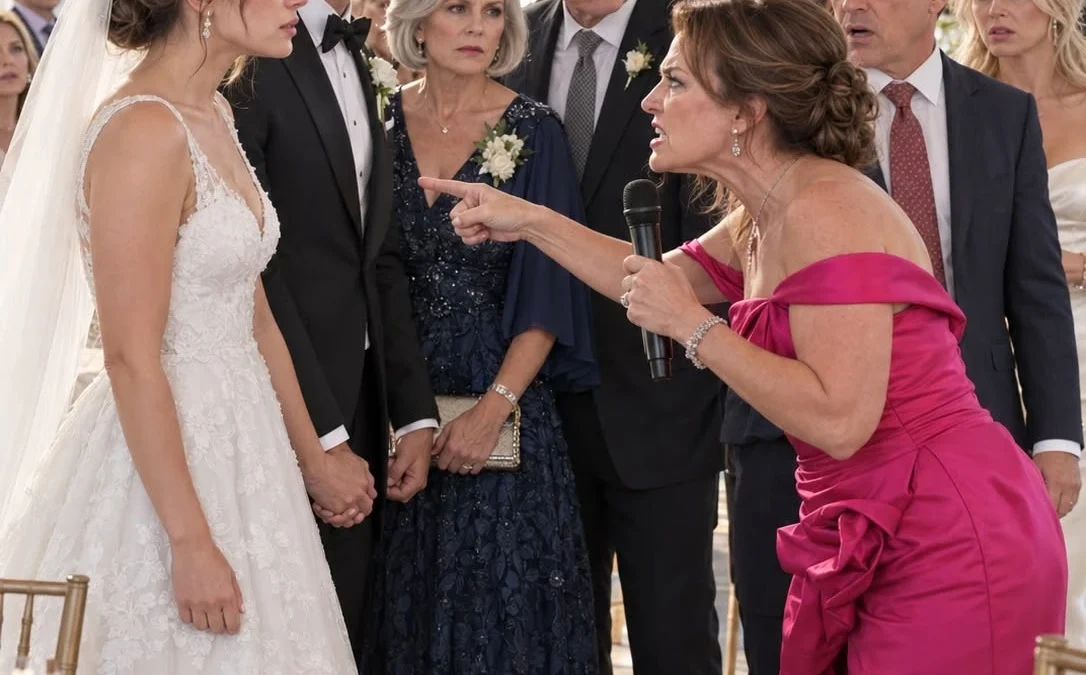
That was when Muriel snapped.
She marched across the dance floor dragging Reginald behind her, with Priscilla trailing like a confused ghost. She snatched the microphone from the startled DJ.
The music cut out. The whole tent went silent.
“Excuse me!” Her voice screeched through the speakers. “There seems to be a mistake. I am the mother of the bride, Muriel Vance, and this is her father, Reginald. Those people”—she aimed a shaking finger at Beatrice and Theodore—”are impostors.”
A murmur rolled through the crowd. My hand tightened around Julian’s.
“Mom, stop,” I said, my voice carrying without a microphone.
“No, I will not stop! You ungrateful girl. We raised you. We fed you. And you invite us here, shove us in the back, and let these strangers take credit! After everything we did for you—”
“Everything you did for me?”
I walked onto the dance floor and stood five feet from her. I looked her in the eye.
“You mean ignoring my graduation to go to a modeling audition? You mean telling me my sister was the only one worth praising? You mean five years of silence while I built a life from scratch?”
“We were busy,” Muriel sputtered. “Priscilla needed us. She’s delicate.”
“Priscilla is a thirty-year-old woman wearing white to her sister’s wedding,” I said, glancing at her. Priscilla suddenly looked very small. “That isn’t delicate. That’s pathetic.”
The crowd gasped.
“How dare you?” Reginald’s face went red. “We are your parents. You owe us respect.”
“I owe you nothing. And actually,” I said calmly, “you aren’t my parents. Not legally.”
Muriel froze. “What?”
Beatrice stepped up beside me. She didn’t shout. She never needed to.
“Estelle was legally adopted by Theodore and myself six months ago. The paperwork is filed with the state. She is a Darlington. You have no legal claim to her, and after tonight, you will have no social access to her either.”
Muriel stared at me, her eyes wide with horror.
“You… you replaced us.”
“I didn’t replace you,” I said, finally delivering the truth I’d carried for years. “You vacated the position. Beatrice and Theodore simply applied for the job, and they were overqualified.”
Not a single person in that tent breathed.
Theodore stepped up on my other side and nodded to the guards. “I believe you are trespassing at my daughter’s wedding. Please remove yourselves, or the police will be called.”
“You can’t do this!” Priscilla cried, tears finally falling. “We’re family!”
I looked at the three of them. The people who gave me life. The people who never once made it feel worth living.
“No. You share my DNA. These people”—I gestured to Julian, to Beatrice, to Theodore, to the whole warm, glittering room—”share my life. Goodbye, Muriel. Goodbye, Reginald.”
The security guards moved in. They escorted my screaming parents and my sister out of the tent and into the night.
As they disappeared, the band hesitated.
“Play,” I told the bandleader. “Play something loud.”
And they did.
The night didn’t end in ruin. It ended in dancing. I danced with Theodore. I danced with Julian. I danced until my feet ached, feeling lighter than air. 💃
I never heard from Muriel or Reginald again. I suspect Beatrice had her old law firm send a cease-and-desist letter. I never asked. I didn’t need to know.
Five years have passed.
I’m sitting in the sunroom of our own home as I write this. Light filters through the oak trees. On the floor, my two-year-old daughter, Clara, is building a tower of blocks, and Beatrice is down there with her, cheering every block.
“Good job, Clara! Look at that structure. You have your grandfather’s eye for engineering.”
Clara knocks it over and giggles.
“Oh, wonderful crash!” Beatrice laughs. “Let’s build it again.”
I watch them, and I feel a profound, quiet peace.
Clara will never know what it feels like to be second best. She will never have her achievements weighed against someone’s looks. She will grow up knowing her worth is inherent, not conditional.
On the mantle is a photo from the wedding. Me, Julian, Beatrice, and Theodore, laughing in the middle of the dance floor. A family built not by blood, but by choice.
We’re taught that family is a fixed point in the universe, an unchangeable gravity, and that we must endure anything for the sake of shared history.
But history is just what happened yesterday.
It doesn’t dictate tomorrow.
I learned that worthiness isn’t a trophy you win at a pageant. It isn’t a grade on a report card. It’s the quiet certainty that you deserve to be heard, to be seen, and to be loved without fine print.
I had to walk away from the people who gave me life to find the people who gave me a life worth living.
So if you’re standing in the shadow of someone else’s spotlight, waiting for a crumb of praise that never comes, please stop waiting.
Step out of the room.
Get in your car.
Find your own table.
There are people out there who will look at you and see the whole sun, not just the runner-up.
I found mine. 🤍
And I dare say the view from here is magnificent.
Disclaimer: This story is entirely fictional and created for entertainment purposes only. It does not represent any organization or individual, nor does it encourage inappropriate behavior. The content was generated with AI assistance.








