“No One Has Ever Chosen Me,” She Whispered to the Frozen Night, Never Knowing the Coldest Duke in England Was Hiding Six Feet Away
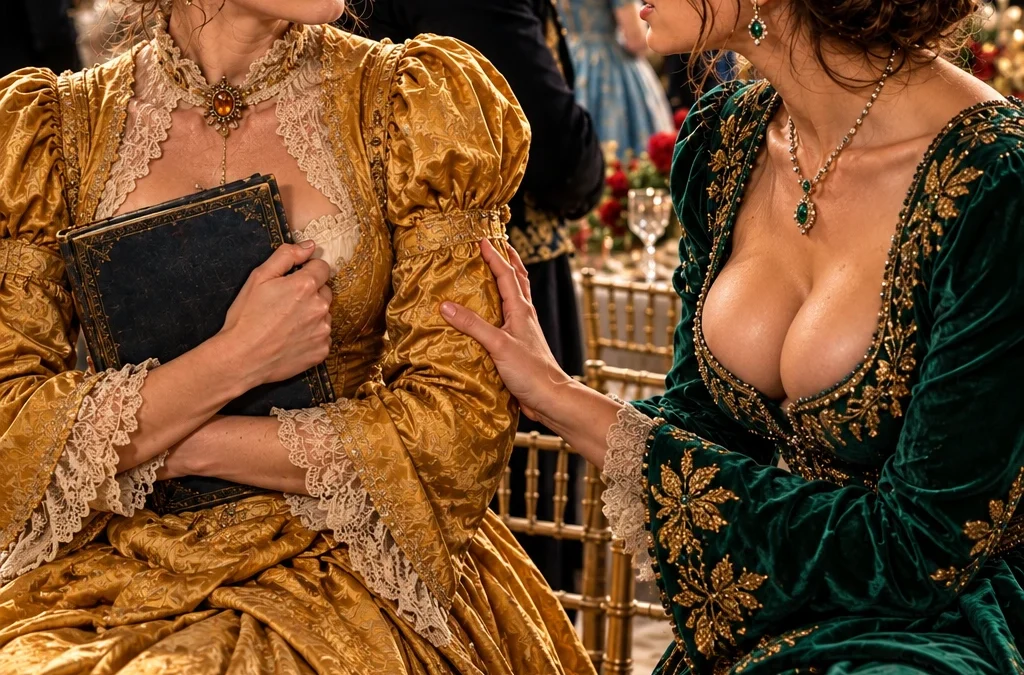
😱 “No One Has Ever Chosen Me,” She Whispered to the Frozen Night, Never Knowing the Coldest Duke in England Was Hiding Six Feet Away
PART 1
There is no room in London lonelier than a crowded ballroom. 💔
It is the only place where a woman can be surrounded by four hundred people and still be counted as no one at all.
Catherine Elwood had been counted as no one for seven years, ever since the winter her father died and her aunt took her in with a sigh that never quite finished leaving the house. She was twenty-three. She wore her dead mother’s gown, made over for the third time. She had learned to stand so still at a ball that people passed her the way they passed a coat stand.
On the last Thursday of January, 1816, she stood alone on a frozen stone balcony at Lindhurst House and whispered a sentence she had never said aloud, believing only the stars could hear it.
She was wrong. 😳
The carriage smelled of damp straw and lavender water. Aunt Harriet sat opposite with a fan and a list of instructions.
“You will stand by the pillars. A gray gown beside my daughters’ white and primrose is a reproach to the eye. And I put a new ribbon on that bodice, one shilling and sixpence, so that you may feel the proper gratitude.”
“Yes, Aunt.”
Catherine had sewn that ribbon on herself by candlelight after finishing the household accounts. There was no profit in saying so.
“One more thing. Mrs. Pomfret in Harrogate needs a governess by July. Forty pounds a year. If neither Louisa nor Sophia is spoken for by Midsummer, I shall write and tell her you are free.”
Catherine counted the buttons on her left glove. Eight. There had always been eight. The counting was never about the number. It was about having something to hold while her face did what it had been trained to do, which was nothing. 🕯️
Inside, three chandeliers blazed over a ceiling of painted cherubs. Catherine counted the candles before her cloak was fully off. Two hundred and twelve. She held the number close like a coin in her pocket.
From her pocket she drew a small ivory dance card on a silk cord. Her father had given it to her on her sixteenth birthday. “I expect you’ll need a bigger one,” he’d said, smiling over his spectacles, “because I intend to be insufferable about how popular you are.”
He died three weeks later. The card had been to seven winters of balls and had never held a single name. She carried it anyway, the way some people carry a letter they cannot burn.
Her cousin Sophia brought lemonade and a stolen shawl. “The pillar is very lucky to have you.” It was the first kindness of the evening. It lasted four minutes.
Then two young gentlemen drifted to the other side of her pillar. A pillar is a poor wall.
“The gray one by the door. Poor relation. Sews the girls’ flounces and keeps the household books. Lives on what the family forgets to count.”
“Does she dance?”
“Does a footstool dance?”
They laughed. Catherine walked away with her spine as straight as a ruler. She did not run, because a lady does not run. She did not cry, because crying was an extravagance she could not afford.
She slipped through a pair of glass doors onto the balcony. The frost bit through her gloves. Above the chimney pots, nine thin stars burned. 🌌
Nine was a manageable number.
Then she heard her own voice, flat as a clerk reading out a total.
“No one has ever chosen me.”
The words hung in the cold, white and small. Nothing answered. She drew a breath, squared her shoulders, and prepared to be nobody again.
She never knew that six feet away, behind a potted orange tree, stood the Duke of Ashcom. ❄️
Thirty-two years old. Twenty thousand a year. Cold, clever, and unmarried. They said he once cut a viscount dead by looking at him for four seconds. He had come to this ball meaning to stay forty minutes, and had fled a baroness with a third daughter into the nearest dark.
He heard every word.
It was the lack of self-pity that undid him. She said it like a woman reading the last line of a column she had checked many times and found correct. He ought to have coughed. Any gentleman would have. But to reveal himself would tell her that her one private moment had been overheard by a stranger. So he stood absolutely still among the orange leaves and listened to her breathe.
When the doors closed behind her, a line of frost on the rail was marked with the prints of two gloved hands.
In seven years, the Duke had not asked a single woman to dance.
Three minutes later, the room changed shape. A silence spread like ink in water. The crowd parted, and the Duke of Ashcom walked straight to the east pillar and bowed to the girl nobody saw.
“Miss Elwood. Would you do me the honor of the next dance?”
“Your grace must be mistaken. My cousins are just there in white and primrose.”
“I have no business with your cousins. I came across the room to ask you.” 🕯️
He borrowed her dance card. She knew he would see it: all twelve lines blank. He wrote one word on the first line and never remarked on the other eleven.
In the middle of the dance she whispered the number she’d been counting. “Two hundred and twelve. Candles. It is better than screaming.”
“I make it two hundred and thirteen. The footman by the north door has just lit another, and I believe the others are cross with him.”
She laughed. A real laugh. And the Duke looked like a man who had put his hand into a cold river and found it warm.
Within days came a black-sealed note: the Dowager Duchess of Ashcom requested Miss Elwood’s company at tea. There she offered Catherine fifty pounds a quarter to untangle the accounts of a charity school that hadn’t balanced in two years.
Aunt Harriet tried to stop it. “She is a plain, simple girl, of no consequence to anyone.”
The Duke had been standing in the doorway.
“In this house, Miss Elwood is a guest of my mother’s. I would take it as a kindness if you would consider that phrase withdrawn.” 🥶
Catherine found the error no one else could: a figure copied wrong, an entry recorded twice, and a coal merchant overcharging for two years. One hundred and eighty pounds.
But her small triumph led somewhere darker. Searching her uncle’s desk for a laundry receipt, she found a letter from a bank. It said the trust account left by her late father, which had held £1,500, now held £310.
She put it back exactly as she’d found it.
She told no one. She simply began writing down every date and every sum in a small black notebook. Numbers were the only weapon she had ever been allowed to carry. 🖤
And the Duke? He had one more secret, sitting in his chest like a swallowed stone, and he was running out of time to tell her.
PART 2
Spring came to London, and so did the whispers.
Catherine counted the hours until her afternoons in Keren Street. She told herself it was the fifty pounds. At Easter, the Dowager invited the whole Pembroke family to Ashcom Park, and one sleepless night Catherine crept down to the library in her wrapper. The Duke was there in his shirtsleeves, with the Dowager’s pug, Wellington, posted on the threshold as a chaperone. 🐶
“I may not make tea well. In thirty-two years I have done it twice. But I know you take it without sugar.”
It was dreadful tea, and the best she had ever drunk.
By the dying fire she told him what she had never told anyone. “My aunt said on my first night that I was an expense. I began counting what I cost her. After a while I counted everything, because as long as I was counting, I did not have to feel the things that had no number.”
He was silent so long she looked up.
“I had a count of my own,” he said quietly. “Her name was Cordelia. She said she loved me. Then I stood on the other side of a door and heard her tell a friend she would endure me for the coronet, and that a duke could be managed like any other large dog. Since then, when anyone says a kind word to me, I hear the figures underneath it. You are the first person in seven years whose kindness I couldn’t hear the sum of.” 💫
His fingers closed around hers. And still he did not tell her the one thing he’d been holding back.
Then, in May, a woman in lilac silk crossed a crowded musicale with the ease of a cat entering a dairy.
Lady Harkort. Cordelia.
“His grace is so kind to anyone pitiable. It is a habit of his, like feeding strays at the kitchen door. I only hope you won’t mistake it for anything more.”
Then Aunt Harriet made it public. “My niece has been angling for a rich man since January. A girl brought up on charity will do a great deal to get a coronet.”
Eighty people held their breath. The Duke began to rise, and Catherine laid two fingers on his sleeve. “Please. Let me carry my own weight.” 😶
He sat. It cost him visibly. She walked out through eighty people with her spine straight.
It might have healed. But days later, she arrived early at Keren Street to return the school accounts, and the study door stood open.
“Are you going to marry the girl?” That was Lord Wexley. “The whole town is betting on when.”
And the Duke’s voice, hard and brittle as thin ice: “Good God, Hugh, I have shown a lonely girl some kindness. That is the whole of it. I mean to see that she is comfortably provided for, and after that she may go wherever she likes.” 💔
Catherine stood frozen with her hand raised to knock.
Kindness. Provided for. It was the very tune Lady Harkort had played.
She laid the folio on the hall table and walked out. By evening she had written her resignation. By Friday her aunt had written to Harrogate. Catherine was expected on the York Mail on the eighth of July.
The Duke called three times and was turned away. She returned his note unopened. Even the Dowager came in person, took Catherine’s face in her papery hands, and whispered, “Do not decide the sum before you have seen all the figures.”
Then came the twenty-eighth of June, and Lady Lindhurst’s Midsummer Ball.
Catherine wore the gray gown one last time. She stood at the east pillar, where she had stood in January, and counted 264 candles. In her reticule, beside the ivory card, lay the black notebook.
Across the room the Duke stood by the windows, looking at no one. His eyes kept returning to her pillar, then dragging themselves back to the floor.
At eleven, Lady Harkort touched his sleeve. “Let me make it up to you at supper.”
And that was when Aunt Harriet, with Uncle Gerald in tow, swept across the floor and cried loud enough to turn forty heads:
“Your grace, I would not have you deceived. She is a scheming girl with no fortune and no shame!”
Catherine stepped out from the pillar.
Four hundred faces turned. Her hands were ice. The old numbness tried to close over her like water.
And then she thought, quite clearly: I have been invisible for seven years. This is not a thing to waste.
“Aunt,” she said, and her voice carried farther than she expected. “You have said that twice now in public. I should like to answer it once.” 🔥
PART 3
The Duke of Ashcom had moved.
Catherine saw him from the corner of her eye, coming through the crowd with the quick, silent stride of a man who had made up his mind. He stopped an arm’s length away and offered his arm, palm up, without a word.
She didn’t take it. He didn’t seem to expect her to.
“Miss Elwood has the floor,” he told the room, in the voice that had once cut a viscount dead. “I would not interrupt her for the world.”
Catherine opened her reticule and took out the small black notebook. 📓
“I have kept my uncle’s household books for seven years. Every candle, every coal, every pair of stockings. I am a poor relation, and I am told I am of no consequence, but I have always been very thorough.” She turned to the room. “My father, the Reverend Thomas Elwood, left me fifteen hundred pounds in the three per cent consols, held in trust with my uncle, Mr. Gerald Pembroke, as sole trustee. In March, I found a letter from the bank. It says the account now holds three hundred and ten.”
A murmur ran around the ring of watchers. Uncle Gerald had gone the color of tallow.
“This is nonsense. The girl is overwrought. She has been reading novels!”
“On the eleventh of October, 1812, four hundred pounds,” said Catherine, turning a page. “On the second of March, 1814, five hundred. On the ninth of November last, two hundred and ninety. That is eleven hundred and ninety pounds, Uncle. I believe the first sum went to a gentleman named Craig in Pall Mall. The letter is in the second drawer of your desk, beneath the laundry receipts. I put it back exactly where I found it, and I should be very surprised if you have moved it since.” 😤
Aunt Harriet had both hands pressed to her mouth.
“I took work at the Duke’s house for fifty pounds a quarter because I wished to buy a ticket out of yours. I did not need his fortune, Aunt. I needed my own, which has been spent. I should like to ask Lord Lindhurst, who sits on the bench and in the House of Lords, whether a trustee who draws upon a trust to pay his gaming debts is a gentleman.”
Lord Lindhurst had come up behind her, a heavy gray man with a face like a closed ledger. When he spoke, it was very slowly.
“He is not, Miss Elwood. He is a defaulter, and the Court of Chancery has a great deal to say about men of that kind. Pembroke, you will wait upon my solicitor on Monday at ten, and you will bring every paper you possess. I will have this restored to the last shilling with interest. And I would be obliged if you and Mrs. Pembroke would leave my house tonight.” ⚖️
The silence in the ballroom was total.
Then Sophia broke from her mother’s side, crossed the floor, and took Catherine’s hand in both of her own. “It is true,” she said, in a trembling, defiant little voice. “I have watched her do those books for years, and I never said a word. I am so sorry, Catherine.”
Catherine pressed her cousin’s fingers and could not trust herself to answer. 🥹
The Pembrokes left by the side door. By the end of the week, all of London knew why.
Uncle Gerald sold the Surrey acres and two hunters and gave up the lease on Great Russell Street to repay the trust. By August they had retired to a damp cottage in Kent. No card was ever left for them, and no one called. Aunt Harriet was never again received in any drawing room that mattered. It was said she sat at her window every morning at eleven, listening for a carriage that did not come. 🍂
But the room was not finished.
Lady Harkort had been standing white-lipped three feet away. Now, seeing the tide turn, she pushed forward with a brittle smile and laid her hand on the Duke’s arm.
“Frederick, surely you will not be seen with a girl who has made such a scene. Everyone knows you and I have an understanding.”
“I remember our understanding perfectly, Cordelia,” said the Duke. His voice was not raised, but it carried to the walls. “I stood on the other side of a door in the spring of 1809 and heard you tell Miss Waverly that you would endure me for the coronet and the twenty thousand a year, and that a duke could be managed like any other large dog. I have a very good memory.”
Her face went the color of her cream-colored gown. Somewhere a gentleman choked on his champagne. Lady Dunore said, quite clearly, “Well, I never.”
Cordelia Harkort turned and left without another word. She went to Paris for her health in July and had the good sense to stay there. 👑
Then the Duke turned to the whole room.
“I was a coward in May. I said a thing about Miss Elwood that I did not mean, in a moment of fear, and she heard it, and she was right to leave. I have apologized to her in two notes, neither of which she has read. I now apologize in public, since it seems to be the only place she cannot walk out of.”
His mouth moved at one corner.
“I intend to court Miss Elwood, with her permission and in front of anyone who cares to watch, since she has spent seven years in rooms where no one did. I do not command her. I only ask.” He turned. The silver-gray eyes were not cold at all. “Miss Elwood. May I?”
Four hundred pairs of eyes. Catherine thought she ought to be terrified. Instead she felt light, like a woman who has carried a trunk for years and has just been told she may set it down.
“You may call on Tuesday, your grace. At four. I take my tea without sugar.”
“I am aware,” said the Duke, and bowed. ☕
In the silence that followed, Lady Dunore announced to no one in particular that it was the twenty-eighth of June and she had won her fifty guineas with two days to spare. 😂
Afterward, Catherine could not remember how she reached the balcony. She remembered the glass doors, the cool air, the smell of dust and river and lime blossom. She remembered that she was shaking all over now that it was done.
She stood at the rail in the exact place where she had stood in January. She did not count the stars.
“There are not nine tonight,” said a voice behind her. “The sky is too light. I should have to find you nine somewhere else.” 🌙
The Duke stood at the glass doors, looking like a man who had walked into the sea and found it was not cold. He did not come closer. He waited, as he had always waited, until she nodded.
“I have something to say to you, and I am going to say it badly. I did not say it earlier because I did not wish to make you a spectacle twice in one evening.” He drew a breath. “Catherine. I was behind the orange tree.”
She stared at him.
“On the night of the Lindhurst ball, there is a stone alcove just there, and I had gone into it to avoid a baroness with a third daughter.” He nodded to the left, where a glossy-leaved tree in a tub stood sentinel against the dark. “I heard you say that no one had ever chosen you. I should have coughed. I should have told you I was there. I did not, because I could not bear to take from you the only moment you had to yourself. I have felt guilty about it for five months.”
“You eavesdropped,” said Catherine, and to her great annoyance her mouth had begun to twitch.
“I was cornered by a shrub.” He said it with perfect gravity. “I would like to correct the record. You said no one had ever chosen you. It was not true even then. I had chosen you before I knew your name. I have been choosing you every day since. In a library with a pug on the threshold. When you found a hundred and eighty pounds in a coal bill and I wanted to sit down. I was afraid, and I said a stupid, cowardly thing, and I will be afraid again, because I have been alone for a very long time. But I am not leaving this balcony until you know it.” 💛
She found she was crying quietly, without any of the usual effort to prevent it. He took out his handkerchief, which smelled of bergamot, and put it into her hand. She laughed, and blew her nose in the Duke of Ashcom’s linen.
“I am not an easy woman to be chosen by,” she said. “I count. I will count your debts and your dinners and the buttons on your waistcoat. I will not be managed like a large dog.”
“I should be appalled if you were.”
“And I may be very difficult about tea.”
“I should be devastated if you were not.” He looked down at her hand, still wrapped around the ruined handkerchief. “May I kiss you? You may say no. I will go in and dance with Lady Dunore, and I will court you on Tuesday regardless, and every Tuesday after that, for as long as you will let me.”
“Yes,” said Catherine.
It was a very gentle kiss and a very short one, and afterward she could not have said which of them trembled more. His hand came up to cradle her jaw as though she might break, and she felt the hollow of her seven winters go out of her in one long, warm breath. When he drew back, there was a glitter on his lashes he did not bother to hide. 💫
She took the ivory dance card from her reticule and held it out in the pale light. “You wrote on the first line. There are eleven still empty.”
He took the pencil from its silk cord. He wrote Ashcom on the second line, and the third, and all the way down until there was no space left. The pencil scratched softly in the quiet.
When he gave her the card, she looked at twelve lines of the same name in the same clear, slanting hand, and she laughed until she was crying again.
“I shall have nothing left to count.”
“I should hope not,” said Frederick. “I intend to keep you very busy.”
They were married on the fourteenth of September at St. George’s, Hanover Square. The bride wore dove-gray silk, which the Dowager pronounced the only sensible color for a woman who intended to be looked at. Sophia was her bridesmaid. Lord Wexley wept openly in the second pew. And Wellington, who had refused to be left at home, ate a corner of the bishop’s hassock. 🐶
The restored fifteen hundred pounds went to the school in Clerkenwell, which grew to two hundred and four girls, a new roof, and a library with Reverend Thomas Elwood’s name over the door.
Nine summers later, on the cliffs of North Northumberland, the wind came off the sea smelling of salt and crushed thyme. The Duchess of Ashcom sat on a rug with a ledger on her knee and a daughter at each elbow. The house behind them had once been a cold, gray place. Now it was so full of noise and sunlight and dogs that the Duke had been heard to complain he couldn’t find a quiet room to be miserable in.
Her eldest, Eleanor, aged eight, held up a small ivory card on a faded silk cord.
“Mama, why does this say Ashcom on every single line? Papa says it was a joke, but he went rather pink.”
Catherine turned the card over. The old ink had gone brown with the years.
“It was not a joke. A very long time ago, I stood alone at a ball and thought no one in the world would ever choose me. And your father, who was hiding behind an orange tree at the time, thought otherwise.”
“He was hiding behind a tree?” Eleanor was delighted.
“He was cornered by a shrub. He will tell you himself. It is a point of pride.”
Down the slope, a tall dark man in his shirtsleeves was coming up from the beach with a small furious boy under one arm and a bucket of crabs in the other hand. He saw them, and his whole face changed, as it had changed every day for nine years. Catherine felt it somewhere just beneath her ribs, a warmth that had never once needed counting. 🌅
She understood then what the girl at the pillar had not been able to know. To be chosen is not a moment at a ball, or a speech before a crowd, or a name on a line. It is a thing done again every morning, quietly, by someone who could have done otherwise.
And it was the only sum that had ever come out right. ❤️
Disclaimer: This story is entirely fictional and created for entertainment purposes only. It does not represent any organization or individual, nor does it encourage inappropriate behavior. The content was generated with AI assistance.
💬 Which moment did you love most: the candles, the notebook, or the orange tree? And did the villains get what they deserved? Tell me in the comments, and share this with someone who needs to know they are worth choosing. 👇








