NO ONE WANTED THIS ROTTING, SCORCHED GIANT LOG — UNTIL A SINGLE MOM STEPPED FORWARD.
THEN THE RICHEST MAN IN TOWN SAID SOMETHING THAT SHOCKED EVERYONE SILENT
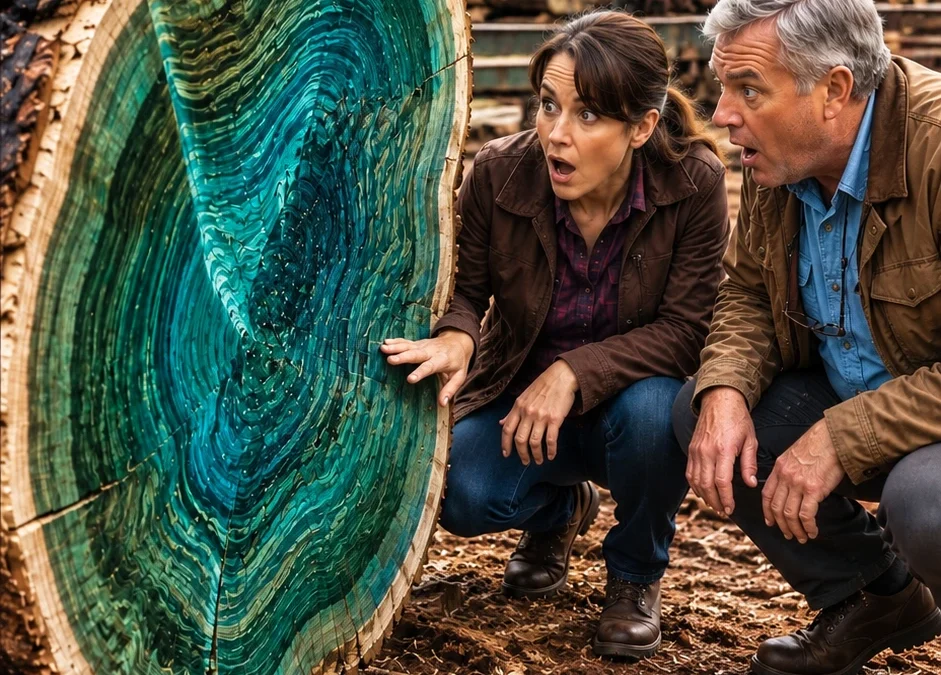
NO ONE WANTED THIS ROTTING, SCORCHED GIANT LOG — UNTIL A SINGLE MOM STEPPED FORWARD.
THEN THE RICHEST MAN IN TOWN SAID SOMETHING THAT SHOCKED EVERYONE SILENT 😱
Part 1
The auction was almost finished, the gravel yard already half-empty, when the manager dragged the tarp off the very last piece.
Forty men stopped talking all at once.
It was nearly 40 feet long, a fallen ancient redwood that had stood on a private ranch in Northern California since long before any of their grandparents were born.
One side was blackened and scarred by fire decades ago.
The base was hollow, dark and damp-looking inside — the unmistakable mark of rot.
Every mill owner walked away without a second thought.
This wasn’t lumber; it was a money pit.
Hauling it alone would cost a fortune.
Specialized equipment would be needed just to touch it.
Nobody wanted it.
Then Preston Harrington laughed.
He ran the most prestigious timber company in the state, supplying luxury hotels and million-dollar estates.
He knew the market better than anyone.
When he saw Maren Winslow hadn’t moved, he shook his head.
“That’s not an asset,” he told her, loud enough for everyone to hear.
“That’s a freight bill that will eat you alive.
”
Maren was 38, a single mom raising her daughter alone in a rented house nine miles out of town.
She drove a beat-up 14-year-old pickup.
Her shop was just one small building with two saws and a drying shed she’d built herself with a neighbor over three summers.
She had no investors, no sales team, no spare cash.
She didn’t argue.
She just walked over, knelt in the red dust, brushed away the dirt, and stared.
For a long time nobody said a word.
Then she looked up.
The auctioneer named a figure fair for sound timber — and got nothing.
Not a single nod.
He lowered it.
Still nothing.
Lower again.
By the fourth time, he was practically begging.
Someone in the back shouted he’d take it for free if they delivered it, and the crowd laughed.
The price dropped toward scrap value, an insult to a tree that had lived for a thousand years.
Maren raised her hand.
Preston’s jaw tightened.
He’d already declared the log worthless in front of everyone — and Preston Harrington never reversed himself publicly.
But he couldn’t stand the thought of a tiny operator walking away with something he’d dismissed.
He made one quick, petty bid just to force her to pay more.
Then he folded his arms, satisfied.
She took it.
“SOLD,” the auctioneer called out.
The crowd began to drift away.
Preston walked past her, close enough that half the yard heard him.
“I hope your bank likes firewood,” he said smoothly, smiling like he was offering her a compliment.
Maren wrote out her deposit without looking up.
Her hand was steady.
But as she stood there, the reality hit her hard — and it was terrifying.
The quotes came in fast.
Oversize permits, pilot cars, a lowboy trailer, cranes on both ends, specialized milling equipment… the cost just to get the log home and make the first cut was already higher than what she’d paid for it.
Dale Merriman, a fair-minded mill owner from the next valley, pulled her aside.
“Flip it,” he advised gently.
“Sell it to a broker.
Take a small loss and walk away clean.
That’s what anyone in their right mind would do.
”
Maren looked back at the giant redwood lying alone in the yard.
She thought about her father, who’d cut timber for 41 years.
He’d taught her something no spreadsheet ever includes: a tree that survives a wound and keeps growing doesn’t just heal — it reorganizes.
The grain shifts, weaving patterns that can never be planted or manufactured.
The fire scar everyone saw as a fatal flaw might actually be the very thing that made this log irreplaceable.
She turned to Dale.
“No,” she said.
“I’m keeping it.
”
Within days, the whispers started.
Preston’s voice carried farthest: “Winslow bought a log she can’t even cut.
” It spread like wildfire through every mill and dealer from Eureka to the Bay Area.
A cabinet shop canceled a large order.
Her cash reserves vanished.
Two brokers offered prices so low they were practically favors.
Then Preston drove out to her shop himself — something he’d never done — and made her an offer below what she’d already spent.
“I’m giving you a way out,” he said generously.
She looked at him straight.
“No.
”
He left confused — and angry.
Everyone watched, waiting for her to fail.
Neighbors gathered when the log finally arrived, massive as a beached whale, longer than her entire workshop.
Her own saw couldn’t begin to handle it.
She was trapped.
She had a giant, heavy, rotting tree sitting in her yard, no way to cut it, no money to hire help, and the most powerful man in the industry telling everyone she was finished.
But Maren didn’t quit.
She rented a massive portable slab saw — for one single exploratory cut.
Just one.
If she was wrong, she’d stop before wasting everything.
Word spread fast.
On that Saturday morning in April, people came to watch.
Dale showed up.
A furniture maker drove 90 minutes just out of curiosity.
Her daughter sat on the fence holding a juice box, unaware her mom’s whole future hung in the balance.
And then — Preston arrived.
Uninvited.
He leaned against his shiny car, smiling faintly.
He was there to watch her prove him right.
The operator spent 40 minutes carefully setting the rails.
Maren walked the log three times, marking her line with chalk, adjusting it by inches, running her hand over the charred wood as if reading it.
“Consulting the spirits?” Preston joked.
Someone laughed.
Then the saw roared to life.
For the first seven feet, it looked terrible.
Dark, muddy wood.
Soft pockets you could push a screwdriver into.
A black streak of old fire damage running deep.
Dale looked down.
The furniture maker shifted his weight, already feeling sorry for her.
Preston’s smile widened — he was exactly where he wanted to be.
Then the blade passed the shoulder of the old scar.
The color changed.
Deep, glowing, rich red — deeper and more alive than any wood they’d ever seen.
And then the grain appeared.
Not straight lines.
Not ordinary clusters.
Long, sweeping, continuous waves curling away from the ancient burn mark in wide, shining bands that caught the morning light and seemed to move when you shifted your stance.
Eight feet of it.
Unbroken.
Breathtaking.
The saw shut down.
Silence fell over the yard.
Wyatt, the operator, took off his gloves and ran his palm across the surface.
“I’ve cut nearly a thousand logs,” he whispered.
“I’ve only seen figure like this… twice.
”
Preston stood frozen.
His smug expression had vanished completely.
Maren looked at the stunning revelation — and then did something no one expected.
“Shut it down,” she said.
“No more cuts today.
”
Preston stepped forward, baffled and sharp.
“Afraid to see what’s left?”
She turned slowly to face him.
Her voice was calm but unshakable.
“No,” she said.
“I’m afraid you’re finally about to understand exactly what you passed on.
”
Part 2
Preston stood there, speechless for the first time in anyone’s memory.
He’d come to watch her fail — and instead, he’d watched her uncover something priceless.
But Maren didn’t explain.
She simply told the operator to pack up, covered the exposed slab, and left everyone standing there wondering.
She brought in Gideon Shaw, an independent timber consultant with 34 years’ experience — a man who never softened the truth to please anyone.
He spent five hours examining every inch of the log: drilling samples, taking moisture readings, crawling into the hollow base, photographing every detail.
Preston heard Shaw was coming and showed up too, bringing coffee for everyone, already preparing his victory speech.
Shaw delivered his findings plainly.
“The core is heavily compromised,” he confirmed.
“No industrial buyer would touch it.
Standard production yield would never justify the cost.
”
Preston set down his cup, ready to say I told you so.
But Gideon hadn’t finished.
“However,” he continued, “the outer section — especially around and downstream from the fire injury — contains extensive areas of rare, high-value figured redwood.
Produced by decades of growth responding to damage.
In all my career, I’ve seen material of this scale and continuity fewer than four times.
”
He paused, letting it sink in.
“This log is useless to a mill.
But to a craftsman? To a designer looking for something one-of-a-kind? It’s irreplaceable.
”
Two markets existed side by side in this business, he explained.
Preston saw only one — board feet, standard grades, predictable profit.
But there was another market entirely: people who didn’t want identical pieces.
They wanted story.
They wanted something that couldn’t be duplicated.
And they would pay premium prices for it.
Preston’s approach changed overnight.
He called Maron, offering several times what she’d paid — more than her shop had earned in two years.
“No risk,” he said.
“No hassle.
” She declined.
He raised it again.
She said no again.
Finally, he dropped the charm.
“Finding pretty wood doesn’t mean you know how to sell it to rich people,” he snapped.
And he was right.
Maren knew beautiful wood — but she didn’t know the architects, the luxury designers, the hotel developers.
Those were Preston’s connections, built over 30 years.
She emailed design firms.
Most never replied.
Galleries told her she needed an established reputation first.
A hotel group said she wasn’t on their approved vendor list — a process that took 18 months.
She sat on the log one evening, the report in her lap, and realized something painful: “A treasure with no buyer is just expensive inventory with a story.
”
So she stopped trying to sell wood.
Instead, she decided to build something.
She would make one finished piece — the best work of her life — and let it speak for itself.
For 19 days she studied the photos, mapped the grain patterns, planned every cut.
She turned down two more offers from Preston during that time.
When she finally had the slabs cut, she didn’t trim away the imperfections.
She kept the live edge.
She kept the charred scar, cleaned and preserved but not hidden.
She kept the healed ridge where the tree had grown over its wound.
The damage wasn’t something to cover up — it was the heart of the design.
The result was a dining table, over 12 feet long, on a sleek steel base.
The whole life of the tree was visible in its surface: the ancient fire wound at one end, the dark band of burn, and then those magnificent rolling waves of grain flowing down the length like a frozen river.
Under oil finish, the pattern seemed to shift as you walked past.
Everyone who saw it reached out to touch it without thinking.
Preston’s verdict came back through the grapevine: “My clients buy perfection.
They don’t buy a tree’s injuries.
”
But he was wrong.
The design world was shifting — toward meaning, toward authenticity, toward pieces that carried a story people could tell.
Maren scraped together every dollar she had and paid for a booth at a top-end architecture and craft show in the Bay Area.
Her spot was terrible — near a corner between a stone importer and a tile company.
For most of the first day, barely anyone stopped.
By late afternoon, she was calculating how many months it would take just to recover the cost.
Then, at 4:20 PM, a man in his fifties stopped.
He didn’t glance and keep walking like everyone else.
He stopped completely.
He walked the entire length of the table slowly, from the scarred end to the far side.
He crouched down and ran his fingertips along the blackened edge.
He stood there for four full minutes without saying a word.
And Maren stayed quiet too — letting the table do the talking.
Finally he introduced himself: Julian Cross, a principal at a prestigious San Francisco architecture firm.
He didn’t ask the price.
He asked where the tree had come from.
She told him — storm salvage, legally documented, from a private ranch, a thousand years old.
He asked about the fire.
She explained how the grain had formed around it over 80 years.
Then he looked up and asked the question that changed everything.
Part 3
Maren thought he wanted to buy the table.
She started to explain she could produce two or three more similar pieces — but he gently interrupted her.
He didn’t want the table.
He wanted the whole tree.
His firm was designing a small, ultra-luxury resort on the Northern California coast.
Every interior element needed to tell the story of the land it stood on.
They’d already rejected two perfectly beautiful material packages — because they were anonymous.
Anyone could buy them.
What Julian needed was something that couldn’t be found anywhere else on Earth.
He wanted the conference table, the reception desk, the wall panels, the lounge tables — all from this single redwood.
He wanted the fire scar visible.
He wanted the grain to flow from room to room, connecting the spaces like a living thread.
It was the most extraordinary request she would ever receive.
And the volume requirement was exactly what the log could provide — barely — if every cut was planned perfectly from the very start.
She knew then why she had stopped the saw that first day.
If she’d cut everything into generic slabs, the continuity would have been lost forever.
She’d preserved something precious without even knowing exactly who needed it.
Julian invited her to a project meeting in San Francisco in 11 days.
She said yes — then went back to her motel room and didn’t sleep.
Because four days later, the agenda arrived.
The timber supplier already on the project was Harrington Architectural Timber.
Preston had been working on it for seven months.
He walked into that conference room on the 18th floor confident, charming, completely sure he understood the situation.
The architects had found a charming little craft piece — and Harrington would buy it from her, mark it up, and deliver it as part of their package.
He complimented her work in a way that made her sound like a hobbyist, not a partner.
Maren presented next.
She had professional photos, Gideon’s report, detailed diagrams showing exactly where each piece would come from and how the grain would connect across the entire building.
She shared the salvage documentation, the drying schedules, moisture testing data, production timelines, insurance certificates — everything organized and indexed.
She showed the hollow sections and the damaged areas honestly, before anyone could ask.
In that room, nothing builds trust faster than someone admitting their material’s limitations voluntarily.
Then Julian placed his hand on the table.
“We’re not buying through you, Preston,” he said clearly.
“We’re contracting Maren directly.
”
For five seconds nobody breathed.
Preston recovered instantly — he was too much of a professional not to — but he shifted immediately into sharp, legitimate questions.
Did she have the capacity? The drying expertise? The certifications? The tolerance controls? Could she meet the deadlines without liquidated damages?
These weren’t cheap shots — they were essential questions.
If she’d signed a contract she couldn’t deliver, the story would have ended in ruin.
But she had every answer.
She’d anticipated every concern.
She’d consulted experts, lined up subcontractors, prepared contingency plans, tested finishes in independent labs.
There were no holes in her work.
Then Julian asked one final question that silenced the room entirely.
“Preston, you inspected this log at the auction, didn’t you?”
“I walked the yard that day, yes,” Preston said carefully.
Pause.
“I did.
”
Julian leaned forward.
“Then why didn’t you buy it?”
Preston had no safe answer.
If he said it looked worthless, he admitted his company had missed the most valuable thing the client wanted — at zero risk and scrap price.
If he said he’d seen the potential but the numbers didn’t work, he conceded that a two-woman shop had seen further than his entire operation.
He chose the second — graceful, but everyone understood the first.
Maren said nothing.
She let the silence speak.
The contract was signed in August.
It didn’t make her an overnight millionaire — after every expense, employee wage, kiln cost, and equipment lease, it was simply a very good year.
She still lives in the same house.
She still drives her truck — though she finally replaced the transmission.
What she gained was something far more valuable: standing.
When the resort opened the following spring, the main hall was featured in every major architectural publication.
The story of the burned log was told in the exact circles Preston had spent 30 years cultivating.
Within 14 months, top design firms from Los Angeles to Seattle were contacting her directly.
She hired more staff, upgraded her equipment, and moved from taking whatever work came to choosing meaningful commissions.
Two years later, Preston wrote to her.
He proposed a partnership — his established sales network representing her unique materials.
It was a generous offer, fair and professional.
She read it twice, thought for four days, and declined politely in three sentences:
“I think we’re each better off focusing on the market we understand.
”
He’d said something very similar to her once, standing beside that log in her yard — and it had meant she should stay small and leave serious business to him.
Coming back, it meant something else entirely.
He never replied.
She kept one section of the log for herself — five feet long, mounted on the wall above the workbench where new apprentices learned their craft.
It shows everything side by side: the magnificent figured grain, the dark burn scar, and also a stretch of perfectly ordinary redwood — the kind anyone could buy by the pallet.
Carved into a small plaque beneath it are two words:
LOOK TWICE.
That is the truth of it, finally.
Maren didn’t beat Preston at his own game — she couldn’t have.
She won by playing a different game entirely.
Where others saw only loss and subtraction, she saw history and possibility.
Where they saw a problem to calculate, she saw a story to unfold.
The “flaw” everyone tried to ignore was actually the prize, wearing a disguise that only worked on people in too much of a hurry to really see.
It never required genius — only the courage to stay when everyone else left, the patience to look closely, and the discipline to prepare thoroughly when there was no guarantee of reward.
The insight opened the door, but steady, unglamorous work walked through it.
And that is something anyone can do — if they’re willing to look twice.
This story is entirely fictional and created for entertainment purposes only.
It does not represent any organization or individual, nor does it encourage inappropriate behavior.
The content was generated with AI assistance.








