“None of Them Will Be My Mother!” the Duke’s 8-Year-Old Daughter Screamed at the Women He Brought Home… Then the New Cook Served a Pie That Made Her Run From the Table in Tears
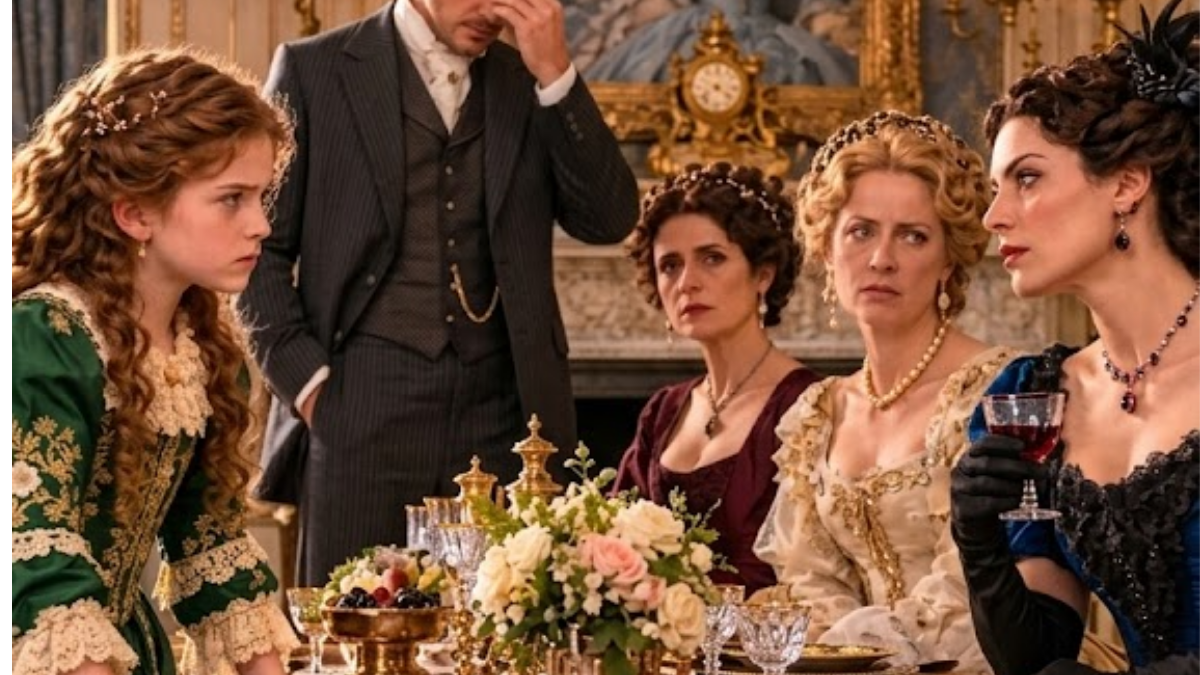
🥧 “None of Them Will Be My Mother!” the Duke’s 8-Year-Old Daughter Screamed at the Women He Brought Home… Then the New Cook Served a Pie That Made Her Run From the Table in Tears 😢
PART 1
“None of them will be my mother.”
Eight-year-old Norah Everheart stood at the end of the dining table with both hands pressed flat against the polished wood. Her chair had shot back so fast that a footman barely caught it before it hit the wall.
Across from her, Lady Beatrice Ashford stared as if the child had committed a crime.
It had been a terrible afternoon.
Norah’s father, Roland, the Duke of Everheart, had invited three women to luncheon so his daughter could “get to know them.” Lady Beatrice. Lady Honoria. Miss Vane. Three possible future duchesses. Three possible stepmothers.
But the luncheon had turned into an inspection. And Norah was the one being inspected.
Earlier, Lady Beatrice had looked up at the portrait above the mantel and frowned. The painting showed Norah’s mother, Cecily Everheart, in a pale blue gown and pearls, her face turned slightly toward the window. The painter had missed the little crease that appeared between her eyebrows whenever someone said something foolish.
Norah had said nothing then. She had only looked at the portrait.
Her mother had been gone three years. Norah knew that. But Cecily had never been just an idea called “Mother.” She had been warm hands. A soft nightgown. A cough behind a closed door. And an apple pie that had to cool before anyone was allowed to cut it. 🍎
“A child who interrupts adults must learn that affection is not the same as indulgence,” Lady Honoria announced.
“I did not interrupt anyone,” Norah said.
“You are interrupting now,” Roland said quietly.
Miss Vane touched her napkin. “The poor child has been without a mother three years. She’s bound to be unsettled.”
Then Lady Beatrice lifted her wine glass. “If I were to become Duchess, I should want that portrait removed before the next dinner party. It’s difficult to begin a new household beneath the eyes of the old one.”
That was when Norah pushed back her chair.
“None of them will be my mother.”
The words hit the room harder than a dropped plate. Lady Honoria gasped. Miss Vane looked down. Lady Beatrice set her glass down so fast that red wine trembled over the rim.
Roland closed his eyes for one second.
He hadn’t wanted this to become a trial. He’d only wanted Norah to see that the future didn’t have to be frightening. He wanted a household that didn’t depend on a little girl reminding her father to eat dinner. He wanted someone, anyone, who knew what to do.
Because he didn’t. 💔
Then, from the service door, came the careful sound of a tray.
A footman entered carrying a round apple pie on a silver platter. Still warm. The crust golden and a little uneven, with leaves cut into the top and a thin ribbon of steam rising through them.
Norah smelled apples. Honey. Lemon.
She stopped breathing.
The footman saw her face change. Quietly, he set the pie on the sideboard, waited a moment for the crust to settle, and cut a small slice.
“It should have cooled another minute,” he murmured. “But some emergencies matter more than pastry.”
Norah crossed the room. She ignored the ladies. She ignored her father. She took the plate, lifted the fork, and took one bite.
Then she went perfectly still.
The apples were sliced thick, soft but not mushy. Honey warmed the center. Lemon brightened the crust.
It wasn’t just apple pie.
It was the kitchen on a clear afternoon. It was her mother wrapped in a blanket, pretending to be annoyed because Norah had stolen the first corner. It was Cecily’s voice saying, “Not yet, darling. If you cut it while it’s hot, the filling will run away.”
Norah set the fork down. Her voice shook.
“Who made this?”
The footman nodded toward the service door. “The new cook, my lady. Agnes Merryweather.”
Norah turned and ran.
Roland rose at once. Behind him, three ladies began talking over one another, but he barely heard them. He knew that look on his daughter’s face. It was the look she wore when a memory opened without warning.
He followed her down the narrow servants’ passage toward the smell of apples.
The kitchen was enormous. Copper pans gleamed along one wall. A black stove breathed steady heat. Two kitchen maids by the sink tried very hard not to stare.
And beside the cooling rack stood a woman with flour on her sleeves and calm, watchful eyes.
Norah stopped right in front of her, chest heaving.
“How do you know my mother’s pie?”
Agnes Merryweather looked at the trembling child. Then at the doorway behind her, where the Duke now stood, uncertain, not wanting to crowd his daughter, not understanding why a cook’s pie had turned her pale as paper.
Agnes lowered her voice.
“Because I knew your mother,” she said, “long before she was ever a duchess.”
Norah’s lips parted. “You… knew Mama?”
Agnes nodded slowly.
“I knew things about Cecily,” she said, glancing at the Duke, “that I suspect even your father never knew.” 😮
👇 Part 2 is in the comments! Can’t find it? Leave any word below and I’ll send it to you privately. ❤️
PART 2
“I knew things about Cecily that I suspect even your father never knew.” Roland stepped into the kitchen. “Then tell me how you have my wife’s recipe,” he said. Agnes gave him a level look. “With respect, Your Grace, it is not a recipe that belongs to a duke.” She explained she’d been a kitchen girl at Rosemere, the country estate of Cecily’s grandmother, when Cecily was sixteen. She’d only come to Everheart for a few weeks because the house cook had fallen ill. Then she sat them both at the scrubbed kitchen table with tea, “because stories taste better with tea,” and began. Cecily had hidden from French lessons in the pantry. She rode a gray pony she’d been forbidden to ride. She gave the first slice of every pie to the stable boys. She once defended a young footman against her own furious father. She ruined at least seven pies, “eight if we count the one she tried to repair with jam.” And she climbed out of windows. “Only low ones,” Agnes added, as Roland turned sharply. Norah laughed out loud for the first time in weeks. 🥧
But Agnes also told the hard parts. A winter illness had settled in Cecily’s chest at sixteen, and a doctor said she might not live long enough to marry or have children. The next morning, Cecily marched into the kitchen wrapped in a blanket and announced she was going to have an ordinary life. Then she asked Agnes to help her make a pie. The illness never fully left. It only learned to wait. When Norah was five, pneumonia came, and Cecily was gone before spring.
That night, under the portrait, Norah finally said what she’d been holding in. “Are you looking for a new wife because you think I’m incomplete? Are you trying to find someone who’ll push Mama out of this house?” Roland’s face tightened. “I only wanted you to have a complete family.” Norah’s eyes filled. “We already ARE a family!” She ran. And Roland finally saw the truth. For three years he had given his daughter everything that could be ordered, and almost nothing that required him to simply sit beside her.
So he changed. He cancelled the visits. He read her bedtime stories, badly at first (“the fox sounds like a magistrate,” Norah complained). He joined her for breakfast, walked in the garden, learned she hated boiled turnips. And one rainy afternoon, for the first time in three years, he unlocked Cecily’s private rooms. Inside, Norah found her mother’s old recipe book from Rosemere, flour still caught in its seams. Beside the apple pie recipe, Cecily had scribbled changes in the margin: Thicker apples. Try honey. Lemon in the crust. Wait before cutting. Then the page lifted under Norah’s fingers. The book had a false lining. Hidden inside was a yellowed, folded letter in her mother’s handwriting. No name on the outside. Just a date from long before her parents ever married, and five words: For my future child. Norah’s hands trembled as she began to unfold it… 😭
👍 Want Part 3? LIKE this post and comment “APPLE PIE” below! Once we hit enough comments, I’ll post the ending right here. 🔥
PART 3
Roland didn’t take the letter from her.
“It may be private,” he said softly. “You may decide whether to read it.”
Norah unfolded the fragile paper. The ink had faded, but the handwriting was unmistakably her mother’s. She read it aloud, her voice barely above a whisper.
My dear child,
If you are reading this, then somehow I became a mother, which my body may never allow. The doctors talk about the future as if it’s a room they’ve already visited. I don’t entirely believe them. But I am sixteen and very tired, and I don’t know which parts of my courage are real.
I want you to know I am not only the girl who was ill. I was the girl who hid in the kitchen. I rode the gray pony when I was forbidden. I argued with my father over a servant and cried over a ruined pie. I was frightened and stubborn, and I always wanted to see what was beyond the next hill.
If you have me, please don’t spend your life watching me breathe. Don’t give up friends or laughter or adventures or silly ordinary fun because I’m tired. Caring for me is not the price of being my child. And don’t polish every memory of me until it becomes too precious to touch.
If I leave you early, love people. Make new friends. Laugh at bad jokes. Let your life become big. I will not be forgotten just because you are happy. Going on living is not betrayal. It’s the part of life I most want to give you.
If I’m beside you when you read this, ask me whether I still owe Agnes a pie. The answer will be yes.
Your loving mother,
Cecily 💌
The only sound was rain against the windows.
Roland didn’t tell her to be brave. He didn’t say the letter was beautiful. He just waited.
Norah folded the letter along its old creases. “She knew she might die.”
“That isn’t what the letter says,” Roland said quietly.
Norah pressed it to her chest. “She didn’t want me to take care of her. She wanted me to love her… without being trapped by it.”
Roland looked down at his own hands. He had polished Cecily’s memory until even he could barely touch it.
Norah picked up her mother’s blue shawl from the chair and wrapped it around her shoulders. “I want to use her things.”
“Then use them.”
“Even the kitchen things?”
“Especially the kitchen things.”
The next morning, Norah showed Agnes the letter. When Agnes reached the last line, she burst out laughing. “She never paid. Not once.”
“She made seven pies,” Norah argued.
“Six and a half. I’m not counting the jam one.”
For the first time in years, the house felt lighter. ✨
But it didn’t last.
On Cecily’s writing desk, beneath the recipe book, Norah found another envelope. This one was new. Addressed to her father. Sealed with the crest of Lady Margaret, a kind widow Roland had met in London.
It wasn’t an invitation. It was a reply to a conversation already begun.
When Roland walked in, Norah was standing there holding it.
“I didn’t read it,” she said.
He believed her. “I was going to tell you when I knew what I wanted.”
“You said you stopped looking.”
“I stopped inviting women here without asking you. That isn’t the same thing.”
Her face went white. “So you’re still going to find someone.”
“I’m considering whether I’d like to know her better.”
“And you’ll bring her here. You’ll move Mama’s portrait. You’ll give her Mama’s room. You’ll stop making the pie because it belongs to the past!”
“No. No. And no.”
“You’re only saying no because we found the letter!”
“I’m saying no because I mean it.”
“You want someone to take care of us!”
He took a step toward her. She stepped back. So he stopped.
“I wanted someone to take care of you,” he admitted, “because I was afraid I couldn’t do it alone.”
“You’re a duke!”
“That doesn’t make me wise.”
“It makes you able to order people to stay,” she cried.
The words struck him because they were true. For three years, every room in the house had obeyed his grief. He had never once ordered himself to sit with his daughter and admit he was afraid.
Norah set the envelope down. “Mama said I could love new people. She didn’t say I had to let them become my mother.”
“You don’t have to.”
Her eyes filled. “You’ll make me anyway.”
And she ran. 😢
Twenty minutes later, the stable master came running. Norah’s pony was gone. So was her little traveling cloak.
Every old instinct screamed inside Roland. Send the footmen. Send the grooms. Close the gates. Search every road.
He didn’t.
“Tell the household I’m looking for her,” he said. “No one is to grab her or drag her back. If you find her first, keep your distance and send word.”
He rode alone. And he knew exactly where she’d gone.
Rosemere.
The housekeeper there recognized Norah’s description at once. “She arrived muddy and out of breath, Your Grace. Said she was looking for the place where the Duchess had once been happy. She went to the old kitchen.”
Roland didn’t ask what Norah had done wrong. He asked whether she had eaten. Whether the pony was safe. Whether anyone had frightened her.
At the kitchen door, he remembered something Cecily once told him: you can judge a person’s true character by whether they wipe their boots before entering a working kitchen.
He wiped them twice.
Norah sat on the stone floor beside the old stove, a box of wooden pastry molds in her lap, her damp cloak folded beside her.
Roland didn’t loom over her. He sat down on the floor a few feet away, muddy riding boots and all.
Norah glanced at them. “Agnes is going to scold you.”
“I expect so.”
For a while, neither spoke. The old kitchen smelled of stone, ash, and apples.
“I thought this was where Mama was happy,” Norah said.
“I think it was.”
“She was sick here.”
“Yes. And angry here. Agnes has made that very clear.”
Norah traced the edge of a wooden mold. “I don’t want you to marry Lady Margaret.”
“I know.”
“I don’t want any of them.” Her chin trembled. “But I don’t want you to be alone forever either. I want you to be happy. I just don’t know how to let someone into the house without losing Mama all over again.”
Roland laid his hand on the floor between them, palm up. Open.
“I’ve been afraid of the very same thing,” he said.
She looked at him in surprise. “You?”
“I was afraid that if I stopped searching, I’d be admitting Cecily was truly gone. I wasn’t trying to replace her, Norah. I was trying to replace what I thought I couldn’t give you. A mother. A safer house. Someone who knew how to make the days keep going.” He swallowed. “And I was terrified that if I protected you too hard, I’d make your life as small as your mother’s illness once made hers.”
“You could have asked Agnes.”
“Agnes makes excellent pie. She would never tolerate my orders.”
“I can hear you, Your Grace,” said a voice from the doorway.
Agnes stood there with a basket of apples on her arm. She’d followed from Everheart and waited outside long enough to let them talk.
“I would never tolerate your orders,” she repeated. “But I might tolerate a written request with proper notice.”
Norah laughed through her tears. 😂
Roland turned back to his daughter. “I’m not asking you to accept a new mother. I’m asking you to believe that if I ever care for someone else, it will never remove your mother from our home.”
“How can you promise that?”
“I can’t promise what another person will feel. But I can promise what I will do. Your mother’s portrait stays. Her room is not given away. Her recipes remain. And you will never be told to call anyone Mother.”
Norah’s fingers tightened on the wooden mold. “And if I don’t like her?”
“You’ll tell me.”
“And if I do like her?”
He breathed slowly. “Then you’ll tell me that too.”
At last, Norah reached out and put her cold little hand in his.
“Mama said I could laugh,” she whispered.
“She did.”
“She said I could have friends. And love new people.”
“She did.”
“That doesn’t mean I’m ready.”
“I know. And I can’t make you ready.”
Agnes set her basket on the worktable with a thump. “Then there’s no reason to sit on a cold floor. There are apples to peel.”
Norah wiped her face. “Thick slices?”
“Thick slices. A spoonful of honey. Lemon in the crust. If your father can grate without losing a knuckle.”
Roland stood and helped his daughter up. “I can grate.”
Agnes eyed his boots. “You can begin by standing on the mat.”
Back at Everheart, Roland wrote honestly to Lady Margaret: he wasn’t ready, and his daughter needed time. Her reply came two weeks later. She didn’t object. She only wrote that if they ever met again, she’d prefer to meet Norah first.
At breakfast, Norah set down her toast and looked at her mother’s portrait for a long time.
“She can’t be my mother,” she said finally. “But maybe she can be a new person.”
“No one is asking for more than that.”
“I can meet her. I might not like her.”
“You may meet her and decide nothing at all.”
“And you won’t look disappointed?”
“I’ll try to look like a man capable of hearing an answer.”
“That’s different from a duke.”
“I’ve been practicing.”
They met in the garden. Norah wore her mother’s blue shawl, and Roland didn’t ask her to take it off. Lady Margaret brought no opinions about portraits or discipline. She brought a basket of pears and asked Agnes whether the kitchen needed winter preserves. She didn’t ask Norah to call her anything. She didn’t pretend to understand.
At the end, Norah said, “You may come again. If you write first.”
Lady Margaret smiled. “That’s a very reasonable condition.”
“It isn’t a promise.”
“I know.” 🍐
Later, Roland asked how she felt.
“Uncertain,” Norah said. “Agnes says pies need time to settle.”
That same evening, Agnes received a letter from her sister. Their little bakery up north was almost ready. Would Agnes come home by autumn?
“Will you leave us?” Norah asked, worried.
“I may. I have a life waiting for me there.” Agnes touched the recipe book. “Leaving a place doesn’t erase what happened in it. I can love this kitchen and still want another one.”
Roland didn’t try to buy her loyalty with a permanent position. He only said, “When you decide, tell us early enough to make the pies properly.”
Agnes smiled. “That’s the first sensible request you’ve ever made.”
On a Saturday afternoon, they baked the first apple pie at Everheart together.
Norah wore an apron over her dress. Her mother’s recipe book lay open between them. And the Duke of Everheart, who commanded estates and tenants and Parliament votes, held an apple in one hand and a peeler in the other.
He peeled the skin in one long strip. Then he cut so deeply that half the apple fell off.
Norah stared. “That isn’t a thick slice.”
“It’s a generous slice.”
“It’s a missing apple.”
Agnes turned away so they wouldn’t see her grin.
Norah fixed the angle of his hand. Agnes measured the honey. Roland grated the lemon, but his first attempt was more bitter white pith than yellow zest.
“Too bitter,” Agnes declared.
“The lemon objected,” Roland replied gravely.
Norah burst out laughing. The sound filled the kitchen and spilled into the hall. Roland looked at her, then at the flour on his sleeve, the ruined apple, the crooked crust folded over itself…
And he laughed too. Not the polite laugh he used at formal dinners. A sudden, rough, completely unpracticed laugh.
Norah pointed at him, delighted. “Today I finally made the Duke who never smiles laugh!”
He tried to recover his dignity. “The lemon did that.”
“I helped.”
“You criticized.”
“That’s how I help.” 🥰
When the pie came out, Norah wanted to cut it right away. Roland reminded her the filling needed to settle. Agnes reminded them both that Cecily had once ignored that very rule and ruined an entire tablecloth.
So they waited.
When it had cooled, Norah carried one small slice into the dining room and set it on the table beneath her mother’s portrait. Thick apples. A bright line of lemon in the crust.
“This is for Mama,” she said softly.
Then she went back to the kitchen and cut three more slices. One for herself. One for her father. One for Agnes.
Roland sat beside his daughter. He didn’t ask whether she was happy. He didn’t ask whether the future felt safe. He simply ate his pie and listened while Norah explained, in great detail, that his apple slices were still uneven.
Agnes poured the tea.
The portrait stayed in the dining room. Cecily’s blue shawl stayed in Norah’s room. The recipe book stayed open on the kitchen table, ready for the next attempt.
Norah still missed her mother. Roland still missed his wife.
But the house no longer treated missing someone as a reason to stop living.
And when Norah laughed again, her father answered with a smile he didn’t have to force. 🍎❤️
THE END.
Disclaimer: This story is entirely fictional and created for entertainment purposes only. It does not represent any organization or individual, nor does it encourage inappropriate behavior. The content was generated with AI assistance.








