On His Wedding Night, the Duke Asked His “Hideous” Bride to Lift Her Veil. What He Saw Made Him Forget to Breathe, and What Her Stepmother Had Hidden Behind It Was Far Worse
On His Wedding Night, the Duke Asked His “Hideous” Bride to Lift Her Veil. What He Saw Made Him Forget to Breathe, and What Her Stepmother Had Hidden Behind It Was Far Worse
PART 1
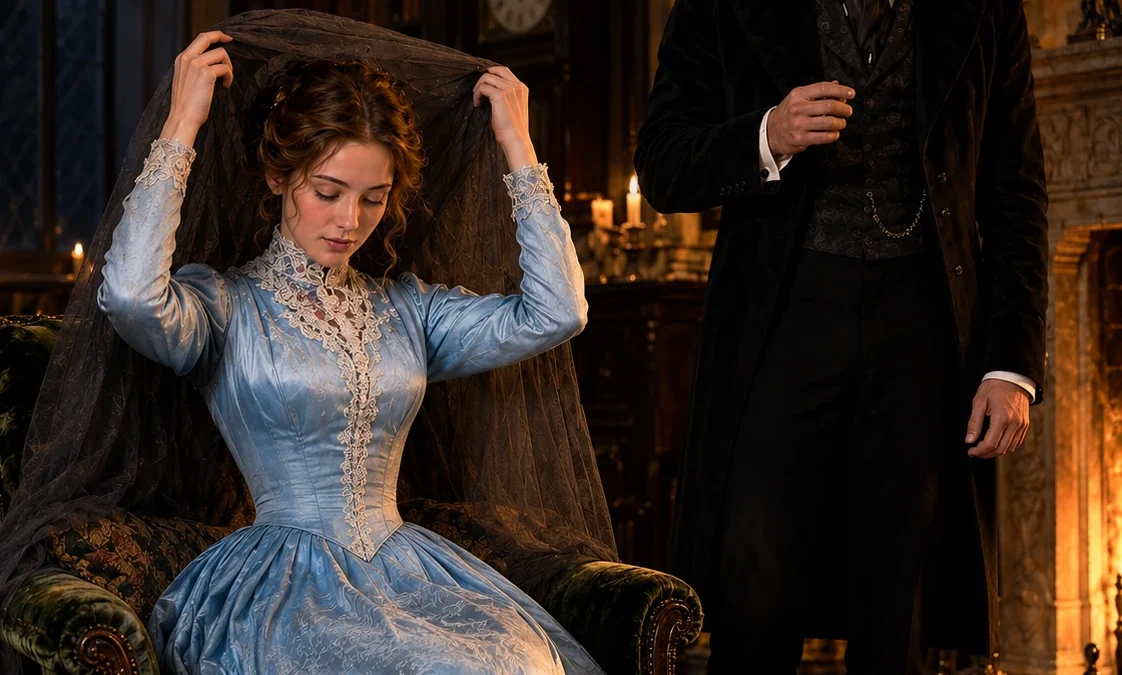
On his wedding night, by the fire in the old library at Glendon Abbey, the Duke of Glendon asked his bride to lift her veil, and he braced himself to be kind. 🕯️
He had planned the words in the carriage. He had said them over in his head for twenty miles of chalk road. Whatever he saw, he would not flinch. He would not look away. He was not a cruel man, whatever else he was.
“You may take it off, if you wish. You do not have to wear it here. Not in this house.”
His bride did not move at first. She sat very straight in the old green chair by the fire, in a gray silk gown high at the neck, with long sleeves to the wrist. Over her head and face hung a veil. Not the thin white lace a bride should wear, but thick dark gray gauze, two layers of it, falling to her shoulders. In all that long day at the church, at the breakfast, in the carriage, Lawrence had not seen one inch of her face.
“Are you sure, Your Grace?” Her voice was low and soft. It shook a little. “My stepmother said it would be better if you never saw it.”
“Your stepmother,” said Lawrence, “is not here.”
The fire cracked. Wind came over the Sussex Downs and pushed at the tall windows.
Then she lifted her slim, trembling hands, drew out the pins one by one, took hold of the veil, and let it fall to the floor.
Lawrence had promised himself he would not flinch. He did not flinch. But he forgot to breathe. 😳
She had a pale, gentle face with a soft, clear brow. Her eyes were large and gray-green, like the sea on a cloudy morning. Her hair was the color of dark honey, with a few strands loose from the pins. And near her left temple, just where her hair began, ran a thin, pale line. A small scar, no longer than his little finger.
That was all. That was the whole of it.
She was not plain. She was not ugly. She was, Lawrence thought, the loveliest face he had ever seen in his life.
She kept her eyes down. She was waiting, he understood, for the blow.
“They told me,” he said slowly, his voice not his own. “They told me…”
“I know what they told you.” She lifted her eyes to his for the first time. “They told everyone.”
“How long have you worn that thing?”
“Since I was fifteen. Eight years. I fell from a horse. My stepmother said it would spoil my face forever. She said no one must see me until it healed. And then she said it had not healed. She said it was worse than ever.” Philippa touched the scar with one finger, quickly, as if it were hot. “I have not looked in a glass since. I did not want to see.”
Lawrence turned to the window so she would not see his face. He had been angry for a month. Now the anger found a new target, and it burned much hotter.
“Is it very bad?” Philippa asked behind him. “You may tell me the truth. I would rather know.”
He turned.
“Lady Philippa, you have been lied to for eight years. And so have I.”
To understand how Lawrence Hale, the proud Duke of Glendon, came to marry a woman whose face he had never seen, you must go back one month.
His father had died the winter before, leaving him a fine old title, a great stone house, three thousand acres of Sussex farmland, two hundred tenant families, and a debt. The debt was to the Duke of Rexford. Lawrence’s father had borrowed it after a bad harvest to feed his tenants, meaning to pay it back, and never had. Now the Duke of Rexford held a paper that said he could take the Glendon farms if the money was not paid by Lady Day.
Then a letter came from Harbury Park, written not by the old Duke, who was ill and rarely left his chair, but by his wife, Duchess Honoria.
My husband loved your father. He does not wish to take your land. If you will marry one of his daughters, the debt will be forgiven on the wedding day.
Lawrence went with his jaw set hard. Six years before he had nearly married a lady in London. Then one night he had heard her laughing behind a door. “Oh, he is dull as a wet Sunday. But a duchess is a duchess.” He had trusted no one since. But two hundred families needed their farms.
At Harbury, the Duchess received him in a yellow drawing room full of mirrors, a handsome woman of fifty with a soft voice and eyes as hard as two blue stones. Beside her sat her own daughter, Lady Celestine, twenty, golden, pretty, and well aware of it, who looked him over as if pricing a horse.
“Oh, no,” said the Duchess, laughing a little silver laugh, when he spoke of Celestine. “Celestine has hopes in another direction. My husband has another daughter, Philippa, by his first wife.” She lowered her voice as if speaking of a death. “Poor Philippa. Her face, you understand. She has worn a veil ever since. She will make no trouble for you at all. It is the kindest thing, really. No other man would take her.”
Celestine hid a laugh behind her fan.
Lawrence wanted to walk out. But he thought of the farms and the families and Lady Day. He signed. He did not even ask to meet his bride before the wedding.
At the church, she walked up the aisle on her father’s arm, all in gray, the thick veil hanging to her shoulders. The old Duke shook as he walked, and looked at no one. Lawrence heard the whispers. Poor creature. They say it is terrible underneath. He said his vows to a curtain of gray gauze. Her small hand in his was as cold as ice. 💔
And now he stood before her, by his own fire, looking at a lovely face that all Sussex believed to be a horror.
He told her she should rest in the blue room, and that no one would trouble her. He did not sleep at all.
In the morning he found her in the breakfast room, standing by the window without the veil. When she heard his step, her hand flew toward her face. Then she stopped, and let it fall.
“Good morning. I did not know if I should wear it. The maid looked at me so strangely.”
“Please do not wear it. Not unless you want to.”
“I do not want to. I have hated it every day for eight years.”
Over breakfast she asked, shyly, if there was an old garden. “A kitchen garden, an herb garden. A house as old as this always has one.”
“Behind the chapel. Nobody has touched it since my mother died. It is all weeds now.”
Her face lit up like a lamp in a dark room. He took her there. She walked straight into nettles to the knee, lifting her gray skirt from the wet grass, and bent to touch a gray-green plant almost hidden by weeds. “Sage! And rosemary, and thyme, and lemon balm. And this is rue. Someone planted this with great care. It is all still here under the weeds.”
“My mother planted it.”
“Then she knew what she was doing.” She smiled up at him, the first time he had seen it. “May I clear it? I would like to have something to do.”
“It is your house now. You may do as you like.”
That afternoon he found he had read the same letter from his steward four times. His window looked out over the chapel roof, and if he stood, he could just see a gray figure in the old herb garden, pulling weeds with her sleeves rolled to the wrist. 🌿
In the evenings she read in the library: books on farming, books on plants, old histories, poems. Her questions about the farms were good ones. She knew about drainage and sheep and which crops tired the land.
“How do you know all this?”
“My mother’s land, Rosewell. Ten miles from here, on the downs. When she died, she left it to me. I lived there with my old nurse most of the time after my fall. My stepmother did not want me at Harbury. I walked the farms every day, in my veil. The tenants were kind.”
Lawrence frowned. “Rosewell is yours.”
“It was left in trust until I married. So I suppose it is yours now, Your Grace. Is that not how it works?”
He said nothing. But that night he read the marriage contract twice from beginning to end. The name Rosewell was not in it anywhere.
He wrote to his old London lawyer, Mr. Thorne, who came down himself with spectacles on the end of his nose.
“It is very strange, Your Grace. Rosewell was left to Lady Philippa by her mother. Five hundred acres, a good house, and a great deal of fine old oak. On her marriage it should have come under your care. But it does not appear in the settlement. And there is something else.” He lifted a paper. “A record of a deed, signed on the morning of your wedding. The owner of Rosewell gave the whole estate away as a gift.”
“To whom?”
Mr. Thorne took off his spectacles. “To her sister, Lady Celestine.”
Lawrence rang for his wife. Philippa came in with earth on her hands and a smile that faded when she saw their faces.
“Lady Philippa, on the morning of your wedding, did you sign any papers?”
She thought. “Yes. My stepmother brought them to my room while I was dressing. She said they were the marriage papers, and the bride must sign before the church. It was only the custom. She held them flat with her hand and showed me only the place at the bottom. I could not see well through the veil.” She looked from one man to the other. “Was that wrong?”
Lawrence came around the desk and took her hand, earth and all. “No. You did nothing wrong. Nothing at all.”
But his voice was very hard, and it was not hard for her. 🔥
The next morning they rode to Rosewell over the high green downs, larks singing up in the sky. Philippa grew quieter with every mile. When they came over the last hill and the valley lay below, she pulled up her horse and sat very still.
Lawrence had heard Rosewell was famous for its oaks. He saw no oaks. He saw a hillside of stumps, pale and raw, with brambles growing between them. He saw cottages with broken roofs and thin smoke rising from only half the chimneys.
“Oh,” said Philippa. It was hardly a word. “Oh, my trees.”
At the first cottage a woman came out with a thin baby on her hip, and stared, and her eyes went wide. “Miss Philippa? Without the veil?”
“What has happened here, Mrs. Ames? Where are the trees? Why is your roof not mended?”
It came out in a rush. The oaks cut down two winters ago and sold. The money gone to Harbury. The rents raised twice. The new agent, Mr. Craig, would not mend roofs or drains. Three families turned out. “We wrote to you, miss. Three times. We thought you did not care.”
“I never had a letter,” said Philippa, white-faced. “Not one.”
That night, back at Glendon, with the whole terrible story laid out before him, Lawrence sat with his fists on the desk. And a letter arrived from Harbury Park.
The Duchess of Rexford and Lady Celestine are coming to Glendon for three days, to see how dear Philippa is settling.
PART 2
“To see how dear Philippa is settling.”
The yellow carriage arrived on a windy afternoon. Lawrence met it on the steps with a cold, polite face. Philippa stood beside him without her veil, in a dove-gray gown with a white lace collar.
The Duchess stepped down and looked at her. For one moment her face went perfectly still. Lawrence saw the hard blue eyes go to the thin scar, then to the honey hair, then the gray-green eyes, and he saw something like fear pass behind them, like a fish under dark water.
Then the Duchess smiled. “My dear girl, without your veil! How brave. Are you sure it is wise, darling? The servants will talk.”
Philippa’s hand rose toward her face. Then stopped. “The servants have been very kind, Mama.” 😌
For two days Celestine was everywhere, laughing at everything Lawrence said, her gloved hand on his arm. “You must be so lonely here. My poor sister was never any company.”
“I find her excellent company,” said Lawrence, and took his arm away.
On the third day the Duchess asked to speak to him alone. She shut the study door, sat, and drew a folded letter from her reticule, looking sad and gentle and full of care. “I have struggled over this, Your Grace. But I would not have you made a fool of after all your goodness.”
It was written in a neat hand, signed Philippa, addressed to dearest Celestine.
You will laugh when I tell you how easily I caught him. The veil was the cleverest thing I ever did. Men are such fools for a mystery. He will be so glad I am not a monster that he will give me anything I ask. A duchess at last. I do not love him, of course. He is cold and dull. But a duchess is a duchess. Burn this.
A duchess is a duchess.
The very words he had heard through a door six years ago. He was a young man again, standing in a dark passage, hearing laughter. 💔
“She has always been sly, poor thing,” the Duchess said softly. “I hoped marriage would change her.”
Lawrence folded the letter. His hands were quite steady. His face was stone. “Thank you, madam. That will be all.”
He did not go down to dinner. When Philippa knocked at his study door late that night, he called through it, “I am busy,” in a voice he had not used to her since the first week. He heard her stand there a long moment. Then her steps went slowly away.
At noon the next day, his butler came with a troubled face. “Your Grace, her Grace has gone. She took the gray mare and a small bag. She left word she was going to Rosewell.” He hesitated. “She was wearing her veil. The boy said she was crying under it.”
Lawrence told himself it was better this way. He told himself all the things a proud man tells himself. Then, because he could not sit still, he went to the library where she had left her books.
On the table lay a small green notebook, full of plants. She had drawn them leaf by leaf, with names and where she found them. Sage by the chapel wall. Wild thyme on the downs above the mill.
He looked at the writing. Then he looked again.
Every letter leaned backward to the left, like grass in a wind blowing the wrong way. The hand of someone who writes with the left hand. He remembered now that she held her fork that way, and her pen.
He took the false letter from his coat and laid it beside the notebook. The letter leaned forward to the right, a pretty flowing hand with large round loops.
He had seen that hand once before. On a little card that came with the yellow carriage: With love from Celestine. 😱
Lawrence stood so fast his chair fell over. And at that moment the butler came in again, and behind him a little old woman in a black bonnet with a face like a wrinkled apple.
“This person says she was her Grace’s nurse.”
“Mrs. Brimble. I nursed Miss Philippa from the day she was born. I have walked from Rosewell. I heard the Duchess came here, and I knew she would make mischief.” Her chin shook. “That scar never got worse. It healed in two months, clean as you like. I told the Duchess so. She said if I told anyone, she would turn me out and I would starve. She told that child every morning she was too ugly to be seen. She took every mirror out of her room. She did it for the money, Your Grace. God forgive me, I was afraid. I am not afraid now.”
Lawrence was already pulling on his coat.
It began to rain before he reached the downs, a cold, heavy rain coming sideways across the hills. He rode hard and did not feel it. The old house at Rosewell was dark except for one window. He found her in the empty parlor by a small fire she had made herself, in her gray dress and her thick gray veil.
“You need not have come,” she said, her voice steady but thin. “Whatever she told you, I understand.”
He crossed the room, soaked to the skin, water running from his hair, and held out the letter and the notebook. “She showed me a letter in your name. For one night I believed it. Then I saw your writing. You write with your left hand. Celestine does not. And Mrs. Brimble came. She told me everything.” His voice broke. “Philippa, I was a fool and a coward. I let an old hurt speak louder than everything I know about you. Will you let me see your face?”
For a long moment she did not move. Then slowly she lifted her hands, took off the veil, and dropped it into the fire.
It caught, burned with a bright yellow flame, and was gone.
“There,” she said through her tears. “Now I cannot put it on again.” 🔥
Two weeks later the Duchess of Rexford gave a grand ball at Harbury Park to announce Celestine’s engagement to Lord Ashgrove. Half of Sussex was there. At ten o’clock the footman called out, “The Duke and Duchess of Glendon.”
They all expected the poor gray ghost in her veil. They expected to pity her, and whisper, and enjoy it.
Philippa walked in on Lawrence’s arm in a gown of deep sea-blue silk with a collar of white lace and a single pearl comb in her honey hair. Her face was bare. The thin pale scar showed at her temple, and she did not try to hide it.
The room went silent. A glass fell somewhere and broke.
“Is that Philippa?” someone whispered. “They said she was a fright.”
The Duchess turned from her guests, and the color left her face completely. Lawrence led his wife straight across the floor through the silent crowd to the old Duke’s chair, where the old man opened his eyes, looked up, and his mouth began to shake.
“Pippa?”
And Lawrence turned to the room, and did not lower his voice. 😳
PART 3
“Pippa,” whispered the old Duke. It was the name he had used when she was small. “Your face. She told me you could not bear to be seen. She told me it would only hurt you to visit. I have not seen your face in eight years.” Tears ran down into his white whiskers. “You look like your mother.”
Philippa knelt by his chair and took his thin hands in hers. “I am here now, Papa.”
The Duchess came forward quickly, her soft voice ready. “My dear, what a surprise. Your Grace, perhaps this is not the time.”
“I think it is exactly the time,” said Lawrence, turning to face the room. “Madam, for eight years you told this county that your stepdaughter was too hideous to be seen. You kept her behind a veil. You took her mirrors. You told her every day that she was a monster. And all the while you were taking the rents of her mother’s estate, selling her mother’s oaks, and putting the money in your own purse.”
A great murmur ran round the room.
“Wicked nonsense!” said the Duchess, her voice gone sharp. “Where is your proof?”
“Here.”
Mr. Thorne stepped from the doorway, and beside him old Mr. Penn leaning on his stick, and behind them, red-nosed and shaking, Mr. Craig with a thick account book under his arm.
“I was the trustee of Rosewell until her Grace had me removed,” said Mr. Penn in a clear old voice. “These are my letters to the Duke, which I now find were never given to him.”
“And these are the true books of Rosewell, Your Grace,” said Mr. Craig miserably. “Every oak sold, every rent raised. Four thousand pounds, all sent to her Grace at Harbury. I kept them in a locked cupboard in case I ever needed them. I am sorry. I only did as I was told.”
“And on my wedding morning,” said Lawrence, “you held a paper flat under your hand and told a girl in a thick veil it was her marriage paper. It was a deed giving her mother’s land to your daughter.” He looked at Lord Ashgrove. “My lord, I believe Rosewell was to be part of your bride’s fortune. I am afraid you will find it was stolen.”
Lord Ashgrove looked at Celestine. He looked at her mother. Then he stepped back from them both very carefully, as if they were a hole in the floor. “I do not think I shall be marrying into this family after all.” He bowed to no one and walked out. Celestine gave a cry and ran up the stairs. 😱
Last of all, Lawrence drew the false letter from his coat. “This you gave me in my own house to break my marriage. It is signed with my wife’s name. But my wife writes with her left hand, and every letter leans backward. This was written by your daughter, at your order. I have her card to match.”
The Duchess opened her mouth. Nothing came out.
Then the old Duke of Rexford did something no one in the county had seen him do for five years. He pushed off his shawl, gripped the arms of his chair, and stood up.
“Honoria.” His voice was weak, but every person in the room heard it. “You have hidden my own daughter from me. You have robbed her. You have lied to me in my own house. It ends tonight. Every penny will be paid back to Rosewell if I must sell your carriages and your jewels to do it. And you will go to the house in Bath, and you will stay there.”
The Duchess looked around at all the faces she had charmed for years. Not one smiled at her now. She turned and walked out of the hall with her back very straight. The crowd parted to let her go, and nobody said goodbye. 🕯️
Later, when the music had begun again and the old Duke sat holding his daughter’s hand and laughing at something she said, Lawrence found Philippa alone on the stone terrace under the stars.
“Are you cold?”
“No.” She turned to him, her face soft and bright in the light from the windows. “Lawrence, you said I was lovely on the wedding night. You did not have to say that. You could have just been kind.”
“I did not say it to be kind. I saw your face twice in my life before I knew your name. Once on a hill under an oak tree, and once by my own fire. I loved it both times.” He took her hands. “I will love it every day I am alive, and the scar with it. Eight years ago I rode past you without a word. I have been sorry ever since. I will not ride past you again.”
She smiled up at him, the same small secret smile he had seen on the hill so long ago. He bent and kissed her forehead, very gently, just beside the thin pale scar. 🥹
Her mother’s land, too, came home.
Mr. Thorne saw to the law. The old Duke paid back every penny he could, the Duchess’s jewels and carriages went to the sale-room, and the deed signed under a lie was struck from the records as the fraud it was. Mr. Craig, in return for his honesty, was dismissed with a character that was true and not unkind, and went to work for a draper in Lewes. The old debt to Rexford was torn up at last, and the Glendon farms were safe, and nobody mentioned Lady Day again.
Celestine was sent to her mother in Bath, and nobody in Sussex pretended to miss her.
Mrs. Brimble came to live at Glendon, and was given the sunniest room in the house, and a chair by the window, and a pot of Philippa’s own rosemary tea every morning. She wept the first time she saw Philippa look into a mirror and smile. 💛
Two springs later, on the hill above Rosewell, a hundred young oak trees stood in neat rows around the one old giant, each no taller than a child, each planted by the Duchess of Glendon with her own two hands. Lawrence had carried the saplings up the hill in a cart. He was told he held them wrong, and did not mind.
The cottages had new roofs. The drains ran clear. Mrs. Ames had a new door painted blue, and a fat baby on her hip who no longer looked thin.
Under the old oak, on the flat stone like a seat, Philippa sat on summer afternoons with a book that had a red cover, her mother’s book of poems. Sometimes Lawrence rode up and did not pass by. He sat beside her on the stone. They said very little. It was the best part of the day.
At Glendon Abbey there were mirrors in every room again, and the Duchess looked into them without fear. And in a drawer of her writing desk lay one small piece of gray gauze, the last scrap that had not burned, which she kept so that she would never forget, and never needed to wear again. 🕯️💛
💭 Isn’t it something, how a woman can be told for eight years that she is a monster, when the only thing hidden was her light?
If this story moved you, a LIKE genuinely helps. 👍 Share it with anyone who has ever been made to feel they should hide. And tell me in the comments: would you have taken off the veil? 👇
Disclaimer: This story is entirely fictional and created for entertainment purposes only. It does not represent any organization or individual, nor does it encourage inappropriate behavior. The content was generated with AI assistance.








