On My Wedding Night, My Husband Locked Me in the Basement While His Mother Moved Into My Apartment. “Tomorrow You’ll Be More Reasonable,” He Said Through the Door.
On My Wedding Night, My Husband Locked Me in the Basement While His Mother Moved Into My Apartment. “Tomorrow You’ll Be More Reasonable,” He Said Through the Door.
Part 1
On my wedding night, my husband locked me in the basement of our building because I refused to give his mother a copy of my keys.
“Tomorrow you’ll be more reasonable,” Adrián said from the other side of the metal door. “A night down here will help you remember what it means to be a family.”
I didn’t scream.
That’s what unsettled him most. For three years he had mistaken my patience for weakness.
My name is Claudia Serrano. I’m thirty-seven, and I’m the maintenance engineer responsible for several office buildings in Madrid. I bought my apartment in Chamberí long before I met him. It wasn’t inherited. It wasn’t a gift. I paid the down payment after years of night shifts, brutal projects, and vacations I never took.
Adrián arrived in my life with a flawless smile, a sales job at an air-conditioning company, and an extraordinary talent for turning any argument into a story where he ended up the victim.
His mother, Mercedes, was more direct.
The first time she visited my apartment, she said, “Too big for two people.”
The second time: “That small bedroom would be perfect for me when I’m older.”
The third time, she opened my closets.
I told myself these were awkward remarks from a woman too attached to her only son.
I was wrong.
At the wedding, held at an estate in Alcalá de Henares, Mercedes walked up while I was talking with my sister Lucía.
“Tomorrow I’ll bring some boxes,” she announced.
I assumed she meant gifts. “What boxes?”
She smiled. “My things. Adrián didn’t tell you because he wanted to spare you stress before the wedding.”
I looked at my brand-new husband.
He lowered his eyes.
Mercedes had sold her apartment in Getafe. According to both of them, starting the next day she would live with us.
“No,” I said.
That one word turned my wedding into a silent war.
On the drive back, Adrián didn’t speak. When we walked into the building, Mercedes appeared behind us with two suitcases.
“I’ll only stay tonight,” she said.
I opened my door, set my bouquet on the table, and turned to face them.
“Not tonight either.”
Adrián slammed the door. “She’s my mother.”
“And this apartment is mine.”
“We’re husband and wife.”
“That doesn’t turn my property into your mother’s decision.”
Mercedes began to cry. Adrián accused me of humiliating her. I said we could pay for a hotel and talk tomorrow.
Then his face changed. He stopped looking offended.
He looked decided.
Minutes later, from the kitchen, I heard a loud bang from the communal basement. I knew what was down there: the pressure pumps, part of the electrical panel. I went down thinking something had failed.
Adrián followed me.
The moment I stepped into the technical room, he shoved me inside, plucked my phone from my hand, and shut the door.
“Tomorrow, when Mom has her boxes inside, we’ll talk.”
From the stairs, Mercedes laughed. “We’ll come get you at 6:40.”
I listened to them walk away.
Then I looked up, and saw a small red light blinking above a camera Adrián didn’t know existed.
I smiled for the first time since the wedding ended.
Because that camera did more than record. It was connected directly to someone who knew this building far too well.
What happened next still gives me chills. Part 2 is in the comments—or leave any word below and I’ll send it to you privately.
Part 2
What happened next still gives me chills. Part 2 is in the comments—or leave any word below and I’ll send it to you privately.
I walked up to the camera and held up three fingers.
It was a signal agreed months earlier with Sergio, the president of our residents’ association and a former colleague of mine, after a string of garage thefts in the neighborhood. The camera had audio. It stored everything on an outside server.
Next to the fire panel, I found an emergency button.
I pressed it.
Not twenty minutes later, I heard movement behind a side door that connected the technical room to the garage of the neighboring building. Sergio appeared with two police officers.
“Do you want to come out?” one asked.
I shook my head. “First I want to know why they were in such a hurry to move Mercedes into my home.”
We pulled the recording. Adrián’s voice came through perfectly.
“Tomorrow she’ll be tired. She’ll sign whatever’s needed.”
Then Mercedes: “She has to do it before the bank man comes.”
A different kind of cold settled into me. This wasn’t only about living arrangements.
Sergio remembered something odd. Three days earlier, a man had asked the doorman about the approximate value of my apartment and whether it carried a mortgage.
I borrowed a phone and called Lucía. She had kept our wedding envelopes and gifts in her car, because I hadn’t trusted leaving them in the estate’s lounge. In one of them, she found a folded document.
An authorization to use my apartment as collateral for a business loan.
My signature sat at the bottom.
It was fake.
The beneficiary was a company connected to Adrián. The debt: €186,000.
I closed my eyes. Everything clicked at once. Mercedes’s hurried sale. The questions about my deed. Adrián pushing for weeks to open a joint account after the wedding.
The officers wanted to go upstairs immediately. I refused.
“They said 6:40.”
I went back to the room. Sergio poured coffee from a thermos. The officers hid behind a cluster of pipes, out of the door’s line of sight.
At 6:39, footsteps.
Adrián turned the bolt. “Good morning, wife. Ready to apologize?”
He opened the door expecting a woman in tears.
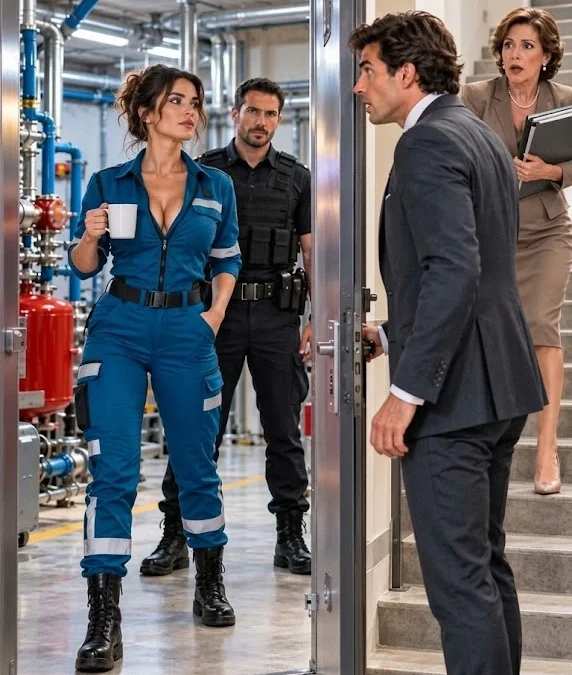
He found me sitting on a toolbox with a cup of coffee in my hands.
Behind me stood two police officers. Beside them was a man in a gray suit who had just arrived with Lucía.
Adrián recognized him instantly. The bank’s risk director. The man he had tried to hand forged documents to that very morning.
That was when he understood I knew far more than he’d imagined.
What he didn’t know was that his own mother had hidden a second document, one that could bring everything down.
If you want to know what was in Mercedes’s brown folder, LIKE this post and comment “6:40.” When enough people comment, I’ll post Part 3. 🔒
Part 3
Adrián backed up until he hit the hallway wall.
“Claudia, this isn’t what it looks like.”
I set the cup down on the toolbox. “Perfect. Then it’ll be easy to explain.”
Mercedes appeared at the top of the stairs in the same champagne-colored dress from the wedding, a coat draped over her shoulders. She was holding a brown folder.
When she saw the officers, she stopped. “What is going on?”
The bank’s risk director, Ernesto Salvatierra, stepped forward. “That’s exactly what we’d like to know.”
Mercedes clutched the folder to her chest.
Adrián looked at her. Not the way a son looks at his mother. The way you look at someone holding something dangerous.
I saw it.
“Give me that folder, Mercedes.”
“It’s private.”
“Then hand it to the police.”
She went pale. One officer approached and told her not to destroy or conceal any documents related to the incident.
She handed it over.
Inside: copies of my deed, Adrián’s bank statements, printed emails, and a private contract.
The contract exposed the first big lie. Mercedes hadn’t sold her apartment because she needed to move. She sold it to cover part of a debt Adrián had run up.
Months earlier, he had persuaded three acquaintances to invest in a small industrial installation company that, he claimed, had won contracts with hotels on the Costa del Sol. The contracts never existed. The business swallowed nearly everything. When the investors demanded their money back, Adrián took personal loans, maxed out credit cards, and finally turned to a finance company.
He owed more than €240,000.
Mercedes had sold her apartment for €178,000. After paying off a remaining mortgage and expenses, she could hand over only part of it.
The shortfall: €186,000.
Exactly the amount on the forged guarantee built on my home.
“Did you know?” I asked her.
She leaned on the railing. “I knew he owed money.”
“That isn’t what I asked.”
Silence.
“Did you know he wanted to use my house?”
She lifted her chin. “You’re married now. When two people marry, they share their problems.”
“Sharing isn’t stealing.”
“We weren’t going to steal anything from you.”
I pointed to the basement. “You locked me in here so I’d sign.”
“We only wanted you to calm down.”
I let out a short laugh. “Funny. You always call it calming down when a woman is left without a phone behind a locked door.”
“I can fix this,” Adrián said.
“No.”
“Listen to me.”
“I’ve been listening to you for three years.”
Ernesto opened the guarantee document. “Sir, this application was submitted electronically four days ago.”
Four days before the wedding. He’d decided to put my home at risk before the ceremony.
“How did you get my documents?”
Adrián didn’t answer, and I remembered an afternoon in August. I’d come home and found the drawer with my personal folders open. He said he was looking for a charger. I believed him. And two weeks earlier, he’d insisted on coming with me to a notary to sign papers for “travel insurance.” I cancelled because of a work emergency. He was furious for hours.
He wasn’t angry about insurance. He needed my signature.
“You photographed my deed.”
He lowered his head. That was enough.
Mercedes began to sob. “I only wanted to help my son.”
I looked at her. For years I’d seen only an invasive mother-in-law, someone who couldn’t accept that her grown son had his own life. That morning I understood something more uncomfortable. She had spent years rescuing Adrián from the consequences of his choices. Paying his fines. Calling his bosses. Justifying his lies. Blaming old girlfriends. Lending him money.
And when she ran out of money, she decided the next person to rescue him was me.
“You sold your home for him,” I said.
“He’s my son.”
“And now you want me to lose mine.”
“Nobody will lose anything if we cooperate.”
That sentence finished breaking something in me.
I went upstairs with the officers. In the entryway, five boxes. Mercedes had started moving in while I was locked below. On the living room table: an open bottle of cava and three glasses.
The third belonged to Raúl, Adrián’s cousin, who was asleep on my couch in his clothes. When he woke and saw the police, he raised both hands.
“I didn’t do anything.”
“What are you doing here?”
He glanced at Adrián. “He asked me to help with the move.”
“At two in the morning?”
Raúl shut his eyes. Then he started talking. Adrián had promised him €5,000 to help empty part of my storage room and place Mercedes’s belongings inside. The plan was simple: when I came out of the basement, Mercedes would already be settled in. Then they’d pressure me to sign a “temporary cohabitation agreement.”
Raúl swore he knew nothing about the loan.
An officer asked to inspect the boxes. Mercedes protested. In the third box, they found a portable printer. Notarial paper. A forged stamp. And several drafts of the document authorizing my apartment as collateral.
Adrián stopped talking. So did Mercedes.
But the worst was in the last box: an envelope with Mercedes’s name. Inside, a signed contract between her and her son. If I guaranteed the loan and the operation went through, Adrián would buy Mercedes a home worth up to €220,000, using part of the money from the future sale of my apartment.
I read the clause twice.
“So this was the ‘living together.'”
Mercedes said nothing.
“You never planned to stay long. You wanted to get inside, pressure me, and turn my home into cash.”
Adrián stepped toward me. An officer blocked him.
“Claudia, Mom was desperate.”
“She doesn’t look desperate in this contract.”
Mercedes suddenly raised her voice. “Because you never understood what family means! You’ve always had your job, your money, your apartment, your decisions. It’s all mine, mine, mine. Adrián needed help. What was a mother supposed to do?”
“Teach him to face what he did.”
“That’s easy to say when he’s not your son.”
I shook my head slowly. “No. What’s hard is loving someone without making everyone else the price of his mistakes.”
She had no answer.
That morning I filed a complaint. I handed over the basement recording, the documents, the drafts, and the messages Adrián had sent Raúl. I asked my lawyer to begin annulment or divorce proceedings immediately.
My marriage had lasted less than twenty-four hours.
The news spread through the family. Then the second battle began. An uncle of Adrián’s called to say I was exaggerating. A cousin wrote that “couples’ matters are settled at home.” A friend of Mercedes said reporting a husband the day after the wedding was “cruel.”
I didn’t answer. Lucía did, with a single message:
“Locking a woman up to force her to put her home at risk isn’t exactly a marriage tradition either.”
Then she blocked them all.
Adrián was released while the investigation continued, and began writing to me from different numbers. First came apologies. I was scared. I felt trapped. I just needed time. Then accusations. You’ve destroyed my mother. Because of you she could lose everything.
Finally: All this over four walls.
I saved that message. Not to answer it. To remind myself why I should never go back.
Because it was never four walls. That apartment held twelve years of my life. The mornings I left before 6 to supervise worksites. The dinners eaten standing up. The Saturdays painting walls with Lucía. My first sofa, bought in installments. My grandmother’s rosemary plant. The pencil marks behind a bookshelf where my niece measured how much she’d grown.
It was the right to have no one decide for me what had cost me so much to build.
Two weeks later a new problem appeared. The finance company claimed the documents Adrián submitted looked authentic and said it would consider seeking damages. I had to prove I had never authorized anything.
Ernesto produced the records. The application had been sent from Adrián’s work computer. And an audio file had been attached by mistake. Adrián had recorded a conversation with his mother while they prepared the papers.
“After the wedding it’ll be harder for her to refuse,” he says.
“And if she refuses anyway?”
“Then we make her understand what’s at stake.”
“How?”
A few seconds of silence. Then: “Leave it to me.”
The basement recording completed the sequence. But one question remained. Who had actually designed the financial scheme?
Investigators found that Adrián didn’t have the skills to fabricate certain documents. Someone had helped him. That someone was his boss, Tomás Villena.
Tomás ran the company where Adrián worked, and he was one of the supposed injured investors. For months he’d lent Adrián money at hidden interest and obtained Mercedes’s personal documents. When Adrián stopped paying, Tomás suggested using my apartment as collateral. In exchange, he’d cancel part of the debt.
It wasn’t the first time he’d done it. Two other families had suffered the same pattern. Indebted people. Relatives who owned property. Documents prepared to push the debt onto whoever had assets.
At first, Adrián had been Tomás’s victim. But then he’d become a willing partner.
When I learned that, I felt something unexpected. Not satisfaction. Sadness.
Because there was a version of this story where Adrián could have come home, sat across from me, and said, “I’ve made a disaster. I need help.”
Maybe I wouldn’t have paid his debt. Probably not. But I’d have helped him find a lawyer, negotiate, sell his car, rebuild his budget, face the consequences. Instead of trusting his wife, he chose to turn her into a resource.
That was the unforgivable part.
Months later, during a court deposition, Adrián asked to speak with me for a few minutes. I agreed, only with lawyers present.
He looked different. He’d lost weight. The expensive suits were gone.
“Mom is living with my aunt,” he said. “She lost almost everything from her apartment.”
I didn’t react. “She chose to hand it to you.”
“Tomás deceived us.”
“And you tried to deceive me.”
He looked down. “Yes.”
It was the first time he’d admitted it without an excuse.
“You know what’s worst?” he said. “When I closed that door, I honestly thought a few hours down there would change your mind.”
“I already know that.”
“I didn’t understand what I was doing.”
“You understood. That’s why you took my phone.”
He closed his eyes. He didn’t try to justify himself again.
The settlement that followed required his cooperation with the investigation into Tomás. Adrián accepted responsibility for the document forgery and for confining me against my will. Mercedes also had to answer for her part. Tomás ended up investigated for a much larger network of irregular operations.
I regained full legal peace of mind over my home.
But it took longer to recover something else: sleep.
For months I woke at 6:40. Always the same time. Sometimes I walked through the apartment checking doors. Sometimes I sat in the kitchen until dawn.
Lucía gave me a new clock. “So you’ll stop looking at your phone when you wake up.”
I laughed. “It still tells time the same way.”
“Yes, but this one is pretty.”
That silliness made me laugh for several minutes. And that’s when I realized I was starting to become myself again.
Almost a year later, the building decided to upgrade its security. Sergio insisted on keeping the basement camera.
“That one doesn’t get touched.”
I agreed. They also installed an interior release on every technical door.
The day the work finished, I went down alone and stood in front of the door where Adrián had locked me in. I opened it. Closed it. Opened it again from inside.
It worked perfectly.
Then I heard footsteps. Mercedes.
I hadn’t seen her in months. She looked smaller. A grocery bag in her hand, a plain coat.
“I came for a box that was left in Sergio’s storage room,” she explained.
I nodded.
She looked at the door. “I think about that night a lot.”
I said nothing.
“For years I believed protecting Adrián meant sparing him every fall.”
“And you ended up pushing other people underneath to cushion it.”
She lowered her eyes. “Yes.”
She didn’t ask for forgiveness dramatically. She didn’t try to hug me.
“I wish I’d understood sooner,” she said, “that a mother can also do harm by trying to save her son from everything.”
I pointed to the stairs. “Your box is upstairs.”
She started to leave, then stopped. “Claudia.”
I waited.
“Thank you for not withdrawing the complaint.”
I frowned.
She breathed deeply. “If you had, Adrián would have learned again that someone always appears to erase what he does.”
For the first time, I didn’t see the mother-in-law who had wanted to take my home. I saw a woman forced too late to face the monstrous result of years of excuses.
I didn’t forgive her. But I didn’t need to hate her either.
“Take care, Mercedes.”
“You too.”
That afternoon I went back to my apartment and opened the door with my own key. I set my bag on a chair and opened the windows. Madrid lay under a cold winter light. Engines, conversations, a motorbike accelerating, a metal shutter rattling in the distance.
On the table sat a blue cup I’d bought after the divorce. On the balcony, my grandmother’s rosemary had grown so large it needed a new pot.
My phone buzzed. Lucía: Dinner?
I wrote back: At my place. Then: Bring bread.
A few minutes later I glanced at the time. 6:40 in the evening.
For months, that number had meant a door opening, and a man certain he’d find a defeated woman inside. Now it was just an hour.
I smiled, closed the balcony door, put on music, and began setting the table.
Because in the end, Adrián had been right about one thing that night. The next morning, I really was a different woman.
Just not a more docile one.
I was a woman who had finally understood that no wedding, no surname, and no twisted idea of family gives anyone the right to lock her up, decide for her, or turn her home into the price of their mistakes.
And ever since, when I turn the key in my front door, the sound of the lock no longer reminds me that I was once trapped.
It reminds me of exactly the opposite.
That now I’m the one who decides who gets to come in. 💛
Disclaimer: This story is entirely fictional and created for entertainment purposes only. It does not represent any organization or individual, nor does it encourage inappropriate behavior. The content was generated with AI assistance.








